Back-to-back (B2B) DJ sets are a staple at drum ‘n’ bass, dubstep, and bass music festivals across the globe. When two DJs share the stage, the energy can be electric – if they’re in sync. But without the right etiquette and preparation, a B2B set can quickly unravel into chaos. Great festival organizers know that ensuring DJs have a clear understanding before they step into the booth is just as important as booking big names. As one seasoned DJ, Mumdance, famously said, “Like any good relationship, a back-to-back is essentially about communication and empathy with your partner.” In that spirit, here’s how to craft simple yet effective agreements and habits that will save your B2B set and turn it into a standout, seamless performance.
Set Ground Rules Before You Hit Play
A successful B2B set starts long before the first track drops. DJs (and the festival teams managing them) should clarify key points in advance so everyone shares the same playbook. Taking a few minutes to discuss these items can prevent misunderstandings during the show:
– Track Selection & Priority: Decide how the DJs will alternate tracks. Will they go one-for-one, two tracks each, or maybe split the set into two halves? Agree on who kicks off the set and who will play the closing track. This prevents awkward pauses and ensures each DJ gets equal shine. Crucially, respect each other’s tracks – if your partner drops a tune, let it breathe before you mix out. Don’t cut off a track prematurely just because you’re eager to play the next banger. Patience shows you’re listening to their selection and builds a better flow. If one DJ has a “must-play” track or a signature song, acknowledge that in advance so the other DJ can build around it rather than accidentally preempt it.
– Microphone Etiquette: Nothing’s worse than two DJs jockeying for the mic or, conversely, both staying silent when some crowd hype is needed. Decide ahead of time how to handle the microphone. Perhaps one DJ is the more enthusiastic host who can MC between transitions, or maybe they’ll split duties (for example, one greets the crowd at the start, the other thanks them at the end). If the festival has a dedicated MC (common at drum & bass events in the UK or reggae-inspired dub festivals), the DJs might agree to skip using the mic altogether and let the MC do the job. The key is to avoid surprises: if one DJ suddenly starts shouting out a shout-out or calling for a rewind without warning, it could catch the other off guard. Agree on basic mic use — when and how to address the crowd — to keep the vibe professional and unified.
– FX and Mixer Controls: Modern DJ mixers come loaded with effects (echo, reverb, filters, etc.), and using them can spice up a set. But in a B2B, uncoordinated FX use can spell trouble. Discuss who will handle common effects and mixer tricks. For instance, if one DJ is about to do a big filter sweep or echo freeze at the end of their track, they should signal to their partner so both aren’t twisting knobs at once. Maybe one DJ loves using the reverb on vocals, while the other is a fan of spinbacks (rewinds) for big drops – talk it through so these surprises become planned moments. Also, decide on the mixer layout and any custom settings (like tempo range, quantization, or FX assignment) before starting, so one DJ doesn’t accidentally change a setting the other relies on. By agreeing on these technical details, both DJs can perform confidently without stepping on each other’s toes (or tracks).
Cue the Communication: Hand Signals and Emergency Plans
Even with the best prep, live sets are unpredictable. That’s where non-verbal communication and backup plans come in:
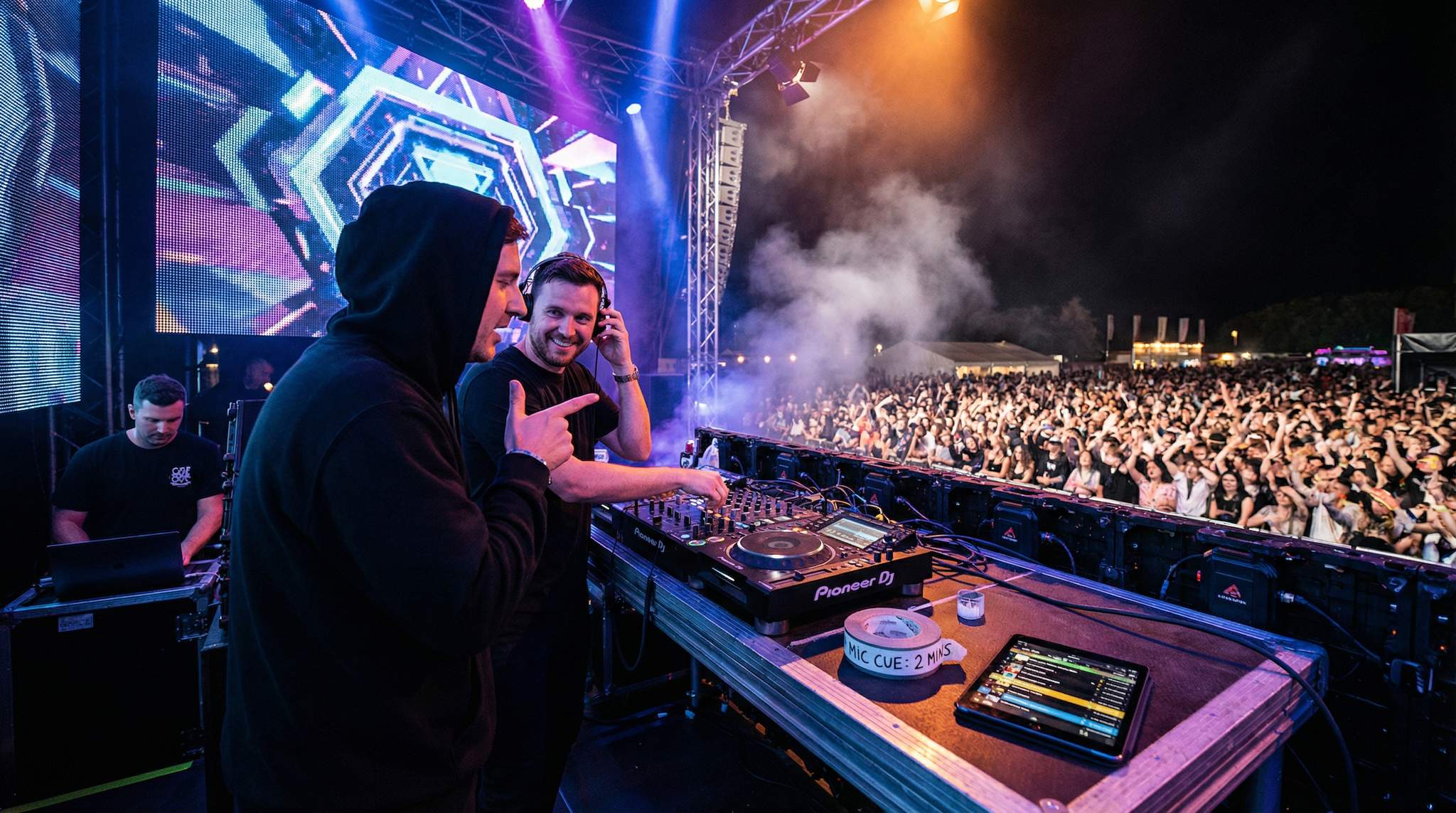
– Hand Signals & Cues: In the noise of a festival stage – whether it’s a warehouse in Germany or an open-air bass stage in New Zealand – talking is difficult. Seasoned festival DJs develop simple hand signals to coordinate in real-time. It could be a pointed finger or a nod to indicate “I’m ready to mix in the next track,” a raised hand with two fingers for “give me two more phrases/measures,” or a circling motion to say “let’s wrap this track up.” Whatever signals you use, rehearse them briefly beforehand so both DJs interpret them the same way. This way, when DJ A wants DJ B to cut the bass for a drop swap, a simple gesture can communicate that instantly without confusion.
– Emergency Reset Plan: Technology can fail or a mix can trainwreck – it happens even to top artists in festivals from London to Los Angeles. What separates pros from amateurs is having a quick recovery strategy. The DJs should agree on an emergency reset tactic: for example, keeping a “safe” track or loop loaded on a spare deck at all times. This standby track (preferably a crowd-pleaser with a simple beat) can be faded in if something goes wrong (like a sudden silence because a USB stick froze or a vinyl record skipped). Another part of the plan could be assigning one DJ to handle fixes while the other keeps music going. If DJ A’s gear crashes, DJ B can extend their track or throw on a filler beat while A reboots or swaps equipment. These contingencies should be discussed so that if a curveball hits, both DJs know who does what in the moment. Even a quick “reset” hand sign or a thumbs-down if a mix is failing can prompt an agreed response (like instantly cutting to that safe track). It’s like a fire drill for your set – practice it to make your response instinctive.
– Stay Cool Under Pressure: Beyond specific signals, just foster an understanding that if one DJ signals distress or something isn’t right, ego goes out the window and teamwork kicks in. Maybe a monitor speaker stopped working or headphones died; a quick heads-up and the other DJ can cover or help. In one anecdote from a club in Singapore, a DJ’s laptop overheated mid-set; his B2B partner noticed him panicking and immediately took over song duties for a few minutes, smoothly buying time for a reboot – the crowd never knew there was an issue. This kind of wordless support only happens if both performers agree beforehand to watch out for each other.
Organize the DJ Booth for Two
Physical space and gear layout are often overlooked factors in a smooth B2B set. Festivals in cities like Barcelona or Jakarta might have spacious stages, whereas a local club in Mumbai or Mexico City could have a tight booth – regardless, a tidy, well-arranged setup is crucial when two people are working together.
– Agreed Deck Layout: Clarify how you’ll share the equipment. For instance, if four CDJ decks are available, perhaps DJ X uses the two on the left and DJ Y uses the two on the right. Alternatively, if you’re both using the same decks, decide on a side to stand on and swap positions only if needed. Stick to an arrangement that avoids bumping into each other. If one DJ is mixing out from Deck 1, the other can prepare on Deck 4 to keep some physical distance between your workflows. Also decide who handles the mixer’s crossfader or if you’ll leave it centered and both just use line faders – consistency helps avoid accidental silence. Mark the mixer channels with each DJ’s name or color code if you have separate inputs, so in the heat of the moment no one pulls down the wrong fader.
– Label and Tidy Cables: With multiple devices comes a spaghetti of wires – and two DJs reaching around can tug the wrong cable by mistake. Before the set, work with the stage crew to label each cable and secure them. Mark which audio cables belong to which device (e.g., DJ X’s controller, DJ Y’s drum machine, etc.) and which channel they’re plugged into. Use colored tape or tags – for example, red tags for DJ X’s gear and blue for DJ Y. This way, if something needs troubleshooting (like swapping a faulty CDJ), it’s immediately clear which cord to pull or replace. Keeping the booth tidy also means stashing away any equipment cases or personal items – there’s limited real estate up there. Avoid drinks near the decks (spilled soda on a mixer during a B2B in Sydney once cut a headline set short). A clean, organized booth means fewer hazards and a smoother performance, letting both DJs focus on music rather than untangling knots or dodging clutter.
– Personal Gear Placement: If the set involves different gear (say one DJ uses a laptop/controller and the other uses USB sticks on CDJs, or perhaps one brings a turntable for some vinyl flair), plan how that will be positioned. Maybe a small stand is needed for the laptop to the side of the mixer, or the turntables are angled a certain way for access. Do a quick run-through during soundcheck: ensure both DJs can comfortably reach what they need without elbowing each other. If one is left-handed or has a preferred orientation, accommodate that in the layout. These little adjustments prevent physical discomfort and performance flubs once the show is live.
Support During the Transition: Tech at the Ready
Even the best DJs can use an extra set of hands during a live set, especially at the start of a B2B performance. A wise festival organizer will station a technician (or stage manager) in the DJ booth for the first several minutes of a B2B set (or during the changeover into it).
– Smooth Changeovers: When one DJ is finishing and two are about to start playing together, there’s a lot happening: plugging in headphones, swapping USB drives or laptops, adjusting mixer settings to personal preferences, possibly loading a custom MIDI mapping or switching DJ software modes. A tech in the booth can help manage this flurry so the music never stops. For instance, at major festivals in the US like EDC or in the UK at Creamfields, stage crews stand by as artists swap over, ensuring the next DJ’s gear is receiving sound and the outgoing DJ’s kit is safely removed. This practice can be just as valuable for a back-to-back setup: the tech can quickly confirm both DJs’ outputs are working, volumes are balanced, and any synced equipment (like midi controllers or effects units) are properly connected.
– First-Minute Fail-safes: The beginning of a set is where most technical issues pop up – maybe a CDJ isn’t reading a USB, or the mixer is still on the previous DJ’s settings. Having a tech right there means there’s immediate help if, say, the sound is only coming from one DJ’s channels or an effect pedal isn’t activating. They can troubleshoot cable issues, do a fast swap to a backup mixer channel, or even communicate to front-of-house sound engineers if something sounds off in the main speakers. This is especially important when artists are playing B2B for the first time; unfamiliar gear or settings can trip them up. A quick assist in the first minutes prevents small hiccups from turning into dead air or noticeable mistakes.
– Peace of Mind: Beyond solving issues, the presence of a competent technician gives the DJs peace of mind so they can focus on performing together. It’s like having a safety net. If everything’s running smoothly after a couple of transitions, the tech can step away discreetly. But knowing they’re there at the start helps both DJs feel supported. Festival teams from Toronto to Tokyo have found that a little extra support at the hand-off leads to tighter sets and happier performers. After all, when artists feel taken care of, they play more confidently – and the crowd can tell.
Collaborative vs. Competitive: The Right B2B Mindset
Perhaps the most important element of a memorable B2B set isn’t technical at all – it’s the attitude the DJs bring. The best back-to-back performances feel like a conversation between two artists, not a contest to see who can dominate. When two DJs are in sync, you can sense it: they’re smiling, grooving to each other’s tracks, and building an atmosphere together that’s greater than the sum of their individual styles.
– Musical Conversation: Encourage DJs to approach the set as a dialogue. Each track one DJ plays is like a statement; the other DJ should respond with something that complements or elevates that statement. For example, if DJ A in a dubstep B2B drops a heavy, aggressive track, DJ B might follow with a track that carries that energy forward or offers a surprising twist, rather than abruptly switching to a mellow tune (unless they both feel a sudden change is needed). By listening actively to each other, the pair can take the crowd on a journey that flows naturally. In genres like drum ’n’ bass, some of the most lauded B2B sets (think legendary sessions at festivals in England or New Zealand) work because the DJs riff off each other’s selections, almost like jazz musicians improvising in tandem.
– No One-Upmanship: Leave egos at the door of the booth. A B2B isn’t about outshining your counterpart with trickier mixes or bigger anthems; if it turns into a show of “who’s better,” the cohesion falls apart. Professional festival organizers have seen this firsthand: B2Bs where DJs start one-upping each other – pushing the tempo rapidly, cranking the volume, or cutting in abruptly – usually end up confusing the crowd and undermining the vibe. In contrast, when DJs support each other (perhaps one gracefully steps back to let the other have a big moment, or they exchange a quick thumbs-up when the other drops a crowd favorite), the audience responds with twice the enthusiasm. Successful back-to-back sets are built on mutual respect. Each DJ should get moments to shine, and each should cheer on their partner’s highlights.
– Adapt and Experiment Together: One beauty of B2B sets is the chance to venture into unplanned territory. Maybe one DJ plays a rare remix or a classic throwback; the other can pick up that thread and run with it, creating a unique experience that wouldn’t happen in a solo set. This works best when both are flexible. If one DJ suddenly slows down the BPM for a creative shift, the other should embrace it and find a fitting next track, rather than insist on sticking solely to their pre-planned list. An open-minded, team-focused approach will yield a set that surprises and delights. It should feel like two friends bouncing ideas off each other in real-time – because that’s essentially what it is. When the chemistry is right, the crowd senses that collaborative energy and the party hits a whole new level.
– Post-Set Debrief: After the lights come up, it’s a smart idea for the DJs to chat and review what went well and what could improve. This isn’t about placing blame; it’s about learning to gel even better the next time. From an event organizer’s perspective, encouraging this reflection (maybe even having a brief check-in with the stage manager) can help iron out any issues for future sets. DJs who regularly play back-to-back often develop almost telepathic understanding over time. They’ll know each other’s body language, strengths, and preferred tricks. The goal is to reach the point where the B2B partners operate as a single unit delivering an unforgettable performance – and that comes from continuous learning and a supportive, not competitive, mindset.
Planning a Festival?
Ticket Fairy's festival ticketing platform handles multi-day passes, RFID wristbands, and complex festival operations.
Frequently Asked Questions
What should DJs discuss before a back-to-back set?
DJs should clarify track selection priority, microphone etiquette, and FX usage before starting a B2B set. Agreeing on who opens and closes, how to alternate tracks (one-for-one or two-for-two), and who handles specific mixer effects prevents awkward pauses and uncoordinated sound clashes during the performance.
How do DJs communicate during a loud festival B2B set?
Seasoned festival DJs use pre-rehearsed hand signals to coordinate in real-time when talking is difficult. Simple gestures like a pointed finger for “ready to mix,” two fingers for “two more phrases,” or a circling motion for “wrap it up” allow performers to communicate instantly without confusion or verbal shouting.
What is an emergency reset plan for DJ sets?
An emergency reset plan involves keeping a safe, crowd-pleasing track loaded on a spare deck to fade in immediately if equipment fails or a mix trainwrecks. This strategy assigns specific roles, such as one DJ handling the fix while the other manages the music, ensuring a quick recovery without dead air.
How should DJs organize the booth for a back-to-back performance?
A successful B2B setup requires a tidy booth with agreed-upon deck layouts and labeled cables to prevent accidental unplugging. DJs should mark mixer channels with names or colors, secure wires with stage crew assistance, and position personal gear like laptops to ensure both performers have comfortable access without crowding.
Why is a collaborative mindset important for B2B DJ sets?
A collaborative mindset turns a B2B set into a cohesive musical conversation rather than a competitive ego clash. When DJs listen actively, support each other’s transitions, and avoid one-upping volume or tempo, the performance flows naturally. This mutual respect creates a unique atmosphere that audiences perceive as a unified, standout show.
Why should a technician be present during a B2B set transition?
Stationing a technician in the booth during the first few minutes of a B2B set ensures smooth changeovers by troubleshooting connection issues immediately. Techs can verify output levels, fix cable problems, and assist with swapping USBs or laptops, allowing the DJs to focus on their performance without technical distractions.