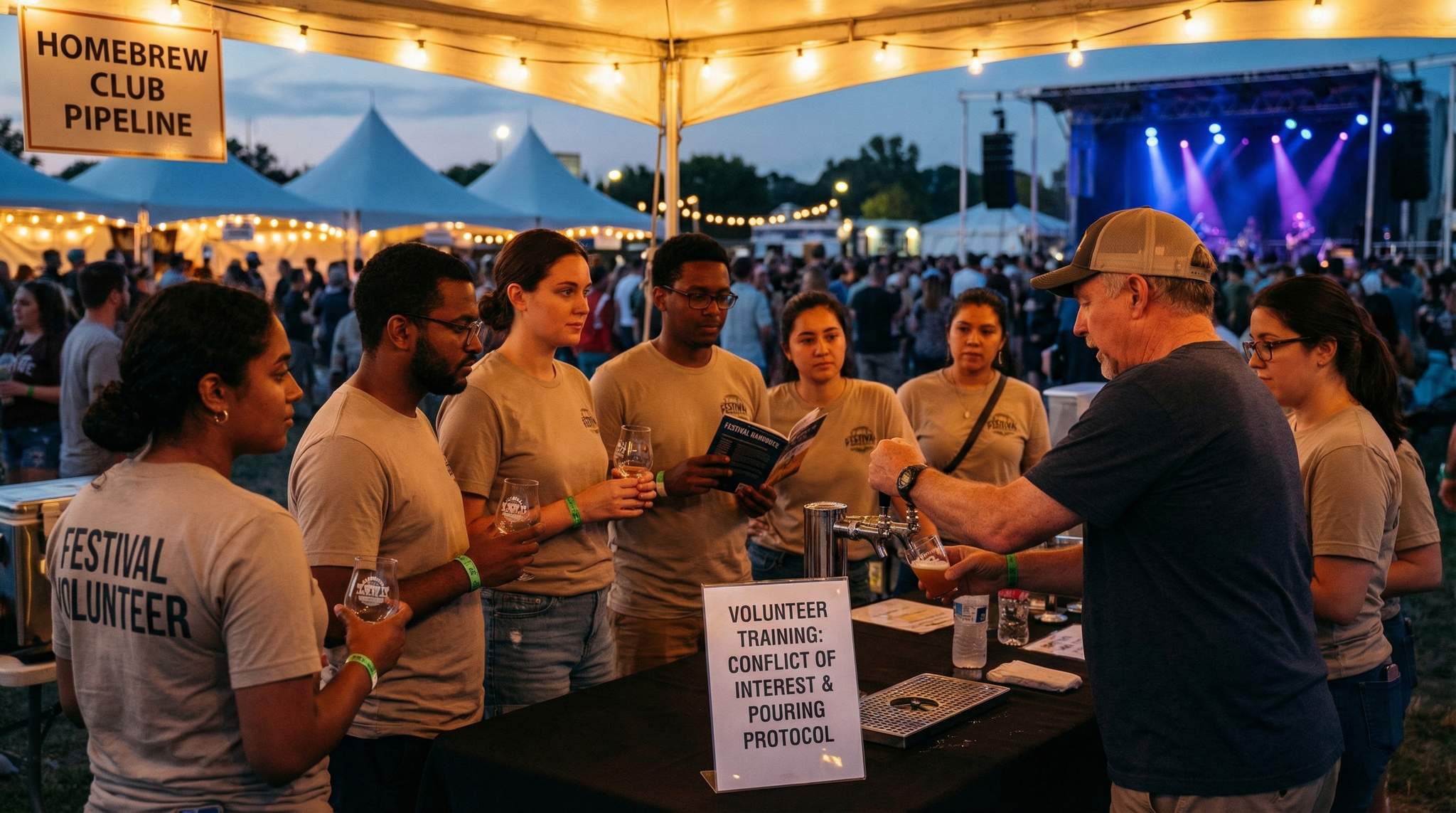
Every successful beer festival – whether a local craft showcase or a world-renowned brew gathering – relies on a dedicated team of volunteers. One powerful strategy for staffing these events is tapping into local homebrew clubs as a volunteer pipeline. Homebrewers are passionate, knowledgeable about beer, and eager to be part of the scene. However, leveraging their enthusiasm requires clear training programs, well-defined perks, and strict conflict-of-interest (COI) rules to ensure their involvement elevates the festival experience instead of complicating it.
Why Homebrew Club Members Make Great Festival Volunteers
Built-in Beer Knowledge: Members of homebrewing clubs typically have a strong foundation in beer styles, brewing processes, and beer culture. This makes them ideal pourers and ambassadors at beer festivals – they can chat with attendees about the difference between an IPA and a stout, explain brewing techniques, and share enthusiasm that enhances the guest experience. Their expertise means they’re less likely to make rookie mistakes (like improperly pouring a foamy beer) and can even help educate attendees in a friendly way.
Because these enthusiasts already understand the science behind fermentation and the intricacies of how to make homemade alcohol, they can easily translate complex brewing jargon into accessible tasting notes for the average festival-goer.
Passion and Motivation: Homebrewers volunteer for the love of beer. They’re the kind of people who will travel to beer festivals for fun, trade tasting notes, and relish the opportunity to be around fellow beer lovers. This intrinsic motivation often makes them reliable and excited volunteers – exactly the kind of energy a festival needs. A volunteer who is genuinely enthusiastic about the brews on offer will create a welcoming vibe at the taps.
Turn Fans Into Your Marketing Team
Ticket Fairy's built-in referral rewards system incentivizes attendees to share your event, delivering 15-25% sales boosts and 30x ROI vs paid ads.
Community Connection: By recruiting from local clubs, festival organizers strengthen ties with the community. In many countries – from the US and Mexico to the UK, Australia, and India – homebrew clubs are tight-knit groups that regularly meet, host competitions, and participate in beer events. Bringing them on board as volunteers doesn’t just fill staffing needs; it integrates the festival with the local beer community. For example, many CAMRA-run festivals in the UK (like regional beer and cider festivals) are entirely staffed by beer enthusiasts from the community. This community-driven atmosphere can be a selling point for attendees and brewers alike, who appreciate the authentic, grassroots spirit.
Examples: At the Great Australasian Beer SpecTAPular (GABS) in Melbourne and Sydney, some 600 passionate volunteers sign up each year. Many of them return annually, treating it as an opportunity to reconnect with fellow beer lovers and go behind the scenes of a major event. Likewise, smaller festivals – whether in Toronto, Auckland, or Barcelona – often reach out to homebrewing societies to staff their pouring stations. By recruiting club members, a festival in, say, Bangalore, India or Cape Town, South Africa can ensure the people serving beer share a common language of craft beer enthusiasm with the attendees, bridging any cultural or knowledge gaps.
Planning a Festival?
Ticket Fairy's festival ticketing platform handles multi-day passes, RFID wristbands, and complex festival operations.
Building the Pipeline: Recruiting Volunteers from Homebrew Clubs
Identifying and connecting with homebrew clubs is the first step. Research local clubs through national homebrew organizations or community social media – most cities and regions (from Los Angeles to London, from Singapore to Sydney) have at least one active homebrewers’ guild or beer enthusiast club. Once identified, approach these clubs well ahead of your festival date:
-
Partnership Outreach: Attend a club meeting or reach out to club leaders. Present the festival’s vision and explain how volunteer involvement is a win-win. Emphasize that their members’ expertise is valued – they won’t just be “beer stall helpers” but an integral part of the festival’s success. Consider offering a shout-out or thanks to the club in the festival program or on social media, giving clubs a bit of publicity (they will appreciate attracting new members too).
-
Clear Perks for Volunteers: To motivate sign-ups, outline what volunteers get in return for their time. Common perks include free festival admission on a day or session they’re not working, a festival t-shirt or special “Volunteer” badge, access to an exclusive tasting or after-party, meal vouchers, and sometimes a small stipend or donation to the club for every member who volunteers. For instance, one beer festival in Northern Ireland assures that volunteers receive free beer, a t-shirt, and a festival glass as thanks for their service. Another example: the Southern California Homebrewers Festival offers free entry (a $60+ value) for just a couple of hours of volunteer work, plus a faster check-in line and the pride of helping make the event happen. These tangible perks, combined with the intangible reward of being part of the beer community, make an enticing package.
-
Define Roles and Expectations Upfront: When recruiting from clubs, be clear about what roles volunteers can fill. Are you seeking pourers to staff brewery booths? People to help with setup and teardown? Ticketing assistants or floaters to manage crowds? Outline the commitment (e.g. “4-hour pouring shift, then you’re free to enjoy the festival”) and any requirements (such as minimum age 18 or 21, depending on local laws). Clarity at the recruitment stage manages expectations and attracts the right folks. Homebrew club members will appreciate knowing exactly how they can help and what they’re signing up for.
Smooth Entry With Mobile Check-In
Scan tickets and manage entry with our mobile check-in app. Supports photo ID verification, real-time capacity tracking, and multi-gate coordination.
-
Group Volunteers by Club When Possible: If multiple members of one club volunteer, consider scheduling them together or giving them a joint assignment (like running a small section of taps). Many clubs enjoy working as a team – it can even become a friendly competition between clubs to see who brings more volunteers or handles the busiest station. This camaraderie can boost the fun factor for volunteers. However, be mindful to mix folks up as needed to ensure good service; don’t let a club clique become isolated from the rest of the volunteer crew or festival operations.
-
Maintain a Volunteer Database: As you gather interest, keep a spreadsheet or database of volunteer sign-ups, noting their homebrew club affiliation, skills (e.g. someone might mention they’re a certified beer judge or have a food handler’s permit), and availability. This will help in role assignments. Many festival producers use online forms (Google Forms or an integrated event platform) for volunteer sign-up to streamline the process. (Tip: If you’re using Ticket Fairy for ticketing your event, you could create a hidden free “Volunteer” ticket tier or a registration form to easily track and communicate with your volunteer sign-ups.)
Need Festival Funding?
Get the capital you need to book headliners, secure venues, and scale your festival production.
Organizers looking to maximize volunteer brewing engagement can look to established regional events for inspiration. For example, the operational model used by the Southern California Homebrewers Festival demonstrates how offering tiered access and exclusive networking opportunities can turn casual hobbyists into a highly reliable annual workforce.
Case Study – Small Festival Success: Imagine a small-town beer fest in California partnering with the local “Valley Homebrewers Club.” The club rallies 20 members to volunteer as pourers. In exchange, the festival provides each volunteer with a free pass to enjoy the event on their off-shift, a commemorative t-shirt, and a private thank-you beer tasting with the brewers after closing. During the festival, attendees rave about how knowledgeable and friendly the servers are. One attendee is surprised to learn the person pouring at his favorite booth isn’t a paid staffer but a volunteering homebrewer who just loves the beer – it creates a memorable impression of an authentic, community-driven festival. The following year, not only do most volunteers sign up again, they bring friends from the club, growing the volunteer pool. This kind of success story is achievable with proper planning and goodwill.
Training Homebrew Volunteers for Success
Even though homebrew club members come with beer savvy, training is essential to align them with your festival’s operations and service standards. A well-trained volunteer will elevate the attendee experience; an untrained one can inadvertently cause chaos (despite good intentions). Here’s how to set volunteers up for success:
-
Orientation Sessions: Host a volunteer orientation prior to the festival (a week or two before works well). This can be in-person at the venue or a local brewery, or virtual via a video call if necessary. In this session, cover the festival layout, schedule, and walk through a “day in the life” of a volunteer. Explain where to check in, where to get their volunteer badge/shirt, where to find water or breaks, and who to contact for questions during the event. Providing a simple Volunteer Handbook or cheat-sheet is helpful – many festivals have volunteer guides and even charters/codes of conduct, which you can adapt to your needs.
Free Tool: Size Your Festival Site
Zoned capacity planning for arena, campsite, parking and entry lanes — against UK Purple Guide and NFPA density standards. Finds your bottleneck zone.
-
Beer Service 101: Even experienced homebrewers need guidance on the specifics of festival pouring. Train volunteers on how to properly pour festival servings (usually a certain ounce or milliliter pour into tasting glasses). Emphasize techniques like tilting the glass and controlling tap flow to minimize foam. If using special equipment – jockey boxes (portable draft systems), cask hand-pumps, etc. – give them a primer on usage and troubleshooting (e.g., what to do if a tap line gets clogged or a keg kicks). Remind them to pour the correct amount (no over-pouring or filling to the brim; consistency is key for fairness and legal compliance).
-
Responsible Alcohol Service: Volunteers must understand the importance of not over-serving attendees. In many jurisdictions (like parts of the US, Canada, Australia, etc.), servers – even volunteer ones – have a legal responsibility not to serve alcohol to intoxicated persons or minors. Clarify the procedure if a volunteer suspects someone is underage or has had too much (usually the protocol is to alert a staff supervisor or security, who can handle it from there). Some festivals require all pouring volunteers to obtain a basic alcohol service certification if the law mandates it, or at least to sign an agreement that they’ll abide by responsible service rules. Also set a no-drinking-while-on-duty rule, which most festivals enforce: for example, London Craft Beer Festival explicitly tells its crew to “save the beer for the end of your shift.” Emphasize that while volunteers will likely get to enjoy free beers later, during their shift their focus is on service, not sampling.
-
Festival Culture & Customer Service: Volunteers are the face of the festival for attendees. Train them in the soft skills: greet each guest with a smile, be patient and friendly (even late in the day when some attendees might be over-excited or a bit difficult). Give guidance on managing lines and answering common questions: e.g., how to politely ask someone for a ticket or token, how to direct people to the nearest restroom or water station, etc. Encourage volunteers to share their beer knowledge when asked by attendees (“What’s a gose?” “Which of these three taps is less bitter?”) – these interactions can make the festival educational and fun for guests. However, also stress the need to keep lines moving; there’s a balance between chit-chat and efficiency during busy times.
-
Scenario Training: Walk through potential situations: What if a keg runs out? (Answer: notify the brewery rep or the festival’s keg manager on duty to swap it – do not leave the booth unattended.) What if a patron complains about a beer or wants a refund/exchange? (Answer: be empathetic, offer a small sample of something else if allowed, and involve a supervisor if needed. Volunteers shouldn’t get into arguments – escalate issues to staff when necessary.) What if an emergency happens (spills, injuries, a fire alarm)? (Answer: follow the festival’s emergency protocol as briefed. Usually that means alerting security or management and calmly clearing the area if required.) Discussing these scenarios in advance helps volunteers feel more confident and less likely to panic or make poor decisions in the moment.
-
Printed Guides & Cheat Sheets: Provide quick-reference materials. For example, a one-page sheet at each pouring station can list the beers being served at that station, their style, key tasting notes, and any special pouring instructions (maybe a beer is bottle-conditioned and needs gentle handling). Also include the important rules in bullet form for easy recall (like “Check ID for anyone who looks under 25,” “Only pour 5 oz samples – no full cups,” “Volunteers may not consume alcohol during shift,” “Keep rinse water and dump bucket handy,” etc.). Laminating this and keeping it at the station ensures volunteers can refresh their memory on the spot.
-
Peer Mentorship: If you have returning volunteers or particularly seasoned individuals (say, someone from the club who has volunteered at many festivals before), enlist them to help train others. Peer training can be very effective – and it starts building a hierarchy where experienced volunteers serve as team leaders. For instance, a veteran volunteer might lead the briefing for all pourers, sharing tips from their own experience (like how to handle the “5 PM rush” calmly). This not only makes training more engaging (new volunteers love hearing war stories and practical tricks), but also empowers experienced helpers, showing that you value their wisdom.
Free Tool: Project Your Bar Revenue
Per-head spend benchmarks by event type turned into projected bar and food revenue, with a stock-mix estimate and gross-margin line. Free calculator.
-
Compliance and Legal Obligations: It is critical to outline exactly what volunteers serving alcohol at a special event must do to remain compliant with local liquor licensing. This typically includes verifying the age of attendees via valid ID checks, refusing service to visibly intoxicated guests, and understanding the specific liability parameters of the venue. Event producers should always consult their local municipal or county regulations to ensure all volunteer pourers meet mandatory certification requirements before stepping behind the taps.
Setting Boundaries: Conflict of Interest and Code of Conduct
Homebrew club volunteers need to abide by the same professionalism as any staff. In fact, because they are so passionate, it’s extra important to set clear boundaries and conflict-of-interest rules. This ensures that their enthusiasm doesn’t inadvertently cross into bias or unprofessional conduct. Key areas to address include:
-
Impartial Service: Volunteers must remember they represent the festival, not any particular brewery or their home club while on duty. They should give equal attention and courtesy to all breweries and attendees. For example, if a volunteer happens to strongly favor one brewery that’s present, they shouldn’t be steering attendees to that booth or talking down other breweries’ products. A good policy is to avoid assigning volunteers to pour for breweries where they have a personal connection or strong bias. If a volunteer is a known super-fan or friend of Brewery X, station them at a different booth or in a general pouring area to maintain impartiality. The goal is to have volunteers serve all guests and brewers fairly.
-
No Self-Promotion or Unapproved Marketing: Make it clear that volunteers cannot promote their own homebrew, club, or side business during the festival unless it’s part of the program. There have been cases of over-enthusiastic volunteers slipping patrons flyers about their club’s upcoming events or trying to network for personal gain on the side – discourage this during their working hours. During a shift, their focus should be on the festival offerings. After-hours or when off-duty, they can network and socialize all they want, but while working they shouldn’t be handing out any materials or pitching anything unrelated to the festival.
-
Confidentiality and “Inside Info”: Volunteers often get behind-the-scenes information – for instance, they might see that a rare keg will be tapped at 3 PM, or overhear a brewer mention a surprise beer debut. Emphasize that any non-public information they learn as part of the festival team should stay private until it’s officially announced. This prevents situations like a volunteer posting on social media about a special tapping before the festival makes it public, or telling select friends to rush to a particular booth (giving those friends an unfair advantage). It also covers things like keeping contest results secret until they’re announced, or not gossiping about a famous brewer spotted backstage. A simple rule is: “If it’s not information given openly to attendees, don’t disclose it.” This keeps the experience fair for everyone and maintains trust with brewers who expect professionalism from the festival staff.
-
Transparency of Affiliations: Ask volunteers to disclose if they have any formal affiliation with a brewery at the festival (for example, if they are employed by or have a close relative at a particular brewery). Similarly, if they work in the industry (at a bar, distributor, etc.), it’s good to know. This helps avoid placing them in conflicting roles. Having a tie doesn’t disqualify someone from volunteering, but it might influence assignments. It also means reminding them not to misuse their volunteer role to snoop on or boost their employer’s competitors. Keeping things transparent ensures everyone knows where potential biases could exist and can mitigate them.
Boost Revenue With Smart Upsells
Sell merchandise, VIP upgrades, parking passes, and add-ons during checkout and via post-purchase emails. Increase average order value by up to 220%.
-
No Special Treatment or Perks-Grabbing: Volunteers should not use their position to secure extra benefits beyond the agreed perks. For instance, they shouldn’t cut the attendee line during their off time, demand freebies beyond their allotment, or stash away rare beers for themselves. Many festivals have an end-of-day system to reward volunteers (like allowing them to take home some leftover beer or merchandise if available). Make sure this is organized and fair – perhaps a simple raffle or a first-come-first-served table after the event – so no one is sneaking off with goodies early. Reinforce that any personal gain beyond the official volunteer perks is against the rules. This also applies to accepting gifts: if a brewery offers a small token of appreciation (like a hat or extra tasting pour), that’s fine, but volunteers should never solicit it or show favoritism in hopes of getting rewards.
-
Adhere to the Code of Conduct: It’s wise to have a basic Volunteer Code of Conduct that all helpers agree to. This code covers professionalism, safety, and respectful behavior (no harassment, discrimination, etc.). Include conflict-of-interest rules in this code. For example, state that volunteers must perform duties impartially and avoid any action that could be perceived as a conflict of interest – such as overly promoting one brewery, disparaging others, or using insider info for personal benefit. Having these guidelines in writing and reviewed during training sets clear expectations. The first step to prevent conflicts of interest is to clearly and consistently define and communicate expectations – so make sure your volunteers understand the values and goals of your event, and their responsibility in upholding them.
-
Enforcement and Accountability: While you hope never to enforce punitive measures, be upfront that serious violations of rules could result in a volunteer being removed from their shift (or not invited back next time). Sometimes just knowing there are boundaries is enough to keep behavior in check. In practice, most homebrew club volunteers are there for the right reasons and will respect the guidelines, especially if you’ve explained why they matter for the festival’s success.
Real-World Example – Avoiding Bias: At one regional beer fest, an eager volunteer started loudly proclaiming that one brewery’s IPA was “the only one worth trying” and actively redirected people away from a neighboring brewery’s booth. It turned out that volunteer was a member of a homebrew club closely tied to the favored brewery. Understandably, the slighted brewery complained. The organizers learned to brief volunteers on impartiality afterward, and they made a point in future to avoid placing volunteers with breweries they have strong loyalties to. With a better conflict-of-interest policy in place, the festival avoided similar incidents the next year and kept relations smooth with all participating brewers.
Another scenario an organizer shared: a volunteer was live-blogging keg updates (“The stout at Booth 12 is almost out – hurry!”) during the event. This well-meaning act caused an unintended stampede to that booth and irked other brewers. The lesson: set social media guidelines for volunteers – ideally, ask them not to post internal event details or play reporter. Information control is important for both safety and fairness, so make sure volunteers know what’s OK to share and what should stay behind the scenes.
Leveling Up: Badge Systems and Volunteer Progression
To build a sustainable volunteer pipeline, treat volunteering as more than a one-off exchange (“work a shift for a free ticket”). Aim to cultivate volunteers who will come back year after year, growing in skill and responsibility. One way to do this is by implementing a tiered badge system or clearly defined volunteer levels:
Smart Promo Codes & Presale Access
Create percentage or flat-rate discount codes with usage limits, date ranges, and ticket type restrictions. Plus unlock codes for private presales.
-
Rookie vs. Veteran Volunteers: Identify those who are new to festival volunteering versus those who have done it before (especially returnees from prior years of your festival). Pair newbies with experienced volunteers when possible, or assign veterans to slightly more complex tasks. For example, an experienced helper could serve as the Lead of a pouring station, overseeing 4–5 newer volunteers and acting as the point person for any issues in that section. They might get a badge or different colored shirt that labels them Section Leader or Team Captain.
-
Training Badges or Certifications: Some festivals offer a mini-“certification” for volunteers who complete training or multiple events. It could be as simple as a badge ribbon that says “Trained Beer Server” for attending the orientation. You might create levels like Beer Festival Server I, II, III, where Level I is basic training, Level II is achieved after volunteering at two festivals or completing an advanced workshop (e.g. learning draft system maintenance or cellar management), and Level III for those taking on leadership roles. While not an official accreditation, these levels give volunteers a sense of achievement and status. It encourages them to return and strive for the next level – turning volunteering into a progression rather than a one-time gig.
-
Incentives for Progression: Reward returning volunteers and those who step up to lead. This could be through added perks: a Level II volunteer might get an extra beer token or a special pin, and a Level III leader might get something like a free ticket to gift to a friend, an invite to a brewers’ VIP party, or even a small stipend or gift card. These rewards, while not huge expenses, make volunteers feel appreciated and recognized for their increasing commitment.
-
Leadership Roles for Volunteers: Beyond pouring, consider roles like Volunteer Coordinator Assistant, Logistics Crew Chief, or Backstage Hospitality Lead that an experienced volunteer could fill instead of hiring additional staff. For example, an Australian beer festival created a “Floor Captain” role for seasoned volunteers to rove the venue, check on each booth, give pourers breaks, and troubleshoot minor issues. These kinds of roles not only improve festival operations (having roving problem-solvers), but also give engaged volunteers new challenges to keep them interested. Essentially, you’re providing growth opportunities within your volunteer program.
-
Feedback and Community: After each festival, solicit feedback from your volunteer crew. Seasoned volunteers in particular will have ideas on how to improve processes. Maybe your token system was confusing, or the volunteers’ break area could be better stocked – they’ll tell you. Involving them in post-event debriefs or surveys makes them feel heard and invested. This also helps identify issues early and shows volunteers that their opinions matter. By fostering a culture of openness (where volunteers can suggest improvements) and by celebrating their contributions, you build loyalty. Many volunteers come to feel that the festival is “theirs” too, not just an event they help at. When that sense of ownership takes root, your volunteer pipeline will sustain itself, as these folks recruit their friends and uphold standards with pride.
-
Examples: The Great British Beer Festival (UK) offers volunteers specialized training like beer handling courses for those who want to take on more responsibility – effectively creating a pipeline of expert staff for future events. In the US, some state craft beer festivals have “Volunteer Captains” for each area, often drawn from the ranks of local homebrew clubs who have helped for years. These captains are given radios and and act almost like staff, proving that with trust and training, volunteers can hold quasi-staff positions. By acknowledging such dedicated volunteers as leaders, festivals tap into a wealth of free yet highly skilled labor – and volunteers gain valuable experience (some even leverage it into careers in brewing or events). It’s a true win-win.
The Homebrewer’s Journey to Leadership — Follow the path from local club member to expert festival captain through a structured system of badges, training, and experience.
Successes, Challenges, and Lessons Learned
Even with the best planning, working with volunteers can be unpredictable. Here are some real-world successes and challenges to be aware of:
Success – Knowledgeable Pourers Enhance the Experience: At the Cape Town Festival of Beer in South Africa, organizers noted that having homebrewer volunteers at the taps was a game-changer. Attendees consistently gave feedback that “the people pouring really knew their stuff and made great recommendations.” Many of those pourers were from local brewing clubs and had been briefed on the beers in advance. The takeaway: knowledgeable volunteers can significantly enrich the attendee experience by engaging and educating guests – a value-add that professional temp staff might not provide.
Whether you are sourcing dedicated party pourers in Cape Town, hiring temporary event staff in London, or recruiting homebrewers in California, the underlying principle remains the same: staff who genuinely care about the product will naturally provide superior customer service and create a safer, more engaging environment.
Success – Volunteer Retention Through Respect: The organizers of GABS in Australia/New Zealand treat their massive volunteer crew as “the heroes they are,” providing meals, break times, and thank-you tokens. As a result, many volunteers return annually. They’ve built a volunteer community: people sign up not just for perks but to be part of the event’s family. Your festival can cultivate this by visibly appreciating volunteers – shout-outs by the MC, an appreciation post on your website or socials, or a small gift (perhaps a special bottle or a commemorative badge). When volunteers feel truly valued, they’ll go above and beyond in their duties and encourage others to join the next time.
Challenge – Understaffing and Overwork: One pitfall is not having enough volunteers or mismanaging shift schedules. A volunteer from Portland recounted an event where he ended up working 4.5 hours straight on what was supposed to be a 3-hour shift because his replacement was late, and by that time many booths had run out of beer. The festival had overestimated its beer supply and underestimated volunteer needs, leading to a frustrating situation. The lesson: always have a few floater volunteers or backups to relieve those who need a break or to cover no-shows. Overworking volunteers not only diminishes their effectiveness (a tired pourer is more likely to make mistakes or get irritable) but can also sour them on volunteering again. Plan conservative shift lengths (2–4 hours maximum for pouring) and ensure each volunteer gets a break if doing multiple shifts.
Challenge – No-Shows and Misbehavior: Occasionally, you’ll have volunteers who don’t show up or who fail to follow the rules. The best antidote is preparation and swift response. Keep a waitlist of potential volunteers or have a couple of staffers on standby to plug gaps if someone flakes. In training, stress the importance of honoring their commitment so the team isn’t left shorthanded. As for misconduct – for example, a volunteer sneaking drinks during their shift or being rude to attendees – address it immediately. Politely reassign or relieve the person if necessary. Enforce a standard: if a volunteer becomes intoxicated on duty or seriously violates conduct, they will be asked to step down. It’s harsh in the moment, but maintaining a safe, professional environment is paramount. By being clear about this upfront, you’ll deter most bad behavior. And fortunately, such cases are rare when volunteers are well-vetted and motivated by the right reasons.
Challenge – Aligning Volunteers and Breweries: When using homebrew club members as pourers, some breweries may initially be wary – breweries often send their own staff because they want knowledgeable representation for their brand. To ease concerns, communicate to brewers that your volunteers are well-trained and informed. In fact, invite brewery reps to brief the volunteers assigned to their booth at the start of a session (a quick 5-minute rundown of the beers and brand story). This collaboration assures brewers that the person pouring their beer knows what they’re talking about, and it makes volunteers feel included and important. Over time, as breweries see volunteers doing a great job (sometimes even more energetically than a fatigued sales rep might!), they will warm up to the model. Many beer festivals find a mix works well: a brewery might send one rep, and the festival pairs them with a knowledgeable volunteer to help serve and chat. The rep can focus on the brand messaging while the volunteer keeps the pours flowing – attendees get the best of both worlds and lines move faster.
Frequently Asked Questions
Why make homebrew club members beer festival volunteers?
Homebrew club members make ideal volunteers because they possess built-in knowledge of beer styles and brewing processes, ensuring they can educate attendees and pour correctly. Their intrinsic passion for beer culture creates a welcoming atmosphere, while recruiting from local clubs strengthens community ties and integrates the festival with the local scene.
How can festivals recruit volunteers from homebrew clubs?
Organizers should research local clubs through national organizations and approach leaders well ahead of the festival date. Effective recruitment involves offering clear perks like free admission, exclusive tastings, or club donations, while defining roles upfront. Grouping volunteers by club can also boost camaraderie and create friendly competition between pouring stations.
What training should beer festival volunteers receive?
Essential training includes orientation sessions covering festival layout and schedules, along with specific instruction on proper pouring techniques to minimize foam. Volunteers must also learn responsible alcohol service laws, such as not serving minors or intoxicated persons, and review emergency protocols and customer service soft skills to manage crowds effectively.
What conflict of interest rules apply to homebrew volunteers?
Volunteers must remain impartial, representing the festival rather than specific breweries or their own clubs. Strict rules prohibit self-promotion, such as handing out personal flyers, and require confidentiality regarding inside information like surprise tappings. Additionally, volunteers should disclose industry affiliations and avoid assigning themselves to pour for breweries where they have personal biases.
How does a volunteer badge system improve retention?
A tiered badge system encourages retention by treating volunteering as a progression rather than a one-time gig. By offering levels like Section Leader or Team Captain to experienced returnees, festivals provide growth opportunities and status. Incentives for progression, such as extra perks or leadership roles, make volunteers feel valued and invested in the event’s success.
What perks are commonly offered to beer festival volunteers?
Common incentives include free festival admission for non-working sessions, commemorative t-shirts, and specialized volunteer badges. Many festivals also provide access to exclusive after-parties or brewer tastings, meal vouchers, and sometimes a donation to the volunteer’s homebrew club. These tangible rewards complement the intangible benefit of networking within the local beer community.
What must volunteers serving alcohol at a special event do to ensure compliance?
Volunteers serving alcohol at a special event must strictly adhere to local liquor licensing laws, which typically require them to verify attendee ages through valid ID checks and refuse service to any visibly intoxicated individuals. Event organizers are responsible for ensuring these volunteers receive adequate training on responsible beverage service and understand the venue’s specific liability protocols before their shift begins.