Why Venues Are Embracing Cashless Payments
Going cashless is no longer a futuristic concept – it’s the new normal for venues in 2026. Major stadiums, arenas, theaters, and clubs worldwide have shifted to card and mobile payments to improve efficiency and guest experience. The benefits are clear: faster transactions, higher spending per patron, and reduced security risks. In fact, 29 out of 30 NFL teams transitioned to fully cash-free operations by 2021, reflecting how quickly the industry embraced digital payments, as noted in FSR Magazine’s industry news coverage. This widespread adoption isn’t just about going high-tech for its own sake – it’s driven by concrete advantages in revenue and service quality.
What Is a Cashless Venue? Understanding the Meaning and Scope
For operators evaluating the shift, the cashless venue meaning is straightforward: it is an event space or facility that no longer accepts physical paper money or coins for any on-site purchases. Having managed everything from intimate basement clubs to 20,000-seat arenas, I can tell you that a true cashless venue relies entirely on digital transactions. This means utilizing cashless payment for venues such as credit and debit cards, mobile wallets, and sometimes closed-loop RFID wristbands. This operational model extends across the entire footprint—from the box office and merchandise stands to the bars and VIP lounges. By 2026, a standard stadiums cashless policy dictates that every point of sale is equipped with contactless technology, fundamentally changing how revenue is captured and managed.
When newer promoters ask me, “what does cashless venue mean for back-of-house operations?”, the answer goes far beyond the point of sale. It signifies a complete overhaul of your financial reconciliation process. Instead of scheduling armored truck pickups and spending hours counting till floats in a secure room, your accounting team shifts to managing digital batch settlements and monitoring real-time revenue dashboards. This operational pivot is what truly defines the modern cash-free facility.
To fully grasp what does cashless venue mean in a broader strategic context, operators must view it as a data-gathering engine. Every tap, swipe, and mobile wallet transaction builds a comprehensive profile of attendee spending habits. This shift from anonymous cash exchanges to trackable digital interactions empowers promoters to optimize F&B layouts, tailor merchandise offerings, and ultimately drive higher lifetime value from their audience.
Go Cashless With RFID Technology
Enable contactless payments, faster entry, and real-time spending analytics with RFID wristbands and NFC-enabled ticketing for your events.
When scaling cashless for stadiums, the operational blueprint expands significantly compared to a mid-sized club. In massive 50,000-plus capacity environments, deploying a unified digital payment ecosystem requires hundreds of networked POS terminals across concourses, VIP suites, and roaming hawkers. The transition to fully cashless stadiums has proven to be one of the most effective ways to handle halftime rushes, where thousands of fans demand service simultaneously. By eliminating the friction of counting bills and making change, stadium operators can maximize throughput during these critical 15-minute revenue windows.
Venues that eliminate cash see tangible uplifts in sales. For example, when Atlanta’s Mercedes-Benz Stadium went 100% cash-free, it achieved a 16% increase in food and beverage sales within the first season, according to Square’s analysis of cashless stadium fan experiences. Fans simply spend more when not limited by the cash in their wallet – digital payments enable quick impulse buys and higher-value purchases. Surveys confirm this psychological effect: patrons are twice as likely to make an impulse purchase with a card versus cash (52% vs 24% in one study), a trend highlighted by Forbes Advisor’s business software insights. By removing the friction of cash handling, venues open the door to greater per-head spending and more efficient operations.
Ready to Sell Tickets?
Create professional event pages with built-in payment processing, marketing tools, and real-time analytics.
Faster Service, Shorter Lines, Happier Guests
Speed is the name of the game in venue operations. Cashless payments dramatically accelerate service, which in turn boosts sales. Every second counts when you’ve got thousands of thirsty fans at intermission. Handling physical money – digging for bills and coins, making change, verifying cash – slows down each transaction. By contrast, tapping a contactless card or phone takes just a second or two. Multiply that time savings across hundreds of transactions and you can see why cashless venues can serve far more guests in the same time frame. In fact, studies show cashless payments can double the throughput at busy bars compared to cash handling. One cashless technology provider calculated that in a 15-minute halftime, a concession stand could complete ~60 cash transactions (at ~15 seconds each) versus as many as 450 contactless transactions (at ~2 seconds each), based on data from SumUp’s business guide on cashless stadiums. The result is shorter queues, faster pours, and happier customers who spend less time waiting and more time enjoying the show.
Faster lines aren’t just a nice-to-have – they directly affect your bottom line. When fans see a quick-moving queue, they’re more likely to jump in and make a purchase rather than hold off. Venues report 15–30% higher per-head spending when lines move faster, as detailed in Ticket Fairy’s strategies for shorter lines and higher sales. Patrons who might skip that second drink or merch item (if lines are long) will eagerly buy when they know it’s a quick tap-and-go. The net effect is a win-win: guests have a better experience, and venues capture more revenue. As one industry report noted, by reducing queues at bars and concessions, venues can increase their takings by around 22% on average after going cashless, according to Tappit’s reasons for festivals to go cashless. In other words, faster service speed translates into real dollars (or pounds, or euros) of additional income.
Security, Safety, and Hygiene Benefits
Beyond speed and sales, going cashless brings security and safety advantages. Removing cash from the premises greatly reduces the risk of theft – there’s no vault of money to tempt thieves, and internal cash skimming by staff virtually disappears. Every digital transaction is recorded, creating an audit trail that deters fraud and errors, a benefit emphasized by Elmelaab’s analysis of why stadiums go cashless. Venues no longer need armored transport or on-site safes, cutting down on costly cash handling logistics. Employee safety also improves; staff don’t have to carry cash boxes through crowds or stay late counting money, which lowers the risk of robbery.
Health and hygiene have become bigger priorities as well. The COVID-19 pandemic accelerated the move to contactless payments because people worried about germs on banknotes and coins. Post-2020, 65% of consumers prefer contactless payments as the safer way to pay, according to FSR Magazine’s reporting on cash-free transitions. A cash-free environment means fewer touchpoints (no exchanging bills) and a cleaner, smoother transaction process. Many venues also tie in mobile ordering or self-serve kiosks alongside cashless payments, further minimizing person-to-person contact. The result is a safer experience during health crises and overall – something both guests and staff appreciate.
Data-Driven Event Marketing
Track ticket sales, demographics, marketing ROI, and social reach in real time. Exportable reports give you the insights to make smarter decisions.
Global Trend, Local Considerations
The cashless venue trend is truly global in 2026. In the UK, the new 62,000-seat Tottenham Hotspur Stadium opened as the country’s first completely cashless stadium, setting the tone for others like Twickenham and Etihad Stadium to follow suit, as highlighted in SumUp’s cashless stadium business guide. Across Europe, Australia, and Asia, large arenas and small clubs alike are rolling out POS terminals and contactless scanners. Even independent music venues have hopped on board, especially after the pandemic forced modernization. Experienced venue managers know that adopting digital payments is key to staying competitive and meeting audience expectations in this era.
However, going fully cash-free doesn’t look identical in every locale. It’s important to consider local laws and audience needs. Some U.S. cities and states have passed regulations requiring businesses to accept cash to ensure inclusion for unbanked patrons, as reported by Axios on cashless business bans. For instance, Massachusetts, California, Philadelphia, New York City and others legally ban cashless-only policies, viewing them as discriminatory against those without bank accounts. Veteran operators suggest checking your local regulations early in the planning process. If 100% cashless isn’t legally allowed, you can implement creative solutions (which we’ll cover later) to reap cashless benefits while staying compliant. The key is balancing the efficiency of cashless systems with accessibility for all customers.
Grow Your Events
Leverage referral marketing, social sharing incentives, and audience insights to sell more tickets.
Overall, the push toward cashless venues is here to stay. With clear gains in speed, sales, and safety, it’s no wonder that industry conferences like IAVM’s VenueConnect feature panels on cashless transitions and nearly every new venue opening touts its contactless infrastructure. Up next, we’ll dive into how to implement card and mobile payments across your operations – from the box office to the bar – and provide a roadmap for a smooth transition.
When independent promoters and touring managers evaluate cashless for concerts, they often look to major league facilities as the benchmark. It is common for industry professionals to ask questions like, “is PNC Park cashless?” or “does Fenway Park take cash?” when modeling their own operations. The reality is that even the most historic, legacy-heavy ballparks and concert grounds have transitioned to digital-first models. For concert organizers, adopting these cashless frameworks means faster merch settlements at the end of the night and streamlined royalty tracking, proving that the benefits extend far beyond just the food and beverage lines.
Upgrading Payment Infrastructure for Cashless Operations
If you are wondering how to get started with contactless payment for events, the first step is conducting a comprehensive audit of your current hardware and network capabilities. Having overseen these transitions in both historic theaters and massive arenas, I always advise mapping out every single point of sale—from the main box office to the furthest roaming merch hawker—to identify where legacy systems create bottlenecks. Once your operational footprint is clearly defined, you can evaluate modern digital payment ecosystems that align with your specific capacity and throughput needs.
Modern POS Systems Built for Speed
Successful cashless implementation starts with the right Point-of-Sale (POS) infrastructure. Old cash registers won’t cut it – you need modern, networked POS systems that can handle high-volume card and mobile transactions seamlessly. This often means upgrading to cloud-connected POS terminals or tablet-based systems with support for EMV chip cards, contactless “tap-to-pay” cards, and mobile wallets (Apple Pay, Google Pay, etc.). Many venues choose solutions specifically designed for events and high throughput environments, such as systems that allow quick-scan of QR codes or RFID wristbands linked to payment accounts, a strategy detailed in Ticket Fairy’s guide to boosting event tech adoption. The goal is to minimize each transaction’s friction: a tap or scan that processes in a second or two.
Boost Revenue With Smart Upsells
Sell merchandise, VIP upgrades, parking passes, and add-ons during checkout and via post-purchase emails. Increase average order value by up to 220%.
When selecting POS hardware and software, venue operators with decades of experience recommend prioritizing a few key features:
- Contactless & Mobile Payment Support – Ensure every terminal accepts NFC payments (contactless cards, smartphone wallets) as well as traditional chip/pin and swipe as backup. In 2026, most guests expect to tap their card or phone to pay.
- Transaction Speed – Look for POS systems known for fast transaction processing. The difference between a system that takes 2 seconds vs. 5 seconds per sale is huge at scale. Studies show contactless transactions can be completed in ~2 seconds on average, versus ~15 seconds for a typical cash sale, according to SumUp’s data on transaction speeds. Faster POS = shorter lines = more sales.
- User-Friendly Interface – A simple, intuitive POS screen for staff helps speed up service. Bartenders and cashiers should be able to ring up items and process payments with minimal taps. Modern systems with touchscreens and visual menus can shorten training time and reduce errors, turning rookies into efficient cashless pros quickly, as noted in LinkedIn articles on sporting venue changes.
- Integration Capabilities – Consider POS solutions that integrate with your other venue systems. For example, linking POS data with your event ticketing platform or CRM can provide a fuller picture of customer behavior. Some all-in-one event management platforms (like Ticket Fairy’s system) even allow linking cashless payments to attendee profiles or wristbands for a seamless experience, as explained in Ticket Fairy’s strategies for apps and cashless tech.
- Analytics & Reporting – Digital payments generate rich data. Choose a system that gives you real-time dashboards and detailed reports on sales per hour, per item, etc. Experienced venue operators emphasize that leveraging these insights can help optimize everything from staffing to inventory. For instance, if data shows beer sales spike at 9pm, you might deploy extra staff to the taps just before the rush.
Modern POS Systems Built for Speed
Successful cashless implementation starts with the right Point-of-Sale (POS) infrastructure. Old cash registers won’t cut it – you need modern, networked POS systems that can handle high-volume card and mobile transactions seamlessly. This often means upgrading to cloud-connected POS terminals or tablet-based systems with support for EMV chip cards, contactless “tap-to-pay” cards, and mobile wallets (Apple Pay, Google Pay, etc.). Many venues choose solutions specifically designed for events and high throughput environments, such as systems that allow quick-scan of QR codes or RFID wristbands linked to payment accounts, a strategy detailed in Ticket Fairy’s guide to boosting event tech adoption. The goal is to minimize each transaction’s friction: a tap or scan that processes in a second or two.
When selecting POS hardware and software, venue operators with decades of experience recommend prioritizing a few key features:
- Contactless & Mobile Payment Support – Ensure every terminal accepts NFC payments (contactless cards, smartphone wallets) as well as traditional chip/pin and swipe as backup. In 2026, most guests expect to tap their card or phone to pay.
- Transaction Speed – Look for POS systems known for fast transaction processing. The difference between a system that takes 2 seconds vs. 5 seconds per sale is huge at scale. Studies show contactless transactions can be completed in ~2 seconds on average, versus ~15 seconds for a typical cash sale, according to SumUp’s data on transaction speeds. Faster POS = shorter lines = more sales.
- User-Friendly Interface – A simple, intuitive POS screen for staff helps speed up service. Bartenders and cashiers should be able to ring up items and process payments with minimal taps. Modern systems with touchscreens and visual menus can shorten training time and reduce errors, turning rookies into efficient cashless pros quickly, as noted in LinkedIn articles on sporting venue changes.
- Integration Capabilities – Consider POS solutions that integrate with your other venue systems. For example, linking POS data with your event ticketing platform or CRM can provide a fuller picture of customer behavior. Some all-in-one event management platforms (like Ticket Fairy’s system) even allow linking cashless payments to attendee profiles or wristbands for a seamless experience, as explained in Ticket Fairy’s strategies for apps and cashless tech.
- Analytics & Reporting – Digital payments generate rich data. Choose a system that gives you real-time dashboards and detailed reports on sales per hour, per item, etc. Experienced venue operators emphasize that leveraging these insights can help optimize everything from staffing to inventory. For instance, if data shows beer sales spike at 9pm, you might deploy extra staff to the taps just before the rush.
When evaluating the best cashless payment for venues, operators must look beyond basic transaction processing. The ideal digital payment architecture should offer robust offline capabilities, seamless integration with your existing ticketing platform, and comprehensive real-time reporting. Whether you are outfitting a historic 500-capacity theater or a sprawling multi-stage festival ground, selecting a vendor that understands the unique high-throughput demands of live entertainment is critical to avoiding mid-event bottlenecks.
Top Picks: Mobile App Payment Systems for Entertainment Venues
When operators ask me about the best mobile app payment systems for entertainment venues, my top picks always center on platforms that unify the guest experience. Rather than juggling a fragmented tech stack, the most effective strategy in 2026 is deploying an integrated ecosystem. Leading solutions fall into three main categories:
- All-in-One Ticketing and Payment Apps: Platforms like Ticket Fairy lead the pack by linking a patron’s ticket directly to their digital wallet. This allows fans to pre-load funds or securely attach a credit card to their profile before they even arrive, enabling frictionless tap-to-pay via their smartphone or a synced RFID wristband.
- Dedicated F&B Mobile Ordering Systems: For massive arenas, specialized mobile ordering apps (or web-based QR code menus) are top choices. These allow guests to order and pay for concessions directly from their seats using Apple Pay or Google Pay, completely bypassing the physical POS terminal.
- White-Label Venue Applications: Many world-class stadiums invest in custom-branded apps. These serve as a centralized hub for digital tickets, interactive maps, and in-app purchases, keeping the entire revenue stream within a controlled, branded environment.
Selecting the right mobile payment architecture depends heavily on your capacity and audience behavior, but prioritizing systems with robust API integrations and offline capabilities is a non-negotiable baseline.
Smooth Entry With Mobile Check-In
Scan tickets and manage entry with our mobile check-in app. Supports photo ID verification, real-time capacity tracking, and multi-gate coordination.
Below is a comparison of payment methods and their typical transaction speeds, to underscore why having the latest contactless-capable POS is so crucial:
| Payment Method | Average Transaction Time | Transactions per Minute (approx.) | Notes |
|---|---|---|---|
| Cash (bills & change) | ~15 seconds ¹ | ~4 | Counting change slows throughput |
| Chip & PIN Card | ~5–8 seconds ¹ | ~8–12 | Inserting card + PIN entry |
| Contactless Card/Mobile | ~2–3 seconds ¹ | ~20–30 | Tap and go (fastest option) |
| ¹ Source: SumUp business guide on cashless stadiums |
As the table shows, contactless payments are vastly faster than handling cash – potentially 5-7 times more transactions per minute. Upgrading your POS infrastructure to support these methods is the foundation of a successful cashless venue. If your current setup is outdated (e.g., clunky registers or slow payment processors), it’s wise to invest in modern systems before flipping the cashless switch. Cutting corners on POS tech can backfire – slow or unreliable payment systems will frustrate guests and staff alike. Instead, many smart venue operators budget for high-quality POS technology as an investment that pays off through higher sales and smoother operations, a sentiment echoed in SumUp’s guide to cashless venue benefits.
Reliable Connectivity and Offline Capabilities
A cashless system is only as good as the network connecting it. Reliable internet connectivity throughout your venue is essential to keep card readers and mobile payment apps running. For venues, that usually means a robust combination of Wi-Fi and ethernet for fixed POS terminals, plus 4G/5G cellular backups for mobile handheld devices. Imagine a sold-out arena and the wifi goes down – if every POS terminal is online-only, sales come to a screeching halt. To avoid this nightmare scenario, top venues work closely with their IT teams to build in redundancy and offline capabilities, as recommended in Ticket Fairy’s advice on boosting event tech adoption.
Here are some best practices to bulletproof your payment network:
- Dedicated POS Network – Set up a separate, secure Wi-Fi network exclusively for payment devices, separate from public guest Wi-Fi. This ensures transaction traffic isn’t clogged by general internet use. Hardwire critical terminals via ethernet where possible (box office windows, main bars) for maximum stability.
- Cellular Backup – Equip mobile POS devices (like handheld card readers or tablets) with cellular data SIMs as a fallback. If the venue’s internet has issues, devices can switch to cellular data to process payments. Many modern event POS systems support this seamlessly, so the transition is automatic if one network fails, a feature highlighted in Ticket Fairy’s guide to resilient event tech).
- Offline Processing Mode – Choose payment software that offers an offline mode. This allows transactions to be authorized locally if connectivity is lost, storing them securely and then uploading once back online. For example, some systems will queue card swipes or taps and complete the authorization later. This is a critical contingency for continuity – you can keep serving guests even during a temporary outage. However, such modes often have limits (e.g., only for transactions under a certain amount or within a time window), and staff may need training on any special offline procedure.
- Power and Battery Backup – Don’t overlook power reliability for your network gear. Use UPS (uninterruptible power supply) backups for routers, switches, and modem equipment so a brief power flicker doesn’t drop your connections. Likewise, have battery packs or charging docks for handheld POS devices so they stay powered through long events.
- Testing and Monitoring – Conduct regular network tests and throughput drills before big events. Savvy venue IT managers will simulate peak loads to see if the system holds up – for instance, connecting dozens of test devices and running transactions simultaneously. It’s also wise to have IT staff or a network monitoring system watch the connections in real time during events, so any hiccup can be addressed immediately. Proactive maintenance of your tech infrastructure is a theme across modern venue operations, discussed in Ticket Fairy’s festival tech trends and Event Tech Live’s insights on B2B event reinvention – payments are no exception.
By ensuring rock-solid connectivity, you greatly reduce the risk that a technical glitch will force you back to cash or halt your sales mid-event. Fans in 2026 have high expectations for always-on service, and top venues leverage IoT and smart infrastructure to keep systems running smoothly, as noted in Forbes Advisor’s coverage of card spending habits. As an added benefit, a well-connected POS network can enable other innovations like mobile ordering, where fans order from their phones for pickup – since those orders need to reach concession printers/tablets reliably. Even if you don’t launch such features on Day 1, building a strong network now future-proofs your venue for continued tech upgrades.
Data Security and Compliance
Handling digital payments means taking on the responsibility of protecting customer data. Cardholder information and any personal data from mobile payment apps must be handled securely to prevent breaches. Venues moving to cashless should ensure their systems and processes comply with PCI DSS (Payment Card Industry Data Security Standard) requirements. This includes using encrypted card readers, regularly updating POS software, and never storing sensitive card data in an unapproved manner. Most reputable POS providers will guide you through PCI compliance, but ultimately the venue operator is responsible for safeguarding that data, a point stressed in Ticket Fairy’s strategies for cashless adoption.
Turn Fans Into Your Marketing Team
Ticket Fairy's built-in referral rewards system incentivizes attendees to share your event, delivering 15-25% sales boosts and 30x ROI vs paid ads.
Cybersecurity becomes a part of venue operations once you’re cashless. Venue managers should work closely with IT/security teams to implement firewalls, anti-malware, and network segmentation that protect payment systems from hackers. A breach not only causes financial risk (fines, chargebacks) but can severely damage your venue’s reputation and trustworthiness. As cashless transactions grow, cybercriminals have a larger target, so it’s crucial to stay one step ahead. Regular security audits, strong passwords/access controls for POS devices, and employee training on phishing awareness are all wise moves. Our guide on venue cybersecurity in 2026 offers a detailed look at how to protect operations and customer data from digital threats, as referenced in Ticket Fairy’s tech audit strategies.
Lastly, consider the compliance aspects beyond PCI. If you integrate mobile payments or a venue app, privacy laws (like GDPR in Europe or CCPA in California) may require proper handling of personal data collected. Ensure that any data gathering (emails, purchasing habits, etc.) is disclosed in your privacy policy and that you obtain necessary consent. Partnering with established, trusted payment providers can ease these worries – vendors like Stripe, PayPal/Braintree, Square, etc., have built-in compliance and can tokenize card data so your systems never even “see” the raw card numbers. Many venues choose to outsource the heavy lifting of payments security to these experts, rather than reinvent the wheel. The bottom line: make security a priority from day one of your cashless rollout. It’s easier to build good practices at the start than to retrofit them after an incident.
Cashless at the Box Office
Card-Only Ticket Sales and Entry
The box office (or ticket counter) is often the first point of contact where patrons encounter your cashless policy. By 2026, a majority of tickets are sold online in advance, but there are always walk-ups and will-call pickups on show day. Converting your box office to cashless involves equipping it with the same payment tech as your bars and merch stands: card readers or terminals at each window, and ideally contactless tap support for speed. For venues using digital ticketing platforms with integrated payments, this can be straightforward – the ticketing system’s app or portal might allow in-person card charges and immediate ticket issuance. If not, a separate POS at the box office can handle card transactions for on-the-spot ticket purchases.
One key to success is making sure the entry experience is as seamless as possible. Longtime venue operators advocate for fully digital ticketing to complement cashless payments, as discussed in Ticket Fairy’s guide to cashless strategies. This means using e-tickets or mobile tickets (QR codes, RFID, etc.) instead of paper tickets or cash exchange at the door. Guests can purchase tickets on their phones and simply scan at the gate, bypassing a traditional “cash or card” box office altogether. If someone arrives without a ticket, many venues encourage them to use their smartphone to buy it online (even on-site) rather than handling a cash sale. You can assist this by having signage or staff with tablets to guide walk-ups through the digital purchase process.
For venues that still offer on-site ticket sales on show night, preparing for a card-only box office line is critical. Ensure you have clear signage: “This venue is now cashless – card or mobile payment only for tickets.” Experienced managers often station a customer service rep near the box office to politely inform any cash-carrying customer of the policy and direct them to solutions. Some venues maintain a single cash-accepting ticket window as an exception, especially in the early transition period or if required by local law. However, the trend is to minimize this, because a single cash line can become a bottleneck and an operational hassle (needing a cash float and security for that one register). If you do keep one, use it as the explicit last resort and still try to convert the customer to digital (“if you have a debit card or can use Apple Pay, that will be much faster”). Often, patrons confronted with a slower “cash only” lane will choose the quicker card option if they have one – which achieves the goal of moving the line faster.
Speeding Up Gate Entry with Cashless Systems
Going cashless at the box office dovetails with speeding up gate entry and admissions. With fewer people stopping to pay cash for tickets or rummaging for exact change, entry lines move more quickly. Guests who buy online or use credit cards get through the gateway in seconds after a quick scan. Some advanced venues integrate their payment system with access control – for instance, using an all-in-one wristband that serves as both the ticket and the payment method for inside purchases, a technology explained in Ticket Fairy’s overview of RFID wristband integration. While full integration might be more common at festivals, venues are adopting similar tech for VIP or season-pass holders. A fan could tap their member RFID card to enter, then use the same card to buy concessions, linking all data together.
Free Tool: Project Your Bar Revenue
Per-head spend benchmarks by event type turned into projected bar and food revenue, with a stock-mix estimate and gross-margin line. Free calculator.
Even without fancy integrations, simply eliminating on-site cash transactions for tickets removes a traditional choke point at venue entrances. The result: less congestion in lobby areas and a smoother flow as the event starts. This contributes to a better guest experience; nobody likes missing the opening act or first quarter because they were stuck at a slow ticket window. Veteran venue managers recommend performing periodic “time-motion” studies at the gates – basically standing and timing how long each step takes – to identify any remaining holdups. If scanning a mobile ticket and a card payment is still causing a delay, consider improvements like more entry scanners, or encouraging fans to use mobile wallets for tickets and payments (so a single tap of their phone could verify their ticket and pay for any at-door upgrade or upsell). Technology is evolving such that one device in the customer’s hand might handle everything. Keeping an eye on these trends can give your venue an edge in convenience.
As we look toward the future of access control, operators frequently seek out the best ticketing platforms with contactless entry and innovative features for 2025 and 2026. The leading solutions in this space go beyond simple barcode scanning; they utilize NFC-enabled digital wallets and dynamic QR codes that refresh every few seconds to prevent screenshot fraud. By integrating these advanced entry features directly with your venue’s payment ecosystem, you create a frictionless perimeter where a single tap grants access and opens a digital tab for the evening.
Serving the Unbanked or Cardless at Box Office
Despite aiming for fully cashless operations, you’ll likely encounter a few would-be attendees who show up with only cash in hand (or without any payment method ready). Maybe they’re unbanked, or their card isn’t working – it’s important not to turn these customers away and lose the sale. Establish a protocol to accommodate cash-dependent guests at the box office in a way that doesn’t derail your overall cashless flow. One popular solution is installing a cash-to-card kiosk nearby. These machines (sometimes called reverse ATMs) let patrons insert cash and receive a prepaid debit card that can be used on-site (and often anywhere Visa/MasterCard are accepted). For example, Mercedes-Benz Stadium implemented vending machines where fans can convert cash to a prepaid card with no fee, as detailed in Square’s case study on cashless stadiums. Having such kiosks available means you can tell guests kindly, “Sorry, we’re cashless, but you can easily load that cash onto a card right over there and then come back to buy your ticket.” Most people will take that option without much complaint if it’s easy and immediate.
If a kiosk isn’t feasible, an alternative is to have a small float of gift cards or voucher codes you can sell for cash. For instance, the box office could accept someone’s $50 cash and hand them a pre-loaded $50 gift card (usable at your venue’s bars and stores). This keeps cash out of the hands of your concession workers while still capturing the revenue. It does require some extra accounting on the back end, but it’s a helpful bridge during the transition period. Importantly, train your box office staff on how to explain these options patiently. They should be ready to reassure confused customers that these policies are in place to improve everyone’s experience (emphasize speed and safety) and that alternatives exist so no one is left out. Good scripting might be: “Our venue is credit/debit only now – it really sped up our lines by 50% and helps us serve you better. If you have cash, let’s get you set up with a quick card so you can enjoy the show.”
Behind the scenes, reconcile any cash from these kiosks or backup processes carefully. Usually, the goal is zero cash handled by staff, but if you do collect any (like exchanging for gift cards), ensure strict controls and promptly deposit it after the event. Over time, you’ll find the need for these exceptions diminishes as regular patrons learn the venue is cashless and come prepared. The ultimate aim is a fully cash-free entry where every transaction is digital – and judging by industry trends, we’re quickly heading in that direction across the board.
Cashless at Bars and Concessions
Equipping Bars with Contactless POS
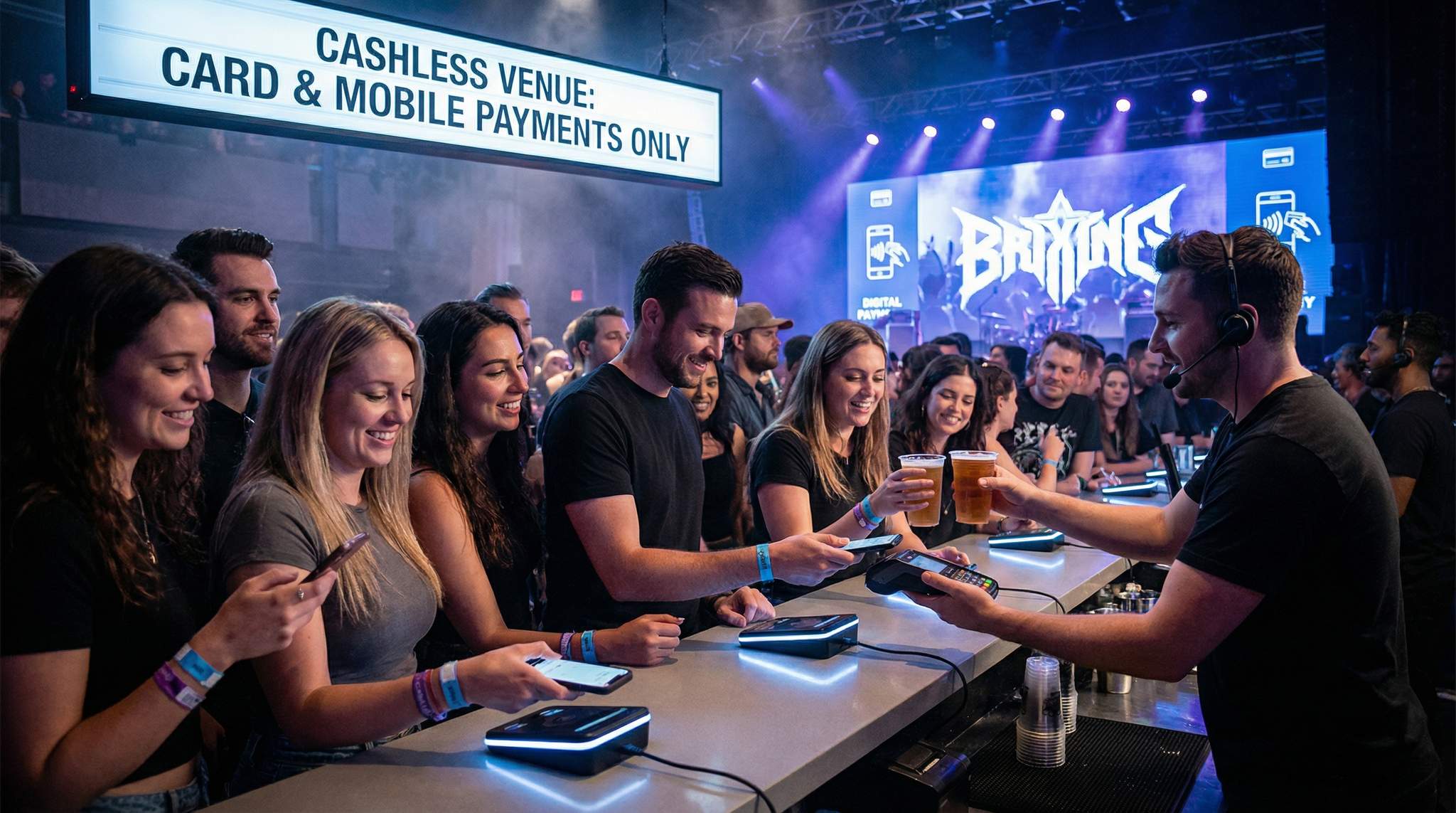
The bars and food concessions are where cashless operations truly shine, often yielding the biggest gains in speed and sales. To implement card & mobile payments here, every point-of-sale must be outfitted with the new payment systems. This typically means giving each bartender or concession cashier a payment terminal or mobile card reader that supports swipe, chip, and tap. Many venues use tablet-based POS at bars – for example, an iPad with a card reader attachment or a purpose-built touchscreen register that takes contactless payments. These devices should be networked (via the robust connectivity we discussed earlier) and ideally portable. Portable POS units let staff walk down the line to take orders and payments during peak rushes, effectively extending service beyond the counter. Some stadiums even equip roaming beer vendors (hawkers) with handheld cashless devices, so they can sell in-seat and take card payments on the spot, as reported in FSR Magazine’s coverage of NFL cashless transitions.
When rolling out new bar POS hardware, involve your bar managers and beverage director in the planning. They will have input on how to arrange the stations for optimal workflow. For instance, you might install one card reader per beer tap or per bartender well, to avoid staff waiting on a single device. Test the reach of wireless handhelds in your venue – does the wifi/cellular connection hold up when the device is at the far end of a VIP lounge or out on the concourse? If not, adjust with signal boosters or wired alternatives. The goal is no bottlenecks: not from payment tech, nor from layout issues. One veteran bar manager at a concert hall put it this way: “Every extra step a bartender takes is one less drink they serve.” With that in mind, design your cashless setup so bartenders can complete a sale (order entry + payment) without unnecessary movement. Many modern systems allow pre-authorizing a tab with a card swipe and later closing all at once, which can be useful for club venues or anytime patrons want to keep a tab open. However, note that pre-auth tabs become less common in fully cashless, because the speed of each card tap is so quick that many venues encourage pay-as-you-go to eliminate the end-of-night crunch of closing tabs.
Reducing Queues and Increasing Throughput
Nothing frustrates fans more than missing part of a show while waiting in a slow bar line. The switch to cashless aims squarely at this problem by shaving precious seconds off each transaction. As we highlighted earlier, replacing cash handling with rapid card taps can multiply how many sales each cashier completes per minute, a benefit detailed in Elmelaab’s analysis of cashless stadium efficiency. The cumulative effect is shorter queues, even at peak times like intermission or halftime. Venue operators who have overseen this transition often literally measure the lines before vs. after. One arena reported that after going cash-free, average wait time at concession stands dropped from over 5 minutes to under 2 minutes on a typical game day. Faster lines not only sell more product – they also keep patrons happier and more likely to return for future events, since a common complaint (“lines were too long”) is resolved.
To maximize throughput gains:
- Optimize Points of Sale Density: Evaluate if you have enough POS terminals now that transactions are faster. If going cashless doubled your speed, you might handle the same crowd with fewer stations or serve more people with the same stations. Many venues actually reduce the number of physical cash registers and instead redeploy staff as runners or additional bartenders, leveraging the faster tech. Others reconfigure the bar to have one staff member pouring drinks while another strictly handles taking payments on a mobile POS, keeping the flow moving.
- Offer Express Lanes or Self-Service: Some innovative venues create an express line for card payments only (no complex orders, just grab-n-go items). In a fully cashless venue this might mean an express line for those using a specific method, like a mobile order pickup or a quick beer station with pre-poured cups. Additionally, consider self-serve kiosks for simple orders – customers can tap through a quick menu, pay right on the screen, and then just grab their item from a pick-up counter. This effectively increases points of sale without adding staff. In 2026, plenty of stadiums have self-order kiosks and find they speed up throughput while being popular with younger, tech-savvy fans, as noted in Square’s insights on self-service tech.
- Train for Peak Efficiency: Even with great tech, human operation matters. Train your bar staff in techniques to handle rushes – for example, preparing multiple orders at once and then taking payments in batch. With cashless, one person might pour 3 beers in a row for 3 customers, then take three separate card payments rapidly. Since tapping a card is so quick, this can be smoother than the old way of “order, pay, make change, next order.” Encourage staff to use the technology to multitask smartly. They should also know the backup plans (like offline mode) so a glitch doesn’t fluster them and slow the line. We’ll touch more on staff training later, but it suffices to say technology + technique together yield the best results.
This efficiency isn’t limited to evening concerts or halftime beer rushes. For multi-purpose spaces hosting daytime conferences or morning events, operators often ask what payment methods speed up coffee and breakfast purchases at cafes or lobby kiosks. In my experience running all-day convention facilities, the answer lies in tap-to-pay digital wallets and pre-loaded event apps. When attendees are grabbing a quick morning coffee before a keynote, contactless mobile payments eliminate the friction of fumbling for small change, keeping the morning rush flowing smoothly and maximizing those crucial early-day F&B revenues.
A real-world example of throughput improvement comes from the earlier mentioned Tottenham Hotspur Stadium: upon opening cashless, they reported significantly shorter queue times at half-time, attributing it to the contactless payment systems in their 65 food & drink outlets. And in the U.S., venues that hosted the first cashless Super Bowl in 2021 saw record concession throughput, proving the concept on one of the world’s biggest stages, according to FSR Magazine’s industry news. When done right, cashless bars let fans get back to their seats faster – with a drink or snack in hand and a smile on their face.
Managing Tips and Gratuities
One concern often raised by bar staff when moving away from cash is tipping. Bartenders and servers are accustomed to cash tips in many venues, and there can be fear that digital payments will hurt their tip earnings. The reality in 2026 is that tipping has adapted rather well to cashless – but you need to configure your POS to facilitate it. Ensure that your payment devices prompt for a tip when appropriate, such as on the signature screen or with preset percentage buttons (e.g. 10%, 15%, 20%). Many tablet POS systems allow a quick “Add Tip” prompt before completing the charge, which patrons will see and can tap an amount. Interestingly, some data shows that people tip slightly more on cards when provided convenient buttons, compared to fishing for loose $1 bills. It’s not uncommon to see average tip percentages rise a bit after implementing these prompts, since the decision is simplified and social norms encourage a quick tap of 18-20%.
However, to make this work, training is key. Staff should know how to politely remind customers about the on-screen tip option if it’s not obvious, but without being pushy. For example, when handing over the card reader, a bartender might say, “This will have an option for tip, and then just tap your card.” This gently signals the customer about tipping in the new system. Furthermore, prepare a process for tip pooling or payout as needed. If previously staff took home cash tips nightly, now tips will be in the system. You may choose to pay out credit-card tips in cash at the end of the night (common in restaurants), or include it in paychecks. Whichever method, communicate it clearly to your team to keep trust. Managers should monitor the tip amounts in early weeks to reassure (or adjust strategy if tips truly dip, though they rarely do in aggregate).
It’s worth noting that cultural expectations around tipping vary by country. In some regions (e.g. parts of Europe or Asia), tipping on card may be unusual or not expected at all. In those cases, going cashless might actually simplify things as staff weren’t relying on tips anyway. But for North American venues or others where tipping is part of staff income, making the digital tipping process smooth is an important part of a successful transition. The good news is that by 2026, customers are largely familiar with adding a tip on a touchscreen – everything from coffee shops to rideshare apps have conditioned people to do this. So with the right POS setup and a little coaching, your staff’s gratuities should remain healthy (or even improve) in a cashless model.
Balancing Speed with Responsible Service
While increasing bar speed is great for revenue, veteran venue operators caution that it must be balanced with responsible alcohol service. Just because it’s easier for a guest to buy multiple drinks quickly doesn’t mean over-service should be allowed. In training, emphasize that staff still need to check IDs, monitor for intoxication, and enforce purchase limits if your venue has them (e.g. two drinks per ID at a time). Going cashless doesn’t remove these duties – in fact, it can aid them. For instance, digital systems can be programmed to flag when a single customer has hit a certain number of drinks within a short period, though such features are more common in specialized systems. At minimum, faster service means bar staff need to stay alert because customers may return more frequently. Be sure your team knows that speed should never come at the expense of safety. This message aligns with the broader topic of responsible alcohol service in venues – a must-read to ensure you’re boosting profits without risking patron safety or legal issues.
In practical terms, consider using some of the efficiency gains to increase safety measures. For example, if going cashless shaved off 2 seconds per transaction, maybe bartenders can take an extra 2 seconds to visually assess the patron for signs of impairment. Or deploy a roving supervisor during peak times to support bartenders in making judgment calls. Some venues also integrate ID scanning devices at the bar which can quickly verify age by scanning a driver’s license barcode. These can fit into a cashless system smoothly and add a layer of security. Ultimately, a cashless venue should strive for better service, not just faster service. By pairing quick payments with conscientious staff, you’ll create an environment where guests can have fun and stay safe – and you’ll keep your liquor license out of jeopardy.
Cashless Merchandise Sales
Mobile POS for Merch Stands
Merchandise booths and gift shops inside venues are another area ripe for cashless transformation. Fans often make spur-of-the-moment decisions to buy a concert t-shirt or team jersey – removing cash barriers makes it more likely they’ll follow through. To implement card and mobile payments at merch stands, provide each merch point with a robust mobile POS setup. This could be as simple as a tablet or smartphone with a connected card reader for smaller stands, or a full touchscreen register with barcode scanner for larger retail shops. The system should handle scanning product codes/PLUs, applying any relevant sales tax, and then taking payment via swipe, chip, or tap. In 2026, many touring artists actually carry their own mobile POS devices (such as Square or Clover) for merch sales that can be set up anywhere in the venue – but as a venue operator, you’ll want to have your own reliable systems for any in-house merchandise operations.
One tip from experienced merch managers is to ensure your POS can handle high transaction volumes in short bursts. Often, merch sales spike right after doors open and immediately after the show ends. You might have a huge surge of people all buying at once. A cloud-based POS should be able to cope, but it’s worth stress-testing in advance. Also, set up multiple payment stations at larger merch areas: for example, a U-shaped booth might have 2-3 staff each with their own device so they can each handle a separate line of customers. Clearly mark prices (in digital and physical signage) and even consider QR codes on merch displays that people can scan to pay through their phone (some venues experiment with this for a virtually self-checkout style experience for merch). The tech is there; it’s a matter of using it creatively to cut down wait times.
Inventory Integration and Tracking
One big advantage of digitalizing merch sales is the improvement in inventory tracking and sales analytics. With all transactions going through a POS, you’ll have real-time data on what items are selling and when. This is a huge upgrade from the days of manual counts and cashbox tallies that often ran late into the night. Modern venue POS systems can integrate merchandise sales into an overall inventory management platform. For instance, when you sell the last size Medium black t-shirt, the system can flag it as out-of-stock so staff don’t keep promising something that’s gone. You can even set alerts to know when a certain item is running low, which is useful if you have backstock that can be brought out or if you need to plan re-orders for the next event.
From a management perspective, these digital records help in identifying top sellers and revenue per head. You might analyze that merch spend per attendee was $5 last month and now it’s $7 after going cashless – perhaps because people can impulsively buy more. In fact, since patrons feel less friction spending with card, they might grab an extra item. (Recall that study: fans feel more secure about their money with cashless and tend to spend more on impulse buys, as noted in Tappit’s blog on cashless festival benefits.) The data can back this up and provide insight into consumer behavior. Use these numbers to adjust your strategy: maybe you realize merchandise does best when sold at multiple locations (because line length dropped) or that bundling items (e.g. hat + scarf combo) could be promoted if you see people often buying both anyway.
Integration also streamlines settlements with artists or vendors. If you host concerts where the artist takes a cut of merch sales, having a clear digital record builds trust and simplifies the reconciliation at the end of the night. No more disputes over cash counts in a messy box – you can both see the POS report stating 250 shirts sold at $30, 100 posters at $10, etc. This transparency can improve relationships with touring partners. It’s worth noting that you should ensure a stable network (again) at merch points, since they might be in odd corners of a lobby or lawn. A portable hotspot or tying into the venue’s mesh Wi-Fi is key so those card readers don’t lose signal amidst a crowd of fans post-show.
Upselling and Higher Spending
Digital payments at merch stands open up opportunities for upselling and increasing average basket size. When fans aren’t constrained by the cash in their pocket, they may be open to buying more items. Train merch sellers to take advantage of this, but in a friendly, non-pushy way. For example, if a fan is buying a band t-shirt, the seller might say, “Do you want to add a poster for $10? We’re doing a 2-for deal tonight.” It’s easier for the customer to say “sure” when paying by card because it doesn’t require having extra cash on hand. According to industry observations, many venues saw notable increases in per-customer merch spending after adopting cashless – often around 15-30% uplift in spend similar to concessions, as reported by Fiserv’s resources on digitizing stadium payments. People feel freer to purchase that extra souvenir or gift.
Some advanced tactics include enabling contactless tipping for merch staff, especially if they help customers with sizing or have a personal touch. It’s not traditionally common to tip at merch, but a small prompt on the tablet (even if just a “leave a tip?” checkbox) can occasionally bring in extra for the seller and encourage great service. Also consider cross-promotions via your payment system. For instance, after a fan buys something, the system could text or email a digital coupon for the venue’s online merch store, or for a discount on F&B that same night (“Show this QR at the bar for $1 off a cocktail”). Because you have their payment tied to contact info (depending on your setup), these kinds of value-adds become possible and can boost overall spend and satisfaction.
Again, it’s important to communicate pricing clearly and avoid any sense of “nickel and diming”. Cashless shouldn’t mean hitting customers with unexpected fees. Make sure your prices are rounded in a friendly way (tax included pricing can simplify things and avoid penny issues, given no one is using pennies physically). Fans generally respond well to the convenience of swiping a card for a $40 hoodie – many actually spend more because they’re not mentally calculating change. Just keep the process smooth: quick authorization, offer email receipts instead of paper (faster and eco-friendly), and have a smile. The ease of the transaction can be a memorable part of the merch-buying experience – which is traditionally a pain point when it involved long waits and fumbling cash while juggling merch items.
Preventing Theft and Fraud
In the past, merch tables could be points of leakage – with busy crowds, a dishonest seller might pocket some cash or miscount change deliberately, or an opportunistic thief could even snatch money from an unattended cash box. Cashless systems virtually eliminate these risks. Every sale is logged; it’s very difficult for an employee to conceal a transaction since the inventory will show a missing item if not recorded. Likewise, without cash on hand, there’s nothing to physically steal from the stand. This peace of mind is a big relief to operators who’ve dealt with shrinkage issues. It’s still wise to enforce sound cash-control practices for any scenario where cash might come into play (like those backup gift card swaps at box office, or maybe older vending machines in the venue). But for merch and concessions run through digital POS, the financial controls are largely built into the system, as noted in Tappit’s reasons for cashless festivals.
One area to watch is chargebacks or card fraud – though relatively rare in face-to-face venue sales, they can happen. A customer might later dispute a charge (claiming it wasn’t them, or they didn’t receive item). To mitigate this, always offer receipts (digital or printed) and ensure your staff input things correctly (e.g., swiping the correct card if holding multiple, etc.). If you sell very high-value merch items (like autographed instruments, expensive jerseys), consider having those transactions involve an ID check or signature to authorize. These are minor tweaks, but they can protect you from the headache of contested charges later. Overall, the risk of fraud is small compared to the old risks of counterfeit bills or employee skimming that cash had. Seasoned venue accountants often sleep easier once cashless is in effect, as the accounting discrepancies diminish and every dollar is accounted for in the software, a benefit highlighted by Elmelaab’s cashless stadium analysis.
Training Staff for Cashless Operations
Educating and Upskilling Your Team
Transitioning to cashless operations isn’t just a technological shift – it’s a people shift. Your staff on the front lines need to be comfortable and competent with the new payment systems. That means thorough training is non-negotiable. Even the most tech-savvy employees will benefit from a structured introduction to the new POS devices and processes. Plan dedicated training sessions for each department: box office, bar/concessions, merch, and any others affected. Ideally, do hands-on workshops where staff can practice ringing up sales and simulating payments before they face real customers. Role-play various scenarios (a card tap working, a chip declining and needing a swipe, a mobile wallet payment, etc.) so they experience it all. Experienced venue managers often bring in the POS vendor to conduct a training seminar or provide how-to videos, which can be very effective.
Key topics to cover in training:
- Device Operation – How to start up the POS, log in, select items, and complete a sale via different payment methods. Make sure everyone knows how to handle common issues like a card that won’t tap (e.g., try inserting the chip, or manually entering if allowed) or a receipt that needs reprinting.
- System Navigation – Teach the interface: how to apply discounts, how to void or refund if needed, how to add tips, etc. The more familiar staff are, the less likely they’ll fumble during a rush. Modern POS can have lots of features (splitting checks, adding notes, etc.), so clarify the essential functions vs. advanced ones to not overwhelm them.
- Troubleshooting Basics – In a cashless world, every staffer is somewhat a “tech operator.” They should know what to do if their tablet freezes or loses connection. Train them on steps like restarting the app, checking wifi signal, switching to offline mode or a backup device. Also, establish a clear procedure: who to call or notify if a major outage occurs. If you have an on-site IT point person or floor manager, staff should know how to get help quickly. A quick recovery from a tech glitch can save an event – and that quickness often comes from staff not panicking because they were prepared, as emphasized in Ticket Fairy’s guide to event tech adoption.
- Customer Communication – Role-play how staff will explain the new system to guests. Even with lots of pre-event communication, there will be customers who bring cash or are surprised by the change. Staff should be patient and positive communicators of the policy: “We’re now cashless to serve you faster and get you back to the show sooner!” and then offer solutions (point to the cash conversion kiosk, etc., as discussed). Empower them with a FAQ: e.g., What if the customer only has cash? What if their card declines? What if they ask why we switched? Having confident answers maintains the venue’s authoritative image and avoids frustration.
Remember, training isn’t one-and-done. Industry veterans recommend a refresh session after the first few events to address any issues staff encountered. For example, maybe staff found the process of doing refunds confusing – that can be re-taught. Moreover, when new employees are hired, incorporate cashless system training into their onboarding checklist. In 2026, being adept with POS tech is as fundamental for venue staff as knowing how to pour a drink or tear a ticket. Make it part of your organization’s culture that you leverage modern tools to deliver great service, a concept discussed in LinkedIn articles on the changing nature of sporting venues.
Alleviating Staff Concerns and Resistance
It’s natural that some team members, especially long-timers, might resist or worry about the shift to cashless. Change can be challenging in any workplace. To gain buy-in, involve staff early on. Clearly communicate why the venue is going cashless and how it benefits not just the business but them as employees: less stress handling cash, shorter lines of cranky customers, possibly higher tips captured on cards, safer working conditions (no cash-related theft risk), and simpler end-of-night duties (no tedious cash counting). When staff see the upside, they’re more likely to support the initiative.
Listen to their concerns individually. Common ones might be: “I’m not good with technology”, or “What if the system goes down? I don’t want angry customers”. Address these with assurance and action. For the first, emphasize that training and ongoing support will be provided, and that the interface is designed to be user-friendly (maybe show examples of success, like “Even our most old-school bartender learned it quickly with a little practice”). For the second, explain the backup plans (offline mode, managers with backup devices, etc.) so they know they won’t be hung out to dry. It can also help to designate a tech support “buddy” on each team – e.g., one person per shift who is especially good with the system and can assist others if someone freezes up or forgets a step.
One specific issue is tip handling, as mentioned earlier. Staff might worry that without cash tips, their income suffers or they can’t immediately pocket tips. Be transparent about how digital tips will be distributed and ensure they get those tips promptly (the same night if possible, via tip-out). Show them data or examples from similar venues that tips held steady or even rose post-cashless, to alleviate fear. Additionally, any incentive you can tie to the success of the transition helps morale. Some venues instituted a small bonus or contest for staff during the first cashless events – e.g., a prize for whoever gets the most positive customer feedback, or a team bonus if sales per hour go up by X%. These fun motivators can turn skepticism into enthusiasm, as staff feel part of a forward-thinking mission.
Finally, keep an open feedback loop. After each event, ask staff what worked and what didn’t. They might have front-line observations that management didn’t consider: perhaps the card readers’ cable is too short and causing awkward movement, or customers kept asking where to tap because signage at the bar wasn’t clear. By quickly addressing these on-the-ground issues, you show the team that their input matters and that the new system is a collaborative success, not just something top-down imposed. In the words of one veteran venue operator, “Your staff are your first customers – sell the change to them, support them, and they’ll sell it to the public.”
Cross-Training and Flexibility
With a fully digital operation, consider cross-training staff across roles to build flexibility. For example, if your box office is idle after the show starts but the bar is slammed, a box office employee who knows how to operate the bar POS (even at a basic level) could jump in to help process orders. Similarly, merch sellers could assist at concession stands during peak F&B times if they’re familiar with that system. Having a unified or similar POS interface across all sales points makes this easier – it’s one big advantage of many modern venue systems. Cross-training not only helps cover surges but also fosters empathy; staff appreciate the challenges of other roles and can support each other better.
Be mindful to still respect specialized skill areas (a security guard likely won’t run a register, of course), but within your operations team find those overlaps. Many venues report that once cash handling is removed, it’s simpler to shuffle staff between duties because they’re not tied to a cash drawer that has to balance at the end of the night. This means, for instance, that a food cashier could be reassigned mid-show to help scan tickets for late arrivals if needed, without worrying about closing out a till right then. Agility in staffing is a hidden perk of cashless systems, and smart managers take advantage of it to optimize labor use and prevent burnout by rotating tasks, a benefit noted in Square’s article on cashless stadium efficiency.
Lastly, ensure managers and supervisors are well-versed in the system too – not just the front-line sellers. They should know how to do overrides, run reports, and troubleshoot higher-level issues. If an employee is struggling or a customer is irate about a payment, a manager who can step in and swiftly operate the device or find a transaction in the system will resolve things much quicker. It sets a strong example when leadership is as fluent in the new tech as anyone. Given how central cashless transactions are to revenue, many GMs and owners are taking personal interest in mastering the data dashboards and real-time sales monitoring that come with it. This ties into a broader point: operating a modern venue is increasingly a tech-centric endeavor, and the most successful operators in 2026 blend hospitality know-how with technological savvy. Training and cross-training your team in that spirit will pay dividends well beyond the transition period.
Communicating the Change to Patrons
Announcing Your Cashless Policy Early
Effective communication with your customers can make the difference between a smooth cashless rollout and a rocky one. Start spreading the word about your venue’s cashless transition well in advance of the first cash-free event. Use all channels at your disposal: your venue website, social media, email newsletters, ticket purchase pages, and on-site signage. The messaging should be clear and upbeat – highlight the positive aspects for attendees (faster service, shorter lines, more convenience) and not just “we’re banning cash.” For example, your announcement might say: “Starting March 2026, The Grand Theater is going cashless! That means quicker bar service and no more ATM lines – just tap your card or phone for instant payments.” By framing it as an upgrade to their experience, you set the right tone, as suggested in Ticket Fairy’s strategies for boosting attendee adoption.
It’s a good idea to use a bit of repetition in the lead-up. People often need to see a message several times before it registers. Post about it regularly on social media (“Tip: Don’t forget, we’re now cashless – bring your card or digital wallet to Friday’s show!”), include a note in pre-event emails or push notifications (“This venue is cashless: please come prepared with a debit/credit card or mobile payment method”), and have a dedicated FAQ section on your site about the new policy. In that FAQ, address common questions: Why are we doing this? What payment types are accepted? What if I forget my card or only have cash? Answering these upfront will reduce confusion on event day, a tip from Ticket Fairy’s guide to cashless adoption hurdles. If you have relationships with local media or community groups, you might even get a blurb in the press (some venues have local news cover their tech upgrades, which helps broadcast the info widely).
On-Site Signage and Guidance
When guests arrive, they should immediately see cues that reinforce the cashless system. Prominent signage at entrances and points of sale is essential. Use friendly, bold signs: “100% Cashless Venue – Pay with Card or Mobile” near the doors, and “No Cash – Card/Contactless Only” at each register. Many venues also utilize digital screens or LED boards, if available, to display reminders (for example, a rotating message on the scoreboard or lobby video wall). During the first few cashless events, you could have staff or volunteers act as greeters at the entrance, verbally letting people know about the cashless policy and guiding those who might need help (like pointing out where the cash-to-card kiosk is). This human touch can preempt frustration – it’s much better a patron hears “by the way, we’re cashless, let us know if you need any help with that” at the door, than after they’ve stood in line with cash in hand.
Consider leveraging the public announcement (PA) system or MCs for reminders as well. For instance, a pre-show announcement or a slide in the event program could mention “Remember, all purchases inside are cashless.” Repetition here is not to nag, but to ensure no one can say they weren’t informed. Importantly, communicate what forms of payment are accepted: credit cards, debit cards, mobile wallets, and possibly your own venue’s loaded-value card if you have one. If you partner with a specific payment sponsor (like a credit card brand), sometimes they provide free signage or decals you can use. Just avoid making it look too cluttered – clarity is key.
One internal strategy is to brief your whole staff (not just those handling payments) about the policy and how to answer questions. Ushers, security guards, and custodians might get asked by guests too (“Can I pay cash anywhere?”). Every staff member should be on the same page: the official line is “No, we don’t accept cash here, but here’s what you can do… [insert solution].” If everyone confidently communicates the same message, it reinforces the new norm. Attendees generally follow along when they sense it’s a standard practice. You want to create an environment where cashless feels like the established default, not an experiment, as advised in Ticket Fairy’s guide to cultural nudges in tech adoption.
Emphasizing Benefits and Perks
To help patrons embrace the change, emphasize the benefits directly affecting them. We’ve stated them, but make sure your communications hammer them home: “Shorter lines at concessions – get back to the action faster!”, “Safer and more hygienic – no need to handle cash, just tap and go”, “Fast, easy payments mean you won’t miss a minute of your event.” Some venues even advertise specific improvements, like “Our average wait time at the bar is now under 2 minutes!” or “Fans spend 40% less time in line with cashless payments.” If you have post-transition data or can cite examples (e.g., “At XYZ Festival, going cashless cut wait times by 80%”), use that in your marketing. People appreciate that it’s being done for them, not just for the venue’s efficiency, a perspective highlighted in Ticket Fairy’s messaging strategies.
Another approach is to incentivize the use of mobile payments. For instance, if a large portion of your crowd has never used Apple Pay or Google Pay, this is an opportunity to nudge them. Some venues offer a small discount or a bonus for using contactless methods: “Tap to Pay and Save 5% on Merchandise” or “First drink $1 off when you pay with your phone!”. Even without discounts, highlighting the cool factor or convenience can push adoption. For example, mention that mobile wallet payments tend to be fastest (because no PIN or signature is needed for contactless under certain limits) – so those using it will get through quickest. People love being in the fast lane. According to promoters, emphasizing that others are using the tech and loving it can create a FOMO effect: nobody wants to be the person holding up the line with antiquated methods, as discussed in Ticket Fairy’s tips on boosting tech adoption.
Finally, consider loyalty or membership tie-ins. If your venue has a membership program or frequent attendee perks, integrate those with cashless: e.g., “Members who pay with their registered card get loyalty points” or “Use your venue app to pay and earn rewards.” This not only drives app adoption (if you have one), but gives a positive reinforcement loop for going cashless. Some venues have even done promotional giveaways – like a contest entry for all purchases made cashlessly, giving a chance to win free tickets or a merch pack. These fun perks tend to soften any resistance and get people talking positively about the new system.
Handling Common Questions and Hurdles
Despite all preparation, expect that a subset of customers will have questions or even complaints about cashless operations. Preparing empathetic and factual responses is key to maintaining goodwill. Here are a few common patron concerns and suggested ways to handle them:
- “Why are you doing this? I like using cash.” – Explain that the venue’s move is primarily for their benefit: “We found that by going cashless we can serve everyone much faster. Lines have been cut in half, so you spend less time waiting. It’s also safer for everyone – no risk of stolen wallets or handling dirty money. Many venues are doing the same and guests are loving the quicker service.” Most people will accept this when they see it’s industry-wide and meant to improve their experience, not to inconvenience them.
- “I don’t have a credit card – how can I buy anything?” – This is where you point to your solution: “No problem, we have a free option for you. See that kiosk? You can insert any cash and it’ll give you a card you can use here and anywhere cards are accepted. It’s really easy – our staff can help if needed.” Alternatively, if you offer your own reloadable wristband or gift card, mention how to obtain and use that. The key is assuring them they won’t be left out. In our experience, once they use the prepaid card and see it works like cash, anxiety goes down. Some might even keep it for future visits.
- “Isn’t this just so you can charge fees or track what I buy?” – A few skeptics might see a nefarious angle. Be transparent: “We aren’t charging any new fees – prices are the same. And while we do see sales data, it’s only used to manage inventory and make sure we have enough next time. We value your privacy.” It’s true that digital payments leave a data trail, but emphasize it’s secure and intended to help improve offerings (like stocking more of a popular beer if it always sells out). If your venue has a privacy policy or if the payment processor is a known trusted company, you can mention that for reassurance (e.g., “Your card info is processed securely by XYZ Bank; we never see your full card number”).
- “What if the system goes down? I don’t want to be unable to buy.” – Some tech-wary folks might bring this up. You can respond confidently: “We have multiple backups in place. Our devices can work offline if needed, and we have redundancies just in case. In the unlikely event of a outage, we have a plan to keep things running. We’ve got you covered.” You don’t need to explain the nitty-gritty (like offline mode or cellular backup), but conveying that you’ve planned for it will comfort them. Also, you could humorously add, “The same question came up when we moved from paper tickets to electronic – and that turned out fine, right?” Drawing parallels to other successful tech shifts can contextualize it.
In all communications, keep the tone helpful, not defensive. Some guests might initially grumble, but often their tune changes once they experience the faster service. Monitor social media and feedback channels after the first events; respond to any negative comments with understanding and clarifications. Oftentimes, you can turn a critic into a fan by simply listening and showing that you care about their experience. Highlight positive feedback publicly (“Thanks @customer, we’re glad you enjoyed breezing through the beer line!”) to further reinforce the message. With time, most of your audience will fully adjust – especially as cashless becomes standard everywhere from coffee shops to sports arenas. The year 2026 is well past the tipping point for cashless acceptance, so you may find that the majority of your patrons hardly bat an eye at the change, as long as you’ve communicated it well.
Overcoming Challenges and Ensuring Continuity
Including Solutions for Unbanked Guests
No venue operator wants to turn away paying customers who happen to not have a bank account or credit card. Even though such cases may be relatively few (in many regions the vast majority of adults have some form of debit card), equity and accessibility are important. We’ve touched on the solution of cash-to-card kiosks – these have proven effective at major venues to accommodate unbanked or cash-preferring guests. If your venue implemented them, monitor their usage. For example, check how many cards are dispensed each event and ensure the machines are well-maintained and stocked. If only a trickle of people use them, one kiosk might suffice; if you see queues at the machine, consider adding more or having staff with mobile POS that can do the same conversion service (essentially selling a gift card for cash).
When evaluating cash-to-card kiosk deployments in stadiums, placement and ratio are critical. In my experience consulting for large-scale arenas, a good rule of thumb is installing one reverse ATM for every 5,000 to 7,500 capacity, strategically positioned near main entrances and high-traffic concourse junctions. These machines must be clearly signposted and regularly serviced to prevent jams during peak ingress, ensuring that your transition to a fully digital payment ecosystem doesn’t inadvertently create new physical bottlenecks.
A successful approach to cash to card kiosk stadiums integration also involves educating your guest services team. Staff stationed near these reverse ATMs must be trained to quickly assist patrons with the conversion process, ensuring that the transition to a digital-only environment feels like a premium service upgrade rather than a restrictive policy.
Another strategy some venues employ is partnering with a payment provider to offer a branded venue card. For instance, you might have a “XYZ Venue Cash Card” that can be loaded and reloaded. If you go this route, try to make it fee-free or low fee, otherwise patrons will feel penalized. It could even double as a loyalty card, encouraging repeat visits (e.g., after the show, the card still has $5 – an incentive to come back and use it). Municipal performing arts centers, in particular, have used this approach as they often serve a broad public audience and want to promote inclusivity.
Importantly, keep tabs on any local regulations about cash acceptance. As noted, some jurisdictions mandate that you accept cash or provide a cash-loading option, as reported by Axios regarding cashless business bans. Document your compliance: have clear signage that “Cash can be converted to card at Guest Services” or similar, to satisfy those rules. Train a few staff to handle any escalations – if someone is adamantly against using a card and causing a scene, a manager might discreetly help them out (perhaps by accepting their cash and running a manager card for the transaction, a last-resort workaround). These should be rare, but having a plan maintains goodwill. Veteran venue operators also suggest working with community advisors if applicable – for instance, consulting with a disability access committee or a community advisory board to ensure your cashless plan doesn’t inadvertently exclude any group. Sometimes feedback from such groups leads to small tweaks like providing a phone info line for older patrons who might not see the web announcements, etc. The goal is a smooth experience for all, even those who need a little extra assistance adapting.
Preparing for System Outages
Even with the best technology and network setup, system outages or glitches are a possibility that must be anticipated. The difference between a minor hiccup and a show-stopping disaster often lies in your preparedness. Having a detailed contingency plan for payment system failure is as crucial as having an evacuation plan for emergencies. Here’s what that might include:
- Redundancy of Devices: Keep a few spare card readers and tablets on hand. If one unit malfunctions, swapping it out can be done in seconds. Also, if a particular area’s POS all fail (say a network switch goes down), you could deploy handheld devices on cellular to that area as a stopgap.
- Fallback to Offline Transactions: Ensure your staff is trained on taking payments offline if needed. For instance, if connectivity is lost, they might still swipe cards and later obtain approval. There’s a small risk of declined cards later, but it’s better than halting all sales. Some venues print a stash of old-school credit card imprint slips (the carbon copy swipers) as a last resort – it’s very 20th-century, but in a pinch, one could take an imprint of a card and signature, then run it once systems are back. This is truly a desperate measure, but having it in the toolbox can be comforting.
- Communication to Patrons: If an outage occurs, quickly communicate with customers in line. Don’t leave them frustrated and clueless. Empower staff or a manager to make a quick announcement like, “Folks, our payment system is momentarily down – we’re working on it and should be back shortly. Thank you for your patience.” If you have displays, maybe flash a message. People tend to be more understanding if they’re informed. In a prolonged outage (more than a few minutes), you might consider a concession: perhaps offering free water or something small to those waiting, as a goodwill gesture.
- Emergency Cash Stash?: This is tricky – some venues keep a small amount of cash on site in case they absolutely need to do cash transactions during an extended tech failure. If allowed and safe, you could have, say, a locked cash box in the safe with a float for a couple of stations. However, using it means you’ve broken the cashless protocol and will have to securely handle and reconcile that money. Another approach if things were dire: you could allow “IOUs” – basically comp the item with a note to charge later (especially for regular patrons or members whose cards on file you have). These situations are highly rare and situational. Most likely, your redundancies will kick in and you won’t need to resort to cash. But thinking through the options in advance is wise. Reading case studies of when event tech goes wrong and how teams recover can provide valuable lessons to incorporate into your plan, as found in FSR Magazine’s industry news.
Whatever your strategy, drill it with staff. You might simulate a network outage during a training session and have the team practice whichever steps you decide on. This way if it ever happens for real, muscle memory takes over instead of panic. Additionally, maintain up-to-date support contacts for your POS provider; a direct line to tech support can speed up troubleshooting if the issue is on the software side. Many venues negotiate a support SLA (service-level agreement) where the vendor provides quick on-call assistance during event hours.
Managing Transaction Costs and Accounting
A behind-the-scenes challenge of going cashless is dealing with transaction fees and financial reconciliation. Credit card processing isn’t free – typically, venues will incur merchant service fees around 2-3% per transaction (depending on volume and the deal with their payment processor). When you move all sales to cards, those fees apply to everything, which can be a substantial cost line. Smart venue managers tackle this in a few ways:
- Negotiate Rates: If your volume of card transactions is increasing dramatically, use that as leverage to get a better rate from your processor. Sometimes switching processors or using the one integrated with your ticketing system (if they offer a competitive rate for on-site sales) can save tens of thousands of dollars a year for a busy venue. It’s a competitive market; don’t be shy to shop around or renegotiate your contract. The larger the venue, the more clout you have – but even independents can often find fintech services tailored for small business with fair rates.
- Adjust Pricing Marginally: Some venues opt to slightly increase prices (1-2%) to offset fees, essentially passing the cost indirectly onto the customer. This is easier to do when you’ve just made a big operational improvement like reducing lines – customers generally won’t notice if a beer went from $9.50 to $9.70, for example, especially if you’ve eliminated the need for cash change. However, be cautious with this approach; transparency matters and in some regions explicitly surcharging card payments is not allowed. It’s usually better to fold it in silently as a small price adjustment if needed, rather than a “card fee.”
- Reap Operations Savings: Remember that going cashless saves money in other areas – fewer bank runs, less labor counting cash, less shrinkage and error. In fact, some analyses show that once you account for those savings, the net cost of card fees is often offset. Still, you’ll want your finance team to track these metrics. Compare your cash handling costs pre-cashless vs. card fees post-cashless. Many managers are pleasantly surprised to find the difference isn’t huge, especially when sales also increase (covering the fees). If you do find the fees burdensome, look into loyalty partnerships (e.g., some banks or card companies might subsidize some costs if you promote their card at your venue) or technological solutions like NFC wearables that use closed-loop payments with lower fees. These are more common in festivals but could be applied at fixed venues too.
- Efficient Accounting: With digital payments, end-of-night reconciliation shifts mostly to verifying the POS reports and ensuring deposits match sales. Train your accounting staff or night managers on pulling the reports from the system. It should break down credit vs debit vs mobile wallet sales, etc., and show totals. You’ll want a process to verify that the amount in the batch settles to your bank correctly. Also, adjust your cash handling protocols – since cash is minimal, your closing checklist might instead involve securing devices and verifying all transactions closed. It’s different work, but often less work overall than counting cash drawers. Some venues repurpose former cash room staff into roles like data analysis of sales patterns – effectively turning former “money counters” into “money analysts,” which can be an uplifting change in job quality.
Continuous Improvement & Feedback Loops
Implementing cashless payments is not a one-time project; treat it as an ongoing improvement initiative. Gather data and feedback continuously. After each event, review sales data alongside any anecdotal notes from staff. Did any particular register have issues? Were there times where transactions slowed (maybe hinting at a network lag)? Use any customer feedback – perhaps you send a post-event survey or monitor social media – to gauge satisfaction with wait times and convenience. The numbers will tell part of the story: if spend per head jumps up and complaints go down, you’re on the right track. If you identify friction points, address them swiftly. For instance, if you notice many people still asking “Do you take cash?” at the stands after a few weeks, maybe your signage isn’t prominent enough or the pre-event comms need boosting.
Stay updated with industry trends and technology updates. Payment tech evolves rapidly. By 2026, features like facial recognition payments or fully checkout-free stores (like Amazon’s Just Walk Out model) are being piloted in some venues, as discussed in Fiserv’s resources on digitizing stadium payments. While you don’t need to adopt every new thing, keep an eye on proven innovations. Perhaps in a year or two, you might integrate your ticketing and payment data for personalized offers (e.g., the system knows a season ticket holder’s favorite beer and offers a fast lane for them). Or maybe you’ll introduce an order-ahead app so guests can place a halftime drink order from their seat. These build on the cashless foundation you’ve laid. The smart venue infrastructure you have – the network, the devices, the data – can enable a lot of these next-level enhancements, a concept supported by Forbes Advisor’s insights on digital spending.
Don’t be afraid to seek out insights from other venues as well. The community of venue operators is quite collaborative through associations like IAVM, INTIX, NIVA, etc. Many share case studies on what worked or what mistakes to avoid. Perhaps attend a conference panel or roundtable on cashless conversion to learn others’ experiences and solutions. For example, someone might have a great tip on how they handled an outage or how they boosted mobile wallet usage by partnering with a sponsor. Learning from peers can save you trial-and-error and spark ideas to further boost your sales and service speed.
In conclusion, continuous improvement ensures that going cashless isn’t just a one-time bump in efficiency, but an ongoing journey of delivering exceptional, modern guest experiences. With each event, you’ll refine the process. Based on veterans’ accounts, within a few months of going cashless you’ll likely wonder how you ever managed with the old cash system. The combination of quicker lines, higher revenue, and richer data is powerful. Stick with it, keep optimizing, and your venue will be well-positioned for the future of live events.
Frequently Asked Questions About Cashless Venues
What does “cashless venue” mean for event organizers?
A cashless venue operates entirely without physical currency. For organizers and promoters, this means deploying digital-only point-of-sale systems across all revenue centers—ticketing, food and beverage, and merchandise—to process card, mobile, or RFID payments exclusively.
What are the best cashless payment systems for venues?
The ideal cashless payment for venues includes cloud-connected POS terminals that support NFC (contactless tap-to-pay), EMV chip cards, and mobile wallets. High-volume spaces often integrate these with their ticketing platforms or use closed-loop RFID wristbands for even faster throughput.
How are stadiums handling cashless policies in 2026?
A typical stadiums cashless policy in 2026 involves 100% digital transactions at all vendor locations, supported by robust Wi-Fi/5G infrastructure, mobile ordering capabilities, and reverse ATMs (cash-to-card kiosks) to accommodate unbanked attendees while maintaining compliance with local financial regulations.
Are stadiums cashless or do they accept cash for food in 2026?
From an operational standpoint, the vast majority of major arenas and stadiums are entirely cashless in 2026 and do not accept physical bills at food or merchandise counters. To serve cash-carrying fans without slowing down concession lines, operators install cash-to-card kiosks (reverse ATMs) throughout the concourse. This ensures the venue remains a high-throughput digital environment while still providing an accessible way for all attendees to purchase food and drinks.
How do I get started with contactless payment for events?
To initiate the transition to digital transactions, begin by auditing your venue’s internet and cellular connectivity, as reliable networks are the backbone of any modern POS infrastructure. Next, replace legacy cash registers with cloud-connected terminals that support NFC (tap-to-pay) and mobile wallets. Finally, ensure your staff is thoroughly trained on the new hardware and launch a communication campaign to inform attendees about the cash-free policy before they arrive on-site.
What are the top picks for mobile app payment systems in entertainment venues?
The best mobile app payment systems for entertainment venues integrate seamlessly with existing ticketing and access control infrastructure. Top picks include all-in-one event platforms like Ticket Fairy that link digital wallets to attendee profiles, specialized in-seat mobile ordering applications for stadiums, and white-label venue apps that consolidate ticketing, merchandise, and food and beverage purchases into a single smartphone interface.
How do cash-to-card kiosks work in stadiums?
In large-scale venues, cash-to-card kiosks (often called reverse ATMs) allow unbanked or cash-carrying attendees to insert physical bills and receive a prepaid debit card of equal value. For operators, deploying these machines is a crucial step in enforcing a strict cash-free policy while remaining compliant with local accessibility laws and ensuring no fan is turned away from making a purchase.
How do operators evaluate cashless payment for venues?
Evaluating cashless payment for venues requires assessing transaction speed, offline processing capabilities, and hardware durability. Venue managers should prioritize systems that integrate directly with their ticketing and inventory software, ensuring seamless financial reconciliation and real-time data visibility across all points of sale.
How does implementing cashless for concerts benefit touring artists and promoters?
Implementing a cashless model for concerts significantly streamlines nightly settlements between the venue, the promoter, and the touring artist. By utilizing digital payments for merchandise and VIP upgrades, operators eliminate the need for manual cash counts, reduce shrinkage, and provide transparent, real-time revenue splits that make end-of-night accounting much more efficient.