When an emergency strikes at a festival – whether it’s a sudden storm at a country music festival in Texas or a security scare at a concert in Singapore – clear communication can literally save lives. Festival producers must be prepared to speak with one voice when things get real. This means having a single, authoritative source of information and instructions for your audience and staff. A well-drilled emergency communications plan can prevent panic, ensure safety, and even save your event from total chaos.
In this guide, a veteran festival organizer shares hard-earned wisdom on emergency communications. We’ll cover how to establish who has authority to halt or restart shows and order evacuations, how to prepare and test your messaging and delivery channels, how to train MCs (emcees) and staff to project calm authority, why time-stamped updates are crucial, and how confident communication prevents stampedes. These tips apply whether you’re running a small boutique festival or a massive multi-day event with hundreds of thousands of attendees.
Table of Contents
– Define a Clear Chain of Command
– Pre-Plan and Test Emergency Messages
– Use Multiple Channels for One Message
– Train MCs and Staff for Calm Authority
– Time-Stamp Every Update
– Confidence and Clarity Prevent Panic
– Key Takeaways
Define a Clear Chain of Command
In an emergency, every second counts. The last thing you want is confusion over who makes the call to pause a performance, restart the show, or evacuate the site. Before your festival even begins, identify a clear chain of command for emergencies:
Free Tool: Size Your Festival Site
Zoned capacity planning for arena, campsite, parking and entry lanes — against UK Purple Guide and NFPA density standards. Finds your bottleneck zone.
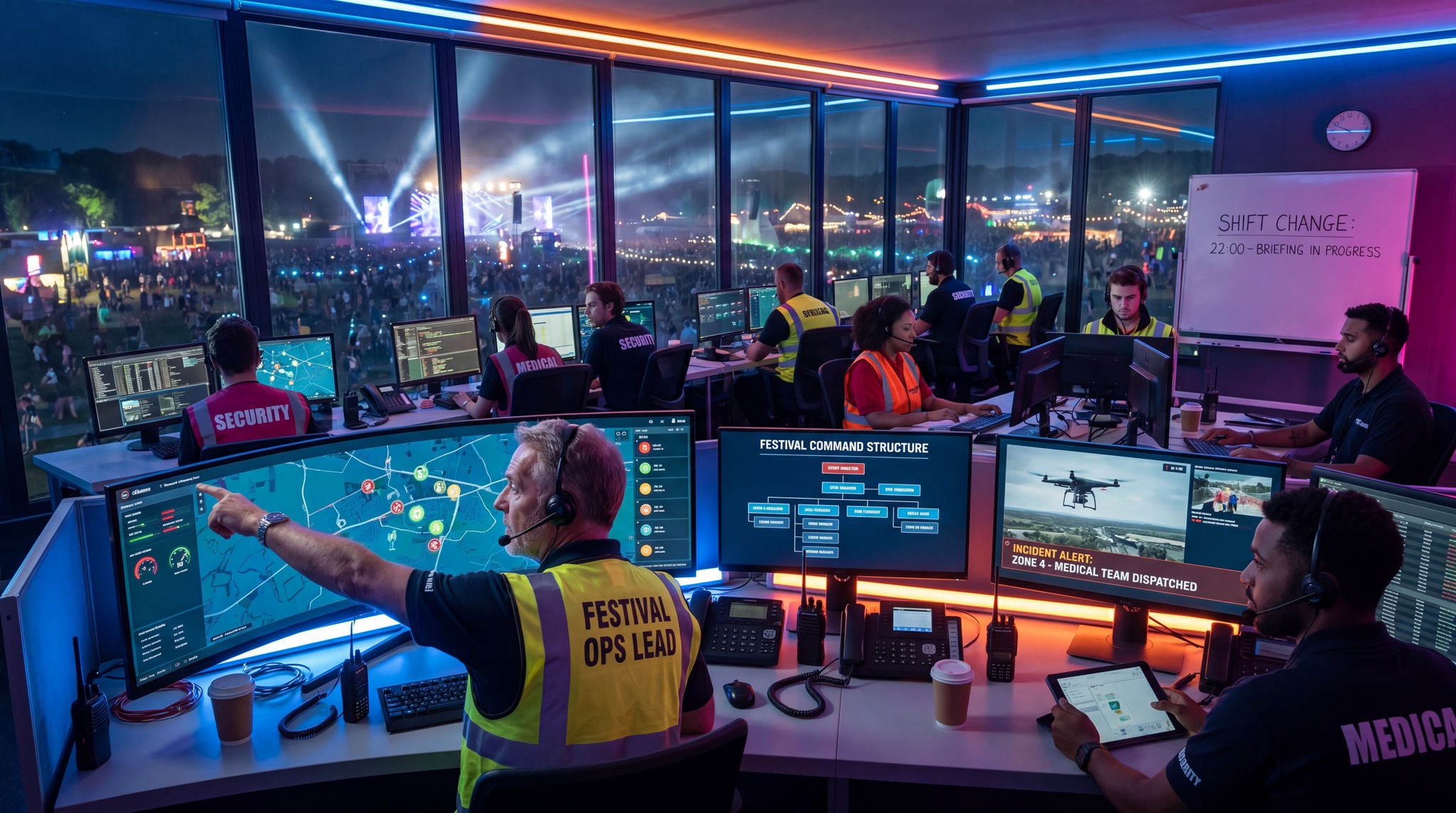
- Assign Decision Makers: Designate the roles (by position, not just names) that have the authority to make critical calls. Usually, this includes the Festival Director or Event Manager, the head of Security/Safety, and key local authorities (like a fire marshal or police commander) in a unified command structure. For example, at major festivals like Glastonbury (UK) or Bonnaroo (USA), an Emergency Operations Centre (EOC) is established where festival officials and local emergency services confer on big decisions. Everyone on the team knows that when a serious situation arises, the call to hold, resume, or evacuate will come from this core group.
- Define Triggers and Protocols: Clearly define what conditions warrant a show hold, a full stop, or an evacuation. Is it lightning within a certain radius? A medical incident in the crowd? A security threat? For instance, many outdoor festivals have a lightning policy (often a 8-mile rule in the US or a specific kilometre radius elsewhere) – if lightning is detected within that range, the festival director in consultation with safety officials will hold performances and possibly evacuate to shelter. Knowing these triggers in advance means faster decisions when it counts.
- Communication of Authority: Ensure every staff member, vendor, artist, and even volunteers know who has the final say. This prevents well-meaning but unqualified staff from making ad-hoc announcements. For example, stage managers should not independently declare an evacuation unless that authority was delegated to them. A real-world lesson came from the Indiana State Fair stage collapse (2011) during a country concert – confusion over weather info and who could call off the show led to a delayed evacuation attempt. Now, many events have explicit rules: only the festival’s incident commander (in coordination with weather officials) can issue the evacuation order, and everyone else follows that lead.
- One Voice Policy: Adopt a “one voice” policy for public announcements. This means all emergency instructions to attendees should ideally come from a single source or spokesperson (or at least be consistently worded), whether that’s the MC on the main stage, a safety officer over the PA system, or an official mobile alert. This unified approach avoids contradictory messages. Attendees should never be hearing different instructions from different stages or staff.
- Joint Agency (JA) Coordination: For large-scale events, establishing a Joint Agency (JA) command center ensures that private festival security, local police, and medical responders are operating from the same playbook. A JA approach prevents siloed decision-making, ensuring that when an evacuation order is given, all responding agencies reinforce the same vocal instructions and physical routing plans.
By defining the chain of command and decision-making authority beforehand, you create a structured response. When lightning strikes or an incident occurs, everyone from your security team to the artists on stage will know who is about to speak and that they must yield and support that decision. The crowd, too, will sense the authority behind a unified message – which makes them more likely to trust and follow instructions.
Pre-Plan and Test Emergency Messages
Moments of crisis are not the time to be scripting your announcement from scratch. The best festival producers prepare pre-written emergency messages for various scenarios and test how they will reach attendees. This preparation ensures that when an emergency hits, you can communicate quickly, clearly, and calmly. Here’s how to do it:
Planning a Festival?
Ticket Fairy's festival ticketing platform handles multi-day passes, RFID wristbands, and complex festival operations.
- Draft Common Scenarios: Think through the top emergency scenarios for your event and draft messages for each. Examples: severe weather delay (“Ladies and gentlemen, we regret to pause the show due to incoming weather…”), evacuation orders (“For your safety, we need everyone to calmly head toward the exits…”), medical emergency halts, missing child alerts, even event cancellation if it comes to that. Write these messages in clear, simple language that a sober or inebriated festival-goer alike can understand. Avoid jargon and keep instructions concise.
- Use a Calm and Positive Tone: The wording should encourage cooperation, not incite fear. Phrases like “please remain calm and proceed slowly” or “for your safety” are helpful. For example, when a storm threatened Bonnaroo Music Festival in Tennessee, officials posted an announcement asking attendees to “please head calmly to the nearest exit and shelter in a vehicle,” according to Billboard’s report on the evacuation. The message was polite but firm about what action to take, and it specifically told people to stay calm. Such phrasing can make a huge difference in how the crowd reacts.
- Include Key Details: A good emergency message includes the what, where, and when/for how long. For instance: “Severe weather is approaching. We are temporarily stopping the show and ask everyone to exit to the campgrounds or your cars for shelter immediately. This is a precaution; no one is in immediate danger, but please move quickly and calmly. We expect to update you in 30 minutes (by 6:30 PM).” This kind of announcement tells people exactly what to do, reassures them, and sets expectations for the next update.
- Multiple Languages (if needed): At international festivals or events with a significant non-English-speaking audience, prepare translations of emergency messages. Large festivals in Europe and Asia often have multi-language announcements. If you’re hosting a festival in a country like Spain or Indonesia with many foreign attendees, have key messages pre-translated (e.g., Spanish, French, Mandarin) and staff or signage ready to deploy them.
- Test Delivery Channels: It’s not enough to write messages – you must ensure they can be delivered fast and widely. Test all communication channels before the festival and even during non-emergency times on site:
- PA System Coverage: Walk the venue (or field) during soundcheck or downtime and play a test announcement. Can it be heard clearly at the back of the field, in the parking lot, at the campsites, in the vendor areas? Are there any dead zones where extra bullhorns or speakers are needed? Many country music festivals are on wide-open farms or ranches, so sound can dissipate – consider delay towers or additional speakers so the announcement reaches the beer tents and the furthest RV in the campground.
- Visual Displays: If you have big LED screens or marquees, plan to flash emergency messages there too. During Lollapalooza in Chicago and Tomorrowland in Belgium, for example, giant screens have been used to display evacuation notices and weather warnings in real-time, complementing audio announcements. This helps reach those who might not clearly hear the PA (or if a person is deaf or the crowd is noisy).
- Mobile Alerts: Leverage technology. If your ticketing platform or festival app supports push notifications or SMS blasts, set those up in advance. For instance, Ticket Fairy’s platform allows event organizers to send urgent updates to all ticket holders via email or mobile notification – a critical feature when you need to reach people not near a stage. Make sure you’ve collected attendee contact info (e.g., mobile numbers) with permission to send emergency texts. Test the system: consider sending a “welcome to the festival” informational text on Day 1 so you know it works and attendees recognize the number/notification.
- Social Media and Website: Prepare to use your festival’s official Twitter, Facebook, Instagram, and website homepage for emergency updates. Pre-draft some holding statements for social media. A quick “UPDATE: [Festival Name] is on hold due to weather. Please shelter and stay tuned for instructions. (Time: 5:45 PM)” can be pinned to the top of your feeds. Many attendees (especially younger ones) will reflexively check social media when something’s happening. For example, Bonnaroo posted its evacuation notice on Instagram in 2022, which read in part “Severe weather is approaching… please exit Centeroo immediately and shelter in a vehicle,” as noted in Billboard’s coverage. Having that message ready to go can save precious minutes. Just ensure someone on the team is tasked with hitting “send” on those socials when needed.
- Battery Backup and Redundancies: An emergency might knock out power (e.g., a power outage or equipment failure). Be prepared with backups: use battery-powered megaphones in case the sound system fails, have generators for emergency lighting and audio, use runner staff if digital comms fail. In 2019, a massive power failure at a European festival shut down the PA — luckily, staff with bullhorns and handheld radios guided attendees to exits until power returned. Redundancy in communication tools is a must for risk management.
- Coordinate with Authorities: Often local police or emergency services will also want to broadcast messages (e.g., an Amber Alert for a missing child or a citywide weather alert). Work out with them in advance how those messages will be delivered to your crowd. Perhaps the festival MC reads a statement provided by police, or the police have a way to break into your PA system. Consistency is key – it’s best if public addresses still come from your event’s designated voice, even if the info originated from authorities, to maintain that one-voice approach.
- Draft a Formal Contingency Message: Take inspiration from state-level crisis communications. For example, official government alerts (such as those issued when the UAE places the safety and security of its citizens, residents and visitors as its highest priority) often state that the situation remains under full control and that authorities are operating within a fully integrated national framework with the highest levels of preparedness and efficiency. They emphasize: “Your safety remains our utmost priority. Please remain indoors in safe areas, await official instructions, and rely solely on official sources for updates.” Adapting this highly authoritative, reassuring template for an emergency music festival scenario ensures attendees know the situation is being managed professionally and prevents them from trusting unverified rumors.
- Prepare a Specific Fire Alarm Announcement Message: Unlike weather delays where attendees might shelter in place, a fire requires immediate, directional evacuation. Your fire alarm announcement message must be distinct from general alerts. A strong template is: “May I have your attention please. A fire alarm has been activated in [Specific Zone/Building/Tent]. Please evacuate this area immediately through the nearest marked exits and proceed to the designated assembly points. Follow the instructions of our safety staff.” Having this script pre-approved by the local fire marshal ensures your team can trigger it without hesitation.
- Structure a Phased Evacuation Announcement: When a full site clearance is necessary, your evacuation announcement must be structured to prevent bottlenecks at the exits. Rather than a blanket “everyone leave now” broadcast, experienced producers use phased messaging. For example, “Attention: We are initiating a controlled site clearance. Guests in the VIP and North Field areas, please proceed to the North Exits now. South Field guests, please stand by for your directional instructions.” This type of targeted emergency egress instruction manages crowd flow and reduces the risk of crushing at the gates.
- Pre-Event Attendee Briefings: Proactive festival communication starts before the gates even open. Fire exits and emergency procedures should indeed be communicated to attendees prior to the start of each event. Send a dedicated “Know Before You Go” email or app notification outlining the location of medical tents, emergency egress routes, and severe weather shelters. Educating your audience in advance reduces confusion if an evacuation order is later required.
By pre-writing messages and rigorously testing your delivery channels, you ensure that when an emergency arises, you’re not scrambling. Instead, you’ll be executing a well-oiled plan: pushing a button to send a text, reading a prepared script over the mic, and flashing a message on the big screens – all within moments of the decision. Attendees will receive clear, unified information quickly, which keeps them safer and more cooperative.
Use Multiple Channels for One Message
“One voice” doesn’t mean using only one channel – in fact, you should communicate through multiple channels simultaneously, but the content of the message must be consistent across all of them. Reaching your attendees through several mediums ensures no one misses the important information, while consistency ensures nobody gets conflicting instructions.
Consider a scenario: A sudden lightning storm is 10 minutes out at a large outdoor country music festival like Stagecoach (USA) or CMC Rocks (Australia). Here’s how multi-channel, one-message communication would work:
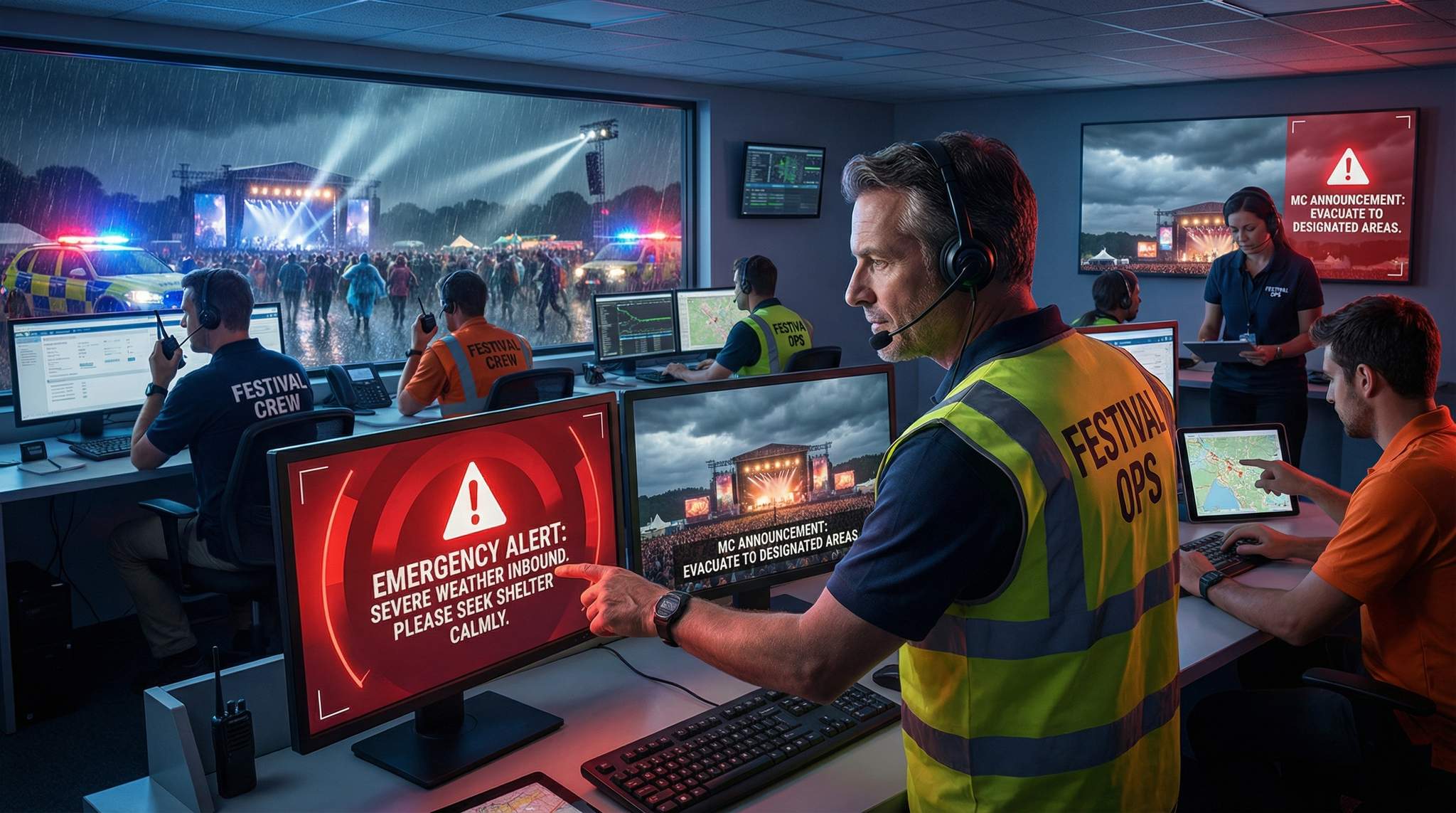
- On-Stage Announcement: The main stage MC or a safety officer grabs the microphone (after being cued by the festival control center) and delivers the prepared message: e.g., “Attention everyone, we have a weather alert. For your safety, we are pausing the show. Please calmly make your way to the exit and shelter in your vehicles. The performance will resume when it’s safe. Follow staff directions and stay tuned for updates.” This announcement is the primary voice most attendees will hear.
- Giant Screens and Signage: At that exact time, your production team flashes the same core message on the LED screens: “Severe Weather Alert – Please Exit to Shelter.” If you have digital signage around the grounds (like screens near tents, entrance gates, parking lots), those should also display the emergency instructions. Bright, bold text that can be read from a distance is important, possibly in multiple languages if needed.
- Mobile App/SMS Push: Simultaneously, your tech team sends out a push notification via the festival app or an SMS to all ticket holders: e.g., “Weather Alert: Festival is on hold due to storm. Please seek shelter in cars or designated areas immediately. Updates to follow. – [Festival Name]”. Attendees who might not be near the stage or who have already wandered to their campsites will get the buzz on their phones. (This is where having a platform like Ticket Fairy with built-in attendee messaging is extremely valuable.)
- Social Media & Website: At the same moment, your social media manager posts the same message on Twitter, Facebook, Instagram, and pins it. Your website’s front page might display a banner: “Festival on Weather Hold – please shelter off-site until further notice.” This helps reach not only attendees (some will check Twitter for info while sheltering) but also informs media and worried family members outside the event who might be following along.
- Staff Communication: Behind the scenes, ensure all staff are getting the same message through internal channels (radio, WhatsApp group, etc.). For example, send a quick text or radio call to all zone managers: “We have ordered a weather hold and evacuation at 5:20 PM. Direct attendees calmly to exits and shelters. Announcements are live.” This way, even the parking crew or those backstage know what attendees have been told and can reinforce, not inadvertently contradict or speculate.
Using all these channels in sync ensures maximum coverage. Someone dancing near the stage will hear the MC; someone at the outskirts may see a screen or get a text; someone in the beer tent might have a staff member walk over and inform them. The key is that all channels carry the same core message and instructions, approved by the chain of command. Attendees will not hear a jumbled mix of different directions – it’s a chorus saying the same thing.
Grow Your Social Following With Every Sale
Require social media follows, shares, or playlist adds to unlock presale access or special pricing. Turn every ticket purchase into audience growth.
A great example of this unified multi-channel approach was during Boots and Hearts Music Festival in Canada when a tornado warning hit in 2022. The organizers notified the crowd over the PA and stage screens to shelter in their cars, posted the message on social media, and even had camp staff making rounds to inform campers, as reported by CTV News Barrie. Shortly after, when the warning was lifted, they again used the same channels to give an all-clear and resume the show, confirming the storm had moved through. Because they blanketed the venue and online space with one coherent voice, the crowd understood what to do and there was no chaos.
Furthermore, when you are telling guests that they need to evacuate, reinforcing your vocal instructions with accessibility-focused channels is vital. Consider attendees who are deaf or hard of hearing; relying solely on PA announcements leaves them vulnerable. Integrating high-intensity strobe lights linked to the emergency system, vibrating haptic alerts via the festival app, and dedicated accessibility staff using sign language ensures that your evacuation directives are universally understood.
Need Festival Funding?
Get the capital you need to book headliners, secure venues, and scale your festival production.
Train MCs and Staff for Calm Authority
Even the best-written emergency script won’t help if it’s delivered poorly. Your MCs and on-mic announcers play a pivotal role in crisis communication. These individuals become the voice of authority the crowd hears. It’s crucial to train them to speak with calm, clear confidence in emergencies. Here’s how to prepare your team:
- Select the Right People: Ideally, the person making emergency announcements is someone with a strong, clear voice who the audience is already accustomed to hearing. Many festivals naturally use the stage MC or a known host. Make sure this person is comfortable taking on a serious tone when needed. They should come across as neither monotone nor panicked – think of the reassuring but firm voice of an airplane pilot during turbulence. If your festival spans multiple stages, consider having an MC at each stage briefed to handle emergency announcements (or a way to patch one voice through all stages simultaneously).
- Provide Training and Scripts: In advance of the festival, sit down with your MCs and walk through the emergency scripts. Explain the scenarios and the importance of specific wording. Encourage them to practice reading the announcements out loud exactly as written, but in a tone that’s confident and steady. It’s important they don’t ad-lib critical instructions (stick to the plan), but they may need to add slight personal authority to keep people calm (e.g., “Folks, I need your attention” in their own style). Conduct role-play drills: What if there’s a sudden storm – have them simulate making that announcement in an empty venue or over a radio. The first time they ever say those words shouldn’t be in front of 50,000 people; practice makes perfect.
- Emphasize Calm Authority: The MC should project that they have the situation under control. Panic is contagious, but so is calm. A classic example comes from a non-festival context that’s often cited in training: During the emergency landing of US Airways Flight 1549 on the Hudson River, the captain’s famously cool announcement to passengers was simply, “This is the captain. Brace for impact.” It was brief, calm, and authoritative. At festivals, an MC might similarly say, “May I have your attention, please.” in a steady tone – just getting a noisy crowd’s attention calmly is the first step. They should avoid screaming or using a tone that conveys fear or uncertainty. Phrases like “Don’t panic!” are actually counterproductive (it might trigger the very panic you’re telling them not to have). Instead, use affirmative language: “We have a plan, and everyone is safest if we follow these steps together.” If the MC remains composed, attendees are more likely to mirror that demeanor.
- Microphone Technique: In a tense moment, adrenaline can make people talk too fast or hold the mic wrong. Train the MC on proper mic use – hold it steadily, speak slowly and enunciate clearly. If they need to repeat the message, that’s fine. Sometimes repeating an instruction twice can help it sink in, especially in a crowd with varying noise levels and attention spans. Something like: “Once again, we need everyone to move calmly to the exits and shelter in your cars due to weather. There is no immediate danger, and the festival will resume as soon as it’s safe. Again, please exit the venue calmly and take shelter.” The repetition and clarity can improve compliance.
- Coordinate with Performers: It’s not just designated MCs – sometimes the band or artist on stage when an emergency hits might try to say something. This can be helpful or harmful depending on their actions. It’s wise to brief artists (especially headliners) in advance: if something happens, stop playing immediately when instructed, and allow the MC or safety officer to make the announcement. If the performers want to help, they can reinforce the MC’s message (“You heard them, folks, let’s all head out slowly and we’ll see you as soon as the storm passes!”). At the Global Citizen Festival in NYC (2018), a sudden scare occurred when a barrier fell and sounded like gunshots, causing panic, an incident detailed by Digital Journal. Chris Martin of Coldplay took the microphone to calm the crowd, reassuring them it was a false alarm, helping to prevent serious injuries. His calm demeanor helped soothe people. That kind of coordination – where artists understand they might need to yield or assist in messaging – is valuable. However, generally keep the official instructions to the professional MC or safety voice to avoid any confusion.
- Empower Staff and Volunteers: While the main announcement will come from the stage or central source, all frontline staff (security, volunteers, ushers, etc.) should also be trained to carry that calm authority in their interactions. For example, if you have to evacuate, your gate staff and security teams will be guiding people out. Brief them to use clear, calm language like “This way, folks. No rush, you’re doing great, thank you,” rather than barking orders. If attendees see confident, composed staff, it reinforces the overall sense of order. Consider doing a short training or drill with staff during pre-festival briefings: give them sample phrases to use and ones to avoid (e.g., avoid speculative comments like “I think the stage might collapse!” which one overzealous guard might blurt without training).
- Reinforce Vocal Instructions Visually: When you are telling guests that they need to evacuate, what’s the best way to reinforce your vocal instructions to help all guests understand? The most effective method is deploying synchronized visual and physical cues. Train your ground staff to use broad, calm hand gestures pointing toward the nearest exits, and equip them with illuminated traffic wands for night events. Simultaneously, ensure that every digital screen and stage monitor displays bold, high-contrast directional arrows that match the PA announcements. This multi-sensory reinforcement is critical for attendees who may be hearing-impaired, wearing earplugs, or disoriented by the crowd noise.
Training your people to communicate calmly under pressure creates a ripple effect of reassurance. A well-trained MC carrying calm authority in their voice can turn a potentially chaotic evacuation into an orderly exit. Seasoned producers will tell you that during a crisis, the crowd subconsciously takes emotional cues from those in charge. If the voice on the speakers is calm and confident, attendees are far more likely to stay composed and cooperate.
Time-Stamp Every Update
In a fast-moving situation, communication is not a one-and-done deal. You may need to provide ongoing updates as an emergency unfolds – and it’s critical to time-stamp each update. Why? Because both your audience and your team need to instantly know how fresh the information is. Time-stamping builds trust and clarity, preventing the spread of rumors or outdated info.
Here’s how to implement time-stamped updates effectively:
Free Tool: Project Your Bar Revenue
Per-head spend benchmarks by event type turned into projected bar and food revenue, with a stock-mix estimate and gross-margin line. Free calculator.
- Include Time in Public Announcements: Whenever you make an announcement over social media, your app, or other written channels, include the time. For example: “UPDATE 7:45 PM: The thunderstorm is continuing. All attendees should remain sheltered in place. Next update by 8:15 PM or sooner if conditions change.” By doing this, anyone reading it knows this was the status as of 7:45 PM. If they come across a tweet or message later, they won’t confuse it with a new update. This is especially important on platforms like Twitter/X or Facebook where posts might get shared without context. Attendees at festivals often screenshot official messages and share them – having the time embedded avoids confusion.
- Regular Cadence of Updates: Even if you don’t have new information, commit to checking in at intervals. For example, “(8:30 PM) We are still on hold due to lightning detected nearby. Thank you for your patience. We will provide another update by 9:00 PM or once we have clearance to resume.” This prevents an information vacuum where rumors can start. It’s amazing how quickly a crowd can become uneasy if they feel they’re being kept in the dark. Even a “no new developments yet” update reassures them that the organizers have not forgotten about them. It also subtly signals that you are monitoring the situation actively with the clock in mind.
- Synchronize Clocks: This might sound trivial, but make sure all your team’s devices and radios are synced to the correct time! If your safety team says “we issued the evac at 5:52” but the social post mistakenly says 5:42, it can create a discrepancy. Use a single time standard (local time zone, obviously) and ensure your key staff are aligned. In some event command centers, they even have a big clock on the wall. This helps when logging incidents too.
- Log Updates in the Command Center: Maintain an internal timeline of events with timestamps for everything – this is useful after the fact for debriefs, but also during the event to keep track. If you have multiple people handling comms, an internal live doc or chat where they note “7:00 PM – first announcement to evacuate made from Stage A; 7:05 PM – all stages cleared; 7:10 PM – social media post #1; 7:40 PM – safety sweep done, all clear given by fire marshal; 7:45 PM – announcement of all-clear issued” and so on. This ensures the next person giving an update knows exactly where things stand to the minute.
- Public Time-stamping Creates Accountability: When attendees see times on your updates, they know you are being transparent and timely. It also pressures your team to indeed give updates as promised. If you stated “next update by 9 PM”, make sure to follow through. If the update is, “(9:00 PM) We’re still monitoring heavy rain, hang tight with us – we will update again by 9:30 PM,” it shows you’re keeping your word. This builds audience trust, which is gold during emergencies. They are more likely to remain calm and follow instructions if they trust you’re on top of it.
- Post-Incident Communication: After the situation is resolved (“all clear” or festival canceled, whatever the outcome), do a final time-stamped update as well. Example: “UPDATE 9:30 PM: All clear! The storm has passed and we are resuming the festival. Thank you for your patience and cooperation. – [Festival Team]” or in a worse scenario, “UPDATE 9:30 PM: Unfortunately, due to ongoing severe weather, we have to cancel the remainder of tonight’s performances. Safety comes first. Please see staff for guidance and travel home safely. We will follow up with more information soon.” Including the timestamp on the final note caps the timeline and signals closure of the incident phase.
Time-stamping every update might seem like a small detail, but it is a professional best practice in crisis communication. Festivals that have done this effectively report far less confusion among attendees. For example, Fuji Rock Festival in Japan (known for sudden mountain weather shifts) constantly messages updates with local time notation, and fans appreciate the clarity. Remember, during a crisis, your attendees’ sense of time may be distorted by stress or boredom while waiting; clear markers help ground them. It also dampens the rumor mill (“Did you hear we’re evacuated till tomorrow?” “No, look, the 8:00 PM update says they’re re-evaluating at 8:30.”). In short, timestamping keeps everyone on the same page – literally by the clock.
Confidence and Clarity Prevent Panic
Crowds can be unpredictable in emergencies – the nightmare scenario is a stampede or crowd crush caused by panic. The antidote to panic is confidence and clarity in your communications. As an experienced festival producer will attest, when people feel that someone competent is in control and telling them exactly what to do, they are far less likely to behave recklessly. Here’s how confident, clear communication can prevent dangerous situations:
- Authoritative Messaging: From the moment you deliver an emergency announcement, it should carry an air of authority and intentionality. This isn’t about being bossy; it’s about instilling confidence that “the organizers know what they’re doing.” If your message is wishy-washy (“Um, we think maybe you all should leave, if that’s okay?”) or sounds unsure (“We’re not sure what’s going on, but maybe exit?”), people will not trust it. They may even ignore it or start to panic because it sounds like you don’t have control. By contrast, a clear directive (“Festival staff are implementing our safety plan now… please follow these instructions…”) gives the impression of a well-oiled plan swinging into action, which fosters compliance and calm.
- Preventing Dangerous Rumours: In a vacuum of information, people fill it with speculation. Confident and frequent official updates nip rumours in the bud. For example, imagine a loud bang happens at a festival – if there’s no immediate announcement, within minutes you might have pockets of the crowd thinking it’s a gunshot or a bomb and running in fear. If you swiftly come on the mic and say, “Attention: The loud noise was caused by a power generator malfunction. There is no danger. Medical and technical teams are responding. Please remain where you are, we will update shortly,” you address the uncertainty head-on. Attendees then aren’t left to guess – they’ve been told what it was (if you know) or at least told what to do. Quick, honest clarity can stop a potential panic wave among tens of thousands of people.
- Case in Point – Managing a Scare: A real example of when confident communication mattered was at a music festival in New York’s Central Park in 2018 (Global Citizen Festival). A fallen barrier made a loud noise that many mistook for gunfire, and hundreds of spectators started to flee in panic, some getting trampled, according to reports from Digital Journal. In the midst of this, event personnel and even artists (like Chris Martin) quickly began urging the crowd to stay calm and explained it was a false alarm, which helped de-escalate the situation. Their prompt, clear announcements likely prevented more injuries. It’s a reminder that speed and clarity in messaging (“It’s NOT what you think, you are safe, please stay calm”) can turn a situation around. On the flip side, delays or weak messaging can let panic spiral. In that case, if nobody had gotten on the mic to clarify, the stampede could have been far worse.
- Visible Leadership: Along with announcements, the presence of staff acting confidently on the ground reinforces the message. If you tell people to evacuate to the north gate, but they see staff standing around confused, confidence erodes. Train your security and volunteer teams to look like they know where to direct people (even if internally they’re just following instructions). Bright vests identifying staff, flashlights at night, hand signals – and a calm demeanor – all contribute to a sense of order. Often, attendees will mirror the behavior of those leading them. If staff are running frantically, attendees run frantically. If staff are briskly walking and calmly saying “this way, folks,” attendees will more likely follow suit.
- Avoid Over- or Under-Reaction: Confidence in communication also means striking the right balance in tone – serious enough that people take it earnestly, but optimistic enough that people don’t lose hope or freak out. For instance, if there’s a structure issue and you need people to move, you say, “We need everyone to move away from the main stage area as a precaution. Our teams are addressing an issue. There’s plenty of time to move safely, so we’re going to do this orderly. Please proceed to the other side of the field.” You’re not shouting “The stage might collapse, run!” (which would incite panic), but you’re also not downplaying it to the point people ignore you. Confidence is projecting that this is under control and if you listen, you’ll be okay. It’s an art as much as a science.
- Plan for Crowd Psychology: Work with your crowd management teams to understand how crowds typically react and how to mitigate panic. For example, psychological studies and past incidents show that crowds respond well to clear guidance and repeat messaging. They also respond to seeing others comply. So your plan might be to get the front sections moving first (people in the back see them moving calmly and realize it’s okay). And use phrases that encourage unity: “Let’s all do this together” or “your cooperation is part of the safety for everyone.” People are less likely to stampede if they feel we’re all in it together versus everyone for themselves.
- Practice = Confidence: Ultimately, your team’s confidence comes from preparation. Conduct drills where you simulate an emergency and practice the communications. Some festivals do a tabletop exercise with staff weeks prior: “What if scenario X happens at 8 PM – go!” and then practice who says what, which channels activate, how the crowd might respond. When you’ve walked through it, if a real emergency happens, it won’t be your team’s first time dealing with it mentally. They’ll project calm because they know they have a plan.
- Pacing the Evacuation Announcement: The cadence of your spoken evacuation announcement directly impacts the crowd’s physical movement speed. If the MC rushes through the script, the crowd will instinctively speed up, increasing the risk of trips and falls. Delivering the site-wide evacuation broadcast at a deliberate, measured pace—inserting strategic pauses between sentences—subconsciously signals to the audience that they should walk, not run, toward the exits.
When you communicate with confidence and clarity, your audience will sense it. They’ll follow instructions more readily, and you reduce the chance of panic turning into physical danger. As one seasoned festival producer put it, “In a crisis, be the leader your crowd needs to hear. If you sound like you know what you’re doing, they’ll trust you and do what you ask.” That trust is everything when it comes to preventing injuries and even saving lives during festival emergencies.
Frequently Asked Questions About Festival Emergency Comms
What is a contingency message in event planning?
A contingency message is a pre-drafted, highly authoritative statement prepared by festival organizers to address specific crisis scenarios. It is designed to immediately establish control, reassure attendees that their safety is the highest priority, and direct them to rely solely on official sources for updates during an emergency music festival situation.
When telling guests they need to evacuate, what’s the best way to reinforce vocal instructions?
The best way to reinforce vocal instructions during an evacuation is through synchronized visual and physical cues. Ground staff should use clear, calm hand gestures and illuminated wands to direct traffic, while all available digital screens, stage monitors, and mobile app push notifications should display bold, high-contrast text and directional arrows that match the spoken announcements.
What is a good escalation flow when a camera event might be a real emergency?
When your festival’s CCTV or drone surveillance team spots an anomaly—often referred to as a “camera event”—you need a rapid escalation flow to determine if it warrants a public safety response. First, the camera operator must immediately notify the Event Control Center (ECC) with a precise location and description. Second, the incident commander dispatches a nearby ground team or roving security supervisor to visually verify the threat within 60 seconds. Third, if the ground team confirms a real emergency (such as a localized fire or crowd crush), the incident commander authorizes the pre-planned communication protocol, triggering the MC and digital channels to broadcast the appropriate evacuation or hold instructions.
How do Joint Agency (JA) operations improve festival emergency communications?
A Joint Agency (JA) operation brings together festival organizers, local law enforcement, fire departments, and medical teams into a unified command structure. This collaboration ensures that all emergency communications—from initial camera event escalations to final evacuation orders—are vetted by relevant experts and broadcasted with a single, authoritative voice, minimizing confusion and accelerating response times.
What are the essential components of a festival evacuation announcement?
An effective festival evacuation announcement must include a clear attention-grabber, the reason for the directive (without inciting panic), specific directional instructions (e.g., “proceed to the North parking lot”), and a reassuring closing statement. It should be delivered calmly over the PA system and immediately reinforced by visual cues on stage screens and push notifications to attendees’ mobile devices.
Why is pre-event festival communication important for emergency preparedness?
Effective festival communication begins before attendees arrive on site. Fire exits and emergency procedures should indeed be communicated to attendees prior to the start of each event. By distributing site maps, shelter locations, and evacuation protocols via email or mobile app ahead of time, organizers ensure the crowd is already familiar with safety measures, which significantly speeds up response times during an actual crisis.
What should a standard fire alarm announcement message include?
A standard fire alarm announcement message must be distinct, authoritative, and highly directional. It should immediately state that an alarm has been activated, specify the affected zone, and instruct guests to evacuate through the nearest marked exits to designated assembly points. Pre-scripting this message ensures staff can deliver it without hesitation or panic.