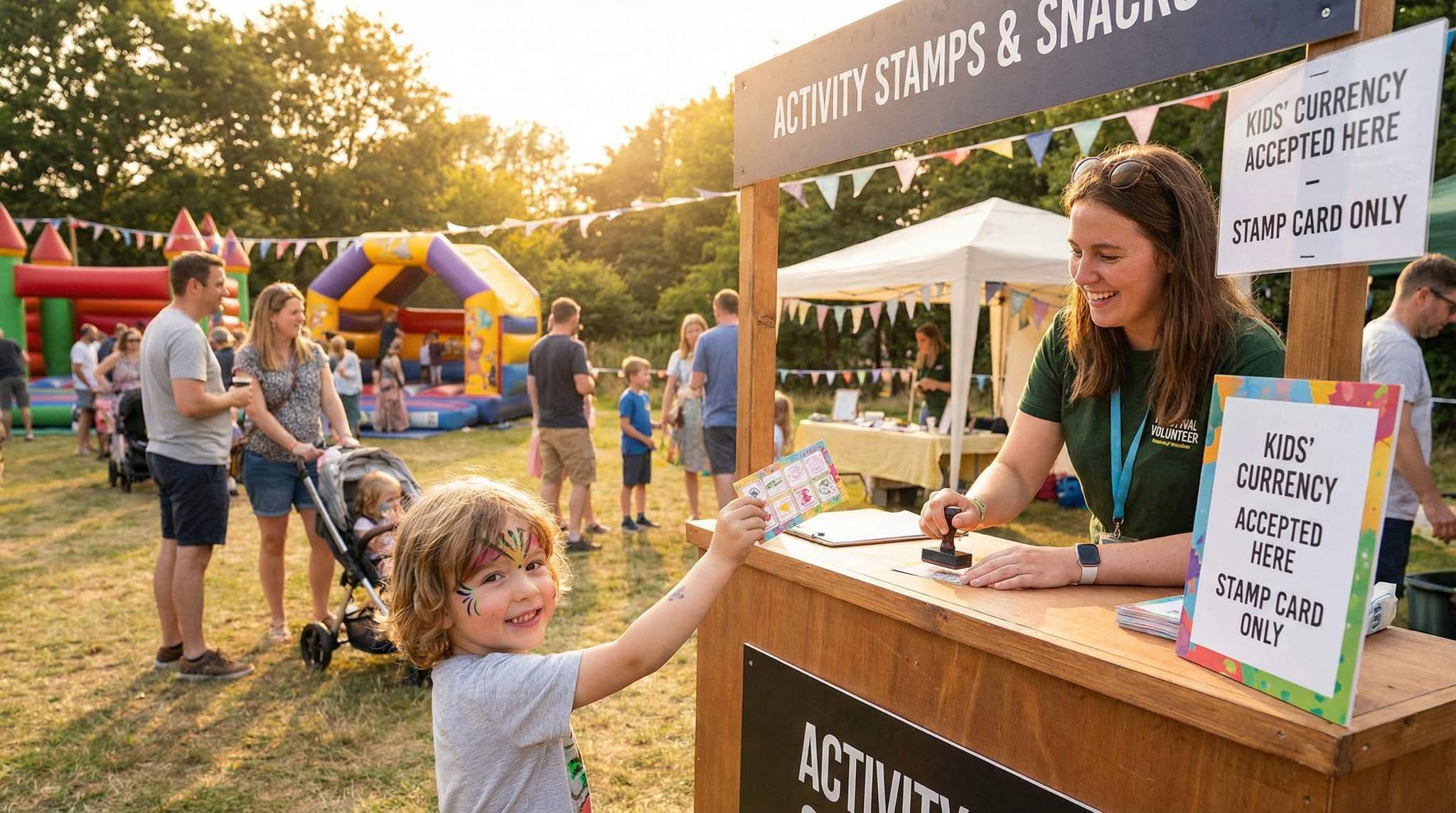
Making Money Fun: Festival Currency for Kids (Stamps, Not Cash)
Imagine a family-friendly festival where children roam freely with colourful stamp cards in hand, eagerly deciding whether to spend their next stamp on a carousel ride, a face painting, or a tasty treat. Instead of clutching coins or asking parents for cash at every stall, kids have their own festival currency – stamps on a card – to pay for crafts, rides, and snacks. This simple idea of using stamp cards (rather than real money) for kids’ purchases is transforming the festival experience for families. It not only reduces the hassle of cash handling at kid-focused stations, but also turns spending into an educational game. Financial literacy meets fun as children learn to budget their day of adventure within the safe boundaries set by parents and organizers.
In this guide, our world-traveled festival producer shares how implementing a stamp-card currency for kids can enhance any family-friendly festival. From real-world case studies to practical tips on logistics, marketing, and community engagement, you’ll learn how to make festival finances child’s play – literally.
Why a Kid-Friendly Festival Currency?
Family festivals present a unique challenge: how do you empower children to enjoy activities and make small purchases, without burdening parents or staff with constant cash transactions? Traditional carnivals have long used ride tickets or tokens for this purpose, making it easier for kids to partake in funfair games. Stamp cards are a modern twist on that idea, offering several benefits for festivals:
-
Safety and Convenience: Carrying cash can be risky or confusing for young kids. A stamp card system eliminates the need for children to hold money or change, reducing the chance of lost cash or tears over a dropped coin. Parents can load up a single card with a set value of stamps, and kids simply get their card stamped at each activity. This keeps money matters in one place (with parents or at secure top-up stations) and streamlines transactions for little ones. Vendors and volunteers love it too – no fumbling with change or card readers at the bouncy castle entrance.
Go Cashless With RFID Technology
Enable contactless payments, faster entry, and real-time spending analytics with RFID wristbands and NFC-enabled ticketing for your events.
-
Empowerment and Independence: For children, having their own “currency” makes them feel grown-up and responsible. It allows even young festival-goers to make decisions: Do I want to spend two stamps on popcorn now, or save them for a pony ride later? Such choices give kids a taste of independence in a controlled environment. Festival producers have found that younger children find it easier to spend vouchers or stamps than real money. Instead of parents dictating every purchase, kids can hand over their card for a stamp themselves, which is a big confidence booster.
-
Financial Literacy Through Fun: A festival stamp card can be a sneaky teaching tool. With a finite number of stamps on their card, kids learn the basics of budgeting. They must budget their day by prioritizing the activities or treats they want most. Once the stamps are used up, they’re gone – unless an adult offers a top-up. This mirrors real-life money decisions on a scale kids can grasp. Some events even take it further: for example, a children’s museum festival in Mexico partnered with a local bank to print playful “peso” stamp cards and included simple money facts on them, turning the whole experience into a mini financial literacy lesson. While the kids just think they’re having fun, they’re also internalizing the idea that resources (stamps or money) are limited and should be spent wisely.
Planning a Festival?
Ticket Fairy's festival ticketing platform handles multi-day passes, RFID wristbands, and complex festival operations.
-
Reduced Cash Handling & More Efficiency: From an organizer’s perspective, a cashless kids’ zone means far fewer headaches. No need to provide heaps of small change at every stall or worry about cash disappearing. At a school fair in the UK, organizers switched to a token system and reported far less time spent managing cash and counting change, which kept the treasurer happy. With stamp cards, the only points handling real money are the initial sales or top-up stations, which can be centrally managed and made very secure. Everything else runs on stamps, speeding up lines. In fact, large festivals worldwide are embracing cashless payments for general audiences to improve efficiency. For example, Camp Bestival – one of the biggest family-focused festivals – implemented RFID wristbands for all purchases, offering a safe and quick solution for families and faster kiosk transactions. Not every festival will invest in high-tech RFID, but a simple stamp card achieves similar efficiency on a smaller budget.
-
Happier Vendors and Volunteers: Kid-centric booths (like craft stations or game tents often staffed by community volunteers or youthful staff) benefit immensely from a simplified payment process. With stamps as currency, you can drop a token in a jar (or simply rely on the stamp as record), a method that allows any volunteer to manage a stall without cash training. There’s no risk of miscounting change or handling electronic payments in a busy kid zone. This simplicity can even enable older kids or teens to help run certain activities since no actual money is handled, simplifying the process for youth volunteers. It’s a great way to involve youth volunteers and build their responsibility.
Designing the Stamp Card System
Launching a festival currency for kids requires careful design and planning. Here’s how to get it right:
1. Create a Fun, Clear Stamp Card: The card itself should be durable, understandable, and appealing to children. Many festivals use a small cardstock card or brochure with clearly marked boxes or icons representing each stamp “credit.” For instance, a city children’s festival in Australia designed a punch-card with 10 circles, each labeled as 1 credit for a ride or snack. Every time a child used one, the vendor punched a hole or stamped a cute icon on the circle. Make sure to print instructions or a legend, such as “One stamp = one snack or game. Some big rides cost 2 stamps.” Use bright colours and maybe festival mascots or artwork to make it exciting. Kids often treat these cards as a souvenir of their day, especially if they feature fun graphics.
Smart Promo Codes & Presale Access
Create percentage or flat-rate discount codes with usage limits, date ranges, and ticket type restrictions. Plus unlock codes for private presales.
2. Set a Clear Value for Stamps: Decide what each stamp is “worth” in real terms and keep it simple. A common approach is 1 stamp = 1 dollar (or local currency unit), or whatever roughly equals the price of a basic kid item at the festival. You can price different activities in stamp units (e.g. small craft = 1 stamp, premium ride = 2 stamps, lunch meal = 3 stamps). Alternatively, avoid tying to currency and say each stamp is good for one defined item (one ride, one serving, etc.), which makes value very straightforward to kids. The key is transparency – families should instantly know what a full card of stamps can get them. If you do tie stamps to monetary value, prominently show conversion (like “1 Stamp = £0.50” or “1 Stamp = $1”) and ensure prices at kid booths are in whole stamps (no half-stamp nonsense!). Consistency prevents confusion.
3. Pricing Bundles and Preventing Shortfalls: Think about how many stamps an average child might use, and sell cards accordingly. Common options are a card of 10 stamps or 20 stamps. You might offer a slight bonus for larger purchases – e.g. buy 10 stamps, get one free stamp – to encourage uptake. (One festival school fair sold tokens at £0.50 each and gave 11 tokens for the price of 10 as a pre-sale deal.) Make sure to have plenty of stamp cards or tokens in stock so you don’t run out mid-festival. One community festival in Hampshire, UK underestimated demand and ran out of tokens halfway, forcing staff to frantically collect used tokens back from stalls to recirculate, a situation avoidable with better planning or by using stamp cards that don’t “run out” as physical objects. Paper stamp cards are essentially infinite as long as you have blank space and a stamp, which is an advantage over limited token coins.
Need Festival Funding?
Get the capital you need to book headliners, secure venues, and scale your festival production.
4. Top-Ups at Lounges or Stations: Even with good planning, some kids will blow through their stamps faster than anticipated (who can blame them when the festival is so fun!). To support families, designate top-up stations where parents can purchase additional stamps or cards conveniently. A great strategy is to integrate these with existing comfortable areas – for example, a Family Lounge or information tent can double as a top-up kiosk. This way, when parents take a breather while kids play, they can easily refill the card for the next round of activities. Spread these stations out (near the kids’ zone entrance, by a main walkway, etc.) to prevent one huge queue. Clearly signpost them with something like “Get Your Stamps Here!” so no one has to trek back to the festival entrance just to add credit. If your event uses a cashless wristband system for adults, consider offering a separate kids’ stamp card as a companion, rather than giving young children an RFID linked to parents’ credit cards. This keeps the kid transactions offline and limited, which parents may prefer.
5. Training Vendors and Staff: Ensure every vendor and volunteer in the kids area knows how the stamp currency works. It sounds obvious, but have a quick training or a cheat-sheet at each booth: e.g. “Face Painting = 1 stamp. Check the card has an available box, stamp it with the provided stamp, and give the biggest smile!” Provide each station with a unique stamp or punch if possible, not just for fun but also to prevent any mischievous duplication of stamps by savvy kids. (Most kids won’t try to counterfeit stamps, but teens might find it a fun challenge – using distinct stamps per booth or serial numbers on cards can deter this.) If a station does run out of ink or loses their stamp, have a backup method like marking the card with a permanent marker or hole-punch. Little issues like this are important to sort out in advance.
6. Festival Entry and Onboarding: Introduce the stamp card system seamlessly as families arrive. At the gate or box office, have staff or signage explaining that the festival is “cash-lite” for kids. If the stamp card is included with certain ticket types (“VIP kids package includes 10 stamps”, etc.), make sure those are handed out or sold right at entry. Many festivals choose to pre-sell stamp cards online as add-ons to tickets – a convenience for parents and a way to gauge demand. For example, Ticket Fairy’s platform allows promoters to offer add-on purchases during checkout, so a parent buying family festival tickets can also buy a $20 kids stamp card package in advance. This not only locks in revenue but also cuts down lines on festival day, since the card can be picked up at a special fast track counter or mailed in advance. If families arrive without knowing about the system, have “greeter” volunteers explain it very simply and direct them to the nearest stamp sales booth. The smoother the introduction, the quicker everyone gets on with enjoying the event.
Teaching Kids Budgeting in Real Time
One of the sweetest advantages of a kids’ festival currency is the opportunity for children to learn about budgeting and choices while having fun. Festival producers can encourage this learning subtly:
Boost Revenue With Smart Upsells
Sell merchandise, VIP upgrades, parking passes, and add-ons during checkout and via post-purchase emails. Increase average order value by up to 220%.
-
Visualise the Budget: A stamp card in hand is a visual budget. As the day starts, a child sees a card full of available stamp spots or tokens. As they get items stamped one by one, the remaining slots remind them what they have left. Parents can help young ones count their remaining stamps after each activity (“You have 5 stamps left on your card – what do you want to do next?”). This tangible countdown teaches consequence: spending a stamp now means one less later.
-
Let Kids Prioritise: Encourage parents to discuss the plan at the start of the day. Maybe hand out a simple festival map or activity list alongside the stamp card. Kids can decide, for example, if the petting zoo or the Ferris wheel is a must-do and allocate their stamps accordingly. Some festivals even incorporate a little planning corner in the family area where kids can sit with crayons and circle the activities they want most. It’s like making a wishlist that must fit the “budget” of stamps they have. This process builds decision-making skills and anticipation.
-
Earning Extra Stamps (Optional): To really drive home the value of effort, a festival might include ways to earn bonus stamps. For instance, a community eco-festival in California set up a “recycling game” where if kids brought a small bag of collected recyclable trash to a booth, they earned an extra stamp for a free snack. Another idea is partnering with educational sponsors: completing a short quiz at the science tent or a mini dance at the music stage could give a reward stamp. These kinds of activities highlight the idea that “money” (even pretend money) is earned through effort or smart choices, not just handed out limitlessly. Just be sure any earnable stamp can’t be exploited endlessly—make it a one-time small bonus so as not to undermine the paid system.
-
No Unlimited Handouts: It’s important that parents set expectations that once the stamps are gone, they’re gone (barring perhaps one top-up if they choose). This mirrors real budgeting and prevents kids from thinking they can just ask for more endlessly. Many festival organizers note that having a finite kid currency actually reduces pestering for more treats—kids quickly learn to pace themselves when they know there’s a limit. One PTA chair in an English school fair observed that parents found it easier to limit spending by giving kids a set number of tokens (“once your tokens are gone, they’re gone”). It might even save parents money compared to countless “Mom, can I have $5 for this?” requests! And if kids do run out of stamps early, it becomes a teachable moment about not spending all your “fun money” at once.
-
Making it Fun, Not Stressful: Of course, the goal isn’t to turn the day into a serious economics lesson. Festival staff can keep the tone light—perhaps have friendly mascots or entertainers remind kids to “spend your stamps wisely and you’ll have memories galore!” Some events give out a small “financial whiz” sticker or certificate at the end of the day to every child who managed their stamp card well (which could be as simple as using it all without losing it). Remember, the focus is on fun. The budgeting aspect is a cool side benefit that parents will appreciate, but for kids it should feel like a game.
Logistics: Venue, Crowd Size, and Types of Festivals
Every festival is different. A local one-day community fair with a few hundred attendees can implement stamp currency very differently from a multi-day international festival with tens of thousands of people. Here’s how to adapt the concept:
Free Tool: Size Your Festival Site
Zoned capacity planning for arena, campsite, parking and entry lanes — against UK Purple Guide and NFPA density standards. Finds your bottleneck zone.
-
Small-Scale Festivals & School Fêtes: Smaller events (school fêtes, church bazaars, town fairs) have likely used paper tickets or coupons for decades – stamp cards are a natural fit here. They are low-cost and can often be produced in-house (even printed on office printers and stamped with a custom rubber stamp). The intimacy of a small event means you can communicate the system personally to each family. In these settings, going “cashless” in the kids area drastically lightens the load on volunteer staff and improves safety. A case in point is the Kempshott Schools Summer Fair in the UK, where organizers introduced a token currency and announced a cashless fair policy to all parents beforehand. The result was a record-breaking £4,000 fundraising profit that year. Families came and stayed longer than usual – partly thanks to great weather, but also because buying a bundle of tokens upfront encouraged them to stick around and use them, keeping families at the event for longer into the evening. The organizers did note some hiccups: many parents initially didn’t understand the token system, leading to long queues at the token booth where parents initially didn’t understand the system, and some bought too many tokens, ending up with leftovers at the end of the fair. These lessons led them to improve signage and allow tokens to be used at more stalls the next year. The takeaway: even at a small scale, communication and planning inventory is key – but the upside in revenue and ease was well worth it.
When evaluating profitable carnival ideas for school fundraisers, organizers should prioritize attractions that naturally encourage repeat spending. High-turnover activities like obstacle courses, dunk tanks, and interactive craft stations are perfect matches for a token economy, as children can quickly spend their festival currency and return to the top-up booth for more.
-
Large Festivals & Multi-Day Events: For a big festival (think 10,000+ attendees, perhaps a regional music festival that welcomes families), a full festival-wide stamp system might be impractical. Instead, use stamp currency in contained areas like the Kids’ Zone or for specific activities (like a “craft passport” where kids collect stamps to redeem a prize). Major festivals often use professional cashless systems (RFID wristbands or festival-specific payment cards) which parents can load with money. In that scenario, communicate clearly how children’s spending will work. Some forward-thinking festivals let parents create sub-accounts or kid wristbands with pre-set limits. For example, a parent’s main RFID wristband can have $200, and they can load $20 onto a separate kids wristband that the child wears, ensuring the child can only spend that much. If high-tech isn’t available, our stamp card method can operate alongside the adult system: parents purchase a physical stamp card for the kids to use while adults use the digital payments elsewhere. Camp Bestival (UK), renowned for its family focus, partnered with a cashless payment provider to improve safety for kids and efficiency for vendors. They gave out RFID wristbands linked to a central wallet, which was great for tech-savvy families. However, not all festivals or attendees are ready for RFID – and stamps or tokens remain a tried-and-true low-tech solution anywhere in the world, from county fairs in the USA to children’s cultural festivals in India.
-
Themed or Cultural Festivals: If your event has a particular theme, you can get creative with the currency. At a pirate-themed kids festival in Sydney, the organizers issued “gold doubloon” tokens (plastic coins) that kids could spend on treasure hunts and goodies. In a science-themed expo in Singapore, they gave out “lab credits” on a stamp card for experiments and exhibits. Tailoring the look and name of your festival currency to fit the theme adds an extra layer of immersion. Just remember to also label things clearly (“1 doubloon = 1 ride entry”) so parents aren’t scratching their heads about conversion rates.
-
International Considerations: Different cultures have different norms about kids handling money. In some countries, children are expected to always be supervised; in others, giving a child a bit of spending money is common. Adjust your messaging accordingly. For instance, in Japan, stamp rally contests for kids are very popular – so a stamp currency would be readily understood and enjoyed. In contrast, in parts of Latin America, you might need to reassure parents that no real money is at risk and the system is secure. Language on the card should be multilingual if you expect non-local attendees. Use universal symbols (like coin icons, ride icons) to indicate usage. And of course, use local currency equivalents or terms that make sense: calling them “tickets”, “coupons”, “stamps”, or “tokens” depending on what’s familiar in your region (e.g., “coupons” might resonate more in North America, while “vouchers” or “token coins” might sound better in Europe or Asia).
Community Engagement and Sponsorship Opportunities
Introducing a festival currency for kids can open doors to involve the community and sponsors in unique ways:
Free Tool: Project Your Bar Revenue
Per-head spend benchmarks by event type turned into projected bar and food revenue, with a stock-mix estimate and gross-margin line. Free calculator.
-
Local Business Sponsorship: Consider getting a sponsor for the stamp cards themselves. A family-oriented brand (like a children’s bank account program, a toy store, or even a kid-friendly food brand) might love to have their logo on the card and a tagline like “Learning about money is fun!” In return, they could underwrite the printing costs or even the value of a few stamps. This kind of sponsorship not only covers your costs but also signals community support. For example, a children’s festival in New Zealand partnered with a regional bank; the bank printed fun facts about saving money on the back of each stamp card and in exchange covered all the craft supplies costs for the festival.
-
Design Contests: Engage the community by letting kids themselves influence the currency design. Some festivals have run contest for children to draw the art for the stamp card or design a mascot for the tokens. The winning design (selected by a panel or public vote) gets featured on the currency, and the young artist is celebrated on stage. This generates local buzz and makes families feel personally connected to the festival. Plus, kids are proud to use a currency designed by one of their peers.
-
Charitable Angle: What if leftover stamps could do good? Inevitably, some families will leave with unused stamps on their card. Instead of those being wasted, encourage donating them. You could set up a “Give Your Leftover Stamps to Charity” box at the exit. For every stamp turned in, the festival donates a set amount to a children’s charity or local school fund. This way, kids learn about giving back. It also softens the disappointment of not using every stamp – parents and kids know it’s helping someone else. One could even frame it as the child giving their last stamp to help others, which is a beautiful memory to end the day. Just be sure to clearly communicate how it works and follow through by actually converting those leftover stamps to real charity contributions after the event.
-
Feedback from Families: Engaging with your community also means listening. After using a stamp system, ask parents and even kids what they thought. Did it make their festival experience better? Any confusion or suggestions? You might find out, for instance, that parents wanted more top-up spots in different areas, or that kids wished the stamps were stickers they could peel off (there’s an idea – using sticker stamps that vendors stick onto a card might double as a keepsake!). Use surveys or social media polls post-event to gather this feedback, and show appreciation for their input. This involvement makes attendees feel valued and part of the festival improvement.
Beyond basic sponsorships, organizers can elevate these systems into comprehensive entertainment cards with festival or cultural event perks. By partnering with local museums, theaters, or family entertainment centers, a fully stamped card could double as a discount voucher for future community activities. This strategy extends the lifecycle of your festival money, providing ongoing value to attendees while strengthening your event’s ties to the local cultural sector.
Structuring these programs as multi-use assets allows promoters to negotiate lucrative cross-promotional deals. For instance, a local zoo or science center might sponsor the printing of your custom currency in exchange for a promotional offer printed on the back. This transforms a simple payment tool into a powerful marketing vehicle that drives foot traffic to regional partners long after your event concludes.
Smooth Entry With Mobile Check-In
Scan tickets and manage entry with our mobile check-in app. Supports photo ID verification, real-time capacity tracking, and multi-gate coordination.
Success Stories and Lessons Learned
To paint a clearer picture, let’s look at a couple of scenarios where festival currency for kids has been implemented:
-
Case Study 1: School Carnival in England: We touched on the Kempshott Schools Association fair earlier – an event that shifted to tokens (a similar premise to stamp cards). In their first year of going cashless, they announced it widely ahead of time to ensure parents were aware of the cashless policy and offered pre-sales of tokens online and at school pickup. The day of the fair saw an initial rush and some confusion, but once families had tokens in hand, the fair ran smoothly and they hit record revenues. Kids dashed between game stalls and craft tables with token jars, loving the freedom. One volunteer noted how even 5-year-olds confidently paid with tokens — something they’d never do with actual coins. However, the organizers learned the hard way to print enough tokens/stamp cards and to allow tokens at every booth. They initially excluded food stalls from the token system, which led to complaints when parents found they couldn’t use their purchased tokens for a burger. The next year, they adjusted by accepting tokens festival-wide and increasing token stock, though weather impacted turnout. Their experience underscores: if you adopt a kids currency, apply it consistently and anticipate demand. Also, always have a plan for those leftover tokens or stamps – communicate whether they can be refunded, used next year, or donated.
-
Case Study 2: Family Music Festival in California: A mid-sized music festival in California decided to enhance its appeal to families by creating a “Kid Zone” with its own currency named “Star Stamps.” The festival’s production team, led by veteran producer Maria Gonzalez, observed that parents were hesitant to give kids cash to buy goodies, and this sometimes caused meltdowns at the merch tent. So, they introduced stamp cards in the Kid Zone: each child ticket came with a card pre-loaded with 5 Star Stamps (included in the ticket price as a perk). Additional stamps could be bought at a whimsical booth shaped like a rocket (keeping with the star theme) inside the Kid Zone. The result was terrific – merchandise sales and participation in kid activities went up because parents had already “allocated” fun money to the kids, and kids felt free to spend it. One crafts vendor said it was “heartwarming to see a seven-year-old come up and ‘pay’ me with their own stamp card, proudly, without mom or dad taking out a wallet.” The independent use of the stamp card made the kids feel on equal footing in the festival experience. The only issue they faced was a few lost cards; their solution next year was to add a space for a parent’s phone number on the card, and to staff the lost-and-found with extra empathy for panicked little ones who misplaced their “money.” In the end, the Kid Zone currency became a regular feature, and the festival even invited a local credit union to do a fun “money for kids” presentation as part of the entertainment, tying into the theme of financial literacy.
-
Case Study 3: Multi-Day Cultural Festival in India: In a large cultural festival in Delhi, which spanned three days and saw thousands of visitors, organizers implemented a coupon system for all ages due to a local mandate to reduce cash transactions on-site. They had separate coupon booklets for the kids’ carnival area, depicting cartoon characters and denominated in low values (10 rupee per coupon. Families appreciated not having to constantly pull out wallets in crowded areas – they could give their children a booklet to manage each day. Kids treated the coupons almost like trading cards. On the downside, some younger kids didn’t grasp the value and handed out coupons too freely to friends or even buskers! Festival staff had to help a few distraught kids who ran out too quickly by gently reminding them to plan their spending next time. The organisers learned to include a short “how it works” talk at the kids’ stage each morning. Despite a few teachable moments needed, the system was largely a hit, and the festival saw higher average spending per family in the kids’ zone than the previous cash-based year. The post-event survey showed parents loved the concept for its convenience, although a handful suggested a refund option for unused coupons. The festival has since decided to allow leftover kids coupons to be used at their partner book store after the event, giving an extra perk to attendees while maintaining the no-cash ethos.
Each of these examples showcases the versatility of a festival currency for children. The common thread is clear: when done thoughtfully, cashless kid currencies can improve the festival experience for families – making transactions safer and smoother, empowering kids, and often boosting the event’s revenue. The pitfalls are avoidable with good planning: communicate clearly, ensure sufficient supply of currency, price things fairly, and have a policy for unused credits.
Tips to Successfully Implement a Kids’ Stamp Card System
To wrap up, here is a concise list of practical tips and best practices for festival producers considering stamp cards or similar currency for kids:
-
Plan the Economics: Balance the stamp pricing so that typical activities are affordable and parents feel they get value. For example, if a parent buys a $10 stamp card, ensure that lets a child enjoy a good mix of experiences (not just one or two things). Overpricing stamps will discourage use; underpricing might hurt your margins – find the sweet spot by estimating costs and observing past spend patterns.
-
Print (or Mint) Quality Currency: Whether it’s paper stamp cards, wooden tokens, or plastic chips – use something that’s hard to duplicate but easy for kids to handle. Unique designs or festival branding help prevent counterfeit and serve as a keepsake. If using paper cards, have a contingency for rain (laminated cards or waterproof ink) so they don’t turn to mush on a wet festival day.
-
Start With a Pilot: If you’re unsure how your audience will respond, pilot the system on a small scale. Perhaps introduce stamp cards just for one section of the festival (like the kids craft corner) or at a minor event before the main festival. Collect feedback and iron out any confusion before scaling up.
-
Communicate Early and Often: As the UK school fair example taught, you can’t over-communicate the plan, as parents not understanding the system leads to queues. Use all channels: event website FAQs, social media, pre-event emails, and signage. Make the messaging positive: “No need to bring heaps of cash – our kids’ zone uses fun stamp cards!” Explain where and how to get the stamps. Staff your entrances and info points with knowledgeable people who can answer questions about the system.
-
Multiple Top-Up Points: Don’t bottleneck your guests. Long lines to buy stamps will frustrate families and defeat the purpose. Staff enough booths or roaming sellers (picture volunteers with mobile belts of stamp cards, like old-fashioned food vendors) especially at peak times. Consider allowing digital payments (credit card, mobile pay) at top-up stations to further reduce friction.
-
Flexibility and Refunds: Decide beforehand on the policy for unused stamps. Many events make them non-refundable (especially if it’s a charity event or fundraiser), which is fine, but tell people upfront. Alternatively, you can allow same-day refunds in a controlled way (e.g., only at the main office at day’s end) or roll-over use at future events. An even better approach, as discussed, is giving leftover value a purpose – such as donating to charity or letting kids swap remaining stamps for a small prize at the exit. Any solution is okay as long as it’s clear to attendees to avoid ill will.
-
Test the System: Before gates open, walk through the entire customer journey yourself (or with a staff member’s child!). Buy a stamp card, go to a sample booth, have it stamped, attempt a top-up, etc. This will quickly reveal any signage issues, training gaps, or awkward pricing. Also test for worst-case scenarios: what if a stamp pad runs dry? What if a parent insists their child get a refund? Prepare your team with answers and alternatives.
-
Keep Security in Mind: Even though it’s “just stamps,” real money is changing hands at purchase points. Treat those like mini bank operations. Secure your cash boxes, use electronic payment where possible, and have a system to periodically collect and secure cash from top-up stations (just as you would from any high-volume ticket booth). In the PTA story, they noted the token booth accumulated a lot of cash – consolidate it to reduce risk, as token booths can accumulate significant cash. Also, be mindful of counterfeit prevention if your festival currency could be attractive to forge (less likely with stamps, but possible with reusable tokens).
-
Train and Trust Your Team: Make sure everyone from senior producers to volunteers understands why you’re doing this. Emphasize the goals: making the festival more family-friendly, safe, and fun. When staff appreciate the benefits – less cash hassle, happier kids – they’ll convey enthusiasm to attendees rather than confusion. Equip them with quick reference sheets for stamp values and a contact to call if any issues arise.
-
Embrace the Fun Factor: Lastly, lean into the fact that this is supposed to add joy to the festival. Maybe have a giant inflatable mascot at the stamp card booth to draw kids over, or a slogan like “Stamp Your Way to Fun!” that you include on banners. Some festivals created photo-op props, like a big fake currency note or oversize token coin kids can pose with, to commemorate their “big spending day.” These lighthearted touches ensure the currency system is not seen as restrictive but rather as an exciting part of the festival adventure.
-
Bridge the Gap with Hybrid Tech: If you are transitioning from paper to digital, consider introducing a hybrid top up card for kids. These physical cards feature a scannable QR code or basic NFC chip, allowing parents to reload funds via their smartphones while children still get the tactile experience of handing over a card at the vendor booth. This modern take on festival money provides organizers with valuable real-time data on family spending habits.
Frequently Asked Questions About Kids’ Festival Money
What is a stamp card in an event context?
For event organizers, a stamp card is a low-tech, physical alternative to digital cashless systems. It acts as dedicated festival money for younger attendees, allowing them to redeem pre-purchased credits (stamps or hole punches) for rides, games, or food without handling actual cash.
How do you manage a top up card for kids at large events?
Managing a top-up card for kids requires setting up centralized, secure kiosks where parents can purchase additional credits. For larger productions, these physical cards can sometimes be linked to a parent’s primary RFID wristband account, bridging the gap between high-tech adult payment systems and accessible children’s currency.
What are some profitable carnival ideas for school fundraisers?
When brainstorming carnival ideas for school events, organizers should focus on high-margin, low-overhead activities that integrate seamlessly with a token or stamp system. Popular options include volunteer-run face painting, simple ring toss games, and craft stations. Using a unified currency system across these activities encourages higher overall spending and simplifies cash management for the PTA or organizing committee.
What are the operational benefits of using a dedicated festival currency?
Implementing a closed-loop festival currency—whether through physical tokens, stamp cards, or digital RFID wristbands—centralizes cash handling, reduces transaction times at individual vendor booths, and provides organizers with precise data on attendee spending patterns. For family events, it also creates a safer, frictionless environment where children can participate in the event economy without carrying real cash.