Data Ethics and First-Party Value are becoming cornerstones of successful festival sponsorship strategies. In an age where privacy scandals and data breaches make headlines, festivals that handle audience data with transparency and respect stand out. By collecting only what’s truly needed, offering perks in exchange for information, and safeguarding data like gold in a vault, festival organizers can transform data collection into a trust-building exercise. This not only keeps attendees happy, but also boosts sponsor confidence – after all, brands want to partner with festivals that audiences trust.
Collect Only What You Need (and Explain Why)
One of the golden rules of data ethics is data minimization – collect only the information you actually plan to use. Festival producers should resist the urge to ask every question under the sun on ticket forms or apps. Instead, identify the key data points that will genuinely improve the festival experience or sponsorship value (e.g. age for age-restricted entry, music genre preferences for stage planning, postcode for understanding travel needs). Limiting data collection not only reduces privacy risks, it shows attendees you respect their personal information and time.
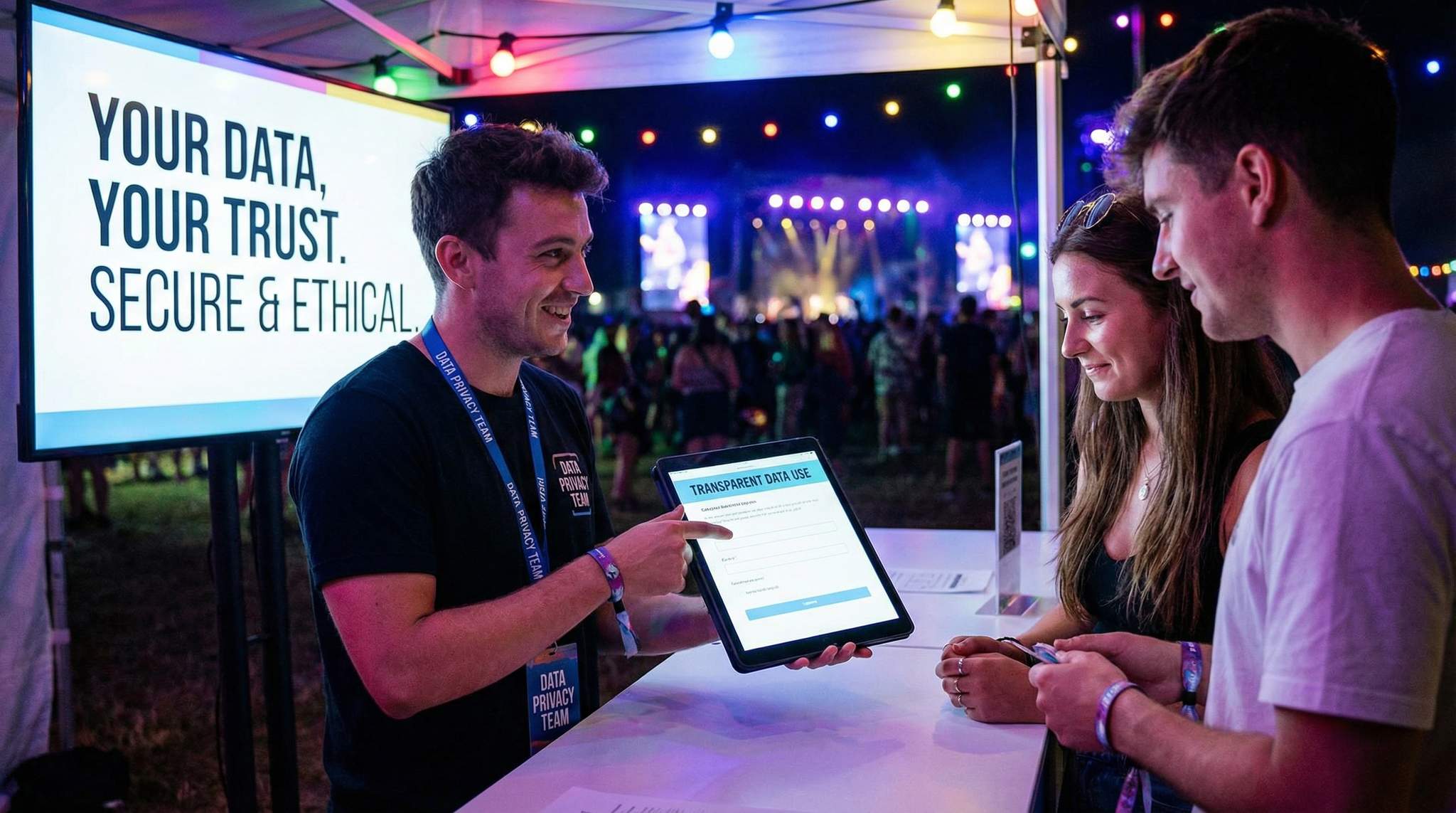
- Be transparent and use plain language: If you do ask for personal data, clearly explain why you need it. Attendees are far more willing to share if they understand the benefit or purpose. For example, Glastonbury Festival requires ticket buyers to submit a photo ID during registration specifically “to prevent touting” (scalping), as detailed in their ticket registration and anti-touting policy. By openly stating this purpose, they turned a potentially intrusive request into a positive feature that fans support, since it keeps tickets fairly distributed. Whenever possible, avoid burying explanations in legalese – instead, use friendly, straightforward language (on forms, FAQs, or signage) to communicate how each piece of data will enhance the attendee’s experience.
- Follow global best practices: Around the world, privacy laws echo the idea of collecting less and explaining more. Europe’s GDPR, for instance, enshrines data minimisation as a principle, and similar regulations from California to Singapore push organisations to justify any personal data they collect. Even if your festival isn’t legally bound by such laws, embracing their spirit is wise. It reassures international attendees (who may be used to strict privacy standards at home) that your event values their privacy. This proactive approach also avoids any nasty surprises if laws tighten in your region – you’ll already be ahead of the curve.
- Real-world tip: Audit your signup forms and data collection points. For each field you ask (name, email, phone, birthday, address, etc.), ask yourself: “How will we use this information to improve the festival or sponsorship outcomes?” If you don’t have a clear answer, consider removing the field. Many savvy events have simplified ticket purchase forms to only essential info, finding it boosts conversion and trust. Tito, a ticketing platform, notes that asking for minimal information upfront not only respects privacy but can also increase ticket sales by reducing friction. The takeaway: lean data collection makes both your attendees and your accountants happier.
Offer Perks for Data (A Fair Exchange)
If you want attendees to voluntarily share more than the bare basics, make it worth their while. Today’s festival-goers are often willing to trade some personal data if they get tangible benefits in return. This is where creativity and understanding your audience come into play – think of perks or exclusive experiences that feel exciting rather than invasive.
- Early entry and VIP treatment: Consider offering early access to the festival or certain stages for fans who opt in to additional data sharing or feedback activities. For example, you might run an online pre-event survey about attendees’ interests; those who complete it could receive a “fast-track” pass to enter the grounds through a shorter line or before general admission. It’s a win-win: you gather valuable insights, and participants feel like insiders. Some festivals have implemented loyalty programs in this vein – Insomniac’s Electric Daisy Carnival (USA) surprised repeat attendees with a special loyalty pre-sale for past festival-goers, giving them first chance to buy tickets and at the best price tiers. By leveraging first-party data (past attendance records) to reward fans, Insomniac both gathered up-to-date contact info and cemented attendee loyalty. The gesture said “we remember and value you,” which goes a long way.
- Exclusive lounges or content: Big festivals often partner with sponsors to create VIP lounges or experiences on-site – why not tie these to data collection in a respectful way? For instance, a festival in Australia or Singapore might collaborate with a beverage sponsor to set up a chilled lounge. Instead of simply charging extra, they could allow access for those who register their wristband and provide some feedback or preferences in the festival app. Attendees who share a bit about themselves (e.g. favourite music genres, or an opt-in to receive updates from the sponsor) gain entry to an air-conditioned lounge with free samples. The attendees enjoy a break from the crowd, the sponsor gains demographic insights and a marketing opt-in, and the festival strengthens its data on attendee preferences. The key is to be clear at the point of collection: “Share X with us and get Y in return.” When fans see immediate value – like a comfy lounge, a free drink, or exclusive merch – they understand why giving data is worthwhile.
- Exclusive content and community perks: Another approach is offering digital perks or content. Many international festivals (from the US to India) use mobile apps or online portals for their community. You can incentivize data sharing by unlocking special content: think exclusive live-streams, behind-the-scenes videos, early lineup announcements, or priority ticket access for future events. For example, a music festival might invite attendees to create a profile on its app and input their top 5 favourite acts. In return, the app could generate a personalised schedule or a playlist featuring those artists, and possibly enter the fan into a draw for a meet-and-greet. This not only gives the attendee a personalised experience, but the festival now knows aggregate data on which artists or genres are most popular among their core fans – immensely useful for planning and sponsor pitches. Always ensure any such program is optional and opt-in; you want fans to feel excited to participate, not forced.
- Keep it ethical: Incentives should feel like bonuses, not coercion. Avoid any practice that feels like you’re holding the event ransom for data (for instance, making essential services conditional on giving more info than necessary). The goal is to build goodwill. When done right, perks for data sharing create a positive feedback loop: attendees see a festival that cares to give them extra value, which builds trust and community. That trust makes them more likely to share data in the future, too. As a mentor might say, always leave your audience feeling they got the better end of the deal. If attendees walk away thinking “Wow, I got that cool perk just for filling a quick survey – sure, I’ll do it again next year,” then you’ve succeeded.
Lock It Down – Security & Privacy are Non-Negotiable
Collecting data is a responsibility. Once attendees entrust you with their personal information, protect it fiercely. Nothing will destroy trust faster than a data breach or careless handling of personal details. Moreover, sponsors and partners are watching – they don’t want their brand associated with a festival known for lax security. Here’s how to make data security and privacy compliance non-negotiable pillars of your festival’s operations:
Turn Fans Into Your Marketing Team
Ticket Fairy's built-in referral rewards system incentivizes attendees to share your event, delivering 15-25% sales boosts and 30x ROI vs paid ads.
- State-of-the-art storage: Ensure that all personal data (names, emails, birthdates, payment info, etc.) is stored securely, encrypted at rest and in transit. Work with reputable tech providers for ticketing and data storage. For instance, if you’re using a ticketing platform like Ticket Fairy, take advantage of its secure infrastructure and enterprise-grade protections rather than, say, keeping spreadsheets of attendee info on a personal laptop. Use strong passwords, enable two-factor authentication on databases and accounts, and limit access to only those staff who genuinely need it. Many major breaches occur because of human error or unnecessary access; a zero-trust mindset internally can prevent mistakes.
- Deletion and retention schedules: Develop a clear data retention policy. Don’t keep personal data longer than needed. If you promise to only use data for the current festival season, then archive or delete it after the event (or after a reasonable period for resolving ticket issues, refunds, or sending post-event surveys). Set schedules to periodically purge old data – for example, delete attendees’ dietary information a month after your food festival ends, or anonymize attendance records from five years ago if they’re only needed for trend analysis. This isn’t just good practice; in some jurisdictions it’s required by law to not retain data indefinitely. Plus, less data stored means less data that can potentially be stolen. If an attendee asks you to remove their information, honour that promptly. Showing respect for user control reinforces trust.
- Vendor audits and strict agreements: Festivals rely on many third-party vendors and tools – maybe a mailing list service, an event app developer, a RFID wristband provider, or a marketing agency. Whenever outside partners handle your attendee data, do your due diligence. Require them to have strong security measures and privacy policies in place. It’s wise to sign Data Processing Agreements (DPAs) with each, specifying how they can use the data, that they must protect it, and that they’ll assist in compliance with any laws. Don’t shy away from asking tough questions: Has the vendor ever had a security breach? How do they encrypt data? Where do they store it (local laws may apply)? Who in their team can access it? If a vendor can’t give good answers, consider it a red flag. Remember, a chain is only as strong as its weakest link. A sobering example: in 2024 Ticketmaster (a large ticketing company) suffered a breach via a third-party services weakness, potentially exposing data of over 500 million customers. Such incidents underscore that even big players can slip up. As a festival organiser, you may not have the resources of Live Nation, but you can certainly demand excellence from any partner you use. Make “privacy by design” a criterion when choosing tech solutions – for instance, prefer a registration app that stores data encrypted on secure servers over one that sends you spreadsheets via email.
- Plan for the worst (and hope for the best): Have an incident response plan for data issues. Just like you’d plan for medical emergencies or weather disasters at a festival, plan for a potential data emergency. Know the steps if a laptop with attendee data is stolen or if you suspect a hack: who will you notify, how will you inform affected attendees, how will you support them and mitigate damage? Transparency is crucial here – hiding a breach usually causes greater backlash later. It’s far better to be upfront and proactive: “We had an issue, here’s what we are doing immediately, here’s how we’ll prevent future incidents, and here’s what you can do.” Being prepared to react swiftly can turn a potential trust-breaker into an opportunity to show your professionalism and care.
Share Insights, Never Identities
Festival sponsors love data – it helps them gauge ROI and learn about the audience they’re reaching. In fact, data and analytics have become a major selling point for sponsorship packages. However, under no circumstances should you hand over raw personal data of your attendees to sponsors or any external party without explicit consent. The ethical (and often legal) approach is to share aggregated insights, not personally identifiable information.
- Aggregate and anonymize: Instead of giving a sponsor your attendee list, provide them with a report of useful stats. For example, you can inform a beverage sponsor that “75% of our 25,000 attendees are between 18–34 years old, and 40% visited the craft beer garden at least once.” Or tell a tech sponsor that “Social media mentions of the festival reached 10 million impressions globally, with top interest coming from Canada, the UK, and Germany.” These kinds of insights are gold to sponsors – they demonstrate the festival’s impact and the audience alignment with the sponsor’s market – but they reveal no personal details of any single attendee. By sharing trends and totals, you preserve privacy while still delivering value. Many festivals create post-event decks or infographics with such data for stakeholders; this not only helps renew sponsors but can also be repurposed as promotional material for next year’s attendees.
- No PII sharing without consent: PII (Personally Identifiable Information) includes names, emails, phone numbers, addresses – any data that can identify an individual. Ethically, this data should remain within the festival’s trusted circle unless an attendee opts in for something specific. If a sponsor activation really needs direct contact with attendees, set it up so that the attendee makes the choice. For instance, a sponsor might run a contest or giveaway asking fans to sign up (thus knowingly providing their email to that sponsor for a chance to win). In such cases, it’s clear to the person what they’re doing. But what you shouldn’t do is quietly hand your entire ticket buyer email list to a sponsor so they can send marketing emails – that would be a breach of trust and likely of law (in many countries it violates anti-spam and privacy regulations). Always ask: would I be okay if my favourite festival randomly gave my personal data to a company to cold-contact me? If the answer is no, don’t do it to your attendees.
- Build partnerships on trust: Some sponsors might pressure you for more granular data – for example, a brand might say, “We’d love to get the contact info of everyone who showed interest in our on-site booth.” It’s tempting to please them, but a savvy festival organizer will find a privacy-respecting solution. Perhaps you can offer to email those attendees on the sponsor’s behalf (“We’ll send a thank-you email to those attendees, and include your special offer link”). Or use a “double opt-in” approach at the booth: attendees scan a QR code that explains they’ll get updates from the sponsor if they proceed. Most reputable sponsors will understand the importance of privacy and not push further if you explain it’s about maintaining attendee trust. In fact, being a festival known for protecting its fans can make you more attractive to high-quality sponsors – they know you won’t land them in a PR fiasco by mishandling data. As a rule of thumb, treat attendee data like community treasure: you can extract insights and even allow controlled access, but you never give away the treasure chest itself.
Trust as a Force Multiplier
In the festival world, trust is currency. The more your audience trusts you, the more likely they are to engage deeply, share information, and become loyal returning attendees. When you implement strong data ethics, you’re not just avoiding problems – you’re actively building a reservoir of goodwill that makes everything easier.
Planning a Festival?
Ticket Fairy's festival ticketing platform handles multi-day passes, RFID wristbands, and complex festival operations.
- Greater fan engagement: Trust makes people more willing to participate. If festival-goers see that you honor their privacy choices and only send relevant communications, they’ll be more inclined to opt into your newsletters or fill out your post-event surveys. Over time, you assemble richer first-party data because your community is willing to share. Consider an attendee who’s been coming for years: if they’ve never been spammed or had a bad experience from giving feedback, by year 5 they might eagerly fill out a detailed survey knowing it genuinely helps shape the event. That detailed feedback loop is incredibly valuable – you learn exactly what different audience segments love or hate, and you can refine the festival accordingly.
- Stronger sponsorship deals: In sponsorship pitches, your festival’s data ethics can be a selling point. How so? Sponsors ultimately want to reach people effectively without backfiring. If you can demonstrate that your audience trusts you (e.g., high opt-in rates for communications, strong participation in festival apps or loyalty programs), sponsors know that any message you deliver on their behalf will be better received. Moreover, you can assure sponsors that you won’t land them in hot water by overstepping privacy boundaries. The result is a more open, collaborative relationship where sponsors feel comfortable investing in activations. They focus on creative ways to integrate with your festival rather than worrying about privacy complaints. Essentially, trust multiplies access – the more trust you earn from your attendees, the more access and insight you can ethically provide to sponsors. And sponsors, seeing robust but anonymized data, will often increase their support, since they can clearly measure outcomes without compromising individual privacy.
- Reputation and word-of-mouth: Festivals live and die by their reputation in the community. News travels fast among fans – both good and bad. If your festival becomes known as one that “really cares about its fans” and treats their data with respect, that can become part of your brand appeal. It’s a competitive advantage. Fans might choose your event over a rival because you’ve demonstrated integrity (just as some might choose one social platform or service over another due to privacy practices). On the flip side, one misstep can do lasting damage. A breach or an outcry over misuse of data could lead to boycotts, negative press, or even sponsors pulling out. Maintaining trust means you avoid those landmines. But beyond avoiding negatives, you actively foster community loyalty – the holy grail for any festival. Loyal fans not only return year after year (driving ticket sales), they also become ambassadors, bringing friends along and hyping your event online.
- Continuous improvement through feedback: When attendees trust you, they’ll give more honest and frequent feedback. This is another underrated benefit of ethical data practices. For example, you might implement a feedback form in your festival app that asks about their favourite moments and any issues. If users know you genuinely listen (because you’ve shown, say, via social media or newsletter, that you acted on last year’s feedback) and that their feedback won’t be public or used against them, they’re more likely to speak up. This creates a virtuous cycle where each year’s event can improve based on candid input. Even negative feedback is a gift if it’s given constructively – and people only bother if they care and trust that you care. In summary, trust isn’t just a warm-and-fuzzy concept; it’s an engine for growth and resilience. It multiplies the opportunities available – be it richer data insight, more enthusiastic sponsors, or a fan community that sticks with you through rainstorms (literal and figurative).