Lasers can transform a music festival stage into a mesmerizing cathedral of light, captivating crowds and creating unforgettable moments. Yet behind the stunning visuals lies a non-negotiable priority: safety. For festival producers, the challenge is delivering jaw-dropping laser effects without endangering anyone or diminishing the wow factor. Fortunately, with the right knowledge and precautions, it’s entirely possible to put on a spectacular laser show that leaves attendees in awe while keeping everyone safe. This guide compiles hard-earned wisdom from veteran festival organizers on how to balance laser show excitement with rigorous safety measures, ensuring your event shines for all the right reasons.
Hire Licensed Operators and Know the Regulations
One of the first steps to a safe and successful laser show is working with licensed and experienced laser operators. Laser display experts come with specialized training and certifications that prepare them to handle high-powered equipment and complex safety protocols. A qualified laser operator (often a Laser Safety Officer in many jurisdictions) will be familiar with calculating safe exposure levels, setting up equipment securely, and complying with local laws. By hiring professionals, a festival producer ensures that the laser equipment is not only used creatively but also correctly — preventing accidents that could harm attendees or staff.
Compliance with local regulations is equally crucial. Different countries have different rules for entertainment lasers. For example, in the United States, any high-powered laser show (especially one that involves audience scanning or outdoor beams) typically requires a variance or special permission from the FDA’s Center for Devices and Radiological Health. In the United Kingdom and Germany, authorities often mandate a permit and a thorough safety assessment before lasers are used at public events. Countries like Canada allow laser shows without prior authorization as long as Maximum Permissible Exposure (MPE) limits are respected, whereas places like Finland outright prohibit scanning lasers directly across an audience. The landscape varies widely: some regions have stringent oversight, while others have minimal regulation. Regardless of where your festival is, always check the local laws and permitting requirements well in advance. Securing all necessary permits or variances not only keeps your event legal, it forces you to document safety measures — a process that can catch potential issues early.
Remember that regulations are just the starting point. Even if local laws are lenient (as in some countries with no specific laser statutes), a responsible festival organizer should impose best-practice safety standards. Being proactive about safety protects your audience and your festival’s reputation. Many top festivals in the world, from Mexico to Singapore, adhere to international safety norms even when not explicitly required. In short: always opt for professional oversight and full compliance. It might require extra budget and paperwork, but it lays the foundation for a worry-free, spectacular show.
Free Tool: Size Your Festival Site
Zoned capacity planning for arena, campsite, parking and entry lanes — against UK Purple Guide and NFPA density standards. Finds your bottleneck zone.
For US-based events, understanding the FDA laser variance process is a critical administrative hurdle. A variance is essentially a legal exemption granted by the Center for Devices and Radiological Health (CDRH) allowing a production company to operate high-powered Class 3B and Class 4 lasers in public. When booking a high-impact DJ laser show, promoters must verify that the contracted laser provider holds a valid, active variance. Operating without this documentation not only risks immediate shutdown by local authorities but also voids event liability insurance. The application process requires detailed equipment specifications and safety protocols, meaning last-minute bookings for festival laser rigs often fail if the paperwork isn’t already in place.
Beyond securing initial permits, maintaining comprehensive on-site documentation is a critical component of managing public laser display compliance. Promoters should ensure their production office holds a detailed risk assessment, a site-specific safety plan, and the lead technician’s credentials. Local authorities, council inspectors, and fire marshals frequently request this paperwork during final pre-show walkthroughs. Having these records readily available proves that your team has proactively addressed potential hazards—from secure beam termination points to crowd control barriers—demonstrating a rigorous commitment to event safety standards.
Planning a Festival?
Ticket Fairy's festival ticketing platform handles multi-day passes, RFID wristbands, and complex festival operations.
Navigating the complex web of safety regulations for public laser displays is a core competency for any modern production team. Whether you are organizing an intimate indoor event or aiming to create the ultimate picture of techno euphoria on a massive outdoor mainstage, the principles of laser light show safety remain the same: protect the audience’s vision at all costs while delivering a high-impact visual experience.
Respect Maximum Permissible Exposure (MPE) Limits
At the heart of laser show safety is a technical concept known as Maximum Permissible Exposure (MPE). MPE is the highest power density of laser light that the human eye (or skin) can be exposed to without likely injury. It’s determined by safety experts and defined in standards like the IEC 60825 and ANSI Z136. For festival producers, the key takeaway is simple: never expose your audience to laser light above the MPE. If lasers will shoot anywhere near the crowd, the beams must be diffused, aimed, or powered such that the exposure remains at or below this safety threshold.
In practical terms, ensuring MPE compliance means carefully calculating or measuring laser output at the closest point where the audience could be hit. Experienced laser operators use tools like laser power meters and software calculations to adjust each effect. They might widen a laser beam (increasing its diameter) or reduce the power output until the intensity is safe for any spectators it might reach. For example, a beam effect that looks stunning 50 meters away might be hazardous at 10 meters; the operator can use optics to broaden that beam close-up, making it eye-safe while still looking bright in the air. An essential practice is performing these measurements during setup and rehearsals – long before attendees arrive – to verify that no beam, static or scanning, exceeds the safety limit at any audience position.
To fully grasp these safety thresholds, promoters often need to understand how laser light shows work on a technical level. Modern entertainment lasers utilize high-speed optical scanners—tiny, motorized mirrors called galvanometers—that rapidly direct the beam to draw shapes and aerial effects. Because the beam is constantly moving, the energy dispersed over any single point is drastically reduced, which is fundamental to maintaining safe exposure levels. If these scanners fail and the beam stops moving, built-in safety interlocks immediately shutter the light to prevent a hazardous static beam from striking the crowd.
Free Tool: Project Your Bar Revenue
Per-head spend benchmarks by event type turned into projected bar and food revenue, with a stock-mix estimate and gross-margin line. Free calculator.
Respecting MPE limits is not just theoretical; it has real consequences. There have been instances where ignoring MPE led to serious injuries. A notorious case occurred in 2008 at a music festival near Moscow, where an improperly configured laser (intended for outdoor use only) was aimed into the crowd under a rain tent. Dozens of attendees suffered eye damage because the beams far exceeded safe levels. Such incidents underscore that MPE limits are non-negotiable – no thrill is worth permanent injury to a fan. By respecting these limits, you ensure that everyone in the crowd can enjoy the stunning visuals without risk, maintaining trust and avoiding legal liabilities.
Set Clear Audience-Scanning Policies
Many electronic music festivals boast dramatic moments where laser beams sweep over the dancing crowd, creating a feeling of total immersion. This effect, known as audience scanning (directing lasers into or over the audience area), can wow attendees – but it must be handled with extreme care. Festival organizers should set a clear policy: either no audience scanning at all, or only do it under strict conditions that guarantee safety. There’s nothing wrong with deciding not to scan the crowd and instead aiming all lasers overhead or onto stage elements; you can still deliver an amazing show with overhead tunnels, sweeps, and graphics. In fact, many world-class festivals choose to keep lasers above eye level unless they’re 100% confident in safety measures.
Need Festival Funding?
Get the capital you need to book headliners, secure venues, and scale your festival production.
If you do incorporate audience scanning, plan it meticulously. Ensure that only continuous-wave (non-pulsed) lasers are used for any effect that might hit the audience – pulsed lasers, such as certain high-power YAG systems, should never be directed at people. Keep the beams moving constantly; a static beam into the crowd is far more dangerous than a fast-moving one because a moving beam greatly reduces exposure time on any one retina. Design your show with wide beam divergence for crowd scans (fatter beams are safer for eyes than tight, small-diameter beams). Modern laser controllers often allow you to set scan safety zones or “attenuation maps,” which automatically dim or shutter the laser output in predefined areas (like where the audience is) to keep exposure levels safe. Utilize these tools so that even if a beam crosses into the audience, it’s been effectively tamed to meet the safety limits.
Communicate your audience scanning policy to the entire production team. The lighting designer, laser operator, and show director should all be aligned on what’s allowed. For instance, if the agreement is “no direct audience scans,” then programming will focus on effects that stop short of the crowd or go high overhead. If limited audience scanning is permitted, ensure spotters or the laser operator continuously monitor that the crowd stays an appropriate distance away (no one climbing on speakers or stage where they could get closer to the lasers). Consider announcing to your audience that your show uses lasers and include standard warnings not to stare directly at laser emitters. While a properly executed show should keep beams eye-safe, it’s wise to remind attendees of basic caution — especially in environments where excitement (and perhaps intoxication) is high.
In essence, treat audience scanning as a privilege that comes with great responsibility. When done right, it can envelop your festival-goers in light and color, amplifying the music’s energy. But it’s never a feature to improvise or take lightly; set firm guidelines ahead of time, and stick to them throughout the event.
Plan for Emergencies: Blackout Cues and E-Stop Protocols
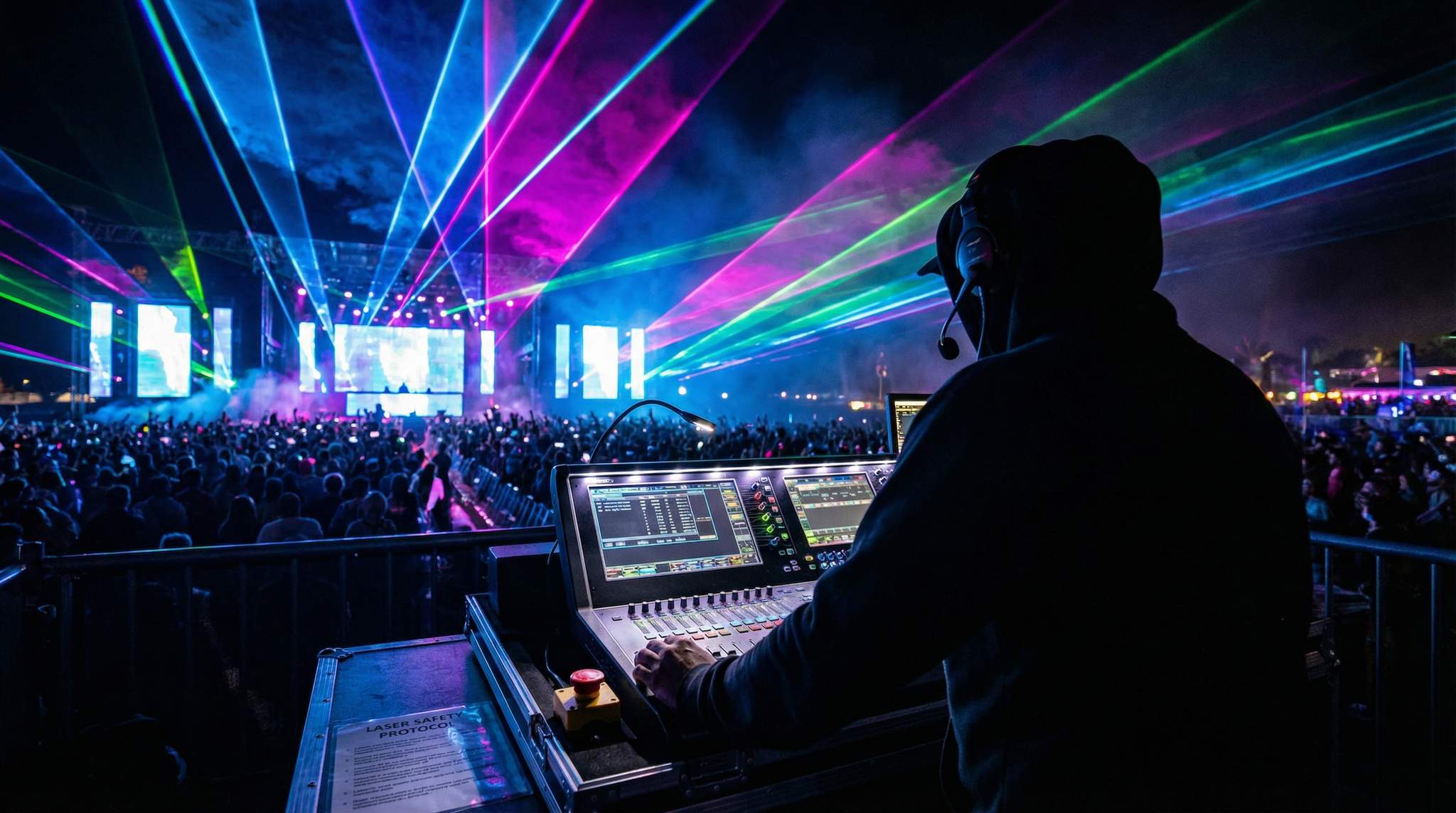
No matter how well you plan, live events always carry a chance of the unexpected — and lasers are no exception. That’s why every festival using lasers should have clearly defined emergency shutdown procedures. In the laser production world, this often means having a big red “E-stop” button (emergency stop) that cuts power to all lasers instantly. Ensure that your laser operator sets up multiple E-stop controls: typically one at the control station (where the laser tech is located) and possibly additional remote stop buttons positioned in strategic spots (side of stage, front of house, etc.) in case someone needs to kill the lasers quickly.
Establish with your team what the blackout cues are — the signals or conditions under which all lasers go dark immediately. For example, if any person or object unexpectedly enters a laser projection zone (like an acrobat, a stray drone, or an audience member who climbed into a restricted area), the operator should be empowered to hit the blackout cue without waiting for approval. Similarly, if a technical malfunction occurs (such as a laser projector misaligning or a beam that isn’t moving when it should), the show must be paused and lasers turned off until it’s resolved. It’s better to have a brief pause in the visuals than to risk an injury.
Coordination with the broader production team is also vital here. The show caller or stage manager should include laser shutoff scenarios in the overall emergency plan. For instance, if there’s a fire alarm, power outage, or crowd surge, lasers should default to off so as not to distract or complicate emergency lighting. Some festivals rehearse emergency cues during soundcheck or production rehearsals: the team practices how to go full blackout on lasers (and possibly other effects) on a cue, so everyone knows how to react calmly if something goes wrong during the live show. This kind of drill ensures that in a real crisis, safety actions happen smoothly even under pressure.
Finally, make sure all key staff know who has the authority to trigger a laser shutdown. Usually the laser operator will do it immediately if they see a hazard, but security personnel, stage managers, or even performers should know to alert the operator or hit an E-stop if they’re in a position to see something the operator can’t. When the entire team understands that safety comes before showmanship, they’ll back the decision to cut lasers if needed — and you can always resume the spectacle once the all-clear is given. Having this safety net in place means you can run an ambitious show with confidence that you’re prepared for the worst-case scenarios.
Enhance the Effect with Haze, Not Smoke Out the Crowd
A laser show’s brilliance is only visible when there are particles in the air for the beams to illuminate. This is where haze and fog machines come into play. Proper use of haze can dramatically enhance laser effects, transforming mere rays into luminous shafts of color that fill the venue. However, striking the right balance is crucial: you want enough haze to make your lasers pop, but not so much that it chokes your audience or obscures their view of the stage and exits.
Coordinate closely between your laser operators and the techs handling haze or fog machines. They should time and dose the haze output to coincide with laser cues. For instance, in a big drop during a DJ’s set where a forest of laser beams will erupt, you might schedule a haze burst beforehand so the air is primed. In contrast, during moments without lasers, you can give the haze a chance to dissipate a bit. This coordination prevents over-saturating the air. It’s also wise to account for airflow and ventilation: in an indoor venue, know the HVAC system’s behavior (where air currents might push the haze), and in outdoor settings consider the wind direction and speed. Strategically placing haze machines (e.g., upwind of the stage) can ensure the mist drifts through the light paths without blowing away too quickly or pooling in one spot.
Just as importantly, choose the right type of atmospheric effect. Haze (producing a fine, long-lasting mist) is usually preferable to thick fog for laser shows, because haze can hang in the air uniformly, making beams visible without creating clouds of smoke. Too much fog can create dense clouds that actually block lasers in patches and can momentarily blind or discomfort your attendees. Always use non-toxic, event-approved haze fluids — many festivals use water-based haze to avoid irritating attendees’ lungs (and to prevent residue on equipment or venue surfaces). If your event is indoors, communicate with the venue about disabling or modifying smoke alarm sensors for the duration of the show if needed (and get any necessary fire marshal approvals). There’s nothing worse than the fire alarm triggering mid-show because the haze set it off!
In summary, haze is the secret sauce that makes laser shows come alive. Deployed thoughtfully, it can significantly boost the wow factor of your lasers. By managing haze output and airflow carefully, you ensure the beams are crisp and bright without compromising air quality or safety. Your audience will be dazzled by the light show—not coughing or squinting through clouds of smoke.
Integrating 3D Volumetric Effects into Your Production
As production values escalate, many promoters are looking beyond standard flat beam projections to incorporate a fully immersive 3D laser light show. For a modern music festival, this means utilizing advanced software and high-speed scanners to create volumetric shapes—like floating pyramids, rotating cones, and complex geometric tunnels—that appear to hover in mid-air above the crowd. Designing a cutting-edge laser show for a music festival requires close collaboration between your visual director and the laser technicians to ensure these three-dimensional effects sync perfectly with video wall content and lighting cues. When deploying these advanced festival lasers, the same rigorous safety standards apply; however, the spatial complexity of 3D projections means your safety zones and attenuation maps must be mapped with even greater precision to account for beams intersecting at multiple angles.
Tailor the Laser Setup to Your Venue and Crowd
A laser effect that is safe and stunning in one context could be inappropriate in another, so it’s important to tailor your laser setup to the venue size and audience environment. In a smaller indoor venue or a low-ceiling warehouse rave, high-powered lasers need extra caution—beams can hit walls and reflect unexpectedly, and the audience is much closer to the sources. Here, you might opt for lower wattage lasers, mount them at higher points away from direct eye level, and use effects like liquid skies (fan-shaped beams over heads) instead of intense beam blasts into the crowd. On the other hand, for a massive outdoor festival stage, you have the freedom to use more powerful lasers that project over long distances, but you must then think about terminating those beams safely. Outdoors, lasers that shoot into open sky should be coordinated with aviation authorities if there’s any chance they reach flight paths, as well as mindful of neighboring areas (you don’t want to inadvertently illuminate someone’s house or a distant road). High-reaching beams are spectacular at events like desert or beach festivals, but checking with local civil aviation on any required notice (for example, filing a notice to airmen in the U.S. or contacting the local airport as is recommended in Australia) is a responsible step if your lasers point upward beyond your site.
Producing an outdoor laser light show introduces environmental variables that indoor venues simply don’t face. Wind can instantly strip away your carefully placed haze, while rain can damage sensitive projector housings. Furthermore, organizers frequently have to manage conflicting special effects. A common production question is whether lasers can stop fireworks or interfere with pyrotechnics. While a laser beam cannot physically stop a firework from detonating, the dense, opaque smoke generated by heavy pyro will completely swallow your laser effects, effectively ruining the visual. Additionally, high-powered beams must never be aimed directly at unexploded pyrotechnic rigging or drone swarms, as the intense heat could theoretically trigger a misfire or damage optical sensors. Always schedule your laser-heavy DJ sets and major pyro moments carefully to avoid these atmospheric clashes.
When mapping out an outdoor laser light show, festival producers must also account for ambient light pollution and site topography. Unlike a dark indoor arena, an open-air festival stage competes with sunset hours, illuminated vendor tents, and stadium-style floodlights. To ensure your festival lasers cut through the night sky effectively, coordinate with your site operations team to minimize competing light sources near the mainstage viewing area. Additionally, consider how the natural landscape—such as natural amphitheaters, tree lines, or nearby bodies of water—can serve as safe, stunning backdrops for high-powered beam termination.
Understanding your audience is another facet of tailoring the show. A family-friendly festival or cultural event might warrant more conservative laser usage (both in patterns and intensity), whereas an underground EDM night might encourage more daring effects (still safe, but perhaps more enveloping and intense). Always gauge crowd demographics and behavior: are attendees likely to be very young, or perhaps more likely to have sensitivities? In such cases, you might limit the duration of intense strobing laser effects or provide more breaks between high-impact sequences. For crowds that are on their feet dancing all night (like at a trance music festival), you can sustain longer laser segments, but be cautious of visual fatigue — even without safety breaches, too much visual stimulus without pause can overwhelm some people.
Also consider the stage design and other production elements. Reflective surfaces like giant disco balls, mirrored panels, or LED screens can bounce laser beams in unplanned directions. Work with your lighting team to position lasers so that any reflections go to safe zones (for example, shooting a laser at a mirror ball can scatter beams everywhere, so those lasers must be kept at low power or high divergence, or maybe avoided unless calculated safe). Cover or flag any shiny surfaces during rehearsals to see if they create hazardous reflections and adjust accordingly. Mount all laser projectors securely, ideally on truss or solid platforms that cannot be jostled by crew or high winds. Before gates open, double-check that all laser fixtures are tightly locked in position and match the approved design, so nothing has drifted off course to point at unwanted areas.
By customizing your approach to the venue and audience, you prevent many problems before they arise. Each festival site – whether a grassy field, an urban park, a stadium, or a cruise ship – comes with unique challenges for laser use. Through careful planning and site visits, identify any potential hazards (like an overhanging roof, an audience balcony, or even shiny art installations on the grounds) and address them in your laser show design. This level of diligence ensures that your lasers integrate seamlessly into the overall event, enhancing the atmosphere in a way that is as safe as it is sensational.
Organizers transitioning from other entertainment sectors often ask how festival environments differ from traditional indoor venues, or specifically, what is a laser show in theatre contexts compared to a festival stage? In a theatrical setting, laser displays are typically highly choreographed to a fixed script with strictly controlled audience seating, making safety zones easier to enforce. Festival lasers, however, must account for unpredictable crowd movement, changing weather conditions, and dynamic live DJ sets, requiring a much more adaptable and robust safety strategy.
Frequently Asked Questions
What is Maximum Permissible Exposure (MPE) in laser safety?
Maximum Permissible Exposure (MPE) is the highest power density of laser light that the human eye or skin can withstand without injury. Festival organizers must ensure that no laser beam exceeds this threshold at any point where the audience is present. Operators often widen beams or reduce power to maintain safe intensity levels for spectators.
How can festivals perform audience scanning safely?
Audience scanning requires using continuous-wave lasers rather than pulsed systems to prevent eye damage. Operators must keep beams moving constantly to reduce exposure time on the retina and utilize wide beam divergence for safety. Modern laser controllers also employ attenuation maps to automatically dim or shutter output in specific zones where the crowd is located.
Why is haze preferred over fog for laser shows?
Haze creates a fine, long-lasting mist that allows laser beams to appear as luminous shafts without obscuring visibility like thick fog. Uniform haze distribution ensures beams remain crisp and bright without forming dense clouds that block light or irritate attendees. Water-based haze fluids are typically used to avoid residue and maintain air quality.
What emergency protocols are required for laser shows?
Laser shows must include emergency stop (E-stop) buttons at the control station and strategic locations to cut power instantly. Operators need defined blackout cues to shut down lasers immediately if a person enters a restricted zone or a technical malfunction occurs. These protocols should be integrated into the festival’s broader emergency response plan.
Do laser shows require special permits or variances?
Regulations vary by country, with the United States requiring a variance from the FDA for high-powered shows and nations like Germany mandating permits and safety assessments. While some regions like Canada focus on adherence to exposure limits rather than prior authorization, organizers must always check local laws and secure necessary paperwork well in advance.
How should laser setups be adjusted for outdoor festivals?
Outdoor festivals allow for more powerful lasers but require strict beam termination to avoid hitting aircraft or neighboring properties. Organizers must coordinate with civil aviation authorities if beams project into the sky. Additionally, wind speed and direction must be monitored to position haze machines effectively, ensuring the atmospheric effects remain visible to the audience.
What are the core principles of laser light show safety?
The foundation of laser light show safety involves adhering to Maximum Permissible Exposure (MPE) limits, securing necessary permits, and employing certified operators. Safety regulations for public laser displays dictate that beams must never expose the audience to hazardous radiation levels, requiring meticulous planning, secure rigging, and reliable emergency stop protocols.
How does a laser show in theatre differ from a festival environment?
A laser show in theatre typically operates within a highly controlled environment with fixed seating, predictable audience behavior, and a strictly choreographed script. In contrast, festival laser productions must adapt to dynamic crowd movements, changing outdoor weather conditions, and live, unscripted DJ sets. Consequently, outdoor and large-scale public events require much more adaptable safety strategies, wider clearance zones, and robust emergency stop protocols to maintain compliance.
What is an FDA laser variance?
An FDA laser variance is a legal permission granted by the Center for Devices and Radiological Health (CDRH) that allows operators to use high-powered Class 3B and Class 4 lasers in public settings. Event organizers must ensure their laser providers hold an active variance to legally and safely operate at a festival.
How do laser light shows work technically?
Entertainment lasers use high-speed motorized mirrors, known as galvanometers, to rapidly move a concentrated beam of light, creating shapes and aerial effects. This constant movement disperses the light’s energy, which is a critical mechanism for keeping the visual display within safe exposure limits for the audience.
Can lasers interfere with fireworks at an outdoor event?
While lasers cannot physically stop fireworks from launching, the thick smoke produced by pyrotechnics can completely obscure an outdoor laser light show. Additionally, safety protocols dictate that high-powered beams should never be directed at loaded pyro rigging or aerial drones to prevent accidental heating or sensor damage.
What is a 3D laser light show in a festival context?
A 3D laser light show utilizes advanced high-speed scanners and atmospheric haze to project volumetric shapes, such as floating geometric tunnels and rotating cones, that appear three-dimensional in mid-air. For a music festival, these immersive effects require precise spatial mapping and attenuation to ensure intersecting beams remain safely above the audience’s maximum permissible exposure limits.
What are the main logistical challenges of producing an outdoor laser light show?
Producing an outdoor laser light show requires managing unpredictable environmental factors like wind, which disperses atmospheric haze, and rain, which necessitates weatherproof projector housings. Festival organizers must also secure proper aviation clearances for skyward beams and coordinate site lighting to prevent ambient light pollution from washing out the visual effects.