Every festival producer knows that a stage is far more than a mere platform for performances – it’s a towering temporary structure that must be as safe as any building. When tens of thousands of festival-goers are dancing under a festival stage roof, their safety depends on meticulous engineering and uncompromising safety protocols. History has shown the devastating consequences when these principles aren’t followed. From collapsed stages in sudden storms to near-misses averted by decisive action, the lessons are clear: treat your festival stage like the critical structure it is.
This guide shares veteran insights into stage engineering and load paths – the invisible forces that keep stages standing. It covers why certified engineers and rigorous inspections are non-negotiable in festival production, how to respect wind ratings and ground limits, and what protocols keep both crew and crowds safe. Whether you’re building a cozy boutique festival stage or a massive main stage for a large-scale festival, these practices apply universally.
Engineering and Load Paths: Treating Stages Like Buildings
A festival stage may be temporary, but it must withstand the same fundamental forces as a permanent building – gravity, wind, and weather. Engineering and load paths refer to how a structure carries weight (like equipment and people) and resists lateral forces (like wind or crowd movement) down to the ground. In practical terms, this means every truss, tower, and ballast weight on your stage is part of a carefully designed system to channel loads safely to the earth.
Engage certified structural engineers early in the design phase to ensure your stage’s load paths are sound. Professional engineers will calculate the stage’s capacity: how much weight the roof can hold, how strong the trusses need to be, and how the structure should be stabilized. For example, major festivals like Glastonbury (UK) and Rock in Rio (Brazil) work with experienced staging companies and engineers who design stages to handle enormous audio, lighting, and scenic loads. These engineers produce detailed drawings and stress calculations that account for every component – from the size of steel beams to the number of ground anchors or ballast blocks required. All stage designs, especially custom or large-scale ones, should have an engineer’s stamp of approval and meet local building codes or event safety guidelines. In the UK, for instance, events follow guidance like the Institution of Structural Engineers’ “Temporary Demountable Structures” code and the Purple Guide for event safety, which insist on proper design and sign-off for stages.
Free Tool: Size Your Festival Site
Zoned capacity planning for arena, campsite, parking and entry lanes — against UK Purple Guide and NFPA density standards. Finds your bottleneck zone.
Engineering load paths also means planning for how additional elements affect the structure. If you plan to hang extra LED screens, art pieces, or elaborate decor on a stage roof, these loads must be accounted for in the design. A veteran festival producer would advise: never “just add” anything to a stage structure without consulting the engineer or the staging supplier. An infamous example is the 2012 stage collapse before a Radiohead concert in Toronto, where the roof design was later found to be flawed and some parts weren’t built to spec. That tragedy, which killed a technician, underlined that only a properly engineered and executed design is acceptable – any deviation or improvisation can be deadly.
Proper stage loading is a critical component of this planning process. When production teams discuss stage loading, they are referring to the strategic distribution of both static weights (like LED walls, PA hangs, and lighting rigs) and dynamic forces (such as moving set pieces or high-energy performer movements) across the deck and roof grid. An unevenly loaded structure can create dangerous stress points, even if the total weight falls under the maximum capacity. To manage this, staging supervisors enforce strict rigging plots and weight distribution plans, ensuring that every piece of equipment is hung exactly where the structural engineer intended.
Planning a Festival?
Ticket Fairy's festival ticketing platform handles multi-day passes, RFID wristbands, and complex festival operations.
In contrast, festivals with complex stages like Tomorrowland (Belgium) ensure that even fantastical stage designs (castle facades, giant moving props) are built on a strong engineered framework provided by professional stage builders (e.g. Stageco). They adhere strictly to the engineer-approved plans, knowing the structure’s integrity is literally holding up the show. Tomorrowland’s strict adherence to engineering advice has allowed it to create jaw-dropping stages year after year without compromising safety.
Engage Certified Engineers for Design and Sign-off
One of the golden rules of festival production is: always have a certified engineer design and sign off on your stage structures. This rule is non-negotiable for large-scale festivals. Whether you’re using an off-the-shelf stage roof system or a custom-built mega-stage, a licensed structural engineer (or a certified staging expert) should review and approve the plans. This typically includes verifying the structure’s load capacity, stability under various conditions, and compliance with safety standards.
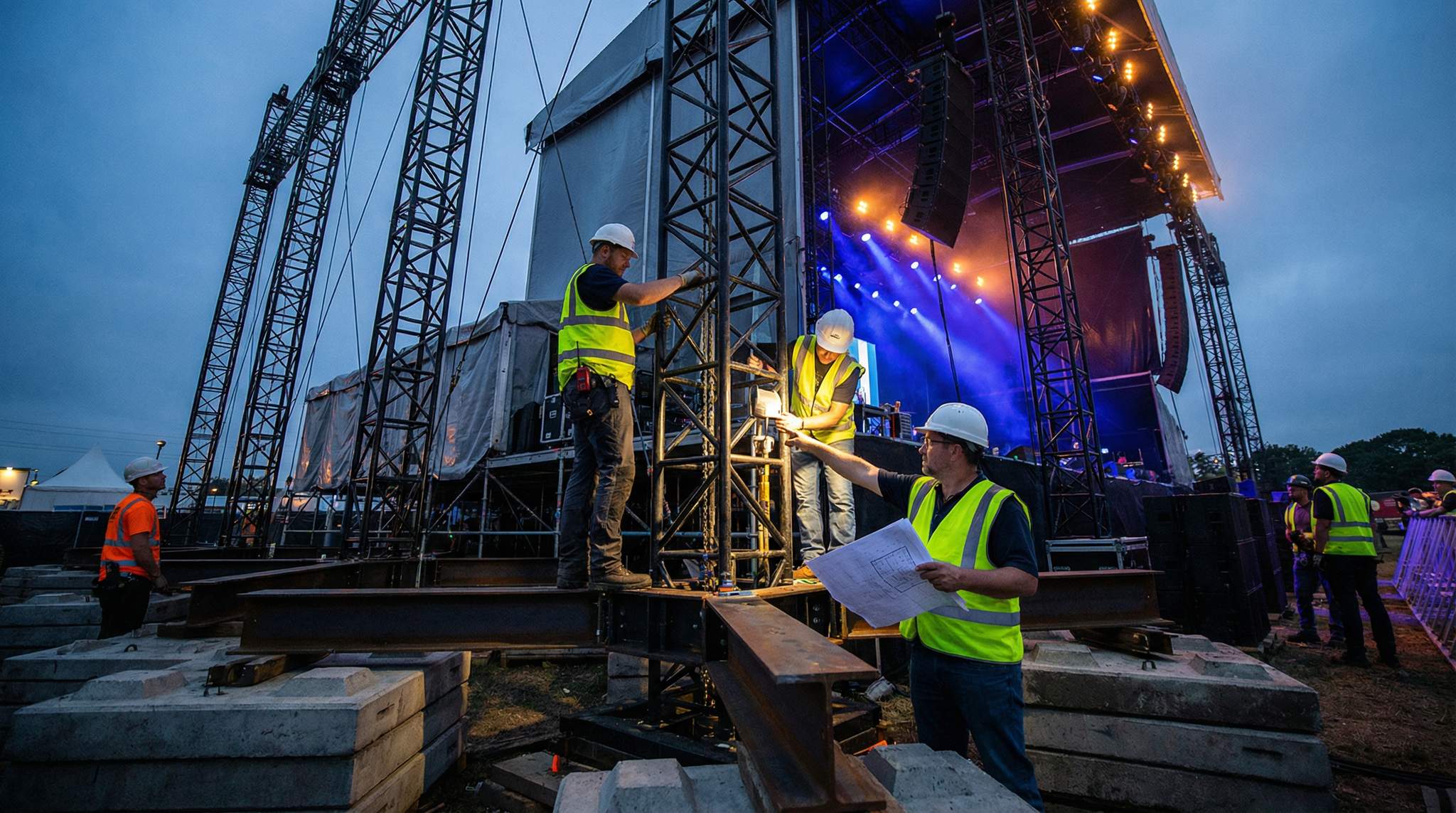
For large festival stages, the process often involves multiple checkpoints. First, during planning, an engineer will produce or vet the structural drawings. Then during the build on-site, the staging company’s engineer or a third-party engineer will inspect the erected structure. They check that all bracings, pins, and supports are in place per the design. Only after this thorough check will they issue a certificate of completion or structural safety certificate. As a festival organiser, ensure you receive this sign-off document and keep it on file (and visible on site if possible). Some production teams literally tape a copy of the structural certificate inside the production office or at the stage entrance – a constant reminder that the stage has been built to spec and is being monitored. It’s also there in case local authorities or safety inspectors want immediate proof of compliance.
Engaging engineers also brings valuable expertise to your production. For example, the producers of Bonnaroo (USA) and Splendour in the Grass (Australia) have spoken about consulting engineers to adapt stage designs to their unique sites – Bonnaroo’s main stage sits on a farm field that can get muddy, and Splendour’s coastal location can face high winds. In each case, engineers recommended specific solutions (like additional ground reinforcement, extra bracing, or higher-rated hardware) to ensure stages remained safe.
Free Tool: Project Your Bar Revenue
Per-head spend benchmarks by event type turned into projected bar and food revenue, with a stock-mix estimate and gross-margin line. Free calculator.
These upfront investments in engineering might increase costs, but they pale in comparison to the cost of a structural failure. The Indiana State Fair stage collapse in 2011 – caused by a severe wind gust hitting an inadequately secured stage – led not only to tragic deaths but also multimillion-dollar legal consequences and new laws in Indiana. Many U.S. festivals drew lessons from that incident: today, you’ll find engineers and safety officials working hand-in-hand at major events like Lollapalooza and Coachella to prevent such scenarios.
In short, never try to cut corners by skipping professional engineering. Treat your stage budget as a life-safety investment. There’s a saying seasoned producers use: “If it’s not signed off, it’s not going up.” Live by that rule.
Need Festival Funding?
Get the capital you need to book headliners, secure venues, and scale your festival production.
Selecting Staging Companies and Festival Set Engineering Services
When newer promoters ask who builds the stages at festivals, the answer goes far beyond a standard construction crew. The industry relies on specialized staging companies and dedicated festival set engineering services. These firms provide the heavy-duty truss systems, scaffolding, and custom fabrication required for a modern music festival stage. As a producer, your job isn’t to figure out how to build a stage from scratch, but rather to procure the right partners who specialize in temporary demountable structures. Look for vendors with a proven track record in live events, comprehensive liability insurance, and an in-house roster of certified riggers and structural engineers. Partnering with top-tier staging professionals ensures that your creative vision is executed safely, efficiently, and fully compliant with local regulations.
When considering how to build a stage that meets global safety standards, remember that the main performance area is just one piece of the puzzle. Modern event sites are essentially pop-up cities filled with various temporary festival structures. From multi-story VIP viewing platforms and front-of-house (FOH) mix towers to massive brand activation pavilions and delay tower arrays, every single one of these builds requires the same rigorous oversight as your primary music festival stage. Building stages for concerts and large-scale outdoor events means coordinating with your staging partners to ensure that all secondary structures are engineered, ballasted, and signed off with the exact same scrutiny as the main roof.
When planning stages for festivals of a massive scale—often referred to internationally as mega-stages or very large stages—the festival stage construction process becomes a multi-week logistical operation. Erecting a colossal festival structure requires phased load-ins, where the steel sub-structure is built and inspected days before the audio, video, and lighting teams even arrive on site. As a producer, mapping out this construction timeline with your staging partners is just as critical as the engineering itself, ensuring no trade overlaps dangerously during the build.
Core Deliverables of Specialized Engineering Partners
When you contract dedicated festival set engineering professionals, you are securing a comprehensive suite of technical deliverables that go far beyond basic scaffolding rental. These experts typically provide 3D structural modeling, dynamic wind load simulations, and custom fabrication blueprints tailored to your specific site topography. For organizers planning mega-structures—often conceptualized globally as very large stages—this level of detailed structural drafting is mandatory. It ensures that massive scenic facades, heavy LED volumes, and complex rigging grids are perfectly integrated into the temporary framework without compromising the safety of the established load paths.
Boost Revenue With Smart Upsells
Sell merchandise, VIP upgrades, parking passes, and add-ons during checkout and via post-purchase emails. Increase average order value by up to 220%.
Choosing the Right Festival Structure for Your Event’s Scale
Selecting the appropriate festival structure is a foundational decision that dictates your entire production timeline, budget, and site layout. For boutique gatherings, a pre-engineered mobile stage might suffice, offering rapid deployment and built-in weather protection. However, as your capacity grows, so do your structural requirements. Transitioning to custom scaffolding and heavy-duty truss systems allows for the massive weight capacities needed to support extensive LED arrays, immersive scenic designs, and complex audio hangs. When dealing with very large stages—often requiring hundreds of tons of steel—the procurement process must begin months in advance. Every temporary edifice on your site, from the towering main stage to the VIP viewing decks, must be evaluated not just for its aesthetic impact, but for its structural integrity and integration into the overall site topography.
Stage Building Logistics: Coordinating the Build Phase
The actual phase of stage building transforms your serene festival site into a high-risk, heavy-duty construction zone. When overseeing the process of building stages for concerts, a producer must meticulously sequence the arrival of different trades. The steel crew always goes first, erecting the primary festival structure and securing the ballast. Only after the structural engineer has signed off on this initial framework should the production teams—audio, lighting, and video—be allowed to commence their rigging. Effective concert stage construction requires strict site management, including designated lanes for heavy plant machinery like cranes and telehandlers, to ensure that the build progresses safely and efficiently without bottlenecking other festival infrastructure projects.
Step-by-Step: Constructing a Temporary Music Stage
For promoters and production managers tasked with figuring out how to build a temp music stage safely, the process is rooted in strict project phasing rather than DIY assembly. Constructing a short-term performance structure begins weeks before the first piece of steel arrives. First, the site must be surveyed and marked, ensuring the ground bearing capacity meets the engineer’s specifications. Next comes the base layer: laying down trackway for heavy machinery and positioning the initial ballast blocks or ground anchors. Once the foundation is secure, the staging vendor’s steel crew erects the primary sub-structure and roof grid. Crucially, no production elements—such as PA hangs, lighting trusses, or LED walls—can be loaded until an independent structural engineer has physically inspected the framework and issued a formal sign-off. Only then does the production load-in commence, transforming the bare scaffolding into a fully functional music festival stage.
Best Practices for Using Temporary Structures at Music Festivals
When overseeing site-wide festival construction, producers must look beyond the main performance area. Implementing best practices for using temporary structures at music festivals ensures that every pop-up element—from VIP hospitality decks and brand activation tents to merchandise pavilions and delay towers—meets the same rigorous safety standards as your primary music festival stage. First, establish a unified site grid and construction schedule to prevent heavy machinery bottlenecks during load-in. Second, mandate that all third-party vendors submit structural calculations and wind-action plans for their specific temporary builds before arriving on site. Finally, appoint a dedicated site safety manager whose sole responsibility is to monitor the integrity of these secondary structures, ensuring they are properly ballasted and anchored according to the overarching engineering plan.
Site-Wide Festival Construction Management
Treating your event grounds as an active, multi-zone building site is the cornerstone of safe festival construction. Beyond the primary performance areas, a comprehensive build plan must account for the simultaneous erection of perimeter fencing, heavy-duty trackway installation, and temporary power distribution networks. As a producer, you are essentially acting as a general contractor for a pop-up city. This requires implementing strict site safety protocols, including mandatory inductions for all crew members, designated heavy machinery routes, and clear separation between pedestrian walkways and forklift traffic. Effective construction management ensures that the myriad of vendors—from scaffolding crews to sanitation providers—can operate concurrently without compromising the structural integrity of the site or the safety of the workforce.
Respect Wind Ratings, Ballast and Ground Bearing Limits
Weather, especially wind, is the ultimate stress test for any festival stage. Every outdoor stage structure has defined wind load ratings – the maximum wind speed (often given in km/h or mph) it can withstand before becoming unstable. As the event organiser, you must know these ratings and respect them unwaveringly. For example, a typical large mobile stage or truss roof might be rated around 65–80 km/h (40–50 mph) sustained winds with all walls and banners attached. Exceeding that, the structure could start to fail. Always ask your staging supplier or engineer: “What’s the max wind speed for this stage, and what are the protocols at various wind speeds?”
Free Tool: When Should You Announce?
Pick your event date and genre — the free planner outputs a recommended announce, presale, on-sale and reminder schedule anchored to how your audience actually buys.
Armed with that data, implement a weather monitoring plan. Use reliable weather forecasting and on-site wind meters (anemometers) to track conditions.
Many festivals have adopted tiered wind action plans. For example:
– Around 30 mph (50 km/h) winds: Stop performances and lower any raised lighting or video walls to reduce wind exposure.
– Around 40 mph (65 km/h) winds: Immediately evacuate the stage and nearby areas; consider lowering the stage roof if the design allows it.
– Above 50 mph (80 km/h) winds: Clear the audience from the vicinity. Do not attempt to use or dismantle the stage until the storm subsides; focus on securing equipment and keeping people safe.
These thresholds depend on the specific structure’s engineering, but the key is to have them decided in advance in consultation with your engineer. Never push your luck when high winds approach – history shows the risk is not worth it. The Ottawa Bluesfest in Canada (2011) saw its stage collapse under a sudden 117 km/h gust; thankfully no lives were lost there, but only because the area was cleared minutes before. Similarly, in 2019 a severe storm at Ultra Music Festival (USA) prompted crews to power down stages and secure equipment, avoiding disaster. Contrast those with unfortunate cases like the Medusa Festival in Spain (2022), where an unexpected wind burst over 80 km/h hit the main stage structure, causing a partial collapse that killed one attendee and injured many. The lesson is painfully clear: respect the wind limits – nature doesn’t negotiate.
Along with wind, pay strict attention to ballast and ground bearing capacity. Ballast refers to the weights (such as concrete blocks, water tanks, or metal plates) used to anchor the stage structure and keep it from lifting or tipping in wind. Your stage’s engineering will specify how many tonnes of ballast are required and exactly how they should be placed or attached. It is crucial not only to have the correct amount of ballast but also to ensure it’s secured (e.g. strapped or bolted) as per design. There have been incidents where heavy winds simply slid loose ballast blocks, effectively un-anchoring the stage. For example, investigators found that some ballast at the Indiana State Fair stage was insufficient or shifted, contributing to the collapse. The fix: always use the proper ballast configuration and never remove or relocate ballast without an engineer’s approval (even if you need to make space backstage – don’t do it!).
Ground bearing pressure is another often overlooked factor, especially for large stages on soft ground. Simply put, the soil beneath your stage must support the tremendous weight of the structure, the ballast, and all the gear on top. If the ground is too soft (imagine a water-logged field or sandy beach), the support legs or ballast could sink unevenly, causing the structure to shift or lean.
Festival producers learned this at muddy events like Glastonbury and the infamous Woodstock ’94, where ground reinforcement became essential. To respect ground bearing limits, consult a geotechnical report if available or have your engineer gauge the site soil.
Solutions can include:
– Spread the load by placing steel base plates or mats under stage legs and towers to increase the contact area.
– Use outriggers or additional support legs to better distribute the weight and stabilise the structure.
– Relocate or redesign the stage placement onto firmer ground if a particular spot cannot handle the load.
Remember, a massive stage can weigh tens of tonnes concentrated on only a few points – those points must be solid. Savvy festival teams have contingency plans for poor ground conditions (for example, having extra mats and supports on hand if the site turns muddy).
In summary, obey what the calculations tell you: if your stage needs 24 concrete blocks and a certain soil compaction, honor those requirements exactly. And when the weather forecast looks ominous, be ready to pause or cancel shows to keep everyone safe. Audiences might grumble at delays due to wind or storms, but they will thank you for preventing a catastrophe.
Control Access During Lifts and Storms
A festival stage under construction (or during a storm) is no place for casual visitors. One of the key safety protocols on site is to control access to the stage and its perimeter during critical times – such as heavy equipment lifts, roof raises, and severe weather events. This means only essential personnel with proper training and safety gear should be in the area, and all others (performers, vendors, non-essential crew) must stay clear.
During the build and break (load-in and load-out), enforce a “hard hat zone” around the stage. When cranes are lifting truss segments or when the roof is being hoisted into place, there is a risk of tools or materials falling. Unfortunately, accidents have occurred during these moments – for instance, a crew member was tragically killed during a stage teardown in Brazil when a structure element fell in high wind. To prevent such incidents, clearly mark the danger zone (using barriers or tape) and post a safety supervisor to keep bystanders out. Many top festivals also schedule stage construction work for times when the site is otherwise empty. For example, Tomorrowland and Singapore’s ZoukOut keep stage builds behind secure fencing and often work overnight when no public is around. The idea is to minimise the chance of any unauthorised person wandering near a half-built structure.
Storm protocols are equally important. If weather deteriorates (lightning, high winds, etc.), your team should have a pre-agreed plan to shut down power and sound and clear all personnel off the stage. No DJ set or soundcheck is worth risking a life. Even crew members should retreat to safe zones if winds are nearing the stage’s limit or if lightning is in the area (tall metal structures can attract strikes).
A strong example of good practice was seen at Electric Daisy Carnival (EDC) Las Vegas 2012, when wind gusts around 30 mph forced organisers to halt the music and move 90,000 fans to safer areas. While disappointed, the crowd’s safety came first.
Likewise, at Coachella, festival organizers have delayed opening campgrounds and stages during windstorms, accepting schedule disruption over hazard (for instance, in 2018 Coachella held off on letting attendees set up tents until a severe wind passed, after gusts damaged a smaller stage tent). By controlling access and activity during such high-risk moments, festival producers contain the potential harm. If a structure were to fail or debris blow around, the fewer people nearby, the better.
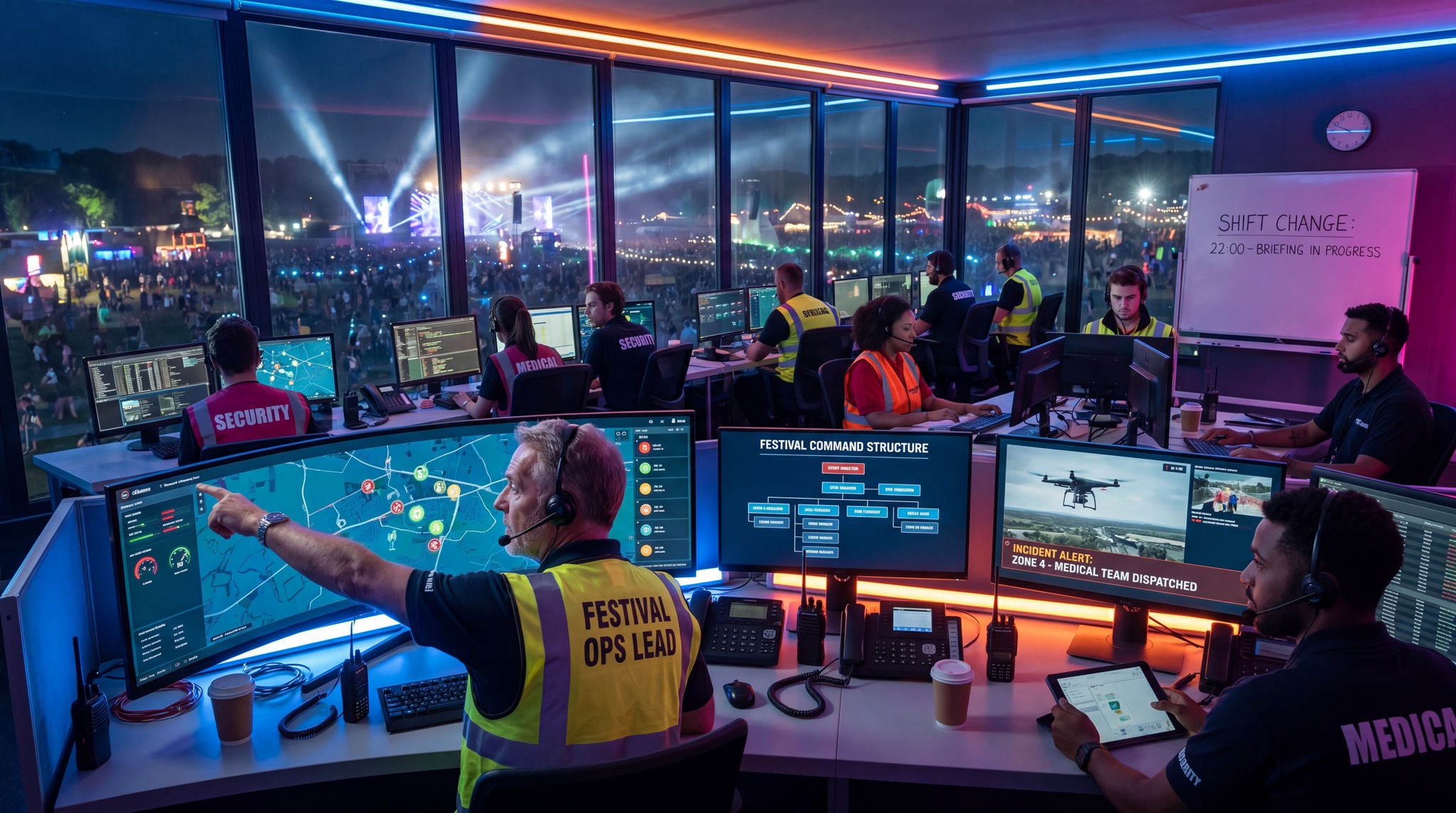
To implement this, assign a Stage Safety Officer or Site Manager whose job is to monitor conditions and give the order: “Stage area is closed until further notice.” Use security staff or barriers to enforce the boundary. Communicate clearly with all crew via radio when these protocols kick in (“All crew: lightning within 8 km, clear the stage now”). It can be helpful to practice this as a drill. The bottom line is during critical lifts or dangerous weather, limit access strictly – it’s a simple step that saves lives.
Keep Inspection Logs Visible and Updated
A stage structure isn’t “set and forget.” It requires ongoing vigilance throughout the event. This is why smart festival teams maintain inspection logs – written records of regular checks on the structure’s condition – and keep them somewhere visible. The visibility serves two purposes: reminding the crew to conduct checks, and showing everyone (including artists and authorities) that safety is being actively managed.
What does an inspection log include? Typically a checklist of key points to examine on the stage: all pin connections secured, no new damage or bent components, guy wires properly tensioned, ballast still in place and not shifted, rain water not pooling on roof covers, and so on. A qualified rigger or structural engineer should walk through this checklist daily (or more frequently during bad weather). After each inspection, they sign and timestamp the log. By visibly posting this log – for example, on a clipboard at the monitor mixing desk or taped inside the stage wing – you create a culture of accountability. Any crew member or even artist manager can glance at it and see “OK, the stage was cleared and checked this morning.” It builds confidence and also means if someone spots an issue (say, a loose bolt) they know who to inform (the person whose name is on the last inspection).
There have been events where these routine checks caught small problems before they became big ones. For instance, at Download Festival (UK), a mid-event inspection once caught a slowly loosening guy-line on a secondary stage after a night of heavy wind. The crew was able to tighten and reinforce it long before gates opened that day – averting a potential failure. Another scenario might be discovering that an enthusiastic crew member hung an extra banner or speaker without clearance; the log and inspection process would catch that unauthorized change, and it can be removed or approved properly.
Moreover, having the logs visible is useful when dealing with local officials and insurers. Should a safety inspector walk into your site office, nothing gives them peace of mind like seeing a well-documented log of structural inspections, complete with engineer signatures if required. It demonstrates professionalism and due diligence. Conversely, never hide or neglect these logs. Not only could that violate safety regulations in many regions, but it also sends the wrong message to your team. Openness about safety checks encourages everyone to speak up if they notice something.
In practice, digital logs or apps are also available (some festival teams use tablet-based checklists). Whether digital or paper, the important thing is they are kept up-to-date and reviewed by the production management daily. Consider having a brief meeting each morning with the stage crew: review the weather forecast, inspect the structure, sign the log, and only then proceed with the day’s show prep. It’s a routine that might just prevent a disaster.
Structure Decisions Are Non-Negotiable
At the end of the day, no aspect of festival management is more critical than the safety of structures over people’s heads. This means that certain decisions – those affecting structural safety – are absolutely non-negotiable. A festival organiser must foster a culture where if the structural engineer or safety officer says “stop”, the show stops. Period. There can be no overriding the engineer due to artist demands, ticket sales, broadcast commitments, or any other pressure.
Consider it this way: a music performance can be rescheduled or cancelled, but lives lost cannot be undone. This perspective has to be crystal clear in the minds of the entire festival leadership and communicated to all stakeholders. Artists and sponsors should be briefed that “safety holds priority over the show” for every festival. Many veteran producers reference the mantra, “The show will go on – only if it’s safe.” If you ever face pushback, remember the hard lessons learned by others. The 2011 Pukkelpop Festival (Belgium) had to cancel its remaining program after a sudden storm caused tents and a stage to collapse, killing multiple attendees. Organisers later noted that evacuating even a few minutes sooner could have saved lives – a tough lesson in not hesitating. Similarly, in 2023 a major event stage in Mexico collapsed after organisers reportedly ignored multiple severe weather warnings – an avoidable disaster that tragically killed several people.
On the flip side, when Storm Lilian hit Leeds Festival (UK) in 2024, the organizers promptly shut down three stages for a day when winds exceeded safety limits. Some big performances were lost, but no one was hurt and the main stages reopened when conditions improved. That decision surely involved difficult conversations with artists and fans, but it was the right call.
Empower your safety team to have the final word. Ensure that contracts with artists and vendors include force majeure clauses that explicitly cover weather and safety stoppages so you don’t face legal wrangling for doing the right thing. Communicate with your audience as well – modern festival-goers are more safety-aware and will appreciate transparency. If you have to pause a show due to an approaching storm, make an announcement explaining it’s for everyone’s safety. It’s better to deal with some disappointed tweets than a preventable tragedy.
Lastly, internalise the idea that structure and safety decisions aren’t just technical – they’re ethical. As a festival producer, you hold thousands of lives in your hands when you erect massive stages or big top tents. It’s a huge responsibility. The truly great producers are not the ones with the flashiest stages or biggest acts, but the ones with an impeccable safety record. They are the professionals who colleagues trust because they consistently put safety first. In the words of one renowned festival director, “You can’t negotiate with physics or weather, so don’t even try – plan for it and respect the plan.” That is the mindset that will carry the next generation of festival organisers through successful and safe events.
Frequently Asked Questions
What are load paths in festival stage engineering?
Load paths refer to the specific route that forces, such as gravity, wind, and equipment weight, take through a structure to reach the ground. In festival stages, every truss, tower, and ballast block is designed to channel these loads safely into the earth. Proper calculation of load paths prevents structural failure under stress.
Why is a structural engineer required for festival stages?
Certified structural engineers are necessary to calculate load capacities, verify stability against wind and weather, and ensure compliance with safety codes. They produce detailed drawings and stress calculations for custom or large-scale stages. Their official sign-off is a critical safety requirement to prevent collapses and ensure the structure can support audio and lighting gear.
What is the maximum wind speed for outdoor festival stages?
Typical large mobile stages or truss roofs are rated to withstand sustained winds of approximately 40–50 mph (65–80 km/h). However, safety protocols usually dictate stopping performances at 30 mph and evacuating the area if winds reach 40 mph. Organizers must strictly adhere to the specific wind ratings provided by the stage manufacturer.
How is ballast used to secure temporary event structures?
Ballast consists of heavy weights, such as concrete blocks or water tanks, used to anchor temporary stages and prevent them from tipping or lifting during high winds. Engineers specify the exact amount and placement of ballast required. These weights must be securely attached or strapped to the structure to prevent shifting during storms.
How do you manage ground bearing capacity for large stages?
Managing ground bearing capacity involves ensuring the soil beneath a stage can support the structure’s concentrated weight without sinking. Solutions include using steel base plates or mats to spread the load over a wider area and using outriggers for stability. Geotechnical reports or soil testing help determine if the ground is too soft for specific loads.
What are the safety protocols for high winds at festivals?
High wind protocols involve a tiered action plan based on wind speed thresholds. Actions typically include lowering video walls and stopping shows at 30 mph, evacuating the stage area at 40 mph, and clearing audiences at 50 mph. Continuous monitoring using on-site anemometers and weather forecasts is essential to execute these plans before conditions become critical.
Why are daily structural inspection logs important for events?
Daily inspection logs provide a written record that a stage has been checked for safety issues, such as loose connections or shifting ballast. Keeping these logs visible and updated ensures accountability, allows for early detection of potential failures, and provides proof of due diligence to safety inspectors and insurance providers.
What safety rules apply during stage construction and load-in?
Stage construction areas must be designated as “hard hat zones” with access restricted to essential, trained personnel wearing proper safety gear. During critical moments like roof raises or heavy lifts, a safety perimeter is enforced to protect bystanders from falling objects. Public access should be completely blocked until the structure is fully secured and signed off.
Who builds the stages at music festivals?
Music festival stages are built by specialized staging and rigging companies that focus on temporary demountable structures. These vendors work alongside festival set engineering services to design, transport, and erect the massive truss and scaffolding systems required. The actual construction is carried out by certified riggers, scaffolders, and stagehands under the strict supervision of structural engineers and site managers.
What types of festival structures require engineering sign-off?
Every temporary build on your site needs professional oversight, not just the main music festival stage. This includes VIP viewing decks, front-of-house (FOH) towers, delay speaker towers, large brand activation tents, and entrance archways. If a structure supports heavy equipment, elevates people, or poses a wind risk, it must be treated with the same engineering rigor as building stages for concerts.
How do you build a stage for a large-scale festival?
As a festival producer, learning how to build a stage is less about physical construction and more about procurement and project management. You must hire specialized staging companies and festival set engineering services to design the system, calculate load paths, and provide certified riggers. The process involves site surveys, structural drafting, securing local permits, and executing a phased load-in where every truss and ballast block is inspected and signed off by a licensed engineer before use.
How long does festival stage construction typically take?
The timeline for festival stage construction varies heavily based on the size and complexity of the festival structure. A standard mobile stage can be deployed in a single day, while erecting very large stages for major global events often requires a multi-week build schedule. Proper planning ensures that the steel framework is fully signed off by engineers before production teams begin rigging lights, video walls, and audio arrays.
What qualifies as a temporary festival structure?
A temporary festival structure encompasses any non-permanent edifice erected for an event. This includes main performance stages, VIP viewing platforms, front-of-house mix towers, delay speaker arrays, brand activation pavilions, and large entrance archways. Because they support heavy equipment and accommodate large crowds, all of these builds require rigorous engineering oversight, proper ballasting, and official safety sign-offs before use.
What does stage loading refer to in event production?
Stage loading refers to the calculated distribution of weight across a temporary structure’s deck, roof, and rigging points. It encompasses both static loads, such as heavy audio arrays and lighting fixtures, and dynamic loads, like moving set pieces or wind resistance. Proper weight distribution ensures that no single truss or support tower is overstressed, maintaining the structural integrity of the entire setup.
What are the key phases of stage building for a festival?
The stage building process typically follows a strict sequence: site marking and ground preparation, followed by the erection of the steel sub-structure and roof grid. Once the primary framework is completed and signed off by a structural engineer, the production phase begins, allowing audio, lighting, and video crews to rig their equipment. Finally, scenic elements and weatherproofing are added before a final safety inspection.
What specific deliverables do festival set engineering professionals provide?
Beyond supplying the physical steel and truss, specialized engineering partners deliver critical technical documentation. This includes 3D structural models, dynamic wind load simulations, custom fabrication blueprints, and detailed rigging plots. These deliverables ensure that complex scenic elements and heavy production gear are safely integrated into the temporary structure’s load paths.
What are the steps for building a temporary music stage?
For event organizers researching how to build a temp music stage safely, the process centers on expert procurement and strict project management rather than DIY construction. You must contract specialized staging vendors who provide engineered truss systems, certified riggers, and comprehensive structural documentation. The producer’s role is to coordinate site logistics, ensure ground bearing conditions are suitable, and verify that an independent structural engineer signs off on the completed temporary framework before any production gear is loaded.
What does site-wide festival construction entail?
Site-wide festival construction encompasses the complete physical build of an event space, transforming an empty field or urban lot into a fully functioning pop-up venue. This process includes erecting main performance stages, installing temporary roadways, deploying power and water infrastructure, and building secondary structures like VIP decks and vendor pavilions. It requires rigorous project management, heavy machinery coordination, and strict adherence to structural engineering and safety guidelines.