Every festival organiser knows that behind the scenes of any great event lies a mountain of paperwork – and much of it revolves around permits and licenses. Whether it’s closing down a street for a lively folk parade, setting up open-fire cooking pits for food vendors, or ensuring your late-night jam session doesn’t violate local noise laws, navigating the permit stack is critical to festival success. Cutting corners on permits isn’t an option; authorities can shut down an event that isn’t compliant, and no festival producer wants to see months of planning go up in smoke. This guide unpacks how seasoned festival producers tackle permits for street closures, open flames, and noise variances, offering real-world examples and actionable advice to keep your folk festival on track and in the community’s good graces.
Mapping Out the Permit Puzzle Early
Start early by mapping out every permit your festival needs – think of it as creating a road map through regulatory terrain. Festivals often require a web of approvals: event permits, street closure authorisations, fire department permits for any flame or pyrotechnics, noise variances for amplified music, health permits for food stalls, building permits for stages and tents, alcohol licenses if you serve drinks, and more. The exact requirements vary by location and size – each city or town can have unique rules, so a small local folk festival might need just a basic events permit and noise waiver, whereas a large international festival will navigate dozens of permits across multiple agencies.
Building a “permit matrix” is a tried-and-true method used by veteran festival organisers to keep everything organised. This is essentially a detailed spreadsheet or table that tracks key information for each required permit:
- Permit Type & Issuing Authority: For example, Street Closure Permit from the City Council, Open Flame Permit from the Fire Marshal, Noise Variance from the Environmental Health Department, etc.
- Deadlines: Application due dates and lead times (some permits might need to be filed 3–6 months in advance, others 30 days – always verify local requirements).
- Owner: The team member responsible for securing that permit. Assign clear owners – one person might handle all fire-related permits, another liaises with city traffic officials. Everyone should know their tasks.
- Status & Notes: Keep a status (e.g. “Submitted on June 1”, “Approved”, “Pending inspection”) and note any special requirements or fees.
By laying out a matrix, nothing slips through the cracks. For instance, at a major event like the National Folk Festival in the US (which often takes place in city centres), the production team would list each street closure and its specific city permit, each needing community notice and police coordination. Simultaneously, the team might list fire permits for any cooking areas or campfires, noise permits for stages running past the usual curfew, and so on. Seasoned producers often colour-code permits by deadline urgency – if your noise variance application is due 60 days out, you want it flagged well ahead of time!
Free Tool: Size Your Festival Site
Zoned capacity planning for arena, campsite, parking and entry lanes — against UK Purple Guide and NFPA density standards. Finds your bottleneck zone.
Street Closure Permits: Coordinating with Cities and Neighbours
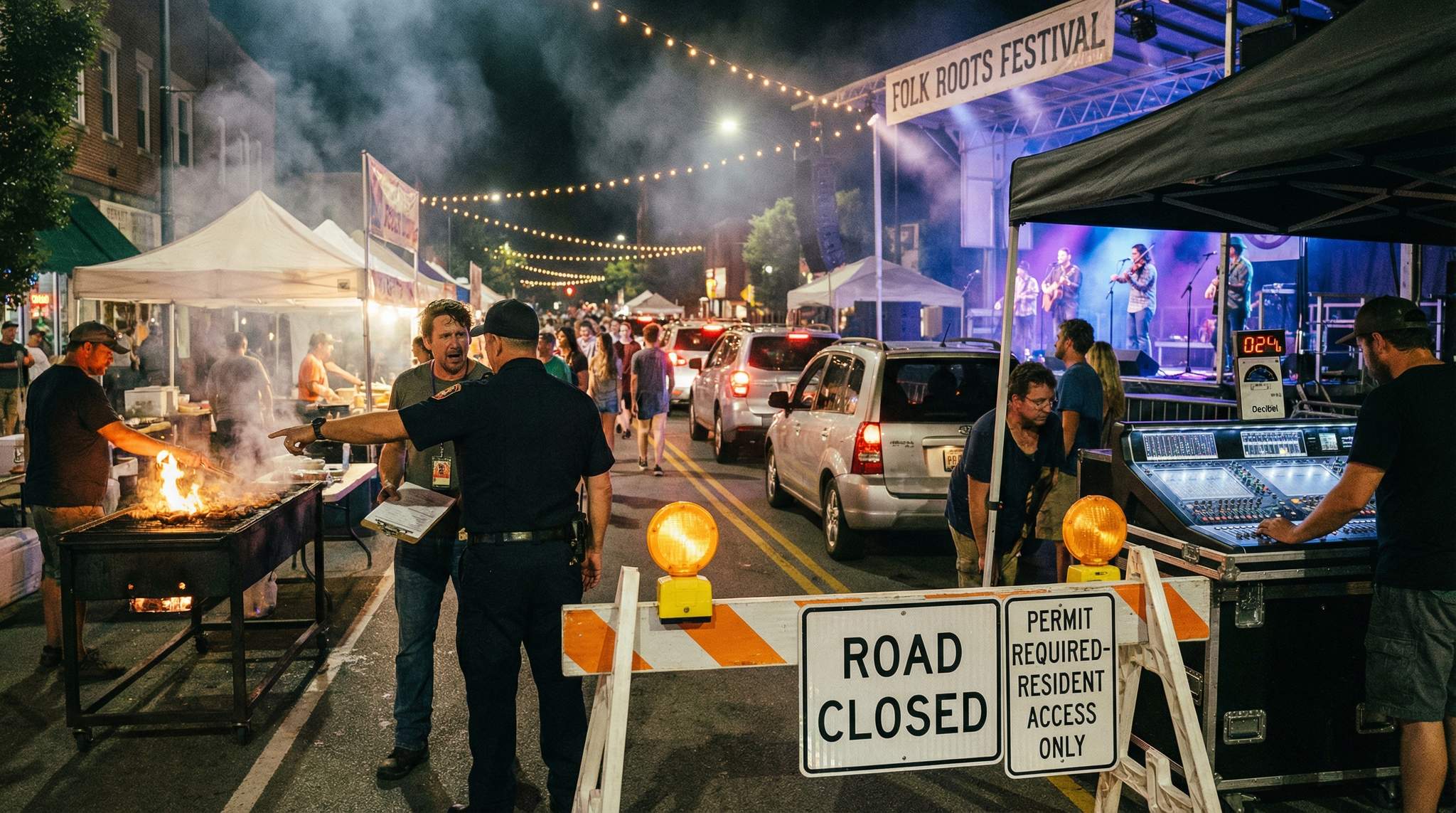
Shutting down streets for a festival is often essential – it gives attendees safe space to roam, dance, and enjoy without traffic. But closing a street means working closely with city authorities and the community. City councils or transportation departments typically require a detailed traffic management plan when you apply for a street closure. This plan should include:
- Exact streets and times of closure: Be precise about which roads, intersections, and the duration of closures (e.g. “Main St from 1st Ave to 5th Ave, Friday 4 PM through Sunday midnight”).
- Detour routes and signage: Show how vehicles will be rerouted. Plan clear detour signage and, if possible, provide advance notice so locals can plan their travel.
- Access for residents and businesses: If people live or work on the closed streets, you may need to issue special access passes or have checkpoints. In one Australian town’s folk festival, even residents needed permits to access their own street during festival hours!
- Emergency vehicle lanes: Always maintain a fire lane or emergency access route through or around the closure area, typically at least 20 feet/6 m wide.
- Public notifications: Plan how to inform the wider community – door-to-door flyers, community meetings, local newspaper notices, social media announcements, etc., to ensure everyone knows when and where streets will be closed.
Early and transparent communication is key. A great example comes from Salisbury, Maryland, which hosted the National Folk Festival. With over 60,000 people expected, organizers and city officials coordinated a series of downtown street and parking lot closures. The city even went door-to-door with notices to residents and businesses, explaining the closure schedule and alternative parking arrangements. This proactive approach not only met city requirements but also earned goodwill from locals who felt respected and informed.
Planning a Festival?
Ticket Fairy's festival ticketing platform handles multi-day passes, RFID wristbands, and complex festival operations.
Another case study is the Port Fairy Folk Festival in Australia, a beloved event that essentially takes over a small town. Organisers work with the local council to pedestrianise key areas, and they coordinate closely with police for crowd management. The festival provides detailed info on road closures and even coordinates with local residents on access permits to minimise inconvenience. By involving the community in planning (through consultations and clear information), Port Fairy’s team turns a potentially disruptive closure into a point of civic pride each year.
Remember: securing the street closure permit is just step one – executing it safely is step two. On the day, have marshals or police at closure points, proper barriers, and clear signage. Monitor the perimeter in case drivers or pedestrians not aware of the festival need guidance. Invite local officials to observe your traffic plan in action; showing competence here builds trust for next time.
Open Flame and Fire Permits: Safety First for Flames
From food stalls with gas burners to artistic fire performances and cozy bonfire circles, open flames can add both flavour and risk to a festival. Most jurisdictions require special fire permits for any open flame use in public events. Fire departments will scrutinise your plans for:
- Cooking equipment: Propane grills, charcoal barbecues, campfires or cooking pits all typically need approval. You’ll often need to list each location and type of flame device, and ensure each is at a safe distance from tents or structures (many fire codes mandate no open flame within ~20 feet/6 m of any tent or combustible structure).
- Fire performance or pyrotechnics: If your folk festival includes things like fire dancing, torches, fireworks, or a ceremonial bonfire, expect a detailed review. You may need a licensed pyro technician and a precise site plan showing safety zones and audience distances. For example, Woodford Folk Festival in Australia is famous for its spectacular closing ceremony “Fire Event”, where a 12-metre high sculpture is ignited with fireworks and becomes a giant bonfire as part of the show. To stage this safely, Woodford’s producers work hand-in-hand with fire marshals – marking out large perimeter clearances, having firefighters on standby, and timing the burn when wind and weather conditions are safe.
- Gas and fuel storage: Storing fuel (like propane cylinders or gasoline for generators) on site must meet safety codes. Typically, fuels need to be in approved containers, within designated storage areas away from crowds, with proper “Flammable” signage and fire extinguishers nearby.
- Tents and flame-proofing: Big tents or marquees often require certificates that their fabric is flame-retardant. Open flames or cooking usually aren’t allowed inside or near tents unless a fire marshal specifically approves it – sometimes a small grilling tent for food vendors can be permitted if it meets special conditions (like having a fire extinguisher and ventilation).
When applying for an open flame permit (sometimes called a fire permit or flame effects permit), submit clear drawings and descriptions. Mark all flame locations on your site map. Note the type of fire (e.g. “Campfire in 3-foot diameter fire pit” or “Propane-fueled torch for juggling act”), and detail your safety measures (fire extinguishers, security or volunteers monitoring, how you’ll extinguish the fire afterwards). The more thorough your plan, the more confidence the fire officials will have.
Free Tool: Project Your Bar Revenue
Per-head spend benchmarks by event type turned into projected bar and food revenue, with a stock-mix estimate and gross-margin line. Free calculator.
A pro tip from veteran festival producers: host a pre-festival walk-through with the fire department inspector a day or two before opening. Show them all the setups – the spacing of food vendor grills, the fire performance area, the stored fuel – so they can see you’ve implemented what was in your permit application. If anything isn’t up to code, the inspector can point it out on the spot, and you still have time to fix it (move a grill, add an extra fire extinguisher, etc.). These pre-walks demonstrate respect and diligence, and can turn the inspector into an ally who helps you succeed rather than a scary figure who shows up opening day with a checklist of violations.
Noise Variances: Balancing Festival Fun with Neighbourhood Peace
Music is the heart of any folk festival – fiddles, drums, and singing voices will carry through the air. But municipalities often impose strict noise ordinances that could put a damper on your nighttime encore. That’s where noise variance permits come in. A noise variance (or exemption) is essentially official permission to exceed standard noise limits or extend beyond normal quiet hours for a special event.
Need Festival Funding?
Get the capital you need to book headliners, secure venues, and scale your festival production.
To secure a noise variance, festival organisers should be prepared to present a case to local authorities or even a city council. Common requirements include:
- Justification and schedule: Outline why the festival needs extended hours or higher decibel levels. For instance, “Outdoor concerts until 11 PM on Friday and Saturday, with amplified sound peaking at 95 dB at the mix position.” Emphasise the cultural and economic benefits of the event to the community – a folk festival brings people together and boosts local business.
- Mitigation measures: Describe how you’ll minimise disturbance. This can include using lower bass settings after a certain hour, orienting speakers away from residential areas, setting up sound barriers or buffers, and clearly defining end times for music each night.
- Community outreach: It’s wise (and sometimes mandated) to notify nearby residents of the festival schedule and provide a contact for noise complaints. Showing that you’ve informed the neighbourhood and have a plan to handle issues goes a long way. Some festivals even distribute free earplugs to the closest neighbours or invite them to enjoy the event as goodwill gestures.
- Compliance history: If your festival has happened before, highlight your track record (e.g., “last year we had zero noise citations and ended all music by 10:55 PM as promised”). A clean record will build confidence that you’re trustworthy.
Even world-famous festivals must respect noise rules. Glastonbury Festival in England, for example, operates under a complex local licence with strict noise control conditions. After the 2022 edition, the local council noted a rise in overnight noise complaints (music reportedly went until 4 AM) and urged the organisers – led by Michael Eavis’s team – to implement better noise monitoring and cutoff enforcement. No event is “too big” to be checked. In response, Glastonbury’s producers have had to review stage schedules and on-site sound management to keep the peace with neighbours and regulators. The lesson for any festival: take noise seriously and work proactively with officials on a variance if needed rather than hoping you won’t get caught.
On the flip side, there are cautionary tales of festivals that failed to manage noise and faced backlash. In fact, after one extremely large 1970 festival in the UK caused major community disruption, the government passed the “Isle of Wight Act 1971”, which requires a special licence for any overnight open-air gathering of more than 5,000 people. In other words, failing to manage noise and crowd impacts can have lasting repercussions beyond one event. In recent years, for example, residents in one Irish town went to court and succeeded in stopping a planned music festival entirely due to concerns including noise and disruption. Losing community support can be fatal to an event. So, if you’re running a folk festival in a normally quiet village or urban park, be humble and proactive: set reasonable hours (perhaps have acoustic-only sets later at night), use technology like directional speakers, and show neighbours you’re listening. Often, getting a noise variance will require a public hearing or letters of support – rally local businesses, cultural groups, and attendees to voice positives about the festival. When authorities see broad support and a solid noise control plan, they are more likely to grant that variance.
Detailed Plans and Drawings: Tents, Stages, and Technical Permits
One big reason to start permit applications early is that many agencies require technical drawings or detailed plans of your festival setup. This isn’t just bureaucratic red tape – officials need to visualize the event to ensure safety and compliance. Key areas where drawings are typically required include:
Free Tool: When Should You Announce?
Pick your event date and genre — the free planner outputs a recommended announce, presale, on-sale and reminder schedule anchored to how your audience actually buys.
- Site plan for overall layout: A to-scale map showing stages, tents, booths, fences, entries/exits, fire lanes, medical tents, toilets, etc. Most permit applications will ask for a site plan. Mark locations of all structures and any hazards like generators or fuel storage.
- Tent and stage plans: Large tents (often over a certain size, like over 200 square feet) usually need a separate tent permit. You may need to submit the tent vendor’s specifications, anchoring method, and a layout of what’s inside the tent. For stages, especially big ones or custom builds, drawings stamped by a structural engineer might be required to get a temporary building permit. Nobody wants a collapse, so expect inspectors to check your stage platform, roof trusses, and rigging points. Include elevations and weight load info in the drawings if asked.
- Electrical and plumbing diagrams: If you’re running power for lighting and sound or setting up water lines (for potable water or misting stations), some jurisdictions want an electrical one-line diagram or a plumbing plan. They might also need an electrician’s or plumber’s sign-off. At a minimum, list out your power sources (generators or grid tie-in) and how you’ll keep them safe from public interference.
- Fire safety plan: We discussed open flame, but even beyond that, many fire departments want an Emergency Action Plan diagram. This highlights fire extinguisher locations, emergency exits (for fenced venues or large tents), first aid stations, and evacuation routes. If you have multiple stages or areas, indicate how you’d evacuate each in an emergency.
Double-check local codes for specifics. For example, California requires detailed drawings and a fire permit for any tent over 400 square feet, plus fire retardancy certificates for tent materials. In the UK, councils often require a to-scale site plan for any significant temporary structures, and they may insist on an on-site inspection before the event to check compliance. In Singapore, organisers of outdoor events must submit layout plans to the police and civil defence force well in advance for approval. Each location has its quirks – the common thread is: detailed paperwork upfront prevents dangerous surprises later.
A real-life lesson: a few years ago a festival attempted to erect a large temporary stage without proper drawings or engineering review. Come inspection day, officials found the stage didn’t meet wind-load requirements – and the festival had to delay opening while emergency bracing was added. The fiasco caused angry fans and additional costs. The takeaway? Invest in professional drawings and review for critical structures. It might cost a bit more in the planning phase, but it averts disaster and ensures inspectors trust you. As a bonus, having detailed site diagrams helps your own team set up efficiently and double-check that everything fits as planned.
Pre-Event Inspections: Walk-Throughs with Authorities
One hallmark of a well-run festival is the absence of last-minute permit drama. The secret weapon here is the pre-event inspection (or “pre-walk”). Instead of waiting for inspectors to show up unannounced during your event, invite them for a scheduled walk-through before the gates open. Many fire marshals, building inspectors, and health officials appreciate the chance to verify compliance in a calmer environment – and it shows them you’re committed to meeting requirements.
Consider scheduling different walk-throughs for different inspectors:
- Fire Department Pre-Walk: Perhaps the day before opening, once your tents are up and vendors set their kitchens. The fire marshal can check that fire lanes are clear, extinguishers are in place, no generators or BBQs are too close to tents, exits are lit, and occupancy limits (for tented stages) are posted. If something’s off, you fix it before showtime. These cooperative inspections can turn a typically nerve-wracking process into a collaborative safety check.
- Building/Safety Inspection: If you have scaffolding stages, bleachers, or heavy structures, get the building inspector or a structural engineer to sign off ahead of time. For example, the Edinburgh Fringe Festival (not folk-specific but relevant for temporary venues) has pop-up stages and seating that city officials inspect each year prior to opening. They look at things like guardrails, stability, proper assembly of modular staging, etc. By walking through early, organisers avoid any show cancellations due to structural safety issues.
- Health Department Walk-Through: If your festival has many food vendors or temporary kitchens, invite the health inspector on the morning of day one before the public enters. Make sure all vendors know the drill (food at safe temperatures, hand-washing stations ready, permits displayed). A unified inspection can be efficient – at large events, inspectors often appreciate the organiser escorting them vendor to vendor to ensure everyone complies. It’s much smoother than inspectors hunting down each stall during the busy event.
Document the results of these pre-walks. If an inspector points out a violation, note it, fix it immediately, and politely ask them to re-inspect if needed. By being responsive on the spot, you prevent small issues from becoming citations or cause for shutting down a booth or area.
In some regions, you can even request a pre-application meeting weeks or months in advance, where you show preliminary plans to the fire or building department and they give feedback. This is like a coaching session so your official submission will sail through. Taking advantage of such opportunities can save you from multiple rounds of revisions on your permit applications.
Turn Fans Into Your Marketing Team
Ticket Fairy's built-in referral rewards system incentivizes attendees to share your event, delivering 15-25% sales boosts and 30x ROI vs paid ads.
Tracking Corrections and Documenting Compliance
Even with great prep, you might get some “corrections” – issues identified by officials that need remedy. How you handle them can make or break your relationship with regulators. Smart festival teams use tools (even a simple spreadsheet or project management app) to track each required correction, who’s fixing it, and proof of completion. For example:
- Fire inspector says you need 4 additional exit signs in a tented venue? Assign a team member to install them that day and take photos as proof.
- Health inspector notes a hand-sanitiser station is empty? Refill it, mark it done, and maybe have the vendor sign off that they’ll check it hourly.
- Building inspector wants an engineer’s letter for the stage truss? Get your hired engineer to email a stamped letter or certificate, and forward it to the inspector’s office.
Keep a binder or cloud folder with all the permit documents and compliance proofs. On-site, have copies of permits and any certificates handy in case an official asks. For instance, keep that tent flame-retardant certificate in the binder. Many festivals have daily operations meetings – make permit compliance a line item on the agenda during the event setup phase (“Have we addressed all Fire Marshal notes? Any pending fixes before opening?”).
It’s worth noting that good documentation isn’t just bureaucracy – it can protect you legally. If a neighbour complains or a question arises about whether you followed the rules, you can readily show, “Here’s the signed-off inspection form and a photo of the fix we did.” This level of organisation can turn a potentially adversarial relationship with authorities into a partnership. They see you genuinely care about safety and compliance, rather than just doing the minimum.
Over time, good paperwork quite literally earns trust. Festival producers who consistently turn in complete, well-prepared applications and then run events that match those plans will develop a positive reputation with local agencies. The first year you might feel scrutinised, but by the third or fourth year, inspectors often start giving you the benefit of the doubt (and sometimes faster approvals). As an example, the long-running Edmonton Folk Music Festival in Canada has a strong rapport with its city officials – they’ve operated safely for decades, so nowadays the permitting process is more streamlined with the city because the festival has proven its competence. Similarly, organisers of Mexico’s Cervantino Festival (a large cultural festival) have noted that maintaining transparent paperwork and working closely with city regulators each year has built mutual respect, allowing them to innovate more each edition with the city’s blessing.
Earning Trust and Building Community Through Compliance
At the end of the day, securing permits is about protecting people and respecting the community – the same goals you likely have as a festival organiser. Embracing the permit process with a positive attitude (instead of viewing it as an obstacle) can actually make your festival better. It forces you to plan thoroughly, think about worst-case scenarios, and engage with your neighbours and local leaders.
Experienced festival producers often become advocates for safety and community integration. They will tell you that when you do things by the book – and prove you’re doing so – it pays off in myriad ways. You might get more flexibility from the city once you’ve shown you manage noise well or clean up properly. You might find the fire department willing to approve a unique fire art installation because they trust your team to handle it right. Doors open when you’ve built that trust bank.
And it’s not only about officials. Attendees and performers indirectly benefit from your permit diligence too. When all permits are in place, the event runs without unexpected shutdowns, evacuations, or angry authorities prowling around. Artists get to play those extra 15 minutes because you secured the noise variance; fans get to dance on a safely engineered stage; vendors operate in a well-inspected food court so nobody goes home sick. It all ties together.
So, the wisdom from veteran festival producers is this: Treat permit compliance as a core part of your festival’s DNA. Train your team to value it, invest time in it, and approach the regulators as partners. Paperwork may not be glamorous, but it lays the groundwork for the magic onstage to happen uninterrupted. As one festival manager put it, “We aim to have boring paperwork so we can throw an exciting festival.” In other words, if your permits process is smooth and drama-free, that’s a sign you’ve done it right – and your reward is an event that the community and authorities welcome year after year.