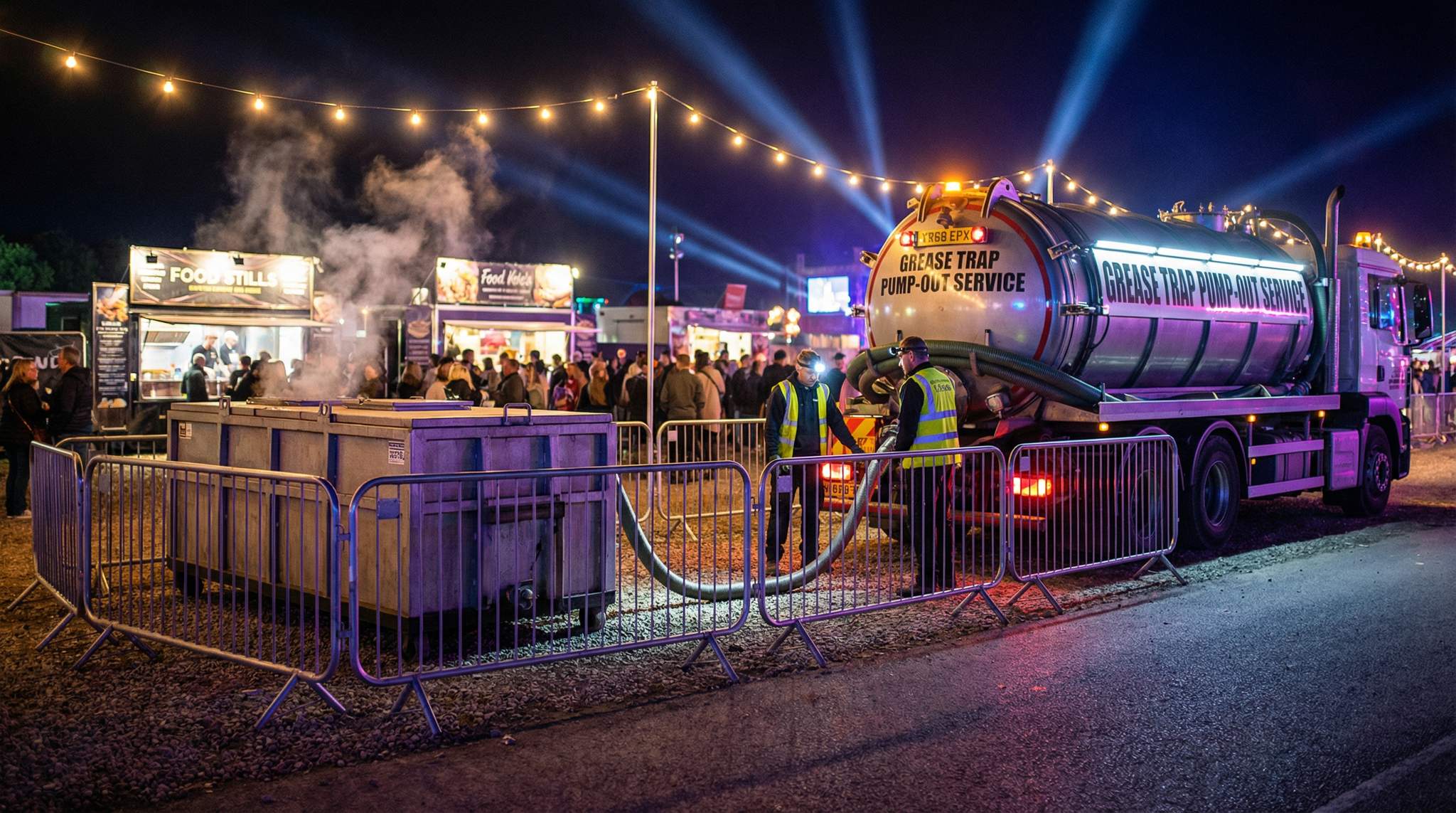
Keeping the Drains Fat-Free: Every food festival producer knows that behind the aroma of sizzling delicacies lies a hidden challenge – grease. Fats, oils, and grease (often called FOG in waste management) can turn from a cooking byproduct into a plumbing nightmare if not handled properly. In the frenzy of a food festival, with dozens of vendors frying and grilling, it’s easy to overlook grease disposal. Yet, ignoring it can mean clogged sewer lines, foul odors, environmental damage, or even costly fines and shutdowns. Successful festival organizers treat grease management as a top priority, ensuring that sewers stay happy and free-flowing throughout the event.
Why Grease Management Matters at Food Festivals
A food festival isn’t just tough on attendees’ belts – it’s tough on the sewer system too. When FOG washes down sinks and drains, it cools and congeals on the way to municipal sewers, sticking to pipes like cholesterol in arteries. Accumulate enough grease and you’ve got a blockage (hello, fatberg!). In cities like London and New York, giant “fatbergs” – huge masses of hardened grease and trash – have formed in sewers, costing authorities millions to remove. The last thing any festival producer wants is for their event to contribute to such a mess or cause a mid-festival sewer overflow.
Beyond the gross factor, there are serious consequences. Many countries enforce strict FOG disposal regulations. For example, the UK, Singapore, and Australia require any commercial or event kitchen (even temporary ones) to use grease interceptors and dispose of FOG properly. A festival that neglects this can face heavy fines, legal action, or be barred from hosting future events. More immediately, a grease-induced plumbing backup could shut down your food stalls mid-event – a disaster for vendors and a PR nightmare for the festival. In short, managing grease isn’t just about keeping the pipes clear; it’s about safety, compliance, and reputation.
Deploying Portable Grease Traps at Events
The cornerstone of festival grease management is the grease trap (also known as a grease interceptor). These devices catch and collect grease from wastewater before it enters the sewer. In a permanent restaurant kitchen, grease traps are often fixed underground or under sinks. At a temporary event, portable grease traps are the go-to solution. They come in various sizes and designs – from small under-sink units that a single food stall can use, to larger above-ground tanks that serve a whole cluster of vendors.
Free Tool: Size Your Festival Site
Zoned capacity planning for arena, campsite, parking and entry lanes — against UK Purple Guide and NFPA density standards. Finds your bottleneck zone.
When selecting equipment, organizers frequently ask which portable grease traps meet FSA standards for temporary food operations or align with local health department codes. While the Food Standards Agency (FSA) and similar regulatory bodies don’t typically endorse specific brands, they require that any fat, oil, and grease separators used in commercial settings effectively prevent FOG from entering the wastewater system. To ensure compliance, look for units certified by recognized plumbing standards (such as PDI-G101 or ASME in the US, or BS EN 1825 in Europe). Partnering with a reputable supplier from the commercial fat, oil, and grease separators market ensures you rent or purchase compliant, high-efficiency units designed specifically for high-volume event use.
Beyond compliance, the physical footprint of a mobile grease interceptor dictates your site design. When mapping out your vendor village, factor in the dimensions of these temporary units. A high-capacity mobile grease interceptor requires a stable, level surface to function correctly; placing one on a sloped grassy hill can disrupt the internal baffles that separate the FOG from the water. Experienced site managers often lay down heavy-duty trackway or plywood bases to ensure these mobile units remain perfectly level and secure throughout the event.
Planning a Festival?
Ticket Fairy's festival ticketing platform handles multi-day passes, RFID wristbands, and complex festival operations.
Choosing the right traps: Start by assessing your festival’s food operations. How many vendors will cook onsite? Are they heavy grease generators (lots of deep-frying or griddling) or lighter operations (like coffee and desserts)? For a small boutique food fair (say 10 vendors), you might provide each vendor with a mini grease trap for their sink or washing station. Larger festivals with dozens of food booths often set up centralized dishwashing or cooking areas, each equipped with a higher-capacity grease interceptor. For instance, a big international street food festival in Singapore might install barrel-sized grease traps at each water station serving the food tents.
Understanding trap types: For most temporary setups, organizers rely on passive grease traps. These systems use gravity to separate water from lighter oils and heavier solids without needing electricity or moving parts. A standard passive under the sink grease trap is highly effective for individual vendor booths with moderate output, such as a taco stand or a donut fryer. Because they are compact and easy to install directly beneath a wash station, an under the sink grease trap allows vendors to manage their own localized wastewater before it ever reaches the communal collection tanks.
Placement and setup: Position grease traps wherever wastewater will be generated. That usually means under each sink or at the outlet of each vendor’s gray water drain. If vendors have self-contained kitchens (like food trucks with built-in waste tanks), instruct them on how to use the event’s grease disposal system instead of dumping their own waste casually. In some cases, festival organizers provide a communal grease trap station – a designated area where vendors can empty greasy water or have their onboard tanks pumped out. Just make sure any communal station is easy to access yet safely away from attendee foot traffic (nobody wants to smell or see the grease collection point).
Maximizing point-of-use efficiency: When deploying an under the sink grease trap for individual stalls, ensure vendors understand the flow rate limitations of these compact units. A localized interceptor is brilliant for catching FOG right at the source, but it requires careful monitoring. If a vendor is running a high-volume dishwashing station, a standard under-counter model might reach its retention capacity faster than anticipated. Organizers should mandate that any point-of-use system is paired with pre-scraping protocols—where vendors wipe down greasy pans before washing—to extend the operational window of these smaller traps between scheduled pump-outs.
Free Tool: Project Your Bar Revenue
Per-head spend benchmarks by event type turned into projected bar and food revenue, with a stock-mix estimate and gross-margin line. Free calculator.
Plan for peak flow: High-traffic food events (for example, a weekend-long BBQ festival in Texas or a bustling night market in Bangkok) can generate an enormous amount of oily wastewater in a short time. It’s crucial to have traps sized for peak demand. A good rule of thumb borrowed from the restaurant industry is the “25% rule” – when a grease trap is a quarter full of grease and solids, it’s due for cleaning. At festivals, reaching that 25% fill can happen within hours if the trap is undersized. It’s better to overestimate and provide a trap with more capacity or multiple traps in rotation than to risk an overflow.
Pump-Out Scheduling: Timing Is Everything
Even the best grease trap will fail if it’s not emptied in time. Pump-out scheduling refers to planning when and how the collected grease and wastewater will be removed from your portable traps. At a multi-day festival, a nightly pump-out is often mandatory. For single-day events, at least an end-of-day pump-out should be on the schedule (and a mid-day pump if the event runs all day and into the night).
Need Festival Funding?
Get the capital you need to book headliners, secure venues, and scale your festival production.
Coordinate with professionals: Line up a licensed waste hauling company (many septic or wastewater service companies handle grease trap pumping) well before your event. Discuss your festival’s schedule and capacity needs so they can bring appropriately sized vacuum tanker trucks. Ensure they’re available during the specific service windows when the truck can access the site – typically either very early morning before attendees arrive, or late at night after the crowds leave. For example, a large food festival in Melbourne scheduled pump-outs at 2:00 AM each night, when the grounds were empty, to avoid disrupting any guest experience.
Service windows and logistics: Set clear service windows in your operations plan. Announce that, say, “11:00 PM to 1:00 AM is grease trap servicing time,” and ensure no other critical operations conflict with that. During these windows, allow the pump truck to drive up close to each trap. This might mean keeping certain gates accessible or having security ready to escort the vehicle through the site. Be mindful of noise and odor – vacuum trucks aren’t silent or pleasant-smelling. If the festival is in a residential neighborhood (imagine a street food fair in Paris or San Francisco), you might have to schedule pump-outs during daylight lulls to respect noise ordinances, balancing that with attendee presence. In any case, communicate clearly with the hauling service so they know the layout (provide a map of trap locations) and the timing. A well-briefed service crew will work efficiently and get out before anyone notices.
Handling hard-to-reach areas: In situations where vacuum trucks cannot physically reach a vendor cluster—such as deep within a muddy field or inside a historic courtyard—waste management crews may utilize a specialized grease trap cleaning pump. These portable pumping systems allow technicians to extract FOG and wastewater from remote passive grease traps and transfer it to a central holding tank or waiting truck, ensuring every under the sink grease trap gets serviced regardless of its location on the festival footprint.
Monitoring and backup plans: Don’t wait until a trap is overflowing to act. Assign a team member or a contracted plumber to monitor the grease traps periodically during the festival. They can use a dipstick or just visual checks to gauge levels. If a trap is filling faster than expected, be ready to call for an unscheduled pump-out or have a backup trap to swap in. This kind of contingency can save the day, especially at large-scale events. Think of it like having a spare generator: you hope you won’t need it, but you’ll be glad it’s there in an emergency. In one instance, the organizers of a massive food and wine festival in California noticed a trap nearing capacity halfway through the day – they swiftly diverted vendors to an alternate trap and brought in an extra pump truck in the afternoon, averting what could have been a messy shutdown.
Keep Tickets in Fans' Hands
Our secure resale marketplace lets attendees exchange tickets at face value, eliminating scalping while keeping you in control of the secondary market.
Vendor Training and Engagement
Your grease management plan is only as good as the cooperation from your food vendors. Educating vendors about proper grease disposal is vital. Well before the festival, include grease disposal instructions in vendor packets and contracts. Make it clear that pouring oil or food scraps down the wrong drain is a serious no-no. Savvy festival producers often require vendors to use only the provided grease traps and waste containers, and not their own ad-hoc solutions that might end up dumped improperly.
Provide the right tools: Ensure every vendor has access to grease-handling materials. This might include grease strainer screens for sink drains (to catch food bits), containers for collecting used deep-fryer oil, and absorbent pads for any small spills. If vendors know there’s a convenient, safe way to get rid of their grease, they’re far less likely to resort to dumping it on the ground or in a random drain. For instance, at a large county fair in California, the festival organizers set up a used cooking oil recycling station behind the food court – vendors brought their vats of spent fryer oil there, where a recycling company paid for the oil and hauled it away. Such initiatives keep oil out of the sewer and even give vendors an incentive to comply.
Clear communication: Inform vendors of the pump-out schedule and what it means for them. If the grease trap servicing happens overnight, ask vendors to secure their equipment and perhaps cover sinks or drains to avoid any odors when the traps are opened. If servicing is during the day, coordinate a brief pause in dishwashing for those affected. Let’s say you have a scheduled pump-out at 3 PM for a trap serving a cluster of stalls at a daytime festival in New Delhi – you’d notify those vendors in advance: “Please plan to pause water usage from 3:00–3:15 PM while we service the grease trap.” Most vendors will gladly cooperate once they understand it prevents nasty problems that could hurt their business.
Enforce rules and support good behavior: It’s wise to have penalties for vendors who violate grease disposal rules (e.g., fines or loss of deposit for dumping grease improperly), but equally important is to make it easy for everyone to do the right thing. Have roaming festival staff or environmental volunteers keep an eye on vendor areas, gently reminding and assisting vendors with proper disposal. Celebrate the vendors who keep their areas clean and follow procedures – a bit of positive reinforcement goes a long way. Ultimately, festival organizers and vendors share the goal of a smooth, successful event; framing grease management as a team effort for the good of the festival can build cooperation.
Scaling for Different Sizes and Locations
Grease trap and pump-out strategies aren’t one-size-fits-all. A small local food festival and a sprawling international food expo will have very different needs. Here’s how to adapt:
-
Small festivals (few vendors, short duration): If you’re running a cozy weekend food festival in a small town or a single-day street food market, you might manage with minimal infrastructure. Perhaps a single medium-sized grease trap can handle waste from a dozen vendors’ collective sink area. Vendors could be asked to carry their wastewater to that station, or you provide portable basins that get emptied into the trap. Pump-out in this case might be just once after the event, or midway if it’s an all-day affair. Small-scale doesn’t mean you can ignore grease, but the solutions can be simpler and more cost-effective. Just don’t fall into the trap of thinking “small event, no problem” – even a few gallons of grease poured in the wrong place can clog pipes or anger the venue owner. So, even at small events, incorporate grease management in your checklist.
-
Large festivals (dozens of vendors, multi-day): Big events need a professional approach. Major food festivals like Taste of Chicago, Sydney’s Night Noodle Markets, or Madrid Fusión can generate hundreds of gallons of greasy wastewater daily. For such scales, invest in multiple traps and possibly large temporary grease interceptors. You might divide the venue into zones, each with its own grease trap system and assigned service crew. Multiple pump-outs per day per zone might be necessary – for example, midday and overnight – especially if the festival runs from lunch through late night. It’s often worth hiring a dedicated environmental services company to manage on-site wastewater for big festivals; they bring in not just tanks and traps, but expertise to anticipate issues. At one huge music and food festival in Mexico, the festival organizers brought in an entire team to oversee water and waste systems, including a schedule of three pump-outs a day for the central grease tank. The result: zero sewer incidents, despite tens of thousands of tacos and churros fried on-site.
-
Venue considerations: Different venues have different challenges. Urban street festivals might have access to city sewers for disposal, but you should still intercept grease before it hits those sewers (and some cities will insist on it). Rural field festivals won’t have any sewer connection – you’ll be dealing 100% with holding tanks and hauling everything off-site, which means you must have capacity for all wastewater. Think about your site’s layout: is it on hard ground or grass? Avoid placing a heavy grease tank on soft ground where it could tip or leak. Is power available? Some advanced grease separators use electrical skimmers or heating elements, though most passive traps don’t need power. Also, consider climate – a winter food festival in Canada might face grease solidifying faster in the cold, so insulated or heated trap units could help, whereas a summer festival in Bali needs to manage odor and rapid bacterial growth in the heat (perhaps using enzymes or deodorizers in traps). Plan for these local factors when selecting equipment and scheduling service.
Budgeting and Risk Management
Including grease management in your budget might not be glamorous, but it’s far cheaper than emergency plumbing repairs or fines. When drafting your festival budget, allocate funds for grease trap rental or purchase, plus the pumping service. Costs will vary by region: a pump-out in New York City might be pricier than one in a smaller city in India, but either way, it’s a necessary expense. Get quotes from service providers early. Some companies might offer package deals if they handle multiple waste services (for instance, grease traps, portable toilets, and greywater all together). Combining services can save money and simplify coordination.
When evaluating equipment costs, some novice promoters might look up a standard domestic grease trap price online and assume they can save money by purchasing residential units. However, domestic models are engineered for low-volume home kitchens, not the relentless output of a commercial food stall. Investing in proper commercial-grade rentals from the fat, oil, and grease separators market is non-negotiable; a cheap residential unit will overflow within hours, leading to cleanup costs that far exceed any initial savings.
When negotiating rental contracts for temporary FOG management systems, clarify whether the delivery, leveling, and final extraction are included in the base rate. Some suppliers will drop off a mobile grease interceptor at the loading dock, leaving your site crew responsible for maneuvering a heavy, awkward tank into position behind the food stalls. Always stipulate “placed and leveled” in your vendor agreements to avoid last-minute logistical headaches during the build phase.
Don’t forget to factor in cleaning and disposal fees. Grease waste has to go somewhere after it’s pumped out – usually to an authorized processing facility. The hauling company’s fee should cover that disposal, but double-check. Keep records of all grease waste disposal; in some jurisdictions, you may need to submit these to authorities post-event to prove proper handling.
From a risk management perspective, consider grease-related mishaps in your contingency planning. What if a pump-out truck breaks down and can’t arrive on schedule? Line up a backup provider, or ensure your primary contractor has contingency plans. What if a vendor causes a massive grease spill (it happens – say a fryer tips over)? Have a spill response kit ready: absorbent materials, a shovel, heavy-duty bags, and a plan to safely dispose of contaminated soil or pavement cleanup debris. Also, review your insurance – some event liability insurance policies cover pollution or environmental damage; grease in a sewer might qualify, so know your coverage. However, insurance is a last resort. Your goal is prevention first.
A well-managed grease plan also protects your relationship with the venue and community. Venues talk – if you leave a venue’s drains in good shape and return the site without nasty surprises, you’re more likely to be welcomed back. On the flip side, a festival that trashes the plumbing might struggle to get permits next time or find themselves unwelcome in other cities. Being proactive about grease shows professionalism. Some savvy festival producers even include their grease management practices in marketing, as part of sustainability initiatives: for example, touting that the festival recycles all cooking oil into biofuel, or that it has a zero-sewer-impact pledge. While attendees might not choose a festival solely because of that, it adds to a positive image and educates the public subtly about responsible event management.
Wrapping Up
Mastering grease traps and pump-out scheduling may not be the most thrilling part of producing a food festival, but it’s absolutely one of the most important. The mark of an experienced festival organizer is foresight into these behind-the-scenes details that keep the event running smoothly. By deploying the right portable grease traps, timing your pump-outs perfectly, and working hand-in-hand with your vendors and waste service crews, you’ll prevent disasters that could literally stink up your festival. In doing so, you protect not just the sewer and the environment, but the overall success and reputation of your event.
Remember, a great food festival isn’t just about amazing food and happy attendees – it’s also about responsible operations. Keep those sewers happy, and your festival will be all the more praiseworthy (and easier to clean up when it’s all over). Future you – and the city drains – will thank you for it.
Frequently Asked Questions
Why is grease management important for food festivals?
Proper grease management prevents fats, oils, and grease (FOG) from congealing in sewers, which causes blockages known as fatbergs and leads to foul odors or overflows. Neglecting disposal regulations can result in heavy fines, legal action, or immediate shutdowns. Effective management ensures safety, compliance, and protects the festival’s reputation.
How often should grease traps be pumped out at festivals?
Grease traps at multi-day festivals typically require nightly pump-outs to prevent overflows. For single-day events, an end-of-day service is standard, though high-traffic festivals may need mid-day pumping. Organizers should schedule licensed waste haulers during specific service windows, such as early morning or late night, to avoid disrupting attendees.
What is the 25% rule for grease traps?
The 25% rule is a maintenance standard borrowed from the restaurant industry indicating that a grease trap requires cleaning once it is one-quarter full of grease and solids. At festivals, high-volume cooking can reach this limit within hours, making it crucial to overestimate trap capacity or schedule frequent pump-outs.
Where should portable grease traps be placed at an event?
Portable grease traps should be positioned wherever wastewater is generated, typically under individual vendor sinks or at the outlet of gray water drains. For larger events, organizers may establish communal grease trap stations away from foot traffic where vendors can empty greasy water or have onboard tanks pumped out safely.
How can food vendors help with grease management?
Vendors play a vital role by using provided grease traps instead of dumping waste into drains or on the ground. Festival organizers should educate vendors on disposal procedures, provide tools like grease strainer screens and oil collection containers, and enforce rules to ensure compliance and prevent plumbing disasters.
What are portable grease traps used for?
Portable grease traps are temporary devices used at events to catch and collect fats, oils, and grease from wastewater before it enters the sewer system. Available in various sizes, they range from small under-sink units for individual stalls to large above-ground tanks serving clusters of vendors to prevent plumbing clogs.
Do houses have grease traps, and can residential equipment be used at festivals?
Standard houses generally do not have grease traps, as residential plumbing systems are designed to handle minimal amounts of cooking oil, relying instead on municipal sewer processing or home septic tanks. Therefore, festival organizers should never allow vendors to use residential-grade sinks or DIY home setups for commercial food prep. Temporary food operations must use commercial-grade passive grease traps or active interceptors to handle the high volume of FOG generated during an event.
Which portable grease traps meet FSA standards for temporary food operations?
The Food Standards Agency (FSA) and local health departments require effective FOG management but do not usually certify specific brands. To meet standards for temporary food operations, organizers should select portable grease traps that comply with recognized plumbing codes (like BS EN 1825 or PDI-G101). Sourcing equipment from established vendors in the fat, oil, and grease separators market ensures the units are legally compliant and properly sized for commercial event usage.
Can festival organizers save money by purchasing domestic grease traps?
While a domestic grease trap price might seem appealingly low compared to commercial rentals, residential units are entirely inadequate for festival volumes. They lack the capacity to handle continuous commercial frying and will quickly overflow. Organizers must source high-capacity units from the commercial fat, oil, and grease separators market to ensure compliance and prevent costly spills.
How do waste crews service traps in hard-to-reach festival areas?
When large vacuum trucks cannot access tight spaces or remote vendor pitches, service professionals use a portable grease trap cleaning pump. This equipment allows them to extract waste from a passive under the sink grease trap and safely transport it to a main collection vehicle without disrupting the event.
What are the flow rate limits for an under the sink grease trap at a festival?
Compact point-of-use interceptors are typically rated for lower flow rates (often between 10 to 50 gallons per minute) compared to large centralized tanks. Festival organizers must ensure that a vendor’s sink discharge does not exceed the unit’s rating, as pushing too much water through an under-counter trap too quickly will flush fats and oils directly into the wastewater system before they can separate.
How do you secure a mobile grease interceptor on uneven festival grounds?
Because temporary FOG separation units rely on gravity and internal baffles to function, they must sit on a completely level surface. Festival site managers should deploy heavy-duty trackway, staging decks, or reinforced plywood bases under any mobile grease interceptor placed on grass, mud, or sloped terrain to ensure optimal performance and prevent accidental tipping.