Eco-Conscious Touring in 2026: Why Green Rooms Must Go Green
The Rise of the Eco-Conscious Artist
Modern touring artists are putting sustainability center stage. In 2026, it’s increasingly common for performers to travel with “eco-riders” – contract riders focused on environmental measures alongside the usual hospitality requests. Major acts like Coldplay and Billie Eilish have led the charge by designing entire tours around cutting carbon emissions and waste. Coldplay even provided venues on their latest tour with a detailed sustainability rider outlining best practices like renewable energy use and plastic bottle bans, effectively raising the bar for everyone, as reported in Pollstar’s coverage of Coldplay’s sustainable touring era. This shift means venue managers must be ready to meet green demands that would have been unheard of even a decade ago. Experienced venue operators note how artist expectations have evolved: where once a headliner might demand a lavish hot tub backstage, today they’re more likely to ask how the venue is powered and whether recycling bins are in place. Embracing these changes isn’t just about appeasing idealistic musicians – it’s fast becoming essential for doing business with top talent.
Fans Expect Sustainable Shows
It’s not just artists – fans are increasingly eco-conscious and paying attention to venue practices. A 2024 survey found 57% of concertgoers consider environmental sustainability important when choosing shows, and 64% say they’re more likely to support artists who cut their tour’s carbon footprint. In other words, going green is now a marketing advantage. Venues known for sustainable initiatives often turn it into a unique selling point that boosts their public image and loyalty with younger audiences. Industry reports indicate that fans – especially Gen Z and Millennials – will even favor one venue over another if it aligns with their environmental values. Forward-thinking venue managers are leveraging this trend, weaving sustainability into their brand. They promote initiatives like carbon-neutral shows or zero-waste operations as part of the experience, effectively turning their venue’s green efforts into a must-visit attraction for eco-conscious fans. The message is clear: demonstrating genuine commitment to sustainability doesn’t just please artists – it also energizes the fanbase and can even drive ticket sales.
Regulations and Industry Pressure
Beyond image, regulatory pressures are escalating worldwide, making sustainable operations a necessity. Many jurisdictions now require large events and venues to meet environmental standards or face penalties. For example, the EU’s Single-Use Plastics Directive has outright banned disposable cutlery, straws, and foam food containers at concerts and festivals, a move that necessitates practical upgrades to cut carbon and costs. Venues that don’t eliminate these items risk losing licenses or incurring fines. Local authorities are also mandating detailed waste management, recycling, and energy efficiency plans as part of venue permits, ensuring that sustainability is integrated into operations. Seasoned venue operators warn that “greenwashing” – advertising eco-friendly claims without real action – can backfire legally and reputationally. In the age of social media, an act as simple as touting a “green venue” while dumping trash out back can spark public backlash, so it is vital to avoid greenwashing by implementing real plans. On the flip side, official sustainability accolades are emerging as a benchmark. Leading festivals have set ambitious targets like 90% waste diversion (meaning only 10% or less of waste goes to landfill), and this gold standard is trickling down to venues of all sizes. Governments and industry groups are also offering carrots: grants, tax breaks, and fast-track permits for venues with verified green credentials. All these factors create a powerful incentive – and obligation – for venues to integrate sustainable practices backstage and beyond. In short, eco-friendly hospitality is no longer a boutique option; it’s becoming the new normal.
To thrive in this landscape, venue managers need practical strategies to “green” their green rooms without sacrificing the comfort artists expect. The following sections break down how to achieve eco-friendly artist hospitality – from deciphering the new demands in riders to implementing plastic-free, low-carbon, and cost-saving solutions that benefit everyone.
Turn Fans Into Your Marketing Team
Ticket Fairy's built-in referral rewards system incentivizes attendees to share your event, delivering 15-25% sales boosts and 30x ROI vs paid ads.
Decoding the Eco-Rider: Aligning with Sustainable Tour Demands
Common Sustainability Requests in 2026 Riders
Venue operators in 2026 are encountering a wave of eco-conscious requests in artist riders. These range from straightforward asks – like “no single-use plastic bottles or straws backstage” – to more extensive requirements such as locally sourced organic meals, provision of recycling and compost bins, or even renewable energy to power the show. It’s a stark contrast from even 10 or 15 years ago; veteran managers recall when riders were mostly about comfort and extravagance (think bowls of certain-colored candies). Today, artists and their management increasingly view the backstage as an extension of their values. Common green rider requests include:
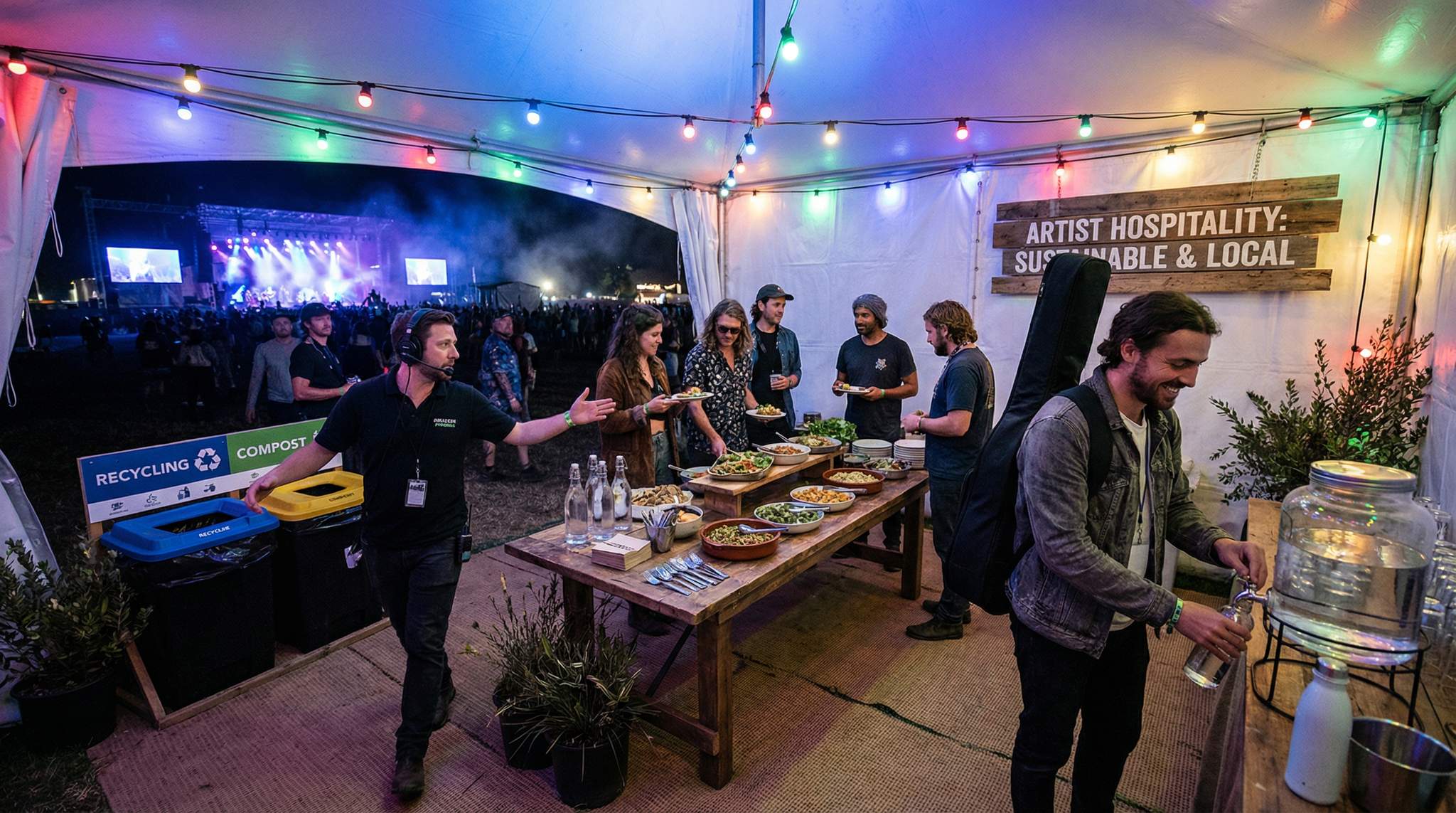
- No single-use plastics: Ban on plastic water bottles, cutlery, plates, or packaging in catering. Artists may request refillable water jugs, glassware, or canned water instead of plastic bottles.
- Farm-to-table catering: Fresh, organic, and locally sourced foods, with vegetarian or vegan options prioritized to reduce environmental impact.
- Recycling and composting setups: Clearly marked bins for recyclables (paper, plastics, cans) and food waste in dressing rooms and catering areas.
- Energy-efficient lighting and power: Use of LED lighting backstage, turning off heating/air conditioning in unused rooms, or even running on renewable power if possible (some riders specify preference for venues powered by green energy).
- Eco-friendly toiletries and cleaning products: If the green room has a shower or bathroom, artists may request biodegradable toiletries (no single-use mini bottles) and that cleaning be done with non-toxic, eco-certified products to avoid harsh chemical fumes.
- Waste reduction initiatives: Requests to donate any unused food or to avoid excess packaging (for example, bulk snack bowls rather than individually packaged snacks, and large-format condiments instead of single packets).
Meeting these modern green room requirements is no longer just a hospitality perk; it is a fundamental operational standard. Venue operators must evaluate their backstage infrastructure to ensure these baseline expectations are met consistently. Standardizing these eco-friendly green room requirements across all your venue’s contracts streamlines the advance process and prevents last-minute scrambles when a highly specific eco-rider lands on your desk.
Planning a Festival?
Ticket Fairy's festival ticketing platform handles multi-day passes, RFID wristbands, and complex festival operations.
These requests are often collectively referred to as an artist’s “eco-rider.” They demonstrate that artists are taking sustainability into account on tour – and they expect venues to partner in those efforts. In fact, many artists now attach sustainability addendums to their contracts. For example, some tours require signing onto programs like Rock and Wrap It Up’s Music Wrap, which stipulates that any prepared but uneaten catering be donated locally rather than trashed. (Over 160 major touring acts have included such clauses, from rock legends to pop stars.) The savvy venue manager should treat these green rider elements with the same seriousness as technical or hospitality requirements – they are a core part of the artist’s show criteria, not an optional nice-to-have.
Collaborating to Meet Green Requirements
When faced with eco-rider requests, communication and early collaboration are key. As soon as the rider is received, venues should engage the artist’s tour manager or production manager about the sustainability items just as they would about staging or sound requirements. Discuss how the venue can fulfill each request and clarify any ambiguities. In many cases, artists’ teams can offer suggestions or resources – they’ve likely been carrying these green practices from city to city. For instance, a tour might travel with its own reusable water bottles for the band and crew, expecting venues to provide bulk water containers to refill. Or an artist working with a sustainability nonprofit like REVERB might share a “green touring checklist” of actions for each venue (REVERB often helps tours implement measures to shrink their carbon footprint). By opening a dialogue, venue managers can show they’re on board and perhaps learn new techniques from the touring crew’s experience.
One effective approach is to designate a sustainability liaison on your venue staff – someone who specifically coordinates all green initiatives with incoming tours. This person can review eco-riders in advance and respond with a plan: listing what the venue already has in place (e.g. “we have filtered water stations and compostable cups ready for you”) and how it will address any special needs. If a request is beyond immediate capabilities, collaborate on alternatives. For example, if an artist asks for a solar-powered dressing room and your venue doesn’t have on-site solar, you might source renewable energy credits for that show or bring in a portable battery generator as a gesture. Most artists are reasonable as long as you demonstrate effort and transparency. The worst move is to agree to everything and then not deliver on show day – that can lead to disappointment or even breach of contract. Instead, be honest about constraints but proactive in finding solutions. Many eco-rider elements can be met through creative problem-solving: if you don’t have compost bins, partner with a local waste company to drop them off for the event; if local organic produce is scarce off-season, work with the artist to tweak the menu to what’s fresh and available.
Experienced operators point out that fulfilling these demands isn’t just a burden – it’s an opportunity to upgrade your venue’s operations permanently. One mid-size arena manager shared a story of a last-minute green request that became a catalyst for change: A superstar act’s team notified the venue 48 hours before showtime that absolutely no single-use plastics could be present backstage. This sent the staff scrambling – they had to rush-order reusable water jugs and metal cups, and frantically swap out plastic-wrapped catering items for alternatives. The up-front costs and stress were high, but the show went on with the artist never seeing a plastic bottle. After that ordeal, the venue decided to implement a plastic-free backstage policy for good, so they’d be ready next time (and indeed, it has saved money and hassle for subsequent shows). The lesson is clear: by anticipating and embracing eco-riders, venues can stay ahead of the curve and avoid last-minute scrambles. Viewing artists’ sustainability requests as a chance to improve can transform a potential headache into a win-win. Many veteran venue managers recommend updating your standard hospitality checklist to include green provisions – effectively internalizing common eco-rider elements as your own policy. That way, when an agent or artist inquires about sustainability, you can confidently say “we’ve got it covered.” It builds your reputation as a venue that “gets it,” which in turn attracts more artists who care about these issues.
Free Tool: Size Your Festival Site
Zoned capacity planning for arena, campsite, parking and entry lanes — against UK Purple Guide and NFPA density standards. Finds your bottleneck zone.
Turning Demands into Long-Term Benefits
Beyond satisfying a single performance, meeting eco-rider requirements can yield long-term benefits for the venue. For one, many sustainable practices ultimately save money (more on that in later sections). If an artist pushes you to switch to bulk dispensers for water and you implement it, you might find your ongoing cost for artist hydration drops significantly compared to buying cases of bottled water for every show. Similarly, providing plant-based meals might seem pricier at first, but if it reduces food safety risks and waste, your overall catering costs could stabilize. Importantly, artists talk to each other and to fans – a band impressed by your green hospitality may spread the word in the industry. It’s not unusual for tour managers to share notes about venues that did an exceptional job meeting sustainability requests. Being known as a venue that wows performers with green initiatives can become a competitive edge in booking. In contrast, venues that ignore or half-heartedly address eco-riders risk developing a poor reputation as out-of-touch. Given how passionate many artists are about climate issues in 2026, failing on sustainability can even be a deal-breaker for future bookings.
One strategy is to incorporate a brief sustainability report or welcome packet for artists on arrival. For example, some venues leave a note or poster in the green room highlighting, “This venue is powered by 50% solar energy” or “We have eliminated single-use plastics, saving 20,000 bottles annually – thank you for helping us keep it going.” It shows pride in your efforts and signals to the artist that their values are shared. When artists see a recycling station or locally sourced fruit platter without even having to ask, it creates an immediate positive impression. They realize the venue isn’t just accommodating a rider reluctantly, but has a genuine commitment. In turn, artists often respond with appreciation – sometimes even spontaneously mentioning the venue’s green hospitality on stage or on social media, which is priceless promotion. (Imagine a singer posting an Instagram story of your backstage with the caption: “Love this plastic-free green room setup!” and helping to green festival artist hospitality. That kind of organic endorsement amplifies your reputation far beyond one show.)
Need Festival Funding?
Get the capital you need to book headliners, secure venues, and scale your festival production.
In summary, understanding and adapting to eco-riders is now a core competency for venue managers. By identifying common sustainability requests, working collaboratively with tour personnel, and using each experience to improve your own operations, you turn what could be challenges into opportunities. Next, we’ll dive into specific areas of eco-friendly backstage hospitality – starting with one of the biggest wins of all: eliminating single-use plastics.
Table: Examples of Eco-Rider Requests and How Venues Can Fulfill Them
| Eco-Friendly Rider Request | How Venues Can Fulfill It |
|---|---|
| No plastic water bottles or straws | Provide jugs of filtered water and reusable bottles or cups (no disposables) |
| Plant-based, organic catering options | Source local farm-to-table ingredients; offer varied vegetarian/vegan menu |
| Recycling and compost bins backstage | Set up clearly labeled recycling bins and food compost containers in all artist areas |
| Environmentally friendly cleaning products | Use non-toxic, eco-certified cleaners for dressing rooms; avoid strong chemicals |
| Donate unused catering & reduce food waste | Partner with programs (e.g. Rock and Wrap It Up) to donate uneaten food; have a plan to compost scraps |
| Energy-efficient lighting and power usage | Install LED bulbs in green rooms; turn off lights and A/C when rooms are empty; provide renewable energy if possible |
| Locally sourced gifts or amenities | If giving artist welcome gifts, choose local artisanal products or sustainable merchandise (no plastic packaging) |
Plastic-Free Backstage: Eliminating Single-Use Waste
Hydration Without the Plastic
One of the simplest and most high-impact changes a venue can make is ditching plastic water bottles backstage. Traditionally, a band’s green room might be stocked with flats of branded bottled water on ice. In a sustainable setup, that practice is replaced by large water dispensers or hydration stations and reusable drinkware. Many venues have installed filtered water coolers in dressing room areas or provide chilled water in pitchers or jugs, accompanied by reusable glassware or metal bottles. Some even give artists a souvenir reusable bottle upon arrival, which doubles as a welcome gift. This switch alone can eliminate hundreds if not thousands of single-use bottles over a series of events. Consider that Glastonbury Festival (a much larger scale, but illustrative) prevented over 1 million plastic bottles from being used in a single weekend simply by banning their sale and providing water refill stations, a strategy that helps cut carbon and costs. While a concert venue won’t hit those numbers, it underlines how quickly the waste adds up – and how significant the impact is when you remove it.
In fact, many artists’ eco-riders specifically call out bottled water. Tours like John Mayer’s 2019 tour and others encouraged a “BYOBottle” policy, where the touring crew carried reusable bottles and expected venues to have refills instead of individual bottles, effectively helping to eliminate unnecessary single-use plastics. Across that tour’s venues, this reportedly avoided over 100,000 disposable bottles that would have otherwise been used. Venues can meet such requests by stocking dressing rooms with water jugs (refilled from tap filters or large gallon containers) and plenty of clean glasses or aluminum canned water (which is recyclable) if reusables are an issue. The cultural shift is remarkable – veteran staff note that where once an artist’s room automatically had a dozen plastic water bottles, now it’s normal to see a couple of glass carafes of water and a stack of cups. Artists have adapted too; most arrive with their own favorite reusable bottle in hand.
Free Tool: Project Your Bar Revenue
Per-head spend benchmarks by event type turned into projected bar and food revenue, with a stock-mix estimate and gross-margin line. Free calculator.
Major venues are adopting this en masse. Red Rocks Amphitheatre in Colorado and the Hollywood Bowl in Los Angeles, for example, have installed dozens of public hydration stations and simultaneously stopped selling single-use plastic water bottles, a move that reduces single-use waste streams. Backstage, they extend the same policy – providing refill points for performers and crew. It’s a move that’s been welcomed by artists and also by venue accountants: the Hollywood Bowl estimated significant savings by not purchasing tens of thousands of bottles each season (instead investing in bulk water and dishwashing). To ensure a smooth transition, many venues keep a small stock of alternatives like boxed water or canned water (in aluminum) for any artist truly not comfortable with tap water – but these are recyclable and still avoid plastic. The goal is to make single-use plastic water bottles essentially extinct backstage, and in 2026 that goal is within reach.
Beyond water, think about other beverages and how to eliminate plastic from them. If you provide sodas or juices, offer them in cans or glass bottles instead of plastic bottles. For alcohol, this is usually straightforward (beer in cans or glass, spirits in glass). For mixers or any drink typically in plastic, seek out alternatives or concentrate syrups to mix with carbonated water on-site. Even the ice bucket can come into play – ensure you’re not using plastic ice bags; use re-usable ice trays or get ice in bulk delivered without single-use plastic when possible. These details show a thorough approach. The cumulative effect is huge waste reduction and a visually plastic-free hospitality area that immediately signals “this venue walks the talk”.
Reusable Serveware and Compostable Alternatives
Plastic reduction goes beyond beverage containers. A typical backstage spread might involve plastic cutlery, Styrofoam or plastic-coated plates, and lots of plastic wrap or packaging on food. Transitioning to reusables is the ideal solution where practical. Experienced venue chefs and hospitality leads often outfit green rooms with real dishware, metal cutlery, and glass cups – just like you’d have at home or in a restaurant. If your venue has a kitchen or dishwashing capacity, this is a no-brainer. You can serve artist meals on proper plates and collect them after. Many smaller clubs have even found creative partnerships, like working with a local dishware rental service or sharing resources with a nearby cafe for washing dishes after shows. As a bonus, real plates and silverware tend to give a classier feel, upgrading the artist experience.
Of course, real reusables aren’t feasible for every venue or every situation (some venues lack kitchens, or occasionally a touring crew wants disposable for convenience). In those cases, compostable serveware is the next best thing. Modern eco-disposables – made from materials like bagasse (sugarcane fiber), bamboo, or PLA bioplastics – can handle everything from hot meals to soups, then break down in compost. Venues should ensure that if they provide compostable plates and utensils, they also provide a means to compost them (otherwise they might end up in the trash, defeating the purpose). This means having a compost bin backstage and a service to collect it. Some regions have industrial compost facilities that will pick up from venues; in other areas, venues partner with local community gardens or farms to take their compostable waste. It might sound like extra work, but many venues report it’s quite manageable – the key is training staff to sort correctly and informing artists that, for example, “all our cups and plates are compostable – please toss them in the green bin.” When everyone knows the system, it becomes second nature.
A number of influential venues have led by example here. In Europe, several arenas and theaters have moved entirely to plant-based compostable cups and cutlery, especially since single-use plastic bans are in effect. The historic Teatro Colón in Buenos Aires switched all its concession and backstage food containers to compostables and coordinated with the city for pick-up, aligning with a municipal zero-waste goal. And festivals via the Drastic on Plastic campaign in the UK proved that even large-scale events can eliminate items like plastic straws, stirrers, and disposable cutlery entirely. Those festival practices are trickling down to clubs and venues: it’s increasingly standard in 2026 that you won’t find a plastic straw in your backstage cocktail or a foam plate under the band’s dinner.
Beyond tableware, consider food packaging and presentation. Avoid individually wrapped servings when possible. Instead of a tray of vegetables with each portion in a plastic cup, present them on a single platter (with proper hygiene of course). Use reusable or biodegradable food wrap instead of cling film for covering dishes. For example, some venues now use beeswax wraps or silicone lids to cover bowls of snacks or prepared salads. If catering is delivered from outside, you can request the vendor use large reusable containers or foil trays (which can be recycled) rather than lots of small plastic ones. Many caterers are happy to comply, especially if they specialize in green events. It may help to write into your standard catering agreements that no Styrofoam or hard-to-recycle plastics should be used in packaging deliveries. Over time, you’ll develop a roster of preferred vendors who know the drill.
Keep Tickets in Fans' Hands
Our secure resale marketplace lets attendees exchange tickets at face value, eliminating scalping while keeping you in control of the secondary market.
The bathroom and dressing room amenities are another place to eliminate single-use plastics. If artists have showers backstage, switch out travel-size shampoo and soap bottles for bulk dispensers or bars. Provide towels and linens that can be washed, not single-use wipes or paper towels (at least for personal use items – obviously paper towels might still be needed for cleaning up messes, though there are reusable cleaning cloth systems for that too). Some venues have started providing reusable toiletry kits for artists with items like metal razors (with fresh blades), washable slippers instead of disposable ones, etc., especially in high-end hospitality situations. This level of detail might exceed what many venues can do daily, but it’s a glimpse of how far the plastic-free ethos can go.
Overall, moving to reusables and compostables in the green room is highly achievable with a bit of planning. It can even save money: the Javits Center in New York (a large convention venue) introduced a reusable cup system for events and found it not only slashed waste but saved money over buying thousands of disposables each month. Venues that invest in a stock of durable cups, plates, and cutlery may spend a few hundred dollars up front, but then reuse them for years – whereas buying disposables for every show is an endless expense. And if washing is a concern, there are now services that will rent out reusable cup systems and handle off-site sanitization (common in Europe and spreading elsewhere). The bottom line: eliminating single-use plastic backstage is one of the best “quick wins” on the road to sustainability, and it’s something fans and artists alike will notice and appreciate.
Going Plastic-Free: Don’t Forget the Details
To truly maintain a plastic-free backstage, venue managers have to think a bit broadly about what enters the green room. It’s easy to swap out water bottles and cutlery, but smaller items can sneak in plastic waste if you’re not careful. Snacks and catering extras are a prime example. Those convenient single-serve packets of ketchup, mustard, mayonnaise, salt, and pepper – they’re all single-use plastics or foil/plastic laminates. A sustainable green room should replace these with condiment stations or reusable containers. For instance, use glass bottles for ketchup and sauces, shakers for salt and pepper, and small bowls or dispensers for things like olive oil or salad dressing. The same goes for coffee and tea: avoid single-serve creamers or sugar packets, and opt for a small pitcher of milk (dairy or non-dairy) and a sugar jar. Tea bags often come individually wrapped in plastic; you can source compostable tea bags or present a selection of teas in a wooden box without the wrapper. These touches reduce a surprising amount of plastic and foil waste, and actually give the backstage a more upscale, personal feel compared to ripping open packets.
Another overlooked area is artist gifts or promo items that venues sometimes leave in the green room. If you welcome artists with a gift basket, make it a sustainable one. Use a reusable tote or woven basket rather than shrink-wrapped cellophane. Choose items that generate less waste: for example, a reusable metal water bottle with the venue’s logo (instead of a plastic trinket), snacks in recyclable or paper packaging, or locally made products with minimal wrapping. If you include a T-shirt or piece of merch, consider using organic cotton or recycled material shirts and avoid individually poly-bagging them, perhaps presenting them in a reusable tote bag. It’s all about consistency – an artist will find it odd if the venue touts “we don’t do plastic bottles” and then hands them a gift bag full of plastic-wrapped goodies.
Even cleaning supplies and trash liners can be addressed. Use large trash bins with biodegradable liners for collecting any waste in the green room. Ideally, if your waste management is good, you’ll have very little actual trash – mostly recyclables and compostables – but whatever garbage is produced, better to line bins with compostable bags than traditional plastic ones. For recycling bins, you might choose not to line at all (dump contents directly into larger recycling dumpsters) or also use clear compostable liners. Cleaning wipes and sprays can often be a source of plastic waste or harsh chemicals; using washable cloths and concentrated eco-friendly cleaners is a smarter choice that also protects air quality backstage.
Finally, engage vendors and crew in the mission. If a caterer knows you have a strict plastic-free policy, they’ll adjust how they deliver food (no more cling film and plastic platters, perhaps they use foil and metal lids that you return). Likewise, make sure your own staff and any freelance stagehands or runners are briefed: if someone runs to the store to fulfill a hospitality request, they should avoid buying plastic-wrapped or Styrofoam-packaged items. This might involve minor changes like choosing paper plates over plastic if an artist asks for extra, or picking aluminum foil over plastic wrap. Small decisions at the last minute can otherwise undermine your efforts, so build a culture where everyone is thinking “is there a greener way to do this?”
Boost Revenue With Smart Upsells
Sell merchandise, VIP upgrades, parking passes, and add-ons during checkout and via post-purchase emails. Increase average order value by up to 220%.
By sweating these details, your venue can achieve a truly plastic-free (or at least plastic-minimal) backstage environment. Not only does that drastically cut down waste and comply with emerging laws, it sends a powerful message to artists. Walking into a green room that lives up to the name – no disposable plastics in sight – has an almost psychological effect. Performers often comment that it feels cleaner and more respectful, knowing that the venue made an effort to avoid trashing the planet on their behalf. And as mentioned, artists will talk: being the venue that “banned single-use plastics backstage and still delivers top-notch hospitality” is going to spread via tour managers, encouraging more acts to play your stage. It’s hard to put a price on that kind of reputation boost.
Sustainable Catering and Local Sourcing
Farm-to-Stage: Local and Seasonal Menus
Food is a central part of artist hospitality, and greening the green room starts in the kitchen. One of the most impactful changes venues can make is shifting to locally sourced, seasonal catering for artists. “Farm-to-table” isn’t just a trendy restaurant concept – it can be applied to backstage catering with great success. By sourcing ingredients from local farms, bakeries, and producers, venues reduce the carbon footprint associated with transporting food long distances. It also often means fresher, higher-quality meals, which artists certainly appreciate. For venue managers, building relationships with local suppliers can even lead to cost savings or sponsorships (e.g. a local organic farm might offer a discount or promotional deal in exchange for mentions or tickets, offsetting costs).
In practice, local sourcing might involve planning menus that highlight what’s in season in your region. For example, instead of flying in exotic fruit in winter, a venue in the UK might serve a hearty vegetable soup with local squash and carrots, accompanied by fresh bread from the bakery down the street. In California in summer, it could be salads and fruit bowls bursting with produce from nearby farms. The key is communicating with tour catering advance: find out artists’ dietary preferences early and design a menu that fits those needs with available seasonal items. Most artists will be excited to try local specialties – it gives them a taste of the region and demonstrates thoughtfulness. A famous case is how some venues in the U.S. Pacific Northwest started serving wild-caught local salmon or farm-fresh berry desserts to visiting artists, rather than generic catered dishes. Not only did this reduce transport emissions, it garnered rave reviews from the performers for the authentic experience.
Local sourcing also means fewer packaged and processed foods. Rather than stocking the green room with brand-name snacks that traveled hundreds of miles, you might include items from the local farmers’ market: a basket of organic apples, locally roasted nuts, or artisanal cheeses from nearby dairies. One small venue in Vermont famously partners with a local farm co-op to deliver fresh produce on show days – artists get to enjoy just-picked cherry tomatoes or cider from an orchard next door. These kinds of touches stand out. They transform hospitality from a cookie-cutter rider checklist into a memorable experience. Artists have been known to remember venues by the great local food they had there. This creates goodwill and positive word-of-mouth.
That said, local and organic can be more expensive, so it requires savvy management to stay on budget. Strategies include planning portions carefully to avoid overspending on pricey organic goods (tie this with waste reduction – serve a reasonable amount, not heaping platters that end up thrown out). Also, diversify the menu with cost-effective sustainable staples: seasonal vegetables (often cheaper at peak season), grains, legumes, and plant proteins are generally affordable and environmentally friendly. Using meat more as a garnish or side rather than the centerpiece can control costs while still keeping meat-eaters satisfied. For example, instead of offering steak for dinner (high cost and high carbon footprint), a venue might provide a delicious vegetarian curry and a smaller side of locally sourced roast chicken – fulfilling the rider’s protein request but emphasizing low-impact ingredients.
Plant-Based and Low-Carbon Menu Options
Globally, there’s a push to reduce meat and dairy consumption to lower carbon emissions, and this is reflected in artist hospitality as well. Plant-based catering has soared in popularity backstage. Many artists and crew are vegetarian or vegan themselves, or at least open to plant-forward meals on tour for health and environmental reasons. Even those who aren’t vegetarian often appreciate a break from heavy, meat-laden catering, which can be a relief on long tour schedules. Venue managers should be prepared to provide hearty, satisfying plant-based meals that don’t feel like an afterthought but rather a highlight of the menu.
Smart Promo Codes & Presale Access
Create percentage or flat-rate discount codes with usage limits, date ranges, and ticket type restrictions. Plus unlock codes for private presales.
Designing low-carbon menus means emphasizing fruits, vegetables, grains, and plant proteins (like beans, lentils, tofu, tempeh, or newer plant-based meat substitutes) and de-emphasizing resource-intensive foods like beef or lamb. Reducing meat isn’t just good for the planet – it can save money too, since produce and legumes are generally cheaper per serving than cuts of meat. A win-win scenario is when an artist’s eco-rider explicitly asks for vegetarian or vegan catering; you’re meeting their demand and controlling costs simultaneously. But even if it’s not mandated, including at least one lavish plant-based dish in every meal spread is a wise move. For instance, you might serve a vibrant stir-fry with local vegetables and tofu, a rich vegan pasta with seasonal pesto, or a protein-packed salad with quinoa, nuts, and roasted veggies. These dishes can stand proudly next to any meat options.
When meat or dairy is on the menu, opt for quality over quantity and sustainability over convention. If you’re providing chicken or beef, see if local free-range or organic options are available – they are often raised more sustainably (though still higher footprint than plant foods). Use smaller portions of meat within mixed dishes (like a beef stew loaded with veggies rather than steaks, or chicken fajitas heavy on peppers and onions) to stretch it further. Offer plant-based milks (oat, almond, soy) alongside dairy for coffee and cereal; these have much lower emissions. In fact, many artists now specifically request non-dairy milk due to either dietary preference or environmental concern. It’s easy for venues to stock a few shelf-stable cartons of oat milk, which have become mainstream.
Training your catering team or chef on these principles is crucial. They might need to develop new recipes or adapt old ones to exclude animal products. There are resources available – for example, the nonprofit REVERB’s Green Rider guide emphasizes that cutting or eliminating meat is one of the single most effective dietary changes for reducing a tour’s carbon footprint (reverb.org). Armed with this knowledge, chefs can get creative to ensure the food is both eco-conscious and crowd-pleasing. Feedback from artists is often positive; many report that the best meals on tour were the inventive vegan dish or the flavorful local veggie spread, because it was a welcome contrast to the usual fried foods or heavy steaks they might get elsewhere. A notable anecdote comes from an Australian arena where the catering team introduced “Meatless Mondays” for any shows at the start of the week – initially met with some skepticism, it ended up being quite popular as bands discovered new favorite foods (and the venue saved a chunk of money on meat those days too!).
Of course, flexibility is key. Not every artist is vegan and riders still often include meats or specific comfort foods. The sustainable approach is balance: fulfill the artist’s must-haves, but round out the menu with green options. If a band really wants burgers, you could provide locally farmed beef patties and a plant-based Impossible™ or bean burger alternative, letting people choose. Encourage tasting of the sustainable options by making them attractive and delicious, not just an obvious token salad. In this way, you meet all needs and quietly nudge greener choices.
Reducing Food Waste Backstage
Sustainability in hospitality isn’t only about what you serve, but also what happens to the leftovers. Food waste is a huge environmental issue – discarded food represents wasted resources and produces greenhouse gases in landfills. Venues can play a role in mitigating this by implementing smart practices to reduce and repurpose excess food from backstage.
Firstly, careful planning can minimize over-catering. Use your historical data and headcounts to cater appropriately for the size of the artist group and crew. It’s tempting to overdo it to be hospitable, but endless trays of uneaten sandwiches benefit no one. Many experienced venue hospitality managers have fine-tuned the art of just enough: providing plenty so no one goes hungry or feels restricted, but not so much that half the spread remains untouched. Communicate with tour managers about timing (e.g., if you know the band often eats light before performing and more after, adjust quantities accordingly rather than putting out a huge pre-show meal that gets wasted). Additionally, ask in advance about preferences – no need to offer a deli platter and a full hot meal and five sides if you learn the group usually keeps it simple.
Despite best efforts, there are usually some leftovers. That’s where donation and reuse steps in. Many venues partner with local charities or food recovery programs to donate unserved, safe-to-eat food at the end of the night. For example, the program Rock and Wrap It Up! (and its Music industry branch “Music Wrap”) will facilitate picking up untouched catering and delivering it to homeless shelters or community kitchens. In the U.S., the Good Samaritan Food Donation Act protects donors from liability when donating in good faith to nonprofits, which has helped such partnerships flourish. As a venue, you might arrange that any pans of food or boxed meals not opened go directly into a fridge and are collected by a charity the next morning. Some venues even coordinate immediate post-show pickups – a local soup kitchen might send a van at 11pm to take the day’s leftovers. This not only cuts waste but also generates positive community impact, which can be great for public relations. (It’s hard to criticize a venue that’s feeding the hungry with last night’s dressing room spread!). Make sure to discuss in the artist advance if you plan to donate leftovers; virtually all artists are happy to support it, and many will enthusiastically approve. A few might even have it in their rider that you should donate extras – about 160 touring artists have that stipulation thanks to programs like Music Wrap.
For food that can’t be donated (e.g., anything already served or perishable items that have been out for a while), composting is the next line of defense. Setting up a compost bin in the kitchen and backstage for food scraps (banana peels, coffee grounds, etc.) ensures that organic waste returns to the earth rather than rotting in a landfill. Many venues now separate food waste as diligently as recycling. If you’re in a city with commercial composting, use it; if not, perhaps a local farm could use your veggie scraps for their compost heap. Even small-scale, some venue staff take compostables home to their own bins – every bit helps. A clean, lidded container in the catering area labeled “Food Scraps for Compost” will cue everyone to pitch apple cores or salad trimmings in there instead of the trash. Over a year, this can divert a significant volume of waste. Some venues track this and share stats like, “We composted 1,000 pounds of organic waste last year,” which impresses both artists and stakeholders.
Another tactic is reusing unopened items for future shows, when safe to do so. For example, if you bought 10 unopened jars of gourmet salsa for an artist and only 3 were used, those remaining jars (if within expiry) can be kept in storage for the next event that could use them. Be mindful of hygiene and appearance – don’t reuse anything that was put out on a buffet or could be seen as “secondhand” to the next artist. But pantry items, drinks, or sealed snacks are fair game to avoid throwing them out. Keep an organized inventory; some venues have a “hospitality closet” where extra non-perishable rider items (chips, candies, beverages, etc.) are stored and rotated into the next rider as appropriate. This prevents the common scenario of dumping unused but perfectly good food after each show. Just make sure the stock is regularly checked for freshness.
Lastly, engage the artists and crew in your waste-reduction ethos. A simple note by the catering table can say, “Feel free to pack up any leftovers for your bus – we aim to leave no waste! If you need containers, ask us.” Often crew members or opening bands would love to take a late-night snack or tomorrow’s lunch from the spread rather than see it tossed. Providing some reusable or compostable take-away containers backstage can encourage this. It’s a hospitable gesture and ensures food gets eaten, not binned. One indie venue in Toronto places a stack of compostable to-go boxes in the dining area with a sign “Help yourself – Waste not, want not!” Performers have appreciated the chance to grab a bite for the road, and it minimizes clean-up waste.
By closing the loop on food waste, venues complete the sustainable catering picture. It’s about thoughtful consumption from start to finish. The results speak for themselves: less garbage hauled away (saving on disposal costs), a lighter environmental footprint, and a story to tell artists and fans about how “this venue not only serves great food, they make sure none of it is wasted.” In an era where both tours and audiences are paying attention to issues like food insecurity and climate change, these backstage efforts truly resonate.
Energy-Efficient Amenities for Backstage Comfort
Lighting the Green Room Efficiently
Backstage areas have plenty of electrical needs – lights, mirrors, sound systems for warm-up music, maybe a TV, mini-fridge, etc. Upgrading to energy-efficient equipment can substantially cut a venue’s power use and align with artists’ eco-expectations. The simplest starting point is lighting. Replacing traditional incandescent or halogen bulbs in dressing rooms and corridors with LED bulbs can reduce electricity consumption by up to 75% for those fixtures. LEDs also emit less heat (helpful in tight backstage rooms) and last many times longer, meaning fewer burnouts mid-show. Savvy venue managers swapped out bulbs years ago, but if any old lighting remains, now is the time to finish the job. Importantly, choose warm-color, high-CRI LED bulbs especially for dressing room vanity mirrors – these give a flattering light similar to old incandescent makeup lights but with a fraction of the energy draw. There were initial complaints some years back that LEDs felt too harsh, but today’s quality LEDs can mimic the softness of incandescent glow perfectly. In fact, one historic theater in Australia did a full retrofit of their dressing room marquee lights with LEDs and found that not a single artist noticed a difference in ambiance – except that the rooms were cooler and the building’s energy bill dropped.
In addition to bulb swaps, install smart controls where feasible. Motion sensors or timers for lights in rarely used areas (like storerooms or hallways) ensure they’re not burning power all day. Dimming systems can be used to reduce lighting levels in lounges or when full brightness isn’t needed, which saves energy and adds a relaxed vibe. Some venues issue crew and artists a simple note, “Please turn off lights and AC when you leave the room” – but technology can assist so it’s not left to memory. At a larger scale, some new performing arts centers integrate their backstage lighting into building automation systems that automatically power down non-essential lights after a certain hour or when a room is unoccupied for 15 minutes. Even a modest music club can put something like a $20 occupancy sensor switch in the crew bathroom or green room hallway. These little improvements all add up across dozens of events.
Another consideration is the equipment and appliances used backstage. Items like refrigerators, coffee makers, microwaves, and space heaters can be energy hogs if they’re outdated. Investing in an Energy Star-rated mini-fridge for the green room, for example, means it will use significantly less electricity (and often be quieter and more reliable). The same goes for ventilation fans or portable AC units sometimes used in older venues – newer models are far more efficient. Keep an eye on “phantom load” too: all those plugged-in phone chargers, idle TVs, and standby electronics draw power even when not in use. A smart practice is to plug clusters of devices into power strips with switches, so at the end of the night or when the area is not in use, one flip cuts power to everything and eliminates standby drain. Train your tech crew or cleaning staff to routinely turn those strips off for the dressing rooms once the show is over or during dark days.
For venues with illuminated marquees or lots of stage lighting, mention of LED upgrades usually focuses on the front-of-house spectacle. But applying the same to backstage is equally important, if less glamorous. It shows a comprehensive commitment. Artists may not see the difference directly, but they’ll notice indirectly – for instance, an LED-lit makeup mirror that doesn’t scorch their face with heat while prepping, or not having breakers trip because old lights were overdrawing circuits. And from the business side, lowering backstage power consumption shaves utility costs. Some venue managers have calculated that just changing out green room and hallway lights and a few appliances trimmed their annual electric bill by several percentage points. Over the long run, these savings can fund other sustainability projects (or just improve the bottom line in tight years). As energy prices rise in many places, efficiency is a financial safety net as well as an environmental strategy.
Smart Climate Control and Water Savings
Maintaining a comfortable environment for artists is a core part of hospitality – nobody wants a sweaty, sweltering green room or an ice-cold dressing area. But comfort doesn’t have to come at the expense of efficiency. Smart climate control can keep temperatures pleasant while avoiding energy waste. Venues should ensure that heating, ventilation, and air conditioning (HVAC) systems backstage are modern and well-maintained. Old HVAC units can guzzle power and run inconsistently. Upgrading to high-efficiency models, or even ductless mini-split systems for specific rooms, lets you precisely control climate in each space and use less electricity or fuel. Importantly, incorporate thermostat controls or smart thermostats that can be scheduled. For example, you might program the dressing room thermostat to a moderate setting during show load-in and soundcheck, bump it a bit cooler when the artist arrives and is active, then automatically ease off overnight when the rooms are empty. Forgetting to adjust the thermostat is common – a smart system does it for you, ensuring you’re not blasting AC in an empty room at 2 AM.
Many venues have found innovative ways to reduce HVAC needs. One trick is improving insulation and sealing drafts in backstage areas (some older theaters are notoriously drafty). Investing in basic weatherstripping or window caulking can keep conditioned air in and reduce how hard your systems work. Another tip: use fans and natural ventilation when appropriate. If the season and security permit, venting a hallway or using a quiet oscillating fan can sometimes replace cranking the AC. Conversely, providing small energy-efficient space heaters in winter for specific spots might be smarter than heating an entire wing. It’s about zoning – heating or cooling only where and when needed. Educate your staff or even the artists: if a band knows the venue is eco-conscious, they might be more willing to throw on a hoodie backstage instead of asking for the heat to be turned up to tropical levels. (Many will anyway prefer moderate settings; it’s often venue crew who, out of habit, max things out without thinking of the waste.)
Water conservation is another backstage consideration, albeit one that often flies under the radar. If your venue has showers for artists or any sinks, installing low-flow faucet aerators and efficient showerheads can cut water use significantly without diminishing experience. Modern low-flow fixtures are quite good – artists likely won’t notice a difference in water pressure, yet you might cut water usage in half. Some venues also use motion-sensor faucets in bathrooms to prevent taps being left running (common during the rush of pre-show or when cleaning up). While water use backstage is typically small compared to the whole venue (especially if audiences have restrooms), every drop counts in a sustainability plan. Moreover, in areas facing water scarcity or high utility costs, these measures are increasingly vital. A few venues have taken it further: implementing greywater systems where sink/shower water is captured to flush toilets. That’s a bigger infrastructure move more applicable to new builds or major renovations, but it shows the direction things are headed.
Don’t overlook water heating efficiency either. If a dingy water heater from 1990 is still serving your backstage, it’s likely inefficient and perhaps wasting energy keeping water hot 24/7. Upgrading to a modern tankless water heater or an Energy Star storage heater can save energy and ensure ample hot water when artists need a post-show shower. Tankless systems heat water on demand, using far less energy during idle times – ideal if showers are only used occasionally. Some venues even have their water heaters on timers, so they’re not maintaining heat all night when no one is around (be careful with this approach; you need to always have hot water during occupancy, but it could be turned down in overnight empty periods). Additionally, insulating hot water pipes prevents heat loss, delivering hot water faster and avoiding waste while people run the tap waiting for it to warm up.
In short, a holistic approach to climate control and plumbing backstage can yield a venue that’s cozy for artists yet lean on resource use. Many improvements in this area are “invisible” – artists won’t specifically praise your efficient boiler or insulated walls. But they will notice the outcomes: a reliably comfortable room, no strange drafts, hot water that doesn’t run out, etc. Meanwhile, you’ll know that behind the scenes your systems are optimized to avoid energy and water waste. Given that energy costs keep rising, these efficiencies have direct financial returns too. One venue manager reported that after optimizing their backstage HVAC and water systems, they saw about a 15% reduction in utility costs for those areas – significant in an industry where margins are thin. And it all contributes to your venue’s overall carbon footprint reduction, an important metric if you’re tracking progress or aiming for certifications.
To track these efficiencies, many venue managers are turning to digital monitoring tools. Utilizing an energy management dashboard or a specialized ecotweaks app allows your facility team to monitor backstage power and water consumption in real-time. These applications help identify phantom power drains and optimize HVAC schedules, ensuring your climate control strategies are actually delivering the projected utility savings.
Tapping Renewable Energy Backstage
For venues looking to go the extra mile, integrating renewable energy into operations is a powerful step – and it can directly extend to backstage hospitality. One obvious route is sourcing green power for your venue. Many utility companies now offer options to purchase electricity from renewable sources (wind, solar, hydro) for a slight premium. By opting into those programs, a venue can essentially run the entire show, including backstage, on renewable energy from the grid. It’s largely an administrative change – but it allows you to tell artists your power is green. Some artists explicitly ask venues to do this in their riders, and will even pay the difference (or buy carbon offsets) if needed. However, the cost difference these days is often minimal, and the goodwill it generates is significant. Imagine being able to say: “Our venue is powered by 100% renewable electricity.” That’s a compelling statement in 2026 and will meet even the most demanding artist’s sustainability rider on energy use.
Venues with the ability to invest in infrastructure have installed on-site renewable systems. Solar panels on the roof are a common choice. These can often cover a chunk of daytime power usage, or at least serve to run some of the backstage operations, like office and hospitality loads. Some performing arts centers and arenas have arrays that generate a sizable portion of their needs – for example, the famous Red Rocks Amphitheatre has added solar panels to help power its visitor center and backstage facilities, reducing reliance on the grid. Even if a full solar install is out of reach, smaller off-grid solutions can be symbolic and practical. One creative example: a mid-sized venue in Germany set up a small solar panel and battery system specifically to power the green room’s lighting and electronics. The system recharges during the day and then for an evening show, all the lamps, phone chargers, and even the TV in the artist lounge run off the battery – effectively solar-powered hospitality. Artists find it novel and laudable. While this mini-system didn’t drastically cut the venue’s overall footprint, it created a conversation piece and showed commitment (plus provided a backup power source for critical needs if the grid ever blinked, which was a nice resilience bonus).
Another aspect is working with artists who have their own renewable energy initiatives. Some tours now carry portable clean energy solutions – such as biofuel generators, portable solar panels, or kinetic energy floors that generate power from dancing fans (Coldplay’s recent tours famously did this for powering parts of the show). As a venue, you can facilitate and coordinate with these efforts. If a band says “we’d like to plug into renewable power if available,” be ready to provide access to any on-site generation you have, or to accommodate their equipment. For instance, a festival venue might allocate space for the tour’s solar panels backstage or help connect a biodiesel generator safely. It may not be common among all acts, but such requests are becoming more frequent as technology advances. Being the venue that enthusiastically supports an artist’s green tech – rather than one that says “nah, just use the wall power” – sets you apart.
Even without on-site renewables, venues can indirectly tap into green energy by investing in carbon offsets or RECs (Renewable Energy Certificates) equivalent to their energy use. Some venues calculate the carbon footprint of a concert (including backstage electricity, maybe even audience travel) and purchase verified offsets to make the event “carbon-neutral.” If you choose this route, be sure to pick reputable offsets (e.g., Gold Standard or Verified Carbon Standard projects) and be transparent about what they support (e.g., reforestation, wind farms, etc.). While offsets aren’t a substitute for direct reductions, they show willingness to take responsibility for emissions that can’t yet be eliminated. An artist with a climate mission will appreciate a venue that says, “We offset the remaining CO2 from your show to ensure it’s carbon-neutral.” It aligns with the direction tours are heading – for instance, Massive Attack and Billie Eilish have engaged in carbon analyses and offsets for their tours, as noted in studies highlighting live music’s biggest climate challenges, and they encourage venues to do the same.
The ultimate example of renewable integration is venues built or retrofitted to rigorous sustainable standards. Seattle’s Climate Pledge Arena is a headline case: it’s the world’s first certified zero-carbon arena, running on 100% renewable electricity, with no fossil fuel in operations, and targeting zero waste, setting a standard for sustainable sports stadiums. They even have on-site solar panels and use collected rainwater to make the ice for hockey games – a very tangible green touch. While most venues can’t replicate that scale, it shows what’s possible. If an arena of 17,000 capacity can eliminate fossil fuels and achieve a >90% waste diversion rate, as seen when Climate Pledge Arena achieved TRUE certification, then certainly a theater or club can manage to power some LED lights with solar or swap a diesel generator for a cleaner option. The direction of travel is clear: the venues of the future aim to be part of the climate solution, not contributors to the problem. Backstage efforts are a piece of that puzzle.
In summary, energy efficiency and renewables in the backstage context both cut costs and demonstrate leadership. Artists may not directly see your energy bills, but they will notice when a venue aligns with their low-carbon touring ethos. Whether it’s bragging that the dressing room lights are solar-powered or simply having an HVAC that doesn’t roar like a jet engine (because it’s new and efficient), these improvements make a difference. And as grids get greener, venues that proactively embrace renewable energy will find themselves ahead of regulations and enjoying positive press. Some local governments even offer grants or rebates for venues investing in solar panels, battery storage, or efficiency upgrades, which can help offset costs for sustainable initiatives and attract sponsorship for green projects – it’s worth exploring those funding avenues, which we’ll touch on later. All these steps reinforce the message to artists: this venue shares your commitment to sustainability, right down to how it powers the amps and lights.
Backstage Waste Management and Recycling
Setting Up Recycling and Compost Stations
Even with all the waste prevention measures discussed (no plastics, less packaging, etc.), running events will inevitably generate some waste. The crucial next step is responsible waste management: make it as easy as possible for artists and crew to recycle and compost backstage. This starts with setting up clearly marked recycling stations in all backstage areas where waste is generated – dressing rooms, production offices, catering areas, and green rooms. At minimum, provide separate bins for recyclables and landfill waste; ideally also one for compostable waste if food is present.
The labeling of these bins should be extremely clear, possibly multilingual (if you host international tours) and using visuals. For example, a blue bin with a recycling symbol and a list/pictures of what can go in (cans, plastic bottles if any, paper) and a black or gray bin for “Waste – Last Resort (Landfill)” indicating what should only go there. If you add a green bin for compostables, label it for “Food Scraps & Compostableware Only – No Plastic” or similar. Early adopting venues sometimes put informative signs like “We recycle 90% of our waste – please help us hit 100%!” which nudges compliance. During load-in, you can even point out to the tour manager, “Here’s our recycling setup – we try to recycle or compost everything possible.” Such cues signal seriousness. Some artists have specific requirements here – a few big tours travel with their own color-coded waste bin system and might ask venues to follow suit. But usually they’ll be happy to see you already have a system.
Placement of these bins matters. They should be right next to any regular trash can – never leave a lone trash can without a recycling buddy, or everything tends to end up in the one bin. In green rooms, a recycling bin for bottles/cans and a small one for food waste (if applicable) should be as commonplace as the trash bin under the sink. If catering is done in a central dining area, ensure a full recycling/compost setup is available where people bus their dishes. One festival reported that when they simply put a compost bin in the artist lounge with a sign, they collected hundreds of pounds of food waste that previously would’ve gone in trash – artists used it when it was obvious and convenient, a simple step in greening festival artist hospitality and reinforcing an organized recycling setup. The same logic applies in venues.
It’s also wise to assign staff responsibility for managing these bins. Have a cleaning crew or designated green team member periodically check and empty recycling and compost receptacles during the event. This prevents overflow (nothing derails good intentions like an overflowing recycling bin – people will just toss recyclables in trash if they see a mess). It also allows for correcting any contamination: staff can pull out obvious contaminants like a plastic cup in the compost bin or a greasy pizza box in recycling, to keep streams clean. Some venues take the extra step of sorting trash after shows to salvage recyclables – a messy job, but it can dramatically boost your diversion rates. However, training everyone (crew, catering, artists) to sort properly in the first place is the preferred route.
Consider providing gentle reminders or signage to artists about waste. A small discreet sign on the green room wall might say, “We are proud to be a nearly zero-waste venue. Please help us recycle and compost – bins provided. Ask us if you’re not sure where something goes!” This invites participation without being preachy. Many artists will gladly cooperate; they’re used to recycling on the road, especially those from regions where it’s mandated. Some tours even bring their own reusable dishware and just need a place to wash it – accommodating that will further cut disposables. One notable example: Jack Johnson’s tours have long been famously green, and venues often recount how his crew would work with local staff to ensure every recycling opportunity was taken, even backstage. If you show that level of enthusiasm, such artists will be thrilled and likely give positive feedback to promoters about your venue.
Handling Special Waste: Batteries, Lamps, and More
While food, paper, and packaging make up the bulk of backstage waste, there are often special waste streams to handle sustainably as well. One common item on tours is batteries – for wireless microphones, in-ear monitors, effects pedals, etc. Some artists still use lots of disposable batteries nightly. An eco-forward venue can help by providing rechargeable batteries and chargers for touring crews to use, or at least by collecting used batteries for proper recycling. If you hand an audio engineer a fresh set of rechargeables and mention you recycle any disposables, they’ll know you’re on top of it. At minimum, have a small bin for “Used Batteries” backstage rather than letting them go in the trash – and then take those to an appropriate e-waste facility or battery collection program (many electronics stores or municipal centers take them). It keeps toxic metals out of landfills and again shows artists you care about every facet of sustainability.
Light bulbs are another. If you’ve replaced lighting with LEDs, you might seldom need to change bulbs, but when you do, ensure any fluorescent or other hazardous bulbs are disposed of properly (per regulations). Keep those away from general trash. Same with broken equipment or electronics: an old amplifier, a burned-out fog machine, etc., should go to e-waste recycling, not the dumpster. Though this is more a production issue than hospitality, it’s worth noting as part of an overall green operation. Tours sometimes have weird waste like set piece materials, costume scraps, or excess merchandise. If an artist asks, “Can we dump this broken guitar amp or this pallet of cardboard here?”, a green-minded venue will say, “Yes, we’ll handle it responsibly,” rather than leaving them to toss it. It might involve taking items to the local recycling center or donating equipment to a charity if fixable. It’s extra work, but it reinforces your venue’s full-spectrum sustainability ethos.
One emerging topic is costume and fabric recycling – not typical for most concerts, but for theater tours or productions, they might discard textiles. There are textile recycling programs in many cities; a venue could facilitate that if needed. Similarly, if you ever provide toiletries or makeup, consider brands that have recycling take-back programs (MAC cosmetics, for example, has a recycle program for containers). These details, while small, can impress tour crews who are sustainability geeks. It signals, “We’ve thought of everything.”
Perhaps most importantly, track and measure your waste diversion. Many advanced venues conduct waste audits, weighing how much trash vs. recycling vs. compost is produced from events. For instance, a theater might find that after implementing these programs, 85% of all backstage waste by weight is being recycled or composted, and only 15% is landfill. Publicly, leading arenas have boasted 90%+ diversion to showcase their success. If you can quantify and share your results, do it. Mention it in press or to promoters, even casually to artists (“we typically only send one small bag to landfill after a show, the rest is recycled”). It holds you accountable and motivates staff, too. Setting a goal like “Zero waste by 2028 for our venue” can unify efforts across departments. Some venues pursue certifications like TRUE Zero Waste (which Climate Pledge Arena achieved at a stunning 93% diversion). These certifications provide frameworks to improve further and give you another credential to show artists and your community.
Another angle: involve artists in leaving the place green. A few festivals have engaged artists in fun ways, like encouraging them to put their recyclables in a certain bin and then donating proceeds from recycled aluminum to a charity of the artist’s choice – just an idea perhaps for a sponsored campaign at bigger venues. But even without gimmicks, most performers are glad to simply see a well-organized recycling program. It reflects a professional operation. Acts coming from overseas, especially Europe, often expect recycling as the norm due to strict laws back home, and will be shocked if they don’t see it. Fortunately in 2026, they usually will – the concept of an all-trash, no-recycling event is increasingly antiquated and may soon be illegal in many places due to greenhouse gas intensity limits.
In conclusion, managing waste backstage is about making the sustainable choice the easy choice. By providing infrastructure (bins, labels), process (staff handling, partnerships for composting), and culture (everyone knowing it’s important), venues can divert the vast majority of their backstage waste from landfills. This closes the loop on the hospitality side: you welcomed artists with greener products, and you responsibly deal with any waste that remains. It’s the full 360-degree approach that truly makes your green room green in practice and not just in name.
Showcasing Sustainability to Artists (and Fans)
Creating a Visible Green Room Experience
Sustainability efforts backstage can sometimes go unnoticed if they’re too behind-the-scenes. Part of good hospitality is presenting your green initiatives in a way that artists actually see and feel. The goal isn’t to brag or overwhelm them with info, but to subtly highlight the features you’ve worked hard on – both to ensure they use them properly and to earn their appreciation. Essentially, you want artists to step into the green room and immediately know this is an eco-friendly space. Here are a few effective ways venues achieve that:
- Signage and notes: A simple, friendly note can go a long way. For instance, a card on the catering table might read, “Welcome! You’ll notice we’ve provided reusable dinnerware and water bottles – no single-use plastics here.? If you need anything, let us know. Enjoy the fresh local produce!” This not only explains the setup (so they’re not hunting for bottled water) but also communicates the why in a positive way. Some venues place a list of green initiatives on the wall in a creative format, like “10 Ways We’ve Greened This Venue,” which could mention things like solar panels on the roof, composting program, etc., written decoratively. Artists can’t help but notice while lounging, and it often sparks conversation.
- Visible sustainable products: Make the sustainable choice visible. Instead of hiding the recycling bin in a closet, place it accessibly with a nice label. Put out the reusable metal straws or bamboo cutlery in a little jar – it actually adds to the hospitality aesthetic. If you’ve given each artist a reusable water bottle, maybe customize it with their name or band logo via a quick sticker – a personal touch that doubles as sustainable swag. Place the organic toiletries or cruelty-free soaps in a basket in the bathroom with a note “All products are eco-friendly and not tested on animals.” These touches ensure artists realize the efforts made on their behalf.
- Green room setup and decor: Some venues theme their backstage decor to reinforce sustainability. For example, using recycled or upcycled furniture, or decorating with plants (bonus: plants improve air quality and ambiance, and can be a talking point if they’re known for being air-purifying). One venue painted their green room with low-VOC (volatile organic compound) paint in a calming sage color and added a living wall herb garden; artists could literally pluck fresh mint for their tea. It was a small herb planter, but it made a memorable impression, underlining the “green” in green room. The idea is not gimmickry, but to create an environment that feels eco-conscious by design.
- Transparency about practices: Some venues leave out data or notes on progress – e.g., a poster with “Last year, with artists’ help, we diverted 20 tons of waste from landfill!” or “This venue is powered by 50% solar energy – check out the panels on our roof if you get a chance.” By sharing these facts, you invite the artist to take pride in being part of that story for the night. It subtly tells them, “we take this seriously, and you’re contributing by being here.” A few artists might even be intrigued enough to ask a staff member for more details, which is a great opportunity to build rapport.
Beyond temporary decor, consider the permanent materials used in your backstage areas. Upgrading to an eco-friendly hospitality finish—such as low-VOC paints, reclaimed wood flooring, or sustainably sourced bamboo cabinetry—demonstrates a deep, structural commitment to the environment. When artists relax in a space designed from the ground up with sustainable finishes, it reinforces the authenticity of your venue’s green initiatives.
Creating a visible green experience isn’t about tooting your horn excessively; it’s about immersing the artist in your venue’s sustainability culture. The result is often that performers feel more at home, especially those who care about the planet. They see they’re in a like-minded space. When an artist walks in and immediately spots the recycling bins, the reusable dishes, maybe a blurb about how you donate leftovers, it sets a tone. Multiple venue operators have noted that artists seem to treat a greener backstage with a bit more respect – perhaps because they sense the care put into it. They might be less likely to trash the room or leave lights on, for instance. It engenders a mutual respect: “We respect you by providing an eco-conscious space; you respect the space by keeping it that way.” That’s a subtle psychological win for the venue-artist relationship.
Artist Relations: Communicate and Impress
Good communication is at the heart of artist relations, and that extends to your sustainability efforts. Make the artist’s team knows what you’ve done to accommodate their eco-rider and any additional green measures you offer. Often the tour manager or production manager is the gatekeeper here. During advance or on arrival, take a moment to say something like, “We noted your artist’s sustainability requests and we’ve taken care of them – no plastics in catering, all local organic food, recycling bins everywhere. If there’s anything else they need in that regard, let us know.” This immediately puts the tour at ease that those details are handled, much as you would reassure them that the stage or sound system is all set. It shows professionalism. Tour managers have a million things to worry about; if you proactively address sustainability (which they might have had issues with at other stops), you’ll stand out as one of the good ones. That can seriously boost your standing for re-bookings and positive word of mouth.
It’s also effective to assign a point person for sustainability on show day to interface with the tour. This could be the hospitality manager or a specific staffer wearing a “Green Ambassador” hat. They can check in with the artist’s rep: “How is everything? Just so you know, if you have recycling from the tour buses, we can take it – don’t hesitate to give it to us.” Some tours accumulate recyclables or waste on their buses or trucks, and a venue offering to handle it (especially if local disposal rules differ) is a huge help. For example, an international band might not know where to recycle certain items in a given city; your staff can take care of it through normal venue channels. These little assists are memorable. Meanwhile, if any issue arises – say the artist wants to recycle something unusual like old guitar strings (yes, there are programs for that!) – your point person can take it on, even if it means mailing it to a recycling program later. You become the hero who solved a problem they didn’t expect a venue to handle.
Sometimes, despite all the preparation, artists or crew might do things that jeopardize your green plans – often unknowingly. Communication helps here too, ideally in a positive, non-confrontational way. If you see the crew about to toss dozens of plastic catering covers, maybe politely mention: “Hey, we actually reuse or recycle those, can we collect them from you?” or if they’re dumping food in the trash, “FYI, we have a compost bin right here for that.” Most crew members will be receptive, especially if framed as helping the venue’s program. They’re usually on auto-pilot from a long tour and might not notice your systems at first. A light reminder is usually all it takes. It can even lead to a good chat and exchange of tips – crew might share what other venues did, giving you new ideas, while you show them how organized your place is.
Another aspect is leveraging feedback from artists. Encourage the tour to let you know if anything could be improved. Perhaps on departure or load-out, ask, “How was everything with the hospitality, including our green initiatives? Anything we could do better next time?” You might learn, for example, that the compost bin wasn’t clearly visible, or they loved the local vegan entree. This information is gold – it helps you refine your approach and also shows the artist that you truly care about getting it right. Many venues keep an artist hospitality log, recording notes from each show about what worked or any special requests, to be even more prepared when the artist (or a similar one) returns. Add a section in that log for sustainability notes as well. If a band praised the efforts, note it; if they had a suggestion (“band X travels with water filters, so didn’t need so many jugs – next time provide more fresh fruit instead”), record that too. Over time, this iterative improvement will make your venue a leader in artist hospitality and sustainability.
Finally, don’t be shy to celebrate successes with the artists. If, for instance, the show that night hit a new milestone – say, “Tonight we achieved a 95% waste diversion rate, a new record for us!” – you might let the tour know, perhaps in a follow-up email or when settling accounts. Thank them for being part of it. It closes the loop and leaves a lasting positive impression. Artists might even mention it on stage to fans (“Give it up for this venue, they just told me this show is nearly zero-waste!”). That kind of organic promotion is priceless and turns your sustainability into part of the fan experience story, too.
Spreading the Word Through Artists and Media
One of the biggest advantages of greening your backstage is the ripple effect it can have beyond the venue’s walls. Artists talking about your venue’s sustainability can amplify your reputation and inspire others. Many performers these days are active on social media and love sharing cool or noteworthy stuff from their tours. If your backstage setup really impresses them – say, the band walks in to find a beautifully arranged spread of local farm snacks, reusable everything, and a note about your solar panels – don’t be surprised if one of them posts a quick Instagram story or tweet about it. As mentioned earlier, an artist might snap a photo of their reusable bottle with your venue logo or the recycling station with a thumbs-up emoji, creating cultural impact and influencing fans. These organic endorsements tell thousands or millions of fans that your venue is forward-thinking. It’s subtle marketing that money can’t buy.
You can encourage this in gentle ways. For example, some venues create a unique hashtag for their sustainability initiatives and put it on the backstage info board or hospitality sheets – something like “#GreenVenueLife” or “#EcoBackstage [Venue Name]”. If artists or crew share a picture, they might use the hashtag, which helps catalog these shout-outs. Another method is providing a photogenic element: one venue painted a mural in the green room that said “Thank You for Rocking Sustainably with Us!” next to a cool artwork. Artists often took selfies in front of it, inadvertently promoting the cause. The key is to make it optional and fun; you can’t force busy artists to be your promoters, but if you create an environment they want to share, they will.
Beyond artist-driven publicity, media and industry attention is a great byproduct of strong sustainability practices. We live in a time where venues and events are being scrutinized for their environmental impact, but also celebrated when they innovate. If your venue undertakes notable green initiatives (like eliminating all single-use plastic or achieving energy savings or community programs with leftover food), consider pitching that story to local press or industry publications. An article in venues or live entertainment magazines highlighting your “eco-friendly backstage transformation” not only boosts your venue’s profile, it also spreads ideas to other venue managers. The press loves real examples and numbers: e.g., “Venue X installed hydration stations and saved 20,000 plastic bottles in one year” or “The legendary Venue Y now sources 80% of backstage catering from within 100 miles, delighting touring artists.” Those are positive headlines. We’ve already seen some media cover how sports arenas and concert halls are going green – your venue could be next on that list if you’re pioneering in your region.
In the industry, word gets around at conferences and forums (like the International Live Music Conference or IAVM meetings). Being known as a leader in green hospitality can even open up new business opportunities – perhaps a sustainable tour or a charity event specifically chooses your venue because of your reputation. It could also attract sponsorship: an eco-conscious brand might want to partner with a venue known for sustainability, providing maybe their sustainable products (like a drinks company with aluminum canned water sponsoring your hydration stations, etc.). Indeed, some sponsors have dedicated budgets for supporting partners’ environmental initiatives, so marketing your green credentials can draw in that support.
Another avenue is certifications and awards – which themselves generate publicity. For example, a venue might pursue certification through a “Green Venue” program or a sustainability award from an industry group or local government. If you achieve one, don’t hide that light under a bushel. Issue a press release, update your website and social pages with the news. When artists see those logos or accolades (maybe proudly displayed backstage or on your venue’s site when they research where they’re playing), it further cements trust. They know coming in that you’ve been externally recognized for your eco-efforts. According to festival sustainability experts, aiming for awards and certifications can drive continuous improvement and signal to all stakeholders that you’re serious about sustainability. For a venue, that could be something like A Greener Festival award (if they offer one for venues), local environmental business awards, or even ISO 20121 certification for sustainable event management. These might sound technical, but they impress promoters and artists’ teams.
Engaging fans through artists is a final flourish. If an artist is particularly enthusiastic about what your venue is doing, they might mention it on stage or encourage fans to participate (like using recycling bins in the lobby). Artists such as Billie Eilish have paused shows to talk about environmental causes and praise venues that are on board, highlighting sustainability’s new importance in touring. If you suspect an artist has that mindset, you can let their team know about any fan-facing green initiatives you have (maybe you’ve implemented a reusable cup system for the audience, or an audience recycling program). Then the artist might incorporate that info into their show messaging. Fans leave with both a great concert experience and respect for how it was organized. It turns sustainability into part of the show’s narrative, which deepens impact.
The big picture is that by showcasing and communicating your sustainability efforts, you amplify the value of those efforts. You’re not just reducing waste and saving energy – you’re building a positive brand story for your venue. In an industry where public sentiment and relationships matter, that can translate into tangible benefits like increased bookings, stronger community support, and even higher patron loyalty (people feel good attending an environmentally responsible venue). It’s truly a virtuous cycle: doing good leads to talking about it, which leads to goodwill and more capacity to do even better.
Building a Green Culture Among Staff and Crew
A venue’s sustainability program is only as strong as the people executing it. That’s why fostering a green culture among your staff is essential for consistency and long-term success. If every member of the venue team – from the backstage hospitality crew to the technical staff to the cleaners and security – understands the importance of the eco-initiatives and their role in it, then sustainable hospitality becomes second nature rather than a special effort.
Start with training and onboarding. New employees and contractors should be briefed on the venue’s green policies as part of their introduction. For example, when you train the cleaning crew, emphasize how to separate recyclables and not just throw everything in one bin at the end of the night. Hospitality staff should know to avoid using disposables and to encourage artists to follow the recycling system. If you have a volunteer program or interns, include them too – young folks often are passionate about these issues and can become your best ambassadors if informed. Some venues hold brief “green drills” or walkthroughs: e.g., a few times a year, the team does a mock setup of a plastic-free green room or traces the waste stream from stage to dumpster to ensure everyone knows the procedure.
Empower one or more “green champions” on your team. These are people who are especially enthusiastic and can lead by example. Often it might be a staffer who proposed the recycling program, or someone personally passionate about climate. Give them the latitude to suggest improvements and maybe a small budget to implement ideas. When peers see their colleagues championing these practices (not just top management enforcing rules), it catches on as part of workplace identity. You can even incorporate a bit of fun competition or recognition: who came up with the best waste-reduction idea this quarter? Which event had the highest recycling rate – reward the team working that night with a shout-out or a pizza party. Celebrate successes internally so everyone feels ownership.
Communication is as important internally as it is with artists. Have quick debriefs after shows where relevant: did everything go to plan with the eco-rider? Any issues separating compost? These reflections mean you catch problems early and continually improve. Also, share the positive feedback you get from artists with the whole staff. If an artist’s tour manager emailed saying “Thanks for accommodating our green requests, it was one of the smoothest stops for us,” let your crew know that. It boosts morale and reinforces why the extra effort is worth it. In venues that are part of larger companies or municipalities, also communicate your progress up the chain – it can attract more support and resources for your initiatives when higher-ups see the positive outcomes (and maybe use your venue as a model for others).
One cannot overlook union labor considerations as well if your venue involves union stagehands or service staff. Work within those agreements to integrate sustainability tasks (for instance, some union crews might have strict delineations of duties – maybe a prop person versus a cleaner – but you can negotiate or clarify that recycling duties are everyone’s responsibility, or assign it without jurisdictional conflicts). In most cases, union crews are happy to comply as long as it’s clearly part of the job expectations and doesn’t violate contracts. In fact, many union workers take pride in doing things the right way, and will pitch in if the venue’s ethos is clear. If any overtime or extra staffing is ever needed specifically for sustainability tasks (like a big show requiring a dedicated team to handle compostables), factor that in and justify it as part of the event cost. It’s similar to safety – non-negotiable investment.
Finally, integrate sustainability into the DNA of decision-making at the venue. When planning any backstage renovation or equipment purchase, ask “Is there an eco-friendly option?” Bring in the green team champion in planning meetings for events so they can voice any concerns (like “we’ll need extra compost bins for that catered gala”). Over time, this mindset becomes habit. The staff won’t ask if they should implement the eco measures for a show, they’ll just do it by default. That’s the end goal: a venue where sustainable hospitality is simply standard hospitality. And when that culture is in place, it shines through to the artists and fans naturally, without even having to point it out. You end up with a crew that might gently remind a visiting production, “Hey, don’t forget to refill your water bottle,” or who take initiative to fix a sustainability snag on the fly (like running to buy more compostable plates if they see supplies are low) because they care.
In essence, building a green culture is about people power. Technologies and policies alone can’t achieve the desired outcomes unless the people on the ground are on board. But once they are, you gain a self-sustaining momentum. New hires will be influenced by the existing culture and adopt it. Artists will feel the cohesive effort from everyone they interact with – one band member noted how at a certain venue “every staff member, from security to catering, kept everything so clean and sorted – you could tell they were all part of the mission.” That’s the level of integrated commitment that turns one-off eco tweaks into a lasting reputation for excellence.
Budgeting and Financing Green Hospitality
High-Impact, Low-Cost Upgrades
A common concern is that pursuing eco-friendly measures backstage will blow up the budget. The reality, as experienced operators will attest, is that many green upgrades are affordable or even cost-neutral, especially when phased in. It’s about prioritizing high-impact, low-cost changes first. We’ve touched on several already: LED bulbs, water refill stations, reusable dishware – these are relatively cheap to implement and start saving money almost immediately. For instance, LED lights for a couple of dressing rooms might cost a few hundred dollars in bulbs, but they’ll slash electricity use and last for years (reducing replacement costs and labor). Switching to a water cooler might involve a small rental fee or a one-time purchase of equipment, but then you stop spending on dozens of water cases each show. Venues have found that eliminating bottled water alone saves significant money; a mid-sized venue might spend $200 on bottled water for artists per event, whereas a filtered water dispenser might cost a few hundred for the whole year. Plus, some artists bring their own bottles, further reducing how much you need to provide.
Other low-hanging fruit include smart thermostats (a few hundred dollars each) to better control heating/cooling schedules – these can pay for themselves in one or two seasons of energy savings. Installing motion-sensor light switches in back halls or bathrooms costs maybe $50-$100 each and ensures lights aren’t left on for days by accident, again saving power. Even straightforward policies cost nothing: e.g., having a rule to only turn on the green room fridge when needed (not running it 24/7 if it’s empty half the time), or defaulting to email/cloud for sharing show advances and schedules rather than printing packets (saving paper and printing costs).
When pitching these ideas to the venue owner or finance manager, frame them as investments with payback. It’s helpful to present a simple ROI (return on investment) calculation: “This $500 spend will save us approximately $300/year in utilities, so it pays back in ~20 months and then continues saving.” Many sustainability measures have payback periods well under 3 years, which is generally attractive for any business expense. Some are almost immediate – for example, if you stop buying single-use cutlery and instead buy a $100 reusable set, you stop the recurring cost of disposables right away (and reduce trash volume, possibly lowering haul fees). Multiply that by multiple supply categories and the savings stack up.
One strategy is to incrementally replace things as they wear out with greener versions. Did the old mini-fridge die? Buy an efficient one now. Are you ordering new merch or swag? Choose the recycled-content version (these days often similarly priced). Staggering changes this way avoids big one-time expenses. However, don’t get caught in the trap of delaying endlessly if something could have large returns – sometimes it’s worth doing a bulk replacement to capture savings sooner, as was the case for many venues doing mass bulb replacements or retrofitting plumbing fixtures once they saw the math.
There are also creative ways to cut upfront costs. Look for partnerships or donations: maybe a local business will sponsor your water refill station (their logo on it) so you don’t pay anything. Or tap into city programs – in many places, utilities or governments offer free energy audits, free LED bulbs, or rebates on efficient appliances for businesses. Some waste management companies will give free recycling bins and training if you commit to a recycling pickup contract with them. Venue managers who network can often snag lightly used equipment from other facilities – e.g., a hotel renovating might give away perfectly good furniture or kitchen gear that you can use to furnish a green room or set up a kitchen area (saves you money and is a form of reuse!).
Finally, don’t overlook the cost of not going green. If a venue ignores sustainability, it might face higher expenses in ways not immediately obvious – regulatory fines (imagine getting penalized for non-compliance with new waste laws), lost business (artists skipping your venue for a more eco-friendly one), or even wasted resources that could be monetized (like not recycling cans that could bring a small rebate, or throwing out unserved beer that you could have saved in kegs). While these may not be line items now, they are risks and missed opportunities. Conversely, a venue that invests wisely in sustainable practices often finds it benefits from positive relationships and sometimes direct financial perks (some city councils reduce licensing fees for venues with green certifications, for example, or at least favor them in grant decisions). In essence, sustainability can be cost-effective when approached strategically, and the next sections will explore how to leverage funding and savings to that end.
Long-Term Savings and ROI
Many green hospitality initiatives not only avoid adding costs – they actively save money in the long run. It’s important to track and highlight these savings to maintain internal support. Let’s consider a few areas where ROI becomes evident:
- Energy Savings: Replacing backstage lighting with LEDs and using smart climate controls lowers electricity usage significantly. Over a year, you might see your utility bills drop by hundreds or thousands of dollars. If your venue has submeters (separate energy tracking for different areas), you can quantify exactly what backstage changes achieved. But even without that, overall consumption records can show a trend. For example, one UK theatre reported a 20% reduction in electricity after an efficiency overhaul which included backstage systems – that’s huge for the bottom line and equated to several thousand pounds saved annually. Those savings accrue year after year. If you invest $1,000 in efficiency and save $500 every year, that’s a 50% annual return – far better than most investments out there!
- Reduced Purchasing Costs: When you eliminate single-use items, you eliminate their recurring expense. Calculate what you used to spend on disposable cups, plates, bottled water, plastic cutlery, etc. Then see what you spend now on reusables and bulk supplies. Often, venues find a sharp drop. Sure, you might spend a bit on dishwashing soap and electricity to wash plates, but that’s trivial compared to constantly buying disposables. The same goes for printing – if you used to print thick packets for each show (schedules, set lists, etc.) and now mostly use digital screens or emails, you save on paper and ink. Even something like donating leftovers can save on waste disposal fees (less weight/volume in the trash dumpster). If you’re in a region where waste is charged by volume or weight, higher recycling and composting means smaller (and cheaper) trash pickups, further proving that sustainable upgrades cut carbon and costs and that slashing waste saves money.
- Maintenance and Replacement: Sustainable choices can also mean better quality and durability. Think of sturdy reusable cups vs. cheap disposables that might spill or cause messes and damage (spills could harm equipment or require cleaning – minor costs but they add up). High-efficiency appliances often have longer lifespans, especially LED lights that last years without replacement. Fewer replacements mean lower maintenance costs and labor. Some venues have found that after going green, the backstage needs less frequent cleaning or restocking runs, because systems are more self-contained (for instance, refillable water means no lugging cases of water and dealing with empties all the time, freeing staff for other tasks). Time saved is money saved in labor-heavy operations.
- Insurance and Risk: Interestingly, greener operations can sometimes lower certain risks. For example, storing fewer flammable plastic items or volatile cleaning chemicals reduces fire hazard, which in rare cases might reflect in insurance premiums or at least reduces risk of incidents that could cost money. Using non-toxic cleaning supplies means less risk of staff or artist illness or allergic reactions (which could have liability or sick-pay costs). These are soft benefits but worth noting.
It’s valuable to put actual numbers to these savings where possible and share them with decision-makers. A simple table of “Action – annual cost before – annual cost after – net saving” can be persuasive. It might show, for example:
- Bottled water: Before $5,000/year, After $1,000/year (water service & cups) = $4,000 saved/year
- Disposables (plates, cutlery, etc.): Before $3,000, After $1,500 (on washing, compostables) = $1,500 saved
- Energy (backstage portion): Before $10,000, After $8,000 = $2,000 saved (these are illustrative, but you get the idea)
That hypothetical scenario already totals $7,500 saved each year, which can be redirected into further improvements or simply improve profit margins. Over, say, 5 years, that’s nearly $40k – not pocket change for a small-to-mid venue.
Moreover, sustainability can open new revenue streams or fortify existing ones. As mentioned earlier, sponsors might be attracted – imagine a solar company sponsoring your venue in exchange for a mention (“XYZ Solar powers Venue ABC’s backstage”). Or a brewery that produces in aluminum cans might sponsor a recycle bin program – giving you cash or product for visibility. Such partnerships can effectively subsidize your operations. Also, some fans will favor businesses with values aligned to theirs, potentially driving ticket or merch sales subtly. It’s hard to quantify, but surveys have shown many consumers, especially younger ones, prefer to support eco-conscious companies and favor brands that cut carbon footprints. That may translate to them choosing shows at your venue or spending a bit more on concessions because they like what you stand for.
Thinking longer-term, future regulatory changes could impose costs on venues that aren’t sustainable. For example, if heavy waste generators face new fees or carbon taxes come into play, venues that have slimmed down their waste and energy use will be in a far better position than those who must suddenly invest to catch up. In some cities, permits and approvals are easier for venues with green measures (or conversely, those without must pay for environmental impact assessments). So by investing now, you likely avoid compliance costs later – another ROI that is often overlooked.
Finally, consider the value of resilience. Some sustainable upgrades make your venue more resilient to interruptions, which can have huge financial implications. For instance, having solar panels with a battery means you can keep critical systems on during a power outage, possibly avoiding show delays or cancellations (lost revenue) in a blackout. Efficient water use and storage could help if city water is disrupted. These are fringe benefits, but climate change is causing more unpredictable events, and a greener venue is often a more resilient one. Insurers and investors are starting to recognize that too.
In summary, the long-term financial argument is strongly in favor of greening your operations. The narrative has shifted from “it’s expensive to be green” to “it’s expensive not to be” – not just environmentally, but financially. By documenting savings and thinking ahead, venue managers can make a compelling case that sustainable hospitality isn’t a luxury or a PR exercise; it’s a sound business strategy that yields dividends year after year.
Ultimately, treating these upgrades as isolated expenses misses the bigger picture. Forward-thinking operators weave a green room technologies commercial strategy into their overall business model. By leveraging sustainable backstage tech—like smart sensors, automated climate control, and high-efficiency appliances—as core assets, venues can negotiate better insurance premiums, attract premium corporate sponsorships, and increase their overall asset valuation. It transforms backstage hospitality from a cost center into a strategic commercial advantage.
Unlocking Grants and Sponsorships
While many eco-upgrades save money over time, getting the initial funding can be a hurdle. Thankfully, 2026 offers more avenues than ever to financially support venue sustainability projects. Venue operators should tap into grants, rebates, and sponsorship opportunities – essentially, free or partner money – to ease budget constraints.
Government and Nonprofit Grants: A growing number of arts councils, city governments, and environmental organizations provide grants specifically for greening cultural venues. For example, some cities have “green business” grant programs that help local businesses (including music venues and theaters) invest in energy efficiency or waste reduction. These might cover a percentage of project costs, like 50% of the expenses for a new HVAC system or LED lighting retrofit. There are also climate action grants in many regions – for instance, the EU has funds available for carbon reduction projects, and certain U.S. states have funds earmarked for waste diversion. In the UK, the Music Venue Trust has advocated for funding to help grassroots venues with infrastructure upgrades, including environmental improvements. Keep an eye on industry associations as well; organizations like NIVA provide lifelines for venue survival through grants and community funding, occasionally announcing opportunities tied to facility upgrades. The key is to be proactive – make a list of potential grants and their deadlines, and be ready to write a brief proposal highlighting how an upgrade will reduce emissions or save water. Often these grants are competitive, but even a few thousand dollars can kickstart a project that was on hold.
Energy Incentives: Utility companies frequently offer rebates or incentives for energy efficiency. This can cover things like lighting, appliances, HVAC and even insulation or windows. For example, a power company might give you $20 per LED fixture you install, or a big rebate for a high-efficiency water heater. Taking advantage of these programs can significantly cut costs – some venues have essentially gotten free LED lights through rebate programs that refunded their purchase. Similarly, if you consider solar panels, many regions have subsidies to offset installation costs or allow you to sell excess power back to the grid (via feed-in tariffs or net metering). These can shorten the payback period of a solar investment dramatically. It’s worth consulting with an energy auditor (often provided free by utilities) to identify all qualifying upgrades and incentives.
Sponsorships and Corporate Partnerships: This is where creative thinking opens new doors. Many companies are eager to associate with sustainability and reach audiences in an authentic way. A venue can offer unique sponsorship packages built around its green initiatives. For instance, a local brewery that prides itself on eco-friendly brewing might sponsor your “green room program.” In exchange for some signage (“Green Room powered by XYZ Brewery – please enjoy our beverages in your reusable cup”), they might provide funding for equipment or annual donations that cover the costs of compostables or renewable energy credits. Larger corporate sponsors (tech companies, beverage brands, even banks) have corporate social responsibility (CSR) budgets. They often look to support visible community efforts. A case in point: a sustainable energy company might pay to place a small solar battery system at your venue as a demo of their product – solving your backup power needs and giving them marketing content.
When approaching sponsors, crafting tailored venue sponsorship proposals is key. Emphasize the audience engagement and goodwill aspects. For example: “By sponsoring our plastic-free initiative, your brand will be seen by 50 artists and their teams yearly who appreciate eco-conscious partners, and we’ll highlight your support in press and on our social media reaching 20,000 local music fans.” Sponsors like metrics and public exposure. Align the sponsorship with their brand – e.g., a sustainable fashion brand might sponsor eco-friendly artist hospitality kits (towels, linens made of organic cotton, etc.), a water filtration company might sponsor the water stations, a recycling company might sponsor your waste bins (this one’s common: branded recycling receptacles). Some venues even manage to get “in-kind” support: maybe a solar company doesn’t give cash but gives a discount or donates panels; or a catering partner provides locally sourced food at cost in exchange for mention in programs as the “sustainable catering partner.”
Community Funding and Crowdfunding: Don’t underestimate the power of community. If you have a strong local following, consider a one-time fundraising campaign specifically for a green upgrade. People might chip in small amounts if they know “this $10 will help put solar panels on our favorite club” or “we’re raising $5k to install new efficient air conditioning to reduce our carbon footprint and improve comfort.” Platforms exist for community fundraising, and fans often feel a sense of ownership in independent venues. This needs to be handled transparently and with thanks (and perhaps small rewards like free entry passes or merch for donors), but it can work especially for beloved grassroots venues. Grants from community development funds or neighborhood improvement funds could also apply if you tie improvements to public benefits (like reduced noise or better environment for the area – e.g., an efficient HVAC might be quieter and benefit neighbors, solar panels are a public statement, etc.).
It’s crucial to remember that money might be available, but you have to seek it out and ask. Venue managers juggling day-to-day operations might feel they lack time for grant writing or sponsor hunting. However, consider it part of the job in today’s climate; allocating some hours each month to finance development can yield big payoffs. Engage staff or even volunteers who have skills in this area – perhaps a board member of a nonprofit you know, or a fan who’s a grant writer, might help craft an application. Also, sharing resources and knowledge across the industry is valuable – if you hear of another venue that got a certain grant, ask them for advice.
The bottom line: don’t let budget be a barrier. Where there’s passion for sustainability, there’s often funding to support it in 2026. By being resourceful and tapping external sources, you can implement eco-friendly measures that might otherwise seem out of reach for your balance sheet. It’s heartening to see that many stakeholders – from governments to businesses to fans – want venues to succeed in this green transition and are willing to help foot the bill.
Additionally, venues can align with industry foundations that support sustainable touring. For example, hosting showcases funded by an eco-conscious band grant for emerging artists can subsidize the cost of greening the event. Some regional arts councils and environmental nonprofits even sponsor specific niche events—such as an eco-conscious band award for emerging artists in tropical, folk, or electronic genres—providing venues with unique programming that comes with built-in funding for sustainable hospitality upgrades.
Continuous Improvement without Breaking the Bank
Greening a venue isn’t a one-and-done project – it’s an ongoing journey. Adopting a mindset of continuous improvement ensures you keep up with new opportunities and steadily enhance sustainability year after year. The good news is, you can do this gradually and strategically, so each step is manageable financially and operationally.
Start with a roadmap. Develop a simple sustainability plan for the next 1, 3, 5 years focusing on backstage/artist hospitality goals. Perhaps year 1 goal: eliminate all single-use plastics and set up basic recycling. Year 2: cut energy use 15% via lighting and HVAC tweaks. Year 3: incorporate renewable energy or offsets for all shows. Year 4: achieve 75% waste diversion (with composting). Year 5: go for a certification or basically have a “zero waste, carbon-aware” backstage. This is just an example – the plan should be tailored to your venue’s size and means. By breaking it into annual targets, you avoid trying to do everything at once (which could indeed be costly or overwhelming). Each year’s budget can allocate a bit toward that year’s projects.
Monitor, measure, adjust. Use the data you collect (on waste, energy, costs, feedback) to refine your practices. Maybe you invested in compostable plates but found out later washing reusables would be cheaper – then you pivot. Or you see that after easy wins, the next chunk of energy reduction is tougher and might require bigger spend (like new HVAC) – so you decide to make do until a grant helps cover it. When improvements plateau or something doesn’t pay off as expected, shift focus to another area. Continuous improvement is not a straight line; it’s iterative.
Keep an innovation fund. If possible, set aside a small portion of venue revenues specifically for sustainability upgrades. Even a few percent of profits or a $1 per ticket “facility improvement fee” (if you have one) can go into this fund. Then when a good idea or new tech comes along, you have some capital ready. Some venues are now experimenting with things like kinetic dance floors (that generate electricity from people’s movement) or advanced air filtration with plants – not core hospitality, but interesting. Maybe not all experiments will be feasible, but having a bit of a budget invites trying new solutions as they emerge. The live events industry in 2026 is filled with startups making eco-tech – from AI-driven energy management to reusable cup tracking systems. Keeping an eye and a small budget for pilots can help you stay at the cutting edge without huge risk.
Learn from others. Engage in venue networks focused on sustainability. Many share case studies and cost estimates which can guide you on what’s bang-for-buck. For example, if a similar-sized venue tried a greywater system and found it too expensive for little gain, you might avoid that. If another found a fantastic local sustainable caterer that’s actually cheaper, you could try them too. Collective knowledge prevents costly missteps and highlights fruitful paths. Quite a few venues and festivals publish annual sustainability reports now – those can be treasure troves of ideas and metrics. Continuous improvement sometimes is as simple as adopting a best practice that’s been proven elsewhere (no need to reinvent the wheel every time).
Maintain flexibility. Budget-wise, build flexibility into your planning. Maybe you allocate $5,000 for “unexpected green improvement opportunities” each year. If none arise, that money can carry over or go into a planned project. If something urgent comes up (say a new law requiring composting service – you might need to buy bins now, not next year as planned), you have some slack to handle it. Also, as you save money from initial efficiency gains, consider re-investing a portion of those savings into the next round of improvements. It creates a self-funding loop. For example, the money saved in year 1 from not buying plastic could finance the LED lights in year 2.
Finally, balance ambition with realism. It’s admirable to want the greenest venue tomorrow, but not if it bankrupts you or overwhelms staff. Pace yourself. As long as you’re continually moving forward – even with small steps like swapping one product or trialing a new bin system – you’re on the right track. Celebrate each milestone and then set the next. Environmental issues can be daunting (climate change, waste crises, etc.), but breaking actions into bite-sized projects keeps morale up and progress steady. A veteran venue operator once said, “We approached it like climbing a mountain: base camp, then one camp at a time. Years later we looked down and couldn’t believe how far we’d come, and it never felt impossible at any single point.” That’s the spirit of continuous improvement. It not only spreads out costs, but also allows culture and habits to adapt in stages, which tends to be more sustainable (pun intended) than sudden drastic shifts.
In closing this section, remember that creating an eco-friendly backstage isn’t a destination but a journey. With each show, each season, you’ll learn and get better. And because the industry and technology are evolving, there will always be new ways to innovate. By building improvement into your venue’s ethos, you’ll ensure that you stay ahead of the curve – and do so in a financially responsible way that secures your venue’s future for decades to come.