Why In-Kind Partnerships Matter
In-kind partnerships – sponsorships where companies provide goods or services instead of cash – can be a financial lifesaver for festivals. They allow a festival to save money by trading for things it needs, rather than buying them outright. This can dramatically shrink the budget without sacrificing quality. Around the world, festivals from small town film showcases to major international events leverage in-kind deals to stretch their funds. When done right, these partnerships create a win-win: the festival cuts costs, and the partner gains exposure or goodwill by supporting the event.
However, not all in-kind sponsorships are equally useful. It’s important to focus on meaningful contributions that replace real expenses, rather than accepting every freebie that comes along. Seasoned festival producers advise approaching in-kind offers with the same rigour as cash deals – ensuring they truly match the festival’s needs and values. As one event professional put it, “an in-kind sponsorship only has value if you’re reducing costs by providing a service I would’ve already provided for my attendees”. In other words, if a partnership isn’t offsetting something you’d otherwise have to pay for, you should ask: is it really worth it?
Securing the right festival partners early in your event’s planning cycle is critical for maximizing these budget offsets. A strategic festival partner doesn’t just provide goods; they integrate seamlessly into your operational framework, solving logistical challenges while achieving their own marketing goals. Whether you are producing a boutique culinary event or a massive multi-day music festival, aligning with partners who understand the unique demands of live event production ensures that the value exchange remains equitable and impactful.
Trade for What You’d Otherwise Buy
The golden rule of cost-saving partnerships is simple: swap for essentials you’re already planning to spend money on. Start by looking at your festival budget and identifying major expenses that an in-kind sponsor could cover. For film festivals, this often includes:
Go Cashless With RFID Technology
Enable contactless payments, faster entry, and real-time spending analytics with RFID wristbands and NFC-enabled ticketing for your events.
-
Media and Advertising: Many festivals partner with media outlets who provide free advertising, press coverage or listings. For example, a regional film festival might secure an in-kind deal with a local newspaper or radio station to run festival ads and editorials at no charge. This replaces marketing spend the festival would otherwise budget for, while the media partner gains content and credit as an “Official Media Sponsor”. The key is ensuring the ad space or airtime is something you’d have paid for – say, a month-long campaign on a popular local channel – and not just bonus filler. Track the coverage to gauge its impact on ticket sales and buzz.
-
Logistics and Travel: Consider what logistics or travel costs you can offload via sponsorship. Transportation and lodging are prime candidates. For instance, the Red Sea International Film Festival in Saudi Arabia partnered with Saudia Airlines as its official carrier, helping fly in filmmakers and guests from around the world. By providing flights, the airline gained visibility and the festival saved massively on travel expenses. Likewise, festivals often team up with hotels or car services: a sponsor hotel might offer free rooms for VIP guests or a shuttle company might provide vans for airport transfers. At the New Forest Film Festival in the UK, boutique hotels like Careys Manor and Rhinefield House each hosted festival presenters for free, saving organisers accommodation costs while showcasing the hotels to visiting filmmakers. These kinds of in-kind deals directly replace expenses – money that would have gone to flights, hotels, or transport can be reallocated elsewhere.
Planning a Festival?
Ticket Fairy's festival ticketing platform handles multi-day passes, RFID wristbands, and complex festival operations.
-
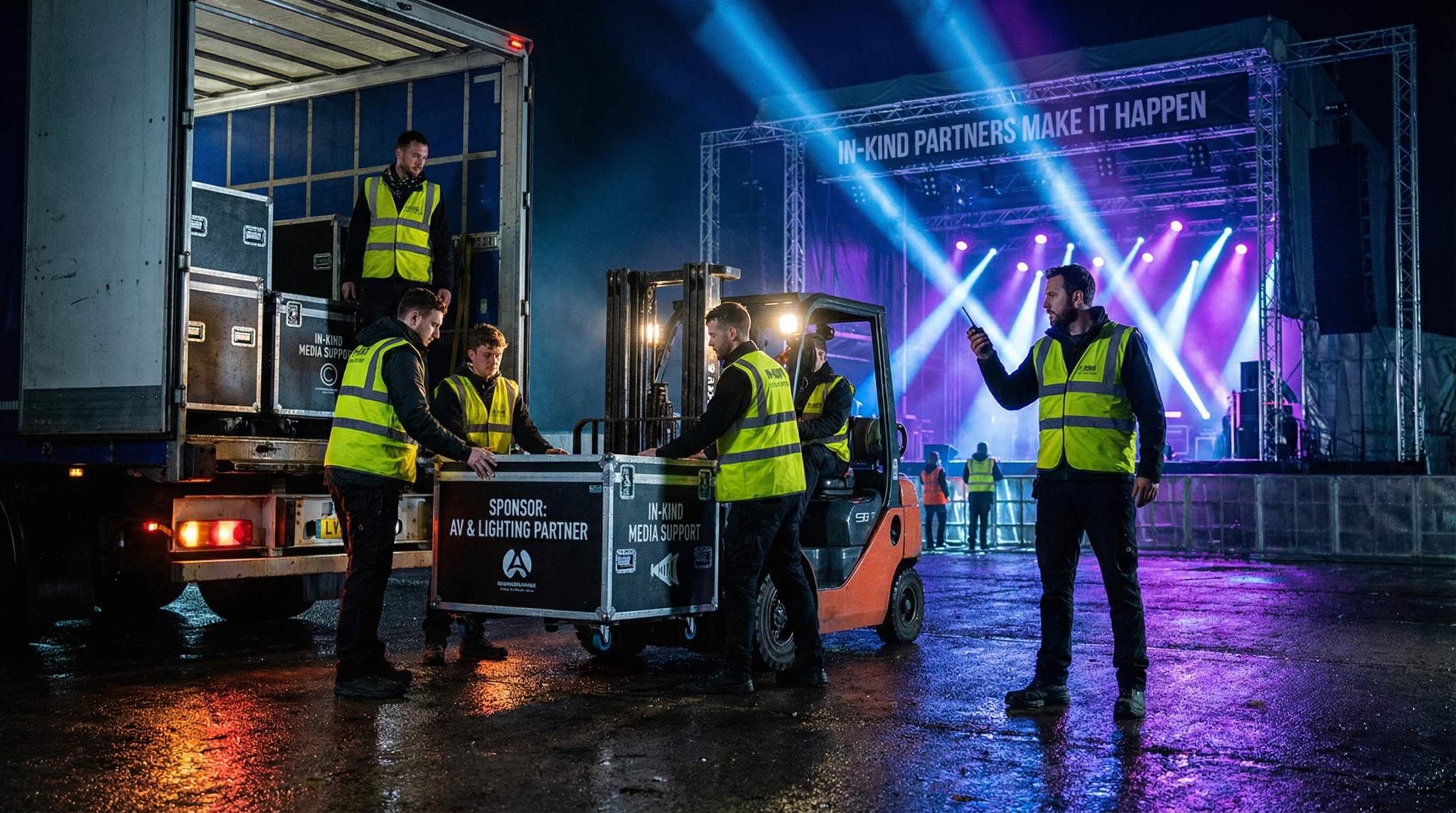
Tech Gear and Equipment: Big-ticket production needs are ideal for in-kind support. Festivals frequently arrange sponsorships for things like A/V equipment, projectors, lighting, staging, or IT services. A notable example is projection equipment – essential for film festivals. In Toronto, the Lavazza IncluCity Film Festival partnered with projector manufacturer Christie, which supplied state-of-the-art laser projectors to screen the films. This solved a technical challenge (outdoor cinema in a historic district) and saved the festival the cost of renting high-end projectors. The festival’s director praised how the partnership let them meet technical needs “with confidence” thanks to Christie’s gear. Similarly, smaller festivals might work with local audio-visual companies or camera suppliers to get discounted or free gear for screenings and events. When a tech sponsor covers an expense you’d budgeted – whether it’s sound systems, laptops for a media centre, or filmmaking gear for workshops – it can significantly reduce your production costs.
-
Financial and Payment Infrastructure: Upgrading your point-of-sale (POS) or cashless systems can be a massive capital expense, making it a prime area for strategic partnerships. Organisers frequently look for payment companies that sponsor music festivals to offset the costs of RFID wristbands, payment terminals, and on-site networking. Fintech brands, digital wallets, and credit card providers are highly motivated to partner with large-scale events because it guarantees thousands of user acquisitions and high transaction volumes. In exchange for exclusive vendor rights (e.g., “the official payment partner of the festival”) or branded fast-track lanes, these financial partners will often provide the necessary hardware, software licensing, and even on-site technical support entirely in-kind. This not only modernises your event’s financial operations but completely removes a major line item from your production budget.
When figuring out how to negotiate music festival sponsorship deals with these financial giants, preparation is key. Brands like Visa, Mastercard, PayPal, and Stripe are looking for data-driven proposals. You need to present clear attendee demographics, projected transaction volumes, and specific activation ideas. Instead of just asking for cash or free POS hardware, propose a tiered partnership where the payment provider gets exclusive naming rights to a cashless top-up station or offers cashback incentives to fans who use their platform. This approach turns a standard vendor negotiation into a strategic, value-driven conversation.
Understanding the specific motivations behind Visa, Mastercard, and PayPal sponsoring music festivals can further refine your pitch. These global financial institutions are typically focused on driving consumer adoption of new payment technologies, such as tap-to-pay wearables or specific digital wallet apps. By offering them an environment where thousands of attendees are making rapid, high-volume purchases—like at busy bar queues or merchandise tents—you provide the perfect testing and showcase ground for their latest fintech products. Highlighting this alignment in your proposal demonstrates that you understand their broader corporate objectives.
Free Tool: Project Your Bar Revenue
Per-head spend benchmarks by event type turned into projected bar and food revenue, with a stock-mix estimate and gross-margin line. Free calculator.
When evaluating which of these giants to approach, it helps to understand their distinct market positioning. While Visa and Mastercard often focus on widespread tap-to-pay adoption across general admission bars and vendors, American Express typically targets premium, high-net-worth demographics. Consequently, when American Express sponsors music festivals, their in-kind contributions frequently center around elevating the VIP experience—such as funding exclusive cardmember lounges, fast-track entry lanes, or premium viewing decks. PayPal and its subsidiary Venmo, on the other hand, might prioritize peer-to-peer ticketing integrations or cashless wristband top-ups. Tailoring your pitch to these specific brand identities makes your proposal much more compelling.
When booking A-list talent, organizers often ask which financial company sponsors concerts or festivals with celebrities to maximize the ROI of their lineup. Major retail banks and credit card issuers—such as Capital One, Citi, and Chase—frequently underwrite high-profile events to offer exclusive presales and VIP access to their cardholders. When pitching these premium financial institutions, the negotiation shifts from purely operational infrastructure to talent-driven marketing. Organizers should highlight meet-and-greet opportunities, exclusive artist merchandise, and dedicated premium viewing areas. Because these banks use celebrity-driven concerts as a primary tool for customer retention, securing them as an in-kind or hybrid sponsor can offset massive talent buying costs or marketing expenses.
Need Festival Funding?
Get the capital you need to book headliners, secure venues, and scale your festival production.
-
Services and Supplies: Don’t overlook other necessities. Printing, insurance, staging materials, tents, catering – virtually any line item someone is willing to donate or loan can be an in-kind saving. The rule of thumb is to target items that are both needed and valuable. For example, if you normally spend $5,000 on printing programmes and a printing company offers to do it gratis in exchange for sponsorship credit, that’s $5,000 saved. Some government or community partners might also cover costs like venue hire or security if the festival brings value to the region. The possibilities are broad – from energy companies providing portable generators, to beverage brands supplying drinks for receptions – as long as it’s something you planned to procure anyway. In-kind sponsorships work best when they zero in on costs the festival must bear, effectively freeing up those funds.
Structuring the Pitch: Negotiating High-Value Sponsorships
Mastering the art of securing these partnerships requires a strategic approach to your pitch. When planning how to negotiate music festival sponsorship deals—especially with major tech, beverage, or financial brands—organisers must shift the conversation from “what we need” to “what we can deliver.” High-value partners expect a clear return on investment (ROI), even when the exchange is entirely in-kind.
Start by building a comprehensive asset inventory. Beyond standard logo placement, identify unique experiential assets you can offer. Can a beverage sponsor take over a dedicated VIP lounge? Could a ticketing or payment provider receive exclusive naming rights to your box office or fast-track entry lanes? By bundling these assets into tiered packages, you give potential partners flexible entry points. During discussions, use your event’s historical data—such as attendee demographics, average dwell time, and past vendor sales—to prove the tangible value of your audience. When both parties clearly understand the commercial benefit, brokering brand deals for essential infrastructure or services becomes a collaborative business discussion rather than a simple request for free goods.
When evaluating potential festival partners, look beyond immediate cash or product injections. The most effective festival partner relationships are built on shared audience demographics and long-term brand alignment. For instance, a sustainable energy brand providing solar generators not only cuts your fuel costs but also reinforces your event’s green credentials, creating a cohesive narrative that resonates with both attendees and future sponsors.
Free Tool: Size Your Festival Site
Zoned capacity planning for arena, campsite, parking and entry lanes — against UK Purple Guide and NFPA density standards. Finds your bottleneck zone.
When targeting emerging financial partners—such as Buy Now, Pay Later (BNPL) services like Klarna or Afterpay, or regional digital wallets—your negotiation strategy should highlight cart abandonment reduction and increased VIP ticket conversions. These specific payment companies sponsor live events to prove that their flexible checkout options drive higher average order values. By offering them exclusive integration at your primary ticketing checkout or on-site merchandise hubs, you can negotiate substantial in-kind marketing support or subsidized processing fees.
Value Contributions at Real Cost (and Track Their Use)
Once you line up an in-kind deal, be rigorous in valuing and tracking it. It’s easy to get dazzled by a sponsor’s claim that their donated product or service is “worth” a huge dollar amount. Instead, calculate how much you would have realistically paid for the same quantity or service on the open market – that figure is the true value to your festival. Sponsorship experts stress making it an apples-to-apples exchange. For example, if a water company gives 50,000 bottles of water and says it’s worth $50,000, consider what buying 50,000 bottles would cost you from a supplier (maybe it’s only $25,000 at bulk rates). That $25,000 is the real in-kind value to use in your budget evaluation. If the sponsor’s valuation is inflated, recognise that and don’t credit the excess – you need to know exactly how much cash expense you’ve avoided.
Track usage as well: ensure the sponsored resources are fully utilised and note how they perform. If a partner provides equipment, did you end up using it all festival long, or were there spares that never left the box? If a media partner promised 20 ad spots, did they actually run and reach the expected audience? By monitoring this, you can calculate the in-kind’s effective value. For instance, maybe a tech company loaned 10 VR headsets for an interactive exhibit, but only 6 were ever in use – that’s a sign you didn’t need all 10, and the true utility was lower than offered. This data is gold for post-event analysis and next-year negotiations.
Accounting for in-kind support is not just about patting yourself on the back for savings – it’s also a safeguard. Record the fair market value and what exactly was provided, as if it were a budget line. If your festival relies on a significant in-kind contribution (say, $25,000 worth of free water) and that sponsor pulls out next year, you’ll suddenly face a big expense to cover, as noted by sponsorship valuation experts. Knowing the exact value helps you plan ahead and avoid nasty surprises. Professional festival organisers often integrate in-kind items into their budget sheet for this reason, so they have a clear picture of the festival’s full cost structure including non-cash support.
Finally, treat in-kind sponsors with the same seriousness as cash sponsors when it comes to deliverables. They deserve agreed-upon benefits (branding, tickets, mentions, etc.) commensurate with the true value they provide. Keep the relationship mutual: track that you are delivering on recognition promised to them, just as you track what they deliver to you. This professionalism not only honours the partnership but makes it more likely they’ll continue the support in future years.
Avoid Clutter from Low-Value Freebies
Just because something is free doesn’t mean it’s valuable. In fact, low-value freebies can become a burden – creating clutter, logistical headaches, or even undermining your festival’s image. It’s important to distinguish between meaningful in-kind contributions and token freebies that don’t actually save you money or enhance the event.
Data-Driven Event Marketing
Track ticket sales, demographics, marketing ROI, and social reach in real time. Exportable reports give you the insights to make smarter decisions.
Be wary of sponsors offering items or services that you never planned to buy in the first place. For example, a company might offer thousands of cheap branded lanyards, keychains, or trinkets for your attendees. Sure, it’s a nice gesture – but did you really need those? If your festival wouldn’t have spent money on custom keychains, then receiving them “in-kind” doesn’t free any budget. It might even cost you time and labour to distribute or clean up leftover clutter. Many experienced festival producers have learned to politely decline such offers or redirect sponsors toward something more useful. As one sponsorship expert advises, don’t give away valuable sponsor benefits (like logo placement or booths) in exchange for things you don’t actually need. There’s no sense in overloading on free products that bring little value to your operations or audience.
Another issue with irrelevant freebies is that they can distract from your festival’s mission or sustainability goals. Attendees nowadays are savvy: they can tell when a free giveaway is just marketing noise. Unused flyers, cheap merchandise that ends up in the bin, or random promo items can cheapen the festival atmosphere. A telling example comes from the outdoor apparel brand Patagonia, which avoids typical event handouts because a free T-shirt that gets thrown away runs counter to everything they stand for. Festivals, too, are increasingly conscious of waste and branding. If your festival highlights environmental responsibility, for instance, accepting boxes of single-use plastic swag would be tone-deaf (and could annoy your crowd).
Focus instead on useful, high-impact freebies or services that genuinely improve the attendee experience. This ties back to the idea of utility-focused sponsorships – like providing free water, sunscreen, phone charging stations, or Wi-Fi as sponsored amenities. These are “freebies” that people actually welcome and that save them (and you) money, rather than ending up as litter. It’s a philosophy embraced even at major film festivals. For instance, at Sundance, Canon USA sponsors a “Creative Studio” lounge where filmmakers get free coffee, snacks, Wi-Fi and hands-on access to the latest camera gear. This in-kind contribution enhances the guest experience – providing hospitality and tech resources the festival would otherwise have to pay for – while giving Canon a chance to showcase its products to exactly the right audience. One boutique festival found success with micro-sponsors who funded things like shaded rest areas and earplug stations, rather than just handing out flyers. Attendees remembered the helpful services fondly, and the sponsors still got their name out in a positive way. The lesson: quality over quantity. Ten minor sponsors giving tiny trinkets can’t match one strong in-kind partner who provides something substantial, like a free shuttle service or a film screening venue.
In summary, be selective. Treat your festival real estate (both physical and mental) as precious. Every sponsor logo on site or in the programme should ideally correlate to a real benefit for the festival or audience. This keeps your event streamlined and your team focused on partnerships that truly matter. It’s perfectly okay to say “no thanks” to a well-meaning sponsor offering a low-value freebie – often, you can suggest an alternative that would be more beneficial, or save the goodwill for a future opportunity better aligned with your needs.
Renew (and Reward) Only What Delivers
In-kind partnerships need continuous evaluation. After each festival edition, take a hard look at which sponsorships actually delivered value – and which fell short. This means revisiting the records you kept on usage and outcomes. Which partners saved you the most money? Which provided services that elevated the attendee experience or eased operational burdens? On the flip side, were there any in-kind deals that sounded great on paper but didn’t pan out in practice?
It’s crucial to renew only the partnerships that prove their worth. For those that did, show genuine appreciation and consider how to grow the relationship. Maybe a local tech company lent you some gear that was extremely useful – next year, you might invite them to become an “Official Technology Partner” with a slightly bigger role, or lock them in early with mutually beneficial terms. If a hotel partner’s free rooms were all utilised and your VIP guests raved about the hospitality, that’s a clear win to repeat. Strengthen these ties by sharing the success metrics with the sponsor (e.g. “Your donated lighting equipment delivered great production value to 5,000 attendees, and we saved $10k in rental fees”). Feeding their ego a bit – and crediting their contribution publicly – can help ensure they come back on board.
Boost Revenue With Smart Upsells
Sell merchandise, VIP upgrades, parking passes, and add-ons during checkout and via post-purchase emails. Increase average order value by up to 220%.
Conversely, don’t be afraid to phase out or adjust deals that didn’t deliver. Perhaps you had an in-kind media sponsor who offered ad space, but you saw no bump in attendance from it – you might downgrade that partnership or request a different kind of support. Or if a sponsor provided too much of something (like far more product than you could use), you can negotiate for a smaller quantity or partial cash support next time. The first year of a deal is often a learning experience; use those lessons to refine the arrangement. Always base decisions on data and results rather than sentiments. A partnership might have sounded impressive, but if it didn’t actually save money or improve the festival, it’s okay to let it lapse.
Another aspect to consider is the hassle factor. Sometimes an in-kind sponsor fulfills their promise, but managing that sponsorship was more trouble than it was worth. For example, if coordinating a sponsor’s involvement required disproportionate staff time, complicated logistics, or came with restrictive strings attached, evaluate if the dollar value truly compensated for those headaches. Successful festival producers weigh the net benefit – subtracting any extra costs or stress an in-kind deal added. One festival organiser shared that they once received free tech gadgets to give attendees, which fit the event’s theme but ended up causing long queues and technical support issues during the festival. The exposure the gadget sponsor got wasn’t worth the operational disruption, so they pivoted to a simpler partnership the next year.
By continually pruning the in-kind deals, you ensure your sponsorship roster doesn’t just accumulate out of tradition, but stays aligned with your festival’s current priorities. This doesn’t mean burning bridges with sponsors you don’t renew – always end on a positive note, thanking them for their past support. The industry is small, and a sponsor who wasn’t the right fit this time could come back in a better capacity for a future event. But your loyalty should be to what works for your festival’s health. Focus your energy on nurturing the high-performing partnerships. Those core in-kind sponsors that reliably deliver year after year effectively become part of your extended team, sharing in your festival’s growth and success.
Frequently Asked Questions
Which payment companies sponsor music festivals?
Major financial brands and fintech startups frequently partner with live events to drive user adoption and showcase their technology. Common sponsors include major credit card networks (like Visa, Mastercard, and American Express), digital wallet providers (such as PayPal, Venmo, and Cash App), and specialized cashless RFID or POS system providers. These brands typically offer in-kind hardware, reduced transaction fees, or direct financial backing in exchange for exclusive vendor rights, branded VIP perks, or fast-track entry lanes.
How do you secure a sponsorship from a fintech or payment brand?
To attract payment companies sponsoring music festivals, organizers must demonstrate high transaction volumes and a captive audience. Pitch the partnership as a user acquisition opportunity. Offer exclusivity, such as making their app the sole method for purchasing VIP upgrades or food and beverage tokens, and provide clear data on your attendees’ spending habits and demographic alignment.
How do you negotiate music festival sponsorship deals with payment providers?
Successfully negotiating music festival sponsorship deals with major payment companies like Visa, Mastercard, PayPal, or Stripe requires a data-first approach. Organizers should come to the table with projected on-site transaction volumes, demographic data, and clear exclusivity terms. Offer tangible assets such as naming rights for cashless top-up zones, fast-track entry lanes for cardholders, or integrated marketing campaigns that drive app downloads. Framing the negotiation around mutual ROI—specifically user acquisition and transaction fees—will yield much stronger in-kind or hybrid sponsorship offers.
What assets should organizers include when pitching in-kind festival sponsors?
Beyond standard logo placement, organizers should pitch experiential and data-driven assets. This includes naming rights to specific stages or VIP areas, exclusive pouring or vending rights, branded fast-track entry lanes, and digital integration such as sponsored app push notifications. Providing clear demographic data and projected attendance figures helps sponsors calculate their potential return on investment, making the negotiation process much smoother.
Why are major brands like Visa, Mastercard, and PayPal sponsoring music festivals?
Global financial networks and digital wallet providers sponsor large-scale live events primarily to drive consumer adoption of new payment technologies and secure exclusive merchant processing rights. When Visa, Mastercard, or PayPal sponsor a music festival, they often aim to showcase tap-to-pay systems, promote specific digital wallets, or offer exclusive presale access to their cardholders. For festival organizers, these partnerships can offset massive infrastructure costs related to point-of-sale hardware and on-site networking.
What metrics help negotiate sponsorship deals with financial brands?
When figuring out how to negotiate music festival sponsorship deals with banking or fintech partners, organizers must present compelling commercial metrics. Key data points include average attendee age, historical food and beverage spend per head, VIP upgrade conversion rates, and total projected on-site transactions. Payment providers want to see a high volume of tech-savvy attendees who are likely to adopt new digital wallets or tap-to-pay wearables during the event.
How do sponsorship strategies differ between Visa, Mastercard, American Express, and PayPal?
While all these major financial networks seek high transaction volumes, their activation strategies vary. Visa and Mastercard generally focus on mass-market tap-to-pay adoption and overall cashless infrastructure. American Express sponsors music festivals primarily to offer exclusive perks to their cardmembers, such as dedicated VIP lounges, presale ticket access, and premium hospitality upgrades. PayPal often targets digital wallet integration and peer-to-peer payment features for ticketing or merchandise. Understanding these distinct goals allows organizers to tailor their in-kind sponsorship pitches effectively.
Which financial companies sponsor high-profile concerts and celebrity festivals?
When organizing events featuring A-list talent, promoters often target major retail banks and credit card issuers like Capital One, Citi, Chase, and American Express. These financial institutions sponsor celebrity-driven concerts and festivals primarily to secure exclusive presale ticketing rights, VIP access, and premium hospitality experiences for their cardholders. Pitching these brands requires highlighting talent-focused assets, such as artist meet-and-greets or exclusive viewing decks, which they can leverage for customer acquisition and loyalty programs.
How do organizers identify the best festival partners for in-kind sponsorships?
The most effective festival partners are brands whose products or services directly replace a planned line-item expense in your production budget. Organizers should audit their operational needs—such as fencing, staging, Wi-Fi infrastructure, or catering—and target B2B or B2C companies that supply those exact resources. A strong festival partner will view the event as a high-visibility showroom for their goods, making the in-kind exchange mutually beneficial.