The Importance of Kid-Friendly Sustainability at Festivals
Family-friendly festivals present a unique opportunity to engage the next generation in sustainable practices. Children are naturally curious and enthusiastic, and when they get involved in eco-friendly initiatives, their energy can be contagious. By designing reusable cup and plate deposit systems that kids can understand and enjoy, festival organizers not only reduce waste but also educate young attendees in real-time. In fact, many events around the world have found that when kids take the lead in returning reusable items, parents and other adults follow suit – proving that kids will lead the adults in building greener festivals.
Modern festivals generate tons of waste from single-use cups, plates, and utensils. A deposit-refund system for reusables can drastically cut this waste by incentivizing attendees to return items for reuse. The key is to make the system fun, simple, and rewarding for children, turning a sustainability measure into an engaging game or mission. This ensures that families participate wholeheartedly and helps cultivate environmentally conscious habits among young festival-goers that can last a lifetime.
Explaining Deposit Systems with Cartoons and Simple Math
Deposit systems might seem complex at first, especially to a child. A great strategy is to explain how deposits work using kid-friendly cartoons and simple math examples. For instance, a cartoon poster or animated screen at a festival could show a friendly character buying a drink with an extra “+£1” for the reusable cup, then returning the cup to get “£1” back. By illustrating that “£1 in, £1 out”, you demystify the deposit concept. Using visuals like smiling cup characters and arrows, or analogies (e.g. “borrowing a cup and giving it back, just like library books,” as explained by Eco Juniors), helps kids immediately grasp that they’re not losing their money – they’re just temporarily helping keep the cup safe until it’s returned.
Keep the numbers straightforward. If the deposit is 1 token or $1, make that consistent and easy to add or subtract. You can even use simple math puzzles on signage: e.g., “If you return 1 cup you get $1. Return 5 cups, get $5. How many dollars for 5 cups?” These little challenges get kids thinking and reinforce the idea that returning more items brings more reward (and less waste). At Ireland’s Electric Picnic festival in 2024, organizers launched a “Return for Children” initiative where deposits on bottles and cans could be donated to children’s charities, according to the Irish Independent. Even though that program was for charity, it was promoted with kid-friendly messaging that emphasized how each bottle or can (and its deposit value) helps kids in need – a concept children could easily understand and feel proud of contributing to.
Go Cashless With RFID Technology
Enable contactless payments, faster entry, and real-time spending analytics with RFID wristbands and NFC-enabled ticketing for your events.
Real-world tip: Collaborate with artists to create a short comic strip in the festival program or on posters around the venue that narrates the journey of a reusable cup. For example, a story of “Cup Hero” who travels from the food stall to the wash station and back can illustrate the circular lifecycle. Keep language simple and positive (“Let’s help Cup Hero get home for a wash so he can come back out to play!”). When the process is communicated on a child’s level, families are far more likely to participate correctly. Festival producers in the UK and Singapore have reported that clear, visual explanations significantly decreased confusion about where to return cups at family events, leading to higher return rates and cleaner grounds.
Designing Child-Height Return Stations
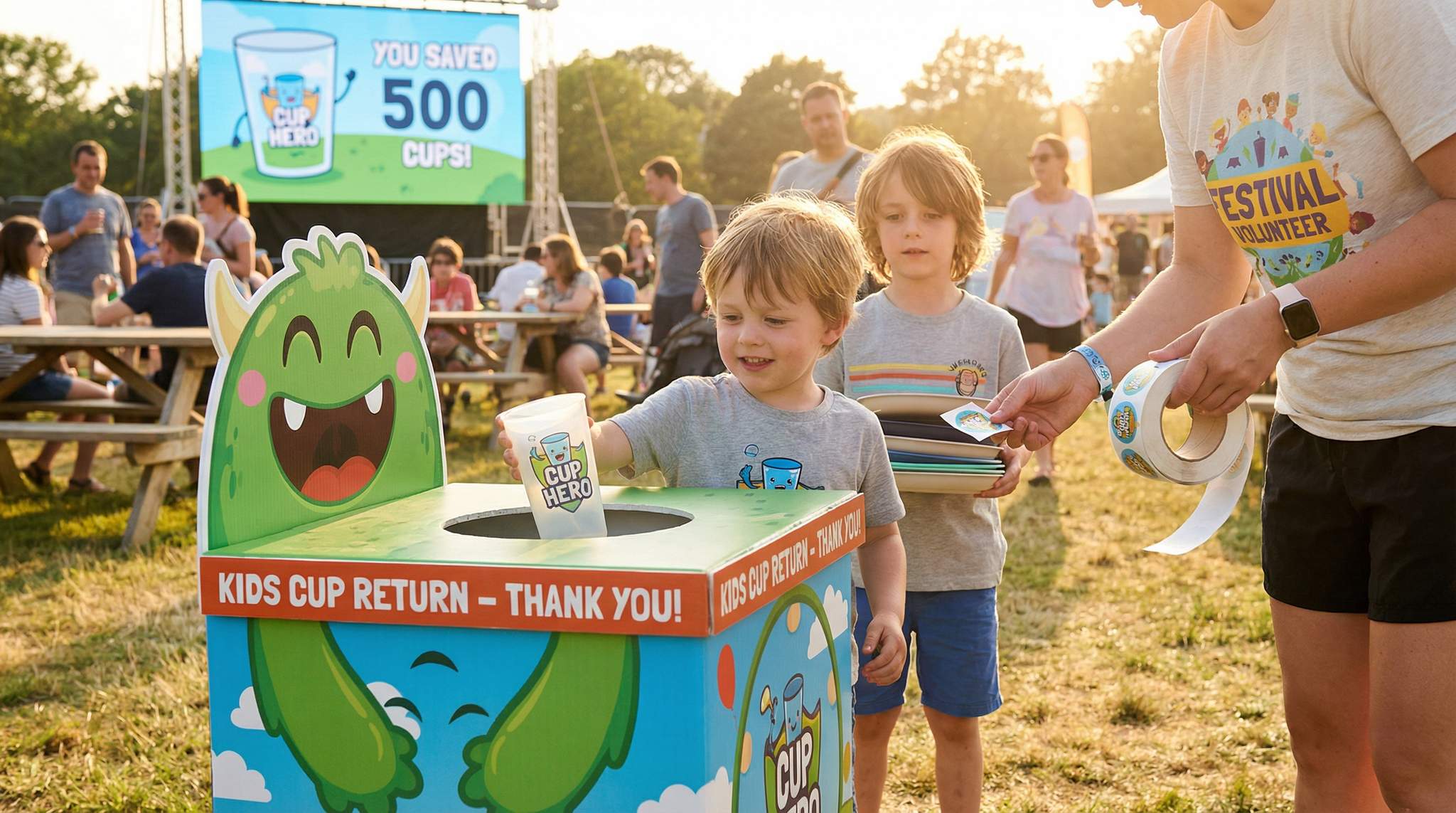
A common oversight in sustainable festival planning is the height and design of waste stations. To truly let kids lead the way, make sure to create child-height return slots and bins for reusable cups and plates. Standard return counters or barrels might be too tall for young kids to use comfortably. By adding lower slots – possibly decorated as friendly “mouths” of a cartoon creature – you empower children to take charge of returning their own items without adult help. This physical independence is exciting for kids and reinforces responsible behavior.
Planning a Festival?
Ticket Fairy's festival ticketing platform handles multi-day passes, RFID wristbands, and complex festival operations.
For example, a festival in Germany modified its cup return bins to include a lower chute labeled “Kids can return cups here!” with bright colours and fun graphics. The result was heartwarming: children as young as four were eagerly running to “feed the recycling monster” with their cups. Some events use a mascot (like a giant bin painted as a smiling character) stationed in the family area. Make it approachable and fun – a return box that thanks the child with a recorded message or sound can turn a mundane task into a memorable moment.
Design considerations for these kid-friendly return points include:
- Safety and Accessibility: Ensure the opening is smooth-edged and large enough for plates or cups but not for kids to reach in too far. A height of about 2–3 feet (60–90 cm) from the ground is usually suitable for children.
- Interactive Elements: A transparent section where kids can see cups piling up or a dial that moves as each cup is inserted can provide instant visual feedback. The more they can see the impact of their action, the better.
- Clear Signage: Use pictures and large fonts saying “Kids Return Cups Here – Thank You!” so even if they can’t read fully, they recognize the station. Including symbols (like a cup and an arrow) guides them intuitively.
By tailoring infrastructure to children, festivals in countries from Australia to Canada have noticed more family participation in waste return programs. At one Canadian community festival, organizers observed far fewer reusable plates left on picnic tables because kids were excited to run them over to the special return bin decorated with a superhero theme. This simple design tweak reduces litter and frees up staff, as children become the most enthusiastic cleanup crew you could ask for.
“You Saved X Cups!” – Counters that Encourage
Nothing motivates kids (and frankly, adults too) like seeing their actions add up to something big. Installing a “You saved X cups!” counter at return stations or on big screens can gamify the whole deposit return experience. Each time a cup or plate is returned, the counter ticks up. It could be a digital display or even a manual flip-board updated by staff every hour. The key is to show progress in real time.
Free Tool: Size Your Festival Site
Zoned capacity planning for arena, campsite, parking and entry lanes — against UK Purple Guide and NFPA density standards. Finds your bottleneck zone.
Several European festivals have adopted digital tally boards that display the cumulative number of cups returned and waste avoided. For instance, Roskilde Festival in Denmark introduced reusable cups in 2019 and highlighted that over 2 million cups are used each year—data highlighted by Roskilde Festival—giving attendees a tangible sense of how each returned cup contributes to a huge collective impact. Imagine a screen at the family area proclaiming, “Kids at the festival have saved 500 cups from landfill today!” Every child who reads that gets a sense of pride and accomplishment. It becomes a friendly competition to see that number climb. You can even break it down per day or per team: e.g., have a “Kids vs Adults” friendly challenge counter, or different counters for each day of the festival to encourage beating yesterday’s record.
For younger children, consider using graphic counters: instead of just numerals, an image of a growing tree or a filling treasure chest can represent progress. One festival in New Zealand projected a cartoon forest on a wall that filled with a new tree for every 50 cups returned. By the end of the weekend, the forest was lush – a visual metaphor that kids found enchanting, as they literally saw the “forest” grow from their efforts.
Need Festival Funding?
Get the capital you need to book headliners, secure venues, and scale your festival production.
To implement this, plan for either electronic sensors at return bins or assign volunteers to update numbers periodically. Many small festivals opt for a simple whiteboard or chalkboard sign at the entrance: “So far, we’ve reused XXX cups – great job!” Update it midday and evening to keep it dynamic. The daily announcement of these stats can even become part of the festival programming (“Green Team Update: 5PM”). Publicly celebrating these numbers not only rewards the kids with a sense of achievement but also signals to all attendees that the festival truly values and acknowledges sustainable actions.
Rewarding Returns with Stickers and Story Cards
While internal motivation is great, children love collectibles and rewards. Providing a small token each time they return a cup or plate can work wonders in reinforcing the habit. Many family-focused events have had success with reward stickers – for example, a set of custom stickers featuring fun characters or messages like “I am a Recycling Hero!” or “Cup Saver Superstar”. Kids can wear these badges of honor on their shirts or stick them on a festival scrapbook. When other kids see these stickers, they often ask how to get one, which spreads the word and enthusiasm for returning reusables.
Another engaging idea is to hand out story cards for returns. Think of them like trading cards that together tell an environmental story. Perhaps there are 5 different cards, each depicting an adventure of a cartoon character (maybe “Eco Eddie” or “Green Gabi”) who goes on quests to save nature by reducing waste. Each returned item earns one random card. Children will want to collect the whole series, which encourages them to keep bringing back cups and plates throughout the day. By the end, they not only have a fun story to take home, but they’ve also internalized its eco-friendly message. Festivals in the UK and India have experimented with similar concepts at green awareness events, noting that the educational stories on the cards often spark family conversations about recycling and climate after the festival.
For practicality, coordinate with the ticketing or token system: you might give one sticker per returned item or one card per child per visit to the return station to prevent any single family from taking a huge handful at once. The cost of printing stickers or cards is relatively low, especially compared to the cleanup cost savings of a successful reusable program. And sponsors might even want to chip in – a local environmental organization or eco-friendly brand might co-sponsor the story cards if their mission aligns, adding a logo in a subtle way.
Let Fans Pay Over Time
Offer flexible payment plans that split ticket costs into manageable installments, making higher-priced events accessible and boosting conversions.
Case Study: At a regional food festival in Spain, organizers noticed a big uptick in kids returning their plates and cups once they started giving out stickers of popular cartoon characters holding recycling bins. Parents reported that their children made a game of collecting stickers from every meal they finished and returned. The festival achieved a 90% return rate on reusables, a significant improvement from previous years. The lesson learned is that a little prize can create a big behavioral shift.
Daily Announcements and Diversion Rate Reports
Transparency and celebration of progress should be part of your festival’s DNA when promoting sustainability. Reporting diversion rates daily – in simple terms that kids can grasp – keeps the momentum going and shows that the festival takes waste reduction seriously. A “diversion rate” means the percentage of waste kept out of landfill (by reuse, recycling, or composting). But rather than bogging people down with percentages, translate this into meaningful figures and announce them in fun ways.
For instance, each day you might announce: “Thanks to everyone (especially the kids!), we returned 1,000 cups yesterday – that’s like removing 30,000 single-use cups from our impact this weekend, citing figures from The Irish Times. Give yourselves a hand!” Framing it like that uses a real example (Body & Soul Festival in Ireland eliminated 30,000 disposable cups by switching to reusables (as reported by The Irish Times)) to quantify the benefit. You could also relate it to something visual: “We saved 1,000 cups – that’s enough to stack as high as the Ferris wheel!” or “We kept 200 plates out of the trash – that’s like 10 full trash bags worth of stuff that didn’t go to landfill.”
Consider making these announcements on stage during breaks, on your festival app, and on social media each day. Many festivals live-post eco-updates (“Day 2: 5,000 cups saved, 85% of all dishes returned for washing!”). When kids hear their contributions acknowledged publicly, it empowers them. Some events even invite a few children on stage to thank them specifically or to let them shout out the daily numbers to the crowd – turning data reporting into a proud moment for the little ones.
Also, display the running totals at info booths or entry/exit points. For example, a sign that reads “By the end of the festival, we collectively prevented X kg of plastic waste” leaves attendees (young and old) feeling accomplished as they head home. If you have the means, a comparison graphic on the final day can drive the point home: e.g., a picture of a landfill crossed out, next to a picture of clean festival grounds, with text like “Last year: 40% of cups were littered. This year: 95% returned and reused!”.
The act of reporting not only educates kids about measuring environmental impact, but also holds the festival accountable. It shows that the organizers value sustainability enough to track it closely. Over time, you can compare year-on-year and keep improving, potentially making these stats a proud part of your festival’s legacy.
Turn Fans Into Your Marketing Team
Ticket Fairy's built-in referral rewards system incentivizes attendees to share your event, delivering 15-25% sales boosts and 30x ROI vs paid ads.
Successes, Challenges, and Lessons Learned
Implementing a reusable cup and plate deposit system in a family-friendly way comes with both triumphs and learning moments:
-
Success – Kids as Eco-Champions: Many organizers report that children became the champions of the program. At one music festival in California, staff noticed kids reminding their parents to “don’t forget the cup, we need to return it!”. This peer influence can dramatically increase overall participation. By empowering kids, you create extra “volunteers” who enthusiastically police their family’s waste habits (in the cutest way possible).
-
Success – Cleaner and Safer Festival Grounds: With a well-run deposit system, the reduction in litter is significant. Body & Soul Festival’s switch to hard plastic reusable cups meant no more fields strewn with disposables, a benefit noted by The Irish Times, improving not just aesthetics but also safety (no broken glass or slippery trash underfoot). Families appreciate a cleaner venue, and maintenance crews can focus on other tasks.
-
Challenge – Communication Gaps: A common challenge is initial confusion about how the deposit works or where to return items – especially if a festival is introducing this system for the first time. Some events learned that simply announcing it at the gate wasn’t enough. You should communicate through multiple channels: pre-festival emails, signage at food stalls (“This meal comes on a reusable plate – £2 deposit will be refunded at return”), info in the festival app, and staff/volunteers verbally reminding people. Repetition and clarity are key. Align your vendors and staff so they all give a consistent simple explanation to anyone unsure.
-
Challenge – Token or Cash Refund Logistics: Decide how returns will be processed in a way that’s easy for families. Physical tokens or coupons given for each returned item can be redeemed for cash or merch. Alternatively, some festivals (like Roskilde) load refunds onto RFID wristbands, as explained in Roskilde’s FAQ, to reduce cash handling. Whichever method, make sure it’s quick and kid-friendly. Long queues at refund booths will discourage participants. If possible, have a dedicated “Family Return” line that is more relaxed, or integrate returns at every bar/food stall like some events do – so parents can get the deposit back immediately when returning their cup with the next order, similar to Shambala Festival’s approach.
-
Lesson – Affordable Souvenirs vs. Returns: Sometimes attendees want to keep a branded reusable cup as a souvenir. If the goal is strictly reuse, that’s a lost cup – but consider it in your stock calculations. Festivals often price the deposit slightly above cost, so if people keep the cup, the extra funds help cover replacements. Another approach: sell separate souvenir cups (perhaps with cool artwork) and clearly distinguish them from the deposit cups. That way, serious collectors can purchase one, and the deposit cups continue to circulate. Communicate to kids that “Cup Hero needs to come back to help again” – framing it as a team effort rather than something to take home. Most will happily return it once they understand the collective benefit.
Free Tool: When Should You Announce?
Pick your event date and genre — the free planner outputs a recommended announce, presale, on-sale and reminder schedule anchored to how your audience actually buys.
-
Lesson – Sanitation and Turnaround: Behind the scenes, be prepared with adequate dishwashing capacity or cup inventory. Kids can be messy – some cups might come back half-full of soda or plates with food scraps. Plan bins for dumping liquids/leftovers before returns. Volunteers at return stations can help quickly rinse or sort items. This is a chance to involve youth volunteers too (teenagers can staff eco-booths as part of a green team, guided by adults). The Smithsonian Folklife Festival in Washington, DC, for example, has a youth-led sustainability team, demonstrating how passionate young people are in these roles, according to the Smithsonian Folklife Festival blog. Tapping into that can help manage the practical side of a deposit system.
-
Failure – Avoiding the “Trash Monster” Scenario: One festival in Asia attempted a reusable plate system but didn’t provide enough return points or any kid-focused engagement – the result was that plates piled up in eating areas and many went missing. The lesson: convenience and culture matter. Make returning items the easiest path (more return bins than trash cans, clearly marked). And create a culture where returning is the fun thing to do. That’s exactly why focusing on children works; kids naturally want to do the right thing when it’s presented as fun and important, and that attitude spreads.
Throughout all these points, feedback is gold. After each festival day, gather a quick debrief from the family campers or send a push notification survey: “How was the cup return experience for you and your kids today? Any ideas to make it better?” You might get gems of insight – maybe kids want the return monster to roar louder, or parents suggest an express line for returns. Iteratively improving the system will ensure it becomes smoother and more beloved each year.
Engaging Different Festival Types and Audiences
Every festival is different. A small local food fair with mostly young families might implement these ideas differently than a massive music festival that has a family section. Here are a few considerations based on festival type and audience:
-
Community and Food Festivals: These often see multi-generational attendees and a relaxed pace. You can easily set up kids’ eco-education booths with coloring activities about recycling. Since food is central, focus on plate returns: perhaps a “kids dish return champion” program where children get a punch on a card for each plate they return, and a full card yields a prize (like a free dessert or a small toy from a sponsor). Local festivals in places like Mexico City and Mumbai have successfully run “zero-waste food court” initiatives that rely heavily on school-aged volunteers to help visitors sort and return their eating ware, turning it into a community effort.
-
Large Music Festivals with Family Areas: Big events (20,000+ people) like Glastonbury (UK) or Lollapalooza (which has a “Kidzapalooza” area) can adapt by having separate return stations in family camping zones or near kids’ activity areas. This keeps things calmer and more manageable for parents with strollers, etc. Incorporate the theme of the festival into the design – e.g., if the festival has a space theme, make the return station a “Space Rocket Recycling Center” for kids. Large festivals should also consider ear-marking some deposit refund proceeds to youth causes or schools, which can be advertised to add a feel-good factor. At a major festival in Australia, the organizers announced that all unclaimed deposits would go towards funding environmental projects at local schools – this encouraged even those without kids to return cups, knowing it had a charitable twist that benefited children.
Free Tool: Project Your Bar Revenue
Per-head spend benchmarks by event type turned into projected bar and food revenue, with a stock-mix estimate and gross-margin line. Free calculator.
-
Cultural or Educational Festivals: Events like science festivals, book fairs, or city cultural festivals often already have young audiences engaged in learning. Here, you can get even more creative: integrate the deposit system into a hands-on demonstration. For instance, an educational festival in France had a mini “recycling lab” for kids where they could bring their used cup, put it on a pedal-powered mini washing station, and see how cleaning for reuse works (with supervision). This kind of interactive approach not only ensures the item’s return, but also teaches the science of sustainability. Tailor the complexity to the age group – even a simple “wash your cup with this bicycle machine” game can leave a lasting impression.
-
Sports or Mixed-Event Festivals: For events that are not strictly music – say a family sports day or a county fair – the deposit system for reusables can be framed as a game or competition. Perhaps each kid who returns an item can shoot a goal with a toy ball or spin a wheel for a small prize. It’s about meeting your audience where they are. A county fair in the USA might staff 4-H club teens at the sustainability booth, leveraging the ethos of youth community service and friendly competition (“let’s beat last year’s collection record!”).
Regardless of type, a common thread is knowing your audience’s motivators. For kids, those motivators are play, praise, and prizes. For adults, it’s convenience, cost-saving (getting their deposit back), and setting a good example for their kids. Design your deposit program to hit all these notes.
Frequently Asked Questions
Why are reusable cup deposit systems important for family festivals?
Reusable cup deposit systems drastically reduce single-use waste while educating the next generation in sustainable practices. Engaging children with fun, simple systems often leads to higher participation rates from parents, as kids enthusiastically lead the way in returning items for reuse, creating a cleaner and greener festival environment.
How can festival organizers explain deposit systems to children?
Organizers can demystify deposit systems using kid-friendly cartoons, simple math like “£1 in, £1 out,” and visual narratives. Strategies include using animated characters or comic strips that show a “Cup Hero” traveling from a food stall to a wash station, helping children understand they are temporarily borrowing the item rather than losing money.
What are the best design features for kid-friendly recycling bins?
Kid-friendly return stations should feature lower slots approximately 2–3 feet from the ground to ensure accessibility for children. Effective designs often include interactive elements like transparent sections to see progress, bright colors, and “monster mouth” openings that make returning items fun, while ensuring safety by preventing children from reaching too far inside.
How can festivals gamify waste reduction for young attendees?
Festivals can gamify waste reduction by installing real-time counters that display “You saved X cups” or using visual metaphors like a growing digital forest. These displays provide instant feedback and a sense of accomplishment, turning the return process into a friendly competition or collective mission that motivates children to participate enthusiastically.
What are effective rewards for returning reusable festival cups?
Small collectibles like “Recycling Hero” stickers or story cards featuring eco-friendly characters are highly effective rewards for children. These items encourage repeat participation as kids try to collect a full set, reinforcing positive behavior while spreading enthusiasm to other families who see the rewards being worn or displayed.
How do reusable cup schemes impact festival waste diversion rates?
Reusable cup schemes significantly increase waste diversion rates by replacing thousands of single-use items with durable alternatives. For example, Ireland’s Body & Soul Festival eliminated 30,000 disposable cups by switching to reusables. Daily announcements of these diversion statistics help quantify the environmental benefit, showing attendees the tangible impact of their participation.
How do deposit refund systems work at music festivals?
Deposit refund systems charge an extra fee (e.g., $1 or £1) upon purchase, which is fully refunded when the item is returned. Refunds can be processed via cash, physical tokens, or digital RFID wristbands. To ensure success, the process must be quick and simple to avoid long queues that discourage families from participating.
What are common challenges with festival reusable cup programs?
Common challenges include initial attendee confusion about return locations, communication gaps, and logistical issues like long refund queues. Additionally, festivals must manage inventory loss from attendees keeping cups as souvenirs and ensure adequate washing capacity to handle messy returns, requiring clear signage and efficient staff to maintain a smooth operation.