Introduction: The Personalized Marketing Imperative in 2026
Rising Demand for Tailored Event Marketing
Modern event audiences expect marketing that speaks directly to them. Generic one-size-fits-all blasts simply don’t cut through the noise anymore. In 2026, 71% of consumers expect personalized experiences, and companies see a 10–15% boost in sales by delivering tailored customer interactions, a key benefit of mapping the event attendee journey. From small club shows to massive festivals, promoters are recognizing that relevance drives results. In fact, nearly 90% of marketers say personalization significantly boosts profitability, according to recent personalization statistics – it’s no longer optional, but mission-critical for event promotion success.
Personalization isn’t just a buzzword – it’s becoming the default. Industry veterans who have ridden out decades of marketing shifts note that attendees today are inundated with content. They quickly tune out anything that doesn’t feel relevant. On the other hand, when an event message aligns with a fan’s interests or past behavior, it grabs attention. Over three-quarters of consumers say they’re more likely to purchase tickets when marketing is personalized to them, as noted in consumer personalization research. The data is clear: tailored messaging leads to engaged, motivated ticket buyers.
The Pitfalls of Generic Campaigns
Relying on broad, generic promotion isn’t just old-fashioned – it’s risky. Blasting the same ad or email to your entire list wastes budget and can even alienate potential attendees. A message that excites Gen Z on TikTok might fall flat with Gen X email subscribers, and vice versa. Seasoned event promoters have learned this the hard way. Many recall “spray and pray” campaigns that tried to be all things to all people and ended up reaching the wrong crowd, resulting in disappointing ticket sales, a challenge often solved by mastering programmatic advertising for events. Undifferentiated marketing often fails to engage your core audience, leading to lukewarm response or even unsubscribes.
Beyond poor engagement, generic campaigns miss opportunities to convert interest into sales. If you send a bland email to 50,000 people, a huge portion will ignore it because it doesn’t speak to what they care about. Meanwhile, your ad dollars may be burning up showing irrelevant messages to people who were never likely to attend. In an era of tight budgets and fierce competition, wasted impressions are wasted money. As one marketing adage goes, “if you try to appeal to everyone, you appeal to no one.” The cost of not personalizing is clear – lower ROI, higher acquisition costs, and tickets left unsold.
Turn Fans Into Your Marketing Team
Ticket Fairy's built-in referral rewards system incentivizes attendees to share your event, delivering 15-25% sales boosts and 30x ROI vs paid ads.
Personalization as a Ticket Sales Booster
The flip side is that personalized marketing drives significantly better results. Study after study shows that tailoring messages to specific segments boosts opens, clicks, and conversions. For example, segmented email campaigns have about 14% higher open rates and 100% more clicks on average than non-segmented sends. Segmenting your event marketing strategy is essential for these results. In real terms, that could mean an email to 10,000 fans yields twice as many engaged readers when it’s targeted by interest or demographic. Those engaged readers then convert to ticket buyers at a much higher clip.
Across channels, the story is similar. Personalized emails overall see 29% higher open rates and 41% higher click-through rates versus generic emails. This aligns with findings on segmenting event marketing strategies. And according to marketing benchmarks, segmented and personalized emails now drive 58% of all email revenue for brands, highlighting the value of targeted segmentation strategies – proving how much more money targeted outreach brings in. Event marketers who leverage their own audience data are reaping the rewards: brands that harness first-party insights have seen conversion rates jump nearly 3× compared to those using generic targeting, further proving that one size doesn’t fit all. In short, customization isn’t just a feel-good tactic, it’s directly profitable. Even small personal touches can meaningfully impact the bottom line. For instance, simply adding a person’s city or music genre preference into an ad can yield higher click-through by instantly signaling “this is about your world.”
Ready to Sell Tickets?
Create professional event pages with built-in payment processing, marketing tools, and real-time analytics.
To illustrate the impact, compare two email approaches:
| Campaign Type | Open Rate (approx) | Click Rate (approx) | Tickets Sold (example) |
|---|---|---|---|
| Generic mass email | 20% | 2% | 100 (baseline) |
| Segmented/personalized email | 25% (+5pp) | 4% (+100%) | 200 (2× more sales) |
Hypothetical illustration: A generic email blast might get 20% opens and 2% clicking through, resulting in ~100 ticket purchases. But a well-segmented, personalized campaign to the same audience could see 25% open and 4% click rates, doubling the ticket sales to ~200. The takeaway is clear – personalization can dramatically amplify your results from the same audience size. It’s about working smarter, not just harder or louder. In the sections ahead, we’ll dive into how to achieve these gains at each step of your marketing.
What is Event Personalization and Why Does It Matter Now?
At its core, what is personalization in the context of live events? Event personalization is the strategic practice of using attendee data to deliver highly relevant, individualized marketing messages, offers, and experiences. Rather than broadcasting a single message, organizers tailor their outreach based on past behaviors, preferences, and demographics. Integrating these tactics directly into your workflow significantly accelerates the event management process. Speed, personalization, and meeting modern market requirements are now deeply intertwined. Today’s market demands agility. By automating personalized touchpoints, promoters can move fans through the buying journey faster, meeting strict market requirements for relevance while reducing the manual workload typically associated with broad-scale event promotion.
The Role of Through the Line Marketing
To fully grasp the power of these tailored approaches, it helps to understand what is through the line marketing and how it applies to live events. Through the line (TTL) marketing is an integrated approach that combines broad, brand-building awareness campaigns (above the line) with highly targeted, direct-response tactics (below the line). For event organizers, effective through the line marketing means running wide-reaching awareness ads to announce a festival lineup, while simultaneously deploying personalized email sequences and retargeting ads to specific audience segments to drive actual ticket sales. Personalization is the engine that makes the “below the line” portion of a TTL strategy so effective, ensuring that once broad awareness is achieved, the follow-up communication speaks directly to individual fan preferences.
Smart Promo Codes & Presale Access
Create percentage or flat-rate discount codes with usage limits, date ranges, and ticket type restrictions. Plus unlock codes for private presales.
Building Data-Driven Audience Segments
Collecting First-Party Data and Fan Insights
Effective personalization starts with quality data about your audience. In the privacy-first landscape of 2026 – where third-party cookies are disappearing and platforms share less targeting data – your own customer info is gold. Mastering first-party data is crucial here. Smart event marketers are doubling down on first-party data collection: emails, phone numbers, past ticket purchases, genre preferences, location, survey responses, and more. This is data fans willingly share with you (by buying tickets, signing up for updates, etc.), so it’s both privacy-safe and highly relevant. According to industry research, 78% of high-growth brands now say first-party data fuels most of their campaigns. This shift towards building your owned audience is accelerating. The message is clear: if you want accurate personalization, build your own data trove.
Developing robust event ticketing data marketing strategies relies heavily on this first-party information. When promoters actively analyze purchase histories, scan times, and add-on preferences directly from their ticketing platforms, they unlock the core components needed for advanced personalization and segmentation. This raw ticketing data transforms into actionable marketing intelligence, allowing venue operators and festival producers to craft campaigns that resonate on an individual level rather than relying on guesswork.
Grow Your Events
Leverage referral marketing, social sharing incentives, and audience insights to sell more tickets.
There are many ways to gather this data ethically and effectively. Use your ticketing platform (like Ticket Fairy) to collect key info during registration – not just name and email, but maybe ask an optional question about favorite genres or how they heard about the event. Run contests or pre-registration waitlists that incentivize fans to share details (e.g. music preferences, birthday, location) in exchange for early access. Monitor your website analytics and social media: see which artists or content fans engage with. Every click or view is a clue to what that person cares about. The goal is to assemble rich profiles of your attendees, while of course being transparent and obtaining consent. When fans know you’ll use their data to give them a better experience, they’re often happy to share – especially if you demonstrate the value (like sending them more of what they’re interested in, and less of what they’re not).
Importantly, make sure your data is organized in one place, such as a CRM or an email marketing/CRM system integrated with your ticketing platform. This way, you can see that, for example, Jane Doe attended two EDM shows last year, always buys VIP, lives in London, and clicks on emails about production quality. These insights will soon inform how you talk to Jane versus another fan. Collecting and leveraging first-party data is the foundation of personalization – it ensures you’re working with accurate, owned information about your fans, rather than relying on broad assumptions. This approach to mastering first-party data ensures accuracy and builds your owned audience.
For promoters operating in bilingual or international markets, implementing specific estrategias de marketing con The Ticket Fairy (marketing strategies with The Ticket Fairy) provides a distinct advantage. The platform’s native data collection tools allow organizers to capture language preferences and regional nuances directly at checkout. By utilizing these built-in features, event producers can seamlessly segment their audiences and deploy culturally relevant campaigns without needing complex third-party integrations.
Defining Segments and Personas
Once you have data, the next step is turning it into meaningful audience segments. Segmenting means grouping your potential attendees by shared attributes or behaviors so you can craft messages tailored to each group. The possibilities are endless, but common segments for events include:
– Demographics: e.g. age group, gender. (A 20-year-old student might respond to different messaging than a 50-year-old professional.)
– Location: local city residents vs. out-of-town travelers, or by region. (Locals might get a “see you there neighbor!” message while travelers get info on hotels and travel packages.)
– Past engagement: first-timers vs. loyal returnees; people who bought VIP passes vs. general admission; those who attended one of your events before vs. completely new leads.
– Interest or genre preferences: what type of music, topic, or experience they like. (If you run a multi-genre festival, you might segment fans into “house music lovers” vs “hip-hop heads” vs “techno purists”, etc.)
– Behavioral indicators: folks who clicked on a certain artist’s profile on your site, added tickets to cart but didn’t buy, or engaged with your social ads – each behavior can define a segment that might need a specific nudge.
Built-In Email Marketing for Events
Send targeted campaigns, automated purchase confirmations, and post-event follow-ups directly from your ticketing dashboard.
For instance, many festival marketers create segments by music taste. A fan who indicated they love house and techno can be one segment, while drum & bass die-hards are another. Genre or topic-based segmentation lets you highlight different lineup elements to each group. Building your owned audience allows for this precision. Similarly, you might find your event appeals to both college students and young professionals – two groups that spend their time and money differently. You’d craft one set of promotions emphasizing budget-friendly fun for students (e.g. early bird discounts, group deals), versus another set highlighting VIP lounges and networking for the professionals.
It’s useful to take segmentation a step further by developing attendee personas – semi-fictional profiles that represent your key segments. For example, “Festival Fiona” might be a persona for 25-year-old music superfans who attend multiple festivals a year, while “Casual Chris” might represent the 30-something who goes to one big event annually with friends. Outline each persona’s goals, pain points, and motivators. Fiona might value exclusive experiences and FOMO, whereas Chris might care more about convenience and price. These personas humanize your data segments and help you craft messaging as if you’re speaking to one person. When writing copy or designing an ad, you can imagine talking to Fiona or Chris directly – making the tone and content far more likely to resonate.
Crucially, ensure your segments and personas cover the full diversity of your potential audience. Experienced event marketers know that inclusivity matters in personalization. Mastering inclusive event marketing ensures you reach everyone. Consider demographics like culture, language, and ability – are you tailoring content for non-English speakers or highlighting accessibility features for attendees with disabilities? Using inclusive language and diverse imagery in your marketing helps each segment feel “this event is for people like me.” The more your audience sees themselves reflected in your promotions, the deeper the connection you’ll forge. Personalization isn’t just about selling tickets – it’s about making every fan feel seen and valued.
Tools for Segmentation and Insights
Manually sifting through thousands of data points to create segments can be daunting – which is why the right tools are essential. Most modern email marketing and CRM platforms (Mailchimp, HubSpot, etc.) have built-in segmentation capabilities. You can set up rules like “segment everyone within 50 miles of the venue” or “segment who clicked the headliner’s video link.” Ticketing platforms like Ticket Fairy also often provide audience analytics dashboards and tagging systems to categorize attendees by purchase history or interest. Leverage these features to automate the grunt work of grouping similar fans.
When selecting these platforms, organizers should look for systems that fit their operational scale. Some independent promoters prefer lightweight, user-friendly options—often seeking out a less annoying CRM solution that doesn’t require a dedicated IT team to manage. Additionally, if you are utilizing partner networks to sell tickets, ensure your CRM and tracking tools can handle complex attribution, such as monitoring an affiliate program PPC policy to prevent partners from bidding on your branded search terms and cannibalizing your direct ad efforts.
Increasingly, AI is supercharging audience segmentation. Machine learning can analyze your ticket buyers and automatically find clusters of people with common traits that you might miss. For example, an AI might reveal that one sizable cluster of your festival audience is 25–34-year-old craft beer enthusiasts who always attend daytime workshop sessions, while another cluster is VIP ticket buyers traveling from overseas. Armed with that insight, you could target the first group with promotions highlighting your on-site craft beer garden, and target the VIP travelers with messaging about hotel packages and backstage tours. AI does the heavy lifting of identifying these patterns. Harnessing AI for event marketing makes this possible. According to veteran promoters, using such data-driven segmentation ensures you focus resources on the audiences most likely to convert – why waste ad spend on unlikely attendees when you can double down on those who will come? Practical AI tools can help identify these high-value targets.
Grow Your Social Following With Every Sale
Require social media follows, shares, or playlist adds to unlock presale access or special pricing. Turn every ticket purchase into audience growth.
Ultimately, building segments is both an art and a science. Aim for groups that are big enough to be worth targeting, but specific enough to tailor uniquely. If a segment gets too broad (e.g. “males 18-65” tells you too little about their interests), consider splitting it or combining criteria (e.g. “young males 18-25 who engage with our EDM content”). If it’s too narrow (say a segment of just 50 people), perhaps group it with a similar cohort unless they’re ultra-high value. Keep refining as you learn – segmentation is not a one-and-done exercise. Over time, your data might show new patterns, or you might decide to segment by engagement level (e.g. super-fans vs casual) rather than just demographics. Stay flexible and let the data guide you to the audience groupings that make marketing most efficient.
To visualize some common segments and tailored approaches, see the table below:
| Audience Segment | Key Characteristics | Tailored Messaging Example |
|---|---|---|
| Loyal Past Attendees | Attended before; repeat buyers | “Welcome back! Since you joined us last year, enjoy first dibs on tickets for 2026.” (Reward loyalty with exclusive early access) |
| New Prospects | Never attended; discovered event recently | “We noticed it’s your first time – here’s what makes our event special…” (Introduce the event’s highlights and offer a newbie discount) |
| Genre Fans (House/EDM) | Music taste: e.g. house music lovers | “House music all night: our Stage 2 lineup is curated for true house heads like you!” (Highlight genre-specific content they love) |
| Location – Local | Lives near venue city | “Hey Austin fam – join the party in your own backyard this weekend!” (Emphasize local community vibe and easy access) |
| Location – Out-of-Towners | Traveling from afar | “Coming from out of town? We’ve partnered with nearby hotels for special rates.” (Acknowledge their travel and provide useful info) |
| VIP Upscale Segment | High spenders; VIP ticket buyers | “Experience VIP treatment: exclusive lounge access and premium views await you.” (Appeal to desire for luxury and status) |
| Bargain Hunters | Price-sensitive buyers | “Limited £30 early bird tickets for budget-conscious fans – don’t miss out!” (Highlight affordable pricing options and deadlines) |
This table illustrates how different segments might receive very different messaging. By adjusting tone, content and offers to each group, you dramatically increase the chances that each recipient will find the message relevant and compelling. Next, let’s explore how to apply this personalization across key marketing channels, starting with the heavyweight: email.
Personalized Email Marketing Campaigns
Crafting Segmented Email Content
Email marketing remains one of the highest-ROI channels for events – and personalization takes it to the next level. (In fact, email consistently drives more ticket sales than social media or ads, converting roughly 8% of recipients into buyers on average. Mastering email marketing automation is key to these results.) Rather than sending the same newsletter to everyone, savvy promoters craft emails that dynamically adapt to each recipient’s profile.
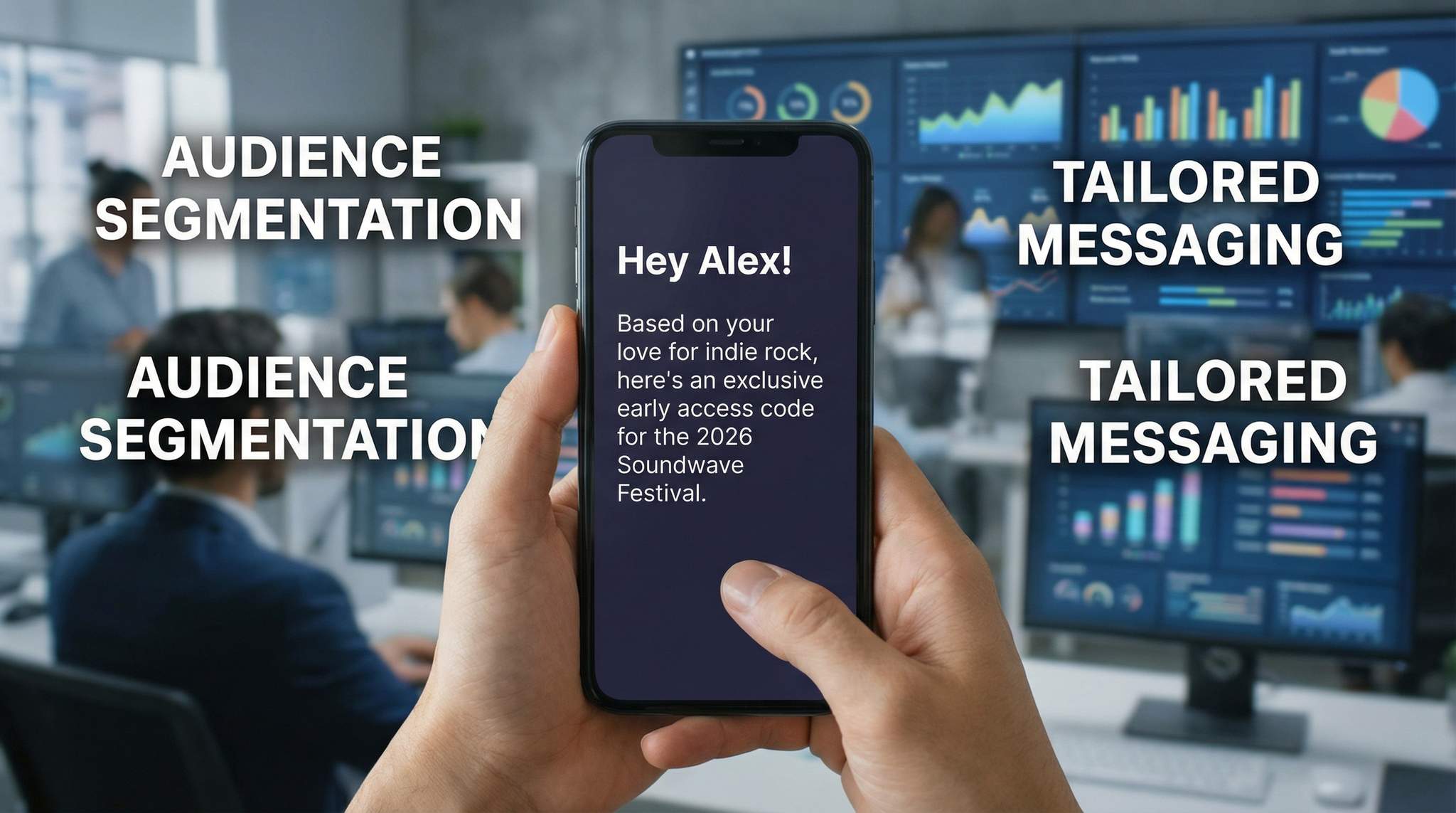
The simplest personalization in email is using the person’s name. A greeting like “Hey Alex,” in an email instantly feels more personal than “Dear Attendee”. Every modern email platform allows merge tags to insert first names, and you should take full advantage of that – it boosts open rates and goodwill. But that’s just the beginning. Dynamic email content lets you go much further: you can swap in different text, images, or call-to-action links in an email based on the recipient’s segment within the same send. For example, in one campaign, subscribers tagged as “EDM Fans” saw a section of the email highlighting the festival’s EDM headliners, while “Hip-Hop Fans” saw a section about the hip-hop stage – all via one email template using conditional content rules. Each reader got an email that felt curated to their tastes, which translated to far higher engagement. One marketing study found that using segmented, personalized email content drove a 27% higher open rate and substantially more clicks than a generic one-size-fits-all email. Building your owned audience with data enables this dynamic content.
Most major email platforms (like Mailchimp, Sendinblue, etc.) have drag-and-drop dynamic content features that make this possible without coding. If not, even a simple approach works: create two versions of an email for two big segments (say, locals vs. travelers) and send them separately to the appropriate lists. The extra effort is usually minimal (swapping a paragraph or two) but the impact can be big. Experienced event email marketers often segment their blasts by at least one criteria (such as geography or engagement level) and report significantly higher click-through as a result. The guiding principle is to make the email feel like it was written for that reader – referencing what they care about or have done. Did they attend last year? Mention it: “Since you partied with us in 2025, we wanted to give you first crack at 2026 tickets…” Did they show interest in a certain artist? Include a photo of that artist or a quote about them. These touches show fans you recognize them, building an emotional connection and trust.
Recover Lost Ticket Sales
Automated abandoned cart emails re-engage potential buyers at the optimal time, recovering lost sales and boosting your conversion rate.
To scale these efforts efficiently, organizers often rely on a dynamic event promotion email template. Having a flexible layout allows your team to swap out specific modules—such as artist spotlights or VIP upgrade offers—without redesigning the entire message from scratch. This is one of the top tips for creating engaging event promotion campaigns, especially during the critical pre-event promotion phase. By standardizing the design while customizing the text and imagery, you streamline your online event promotion workflow, ensuring that every segment receives highly relevant content without overwhelming your marketing staff.
For organizers looking to refine their approach further, partnering with specialized event marketing companies can provide access to advanced resources and proven frameworks. These agencies often utilize a master event marketing email template that integrates seamlessly with CRM data, allowing promoters to deploy promotional campaigns at scale. Whether you are organizing a massive music festival or focusing on niche B2B event marketing, having a repository of adaptable templates ensures your messaging remains consistent, professional, and highly targeted across all audience segments.
Automated Triggers and Behavior-Targeted Emails
Beyond scheduled newsletters, triggered emails based on user actions are a powerful form of one-to-one marketing. One classic example is the abandoned cart email: if someone started buying a ticket on your site but didn’t complete the purchase, you can automatically send an email an hour or a day later saying, “Still thinking about coming? Don’t forget to complete your booking – we’d love to see you!” Often you’ll include a direct link back to their cart. These emails are extremely effective at recovering lost sales, especially if you add a bit of personalization – for instance, mentioning the specific event name or even offering a small incentive (“Here’s a 10% off code, just for you”). Many promoters see a solid percentage of indecisive buyers convert on that second nudge.
Another high-converting trigger is a post-signup or pre-event email sequence. Let’s say someone just joined your mailing list or purchased a ticket. Instead of a generic “thanks” email, set up an automated sequence: Email #1 immediately welcomes them and perhaps asks about their interests via a quick click survey, Email #2 a few days later spotlights content tailored to what they like (e.g. an upcoming artist they might love), and Email #3 offers a referral bonus or upgrade option. You can also automate pre-event engagement emails – for example, one month before the event send “Your Insider Guide to
Event marketers have also found success with re-engagement campaigns targeting behavior segments. For example, identify those who clicked on your event info but haven’t bought a ticket yet; then send a targeted email highlighting what they showed interest in. “Checked out the VIP package? Here’s what makes it worth it – and a peek at last year’s VIP experience photos.” Or, “We noticed you were looking at camping options – did you know we added new luxury tents?”. By directly addressing what a potential attendee did (or didn’t) do, you increase the relevance immensely. One promoter shared that a targeted reminder email to people who had visited the lineup page but not purchased converted a significant chunk of them who just needed that extra reassurance. Behavioral retargeting via email can recapture would-be attendees who were on the fence, gently pushing them over the line with information or incentives related to their specific interests. Building your owned audience helps track these behaviors.
The key is to map out the critical moments in the customer journey – sign-ups, early bird sales, lineup drops, abandoned carts, last-chance before sellout, post-event follow-ups – and set up automated emails to go out at those moments with messaging that feels one-to-one. It’s like having a personal concierge for each fan, but automated behind the scenes. Just be sure to not overdo it; even personalized emails can annoy if you send too many. Aim to provide value with each message (something useful, exciting, or exclusive to that recipient) and you’ll find fans not only tolerate these emails – they engage and even look forward to them.
Data-Driven Event Marketing
Track ticket sales, demographics, marketing ROI, and social reach in real time. Exportable reports give you the insights to make smarter decisions.
Implementing sophisticated event triggered email marketing is ultimately about timing and context. When you align your promotional broadcasts—such as a ticket tier selling out or a new speaker being announced—with automated behavioral triggers, you create a highly responsive communication loop. This ensures that your overall event marketing strategy remains agile, capturing attendee interest at the exact moment their purchase intent is highest.
Personalizing Subject Lines and Send Times
The subject line is your first impression in an inbox – and it’s prime real estate for personalization. Simply adding the recipient’s first name in the subject can lift open rates (e.g. “John, your exclusive presale code inside!”). But you can also personalize by interest or behavior: “Can’t wait for the rock reunion? We’ve got your tickets” or “Jazz Fest Insider: Your Guide to a Smooth Weekend”. These feel like custom messages in a sea of generic subject lines. According to some data, personalized subject lines can increase open rates by as much as 20-50% over standard ones, especially for cold audiences. It makes intuitive sense – seeing your name or a reference to something you love piques curiosity.
Finding the most effective personal touch in subject lines may require experimentation. If you’re unsure whether referencing the person’s name, their city, or perhaps their favorite genre yields the best response – run an A/B test to compare options. For instance, send Subject A: “Your 2026 Festival Lineup Awaits, John!” versus Subject B: “John, Your Favorite Artists Are Coming to XYZ Fest!” (one leverages name at the end, another leads with name and taps favorite artists). See which one gets the higher open rate. Mastering first-party data facilitates this testing. Continually A/B testing different personalization elements – from subject lines to email body content – ensures you’re using the tactics that truly resonate. Top event marketers treat every campaign as an opportunity to learn what personal touches work best with their audience.
Another subtle yet powerful personalization is optimizing send time for each subscriber. AI-powered email tools can now predict when a particular person is most likely to check their inbox (e.g. late night vs early morning) based on past behavior. You might notice emails landing at 7:13pm or 10:47am – that’s send-time personalization in action. Harnessing AI for event marketing allows for real-time optimization. If your platform offers it, send-time optimization can boost open rates by catching each person at the ideal moment they tend to engage. For example, young attendees might open emails late at night, whereas professionals might clear emails at 6am with their coffee. Let the algorithm figure it out and send accordingly. Even without fancy AI, you could segment by broad patterns (send to students in the afternoon after classes, send to working folks early morning or evening). The more you fine-tune timing and frequency to each segment’s habits, the more your emails will be welcomed rather than overlooked.
Lastly, remember that personalization should carry through to your email landing pages. If someone clicks a personalized link or code in the email, make sure the page they land on matches the context (“Hi John, enter your presale code here” or showing the specific lineup section they clicked on). We’ll touch more on landing page personalization later, but it’s part of a seamless email experience. All these email strategies – dynamic content, triggers, subject tweaks, timing – combine to make your subscribers feel like your event communications are crafted just for them. When done right, the payoff is huge: higher open rates, more clicks, and ultimately more tickets sold from your email campaigns.
Personalizing Advertising and Social Media Outreach
Advanced Targeting: Reaching the Right Audience
Personalizing your paid advertising – whether on Meta (Facebook/Instagram), TikTok, Google, or programmatic display – largely comes down to precise audience targeting and tailored ad sets. The days of blasting one ad to millions are over (and thankfully so, for your budget’s sake). In 2026, ad platforms give you the tools to aim specific messages at specific groups, mirroring the segments you’ve defined.
Start with your custom audiences. These are audiences you upload or create based on your own data – like a list of past ticket buyers, newsletter subscribers, or people who visited your website. By targeting them, you can show personalized ads to those who already know your brand. For example, show past attendees an ad that says “We’d love to have you back – check out what’s new this year!” which feels like a warm invitation rather than a generic pitch. At the same time, you can exclude these folks from your general awareness ads (no need to pay to reach people who already bought a ticket or are on your email list – instead, reach them with organic or email channels). Retargeting is another powerful tactic: using tracking pixels, you can have Facebook or Google identify people who visited your event page or added to cart but didn’t purchase, then serve those individuals ads reminding them to finish checkout or highlighting the artist they looked at. These one-to-one follow-up ads often have excellent conversion rates because they’re hitting truly warm prospects. Mastering programmatic advertising can automate this retargeting. A fan who sees “Don’t miss out on the tickets in your cart – final chance to secure your spot!” will recognize the context immediately and often take action.
Next, consider leveraging interest and demographic targeting to reach niche segments with tailored creatives. Platforms like Meta allow incredibly granular interest combos – for instance, you could target “users age 18-30 in Los Angeles who like ‘electronic music’ and ‘festivals’” for your EDM show. For each of these audience sets, create ads that speak their language. The ad for the 18-30 EDM fan might show a viral TikTok-style recap of last year’s rave, with copy emphasizing the bass drops and party atmosphere. Meanwhile, another ad set might target 30-45 year-old local professionals interested in “networking” and “tech conferences” for your B2B event – that ad would highlight the career-advancing workshops and VIP networking sessions, with a more professional tone. By matching the ad content to the target segment, you dramatically increase relevance. It feels less like an ad and more like “oh, this is my kind of event.” It also improves your ad efficiency: relevant ads get higher click-through and relevance scores, often lowering your costs.
Don’t be afraid to create multiple ad versions for multiple segments. Experienced campaign managers might run dozens of micro-targeted ad sets, each speaking to a particular group. For example, one Comic-Con might run separate ads for comic book fans, cosplay enthusiasts, sci-fi movie fans, and anime fans – each showcasing different attractions. Yes, it requires a bit more creative work up front, but with tools like Meta’s dynamic creative or Google’s responsive ads, you can also upload a mix of images and texts and let the algorithm assemble the best combo for each viewer. The principle remains: tailor the message to the audience. A one-size-fits-all ad will be moderately relevant to maybe 20% of people and irrelevant to the rest, whereas a set of personalized ads can each be highly relevant to their respective audiences, driving far better aggregate results.
To truly maximize ad personalization, organizers must map these targeted creatives to every stage of the conversion funnel. For example, a top-of-funnel ad might use a tracking pixel to identify users browsing a specific genre page—such as acoustic guitar performances or indie rock bands. Once that pixel captures their interest, the mid-funnel retargeting ad can serve a highly specific offer, perhaps highlighting a limited-time bargain or early-bird discount for that exact segment. This seamless alignment between tracking technology and creative messaging ensures that your advertising budget is spent moving high-intent buyers toward a final purchase.
Dynamic Ad Content and Creatives
An exciting development in advertising personalization is the rise of dynamic ad content and creative optimization. Programmatic ad platforms and social networks increasingly allow you to feed in multiple assets (headlines, images, videos, ad copy variations) and then automatically show the most pertinent combination to each user based on data. For instance, Facebook’s Dynamic Creative will shuffle and match different headlines and images depending on who’s seeing the ad. If the user’s profile suggests they’re into food and drink, the system might show them your festival ad emphasizing the gourmet food trucks, whereas a more music-oriented user might see the same festival ad but highlighting the headliner’s photo and a snippet of their hit song. The content adapts in real-time to viewer attributes.
You can also set up rules-based dynamic ads. One example: if you’re promoting a multi-city tour, you could use the city name dynamically in the ad copy – “Boston, are you ready to rock?” for people in Boston, “NYC, get ready to dance this Saturday!” for New York audiences, all from one ad template. Similarly, count-down timers in ads (showing days until the event or until ticket price increase) create a personalized sense of urgency depending on timing. Some platforms let you even plug in a person’s own name into an ad (usually via email personalization in sponsored messages), though this is less common in broad ad campaigns due to privacy norms – it works in email better. Still, the concept is to utilize any data you have to customize the creative at scale.
A particularly powerful combo is dynamic product ads/remarketing ads for events. If someone viewed certain content on your site (say the lineup page, or the FAQ about camping), you can have a retargeting ad that automatically shows an image related to that content, like a photo of the camping area and copy “Camping at Festival X: Your home under the stars awaits – book your camping pass now.” This way, the ad is directly tied to what they care about. For e-commerce this is standard (showing the exact product someone browsed), and events can use the same idea to showcase the precise artist or session someone showed interest in.
One note of caution: ensure your dynamic rules make sense and test them. Bad personalization (like an ad that inserts awkward text or mismatched images) can be confusing or comical. Quality check how your dynamic ads render for different segment examples. But done right, dynamic ad content makes your marketing feel remarkably personal at scale. Each viewer gets an ad that seems almost hand-crafted for them, even though it’s all auto-generated behind the scenes. No two fans necessarily see the same creative. This can significantly increase engagement, as people are more likely to click an ad that mirrors their interests or context.
Incorporating dynamic event promotion videos takes this strategy a step further. In the highly competitive concert and event promotion industry, video content consistently outperforms static imagery. By creating modular video assets—where the intro or outro can be swapped to highlight a specific city, genre, or ticket tier—promoters can deliver personalized visual experiences at scale. These tailored clips serve as powerful event marketing promotions, capturing attention in crowded social feeds and driving higher conversion rates across your targeted ad sets.
Lookalike Audiences and Predictive Expansion
Personalization isn’t only about people you already know – it can also help you find new attendees who “look like” your existing fans. This is where lookalike modeling comes in. Platforms like Facebook and TikTok allow you to take a custom audience (e.g. your 1,000 best customers or email subscribers) and have the algorithm find other users with similar profiles and behaviors. Essentially, it’s using AI to clone your ideal attendee. For example, if you upload a list of past VIP ticket buyers, a lookalike audience can find thousands more people who behave similarly online (perhaps in demographics, pages liked, purchasing behavior). This becomes a highly targeted group to run acquisition ads to – they may not know your event yet, but they resemble your converted customers, so they’re excellent prospects.
Event marketers often see great results using lookalikes in combination with personalized creatives. For instance, a festival that knows its core audience are indie rock fans in their 20s can build a 1% lookalike of recent ticket buyers on Facebook. That lookalike might surface more people who stream indie music, follow record labels, or attend other alt-rock events. The promoter then runs ads emphasizing the indie rock aspects of the lineup to this lookalike audience, effectively treating them like existing fans who just haven’t bought yet. It’s a way to personalize on the acquisition side: you’re not just blanketing all of Facebook; you’re pinpointing those with traits similar to your known audience. As a real example, an EDM festival used lookalike modeling to uncover new “ravers” who hadn’t attended yet but had similar music streaming and app usage patterns as their past attendees – this approach expanded their reach to fresh yet relevant fans and boosted ticket sales in new markets. Mastering programmatic advertising helps expand reach effectively.
Platforms also offer predictive targeting such as Google’s “optimized targeting” or Facebook’s broad targeting with conversion optimization, where the AI itself figures out who is converting and adjusts on the fly. While these don’t give you as much explicit control, they leverage big data to find likely ticket buyers beyond the obvious interests. The key is to feed these algorithms with the right signals – your conversion pixel, value data, etc. – and they will automatically seek more people like those who engage or purchase. Over 90% of companies are now using some form of AI to power personalization in marketing, according to personalization statistics, and ad targeting is a prime example.
For event promoters, a great strategy is to start with tight, well-understood segments and creatives (so you set a strong baseline and gather data), then use that data to expand via lookalikes and predictive targeting. Continuously refine with performance data: if you see one audience cluster responding particularly well (say, 35-44 year-old esports fans clicking your concert ads unexpectedly), adjust your strategy to invest more in that segment – maybe even create custom creative for them or a new lookalike based on that subset. Personalization is an iterative process. With each campaign, you learn more about which audience truly clicks with which message, and you can use those insights to fine-tune the next round.
Retargeting and One-to-One Follow-ups on Social
We touched on retargeting via ads earlier, but it deserves its own emphasis because it’s one of the highest-ROI personal marketing tactics. Retargeting means reaching back out to people who have already interacted with your brand (visited your site, engaged with a post, etc.) with tailored content to drive the final action (like ticket purchase). It’s essentially the ad equivalent of an abandoned cart email.
For example, you can set up a retargeting campaign on Facebook/Instagram that only shows to users who watched at least 50% of your event teaser video or who clicked “Interested” on your event page. Since they’ve shown intent, create ads that feel more like a personal invite or a reminder, rather than a cold pitch. “You’ve seen what we’re about – now don’t miss out. Get your ticket to Experience X before it sells out!” Maybe include a testimonial quote from a past attendee (social proof tailored for those on the fence). Because you can assume a higher level of familiarity with retargeted folks, you can be more direct and specific in messaging, even shorter in copy as they likely already know the basics.
One-to-one messaging can be pushed even further on some platforms. For instance, personalized DMs or chatbots: you can run click-to-Messenger ads that open a conversation and then use a bot to address the user by name and answer their particular questions. Or on LinkedIn for B2B events, send a sponsored InMail that greets the recipient by name and mentions something like their industry or job role before pitching the conference relevant to them. These feel like direct outreach. They typically have lower volume but high conversion if executed well, because it’s akin to a personal concierge reaching out.
Across all these ad strategies, keep frequency in mind. You want to be present wherever your audience lives online, but not in a creepy or annoying way. Set caps so you don’t over-serve ads to the same person. And ensure consistency: if someone just bought a ticket, exclude them from sales ads and maybe switch to upsell or “see you at the event” messaging. Nothing breaks the illusion of personalization more than receiving an ad to buy tickets after you’ve already bought one. Sync your data (e.g., via the Ticket Fairy platform or your CRM) so that your marketing touches stay contextually relevant and timely for each person’s journey. Mastering first-party data ensures your messaging stays consistent.
Personalizing Your Website and Landing Pages
Dynamic Landing Pages for Different Audiences
Often the first thing an interested fan sees is your event landing page or website – and this too is a prime canvas for personalization. Rather than a static page that’s identical for everyone, consider ways to make the content adapt based on the visitor’s attributes or referral source. A classic example is using UTM parameters or referral data to customize the headline or text. If someone clicked your ad targeted to London fans, your landing page could automatically say “London’s Biggest New Year Party” as the header, whereas a generic visitor sees “The Biggest New Year Party”. This little geographic insert immediately tells the user “this is relevant to you.”
Many marketing tools enable simple dynamic text replacement on landing pages using query strings (for instance, using a token like {City} in your page copy that gets replaced when the URL includes ?city=London). If you have multiple distinct audience segments hitting the same page, you can also design multiple versions or sections that show/hide. For example, you might create a version of the page with an alternate intro paragraph for returning customers (“Welcome back! Here’s what’s new since last year…”) and use a script or personalization tool to display that to known returning visitors (perhaps identified by a cookie or if they clicked through an email for past attendees). New visitors would see the default intro (“Join us for an unforgettable experience…”). The technology can range from simple (using website personalization plugins or built-in features of builders like Wix, Squarespace’s Member Areas, etc.) to advanced (integration with CRM data for fully personalized pages upon login). Even Ticket Fairy’s event pages allow some customization of content that you can tailor to your audience’s needs (like emphasizing certain info or add-ons if you know the user came via a specific partner link).
Another approach is personalized content recommendations on your site. If your event site has multiple pages (lineup, schedule, blog posts, etc.), you can use algorithms or rules to suggest content a particular user is likely to care about. For instance, on the festival website, a returning user might see a sidebar saying “Recommended for you: Aftermovie from 2022 (since you attended last year)” or “You loved Artist A – check out Artist B on this year’s lineup.” E-commerce sites do this all the time (“you might also like…”); for events, the principle is similar. If your data shows a user frequently checks DJ bios on your site, surface DJ-related content to them. If another user always clicks on venue info, make the venue map easy for them to find. These tailored on-site experiences make fans feel the event really understands them.
Personalization can extend to navigation and calls-to-action as well. For example, you might have a “Buy VIP” button featured prominently for a user who previously bought VIP (knowing they’re likely interested again), whereas a first-time visitor sees a “Why Attend?” informational CTA. Some event organizers even deliver personalized landing pages via email unique links – like each VIP member gets a unique URL that pre-fills their discount or shows their name (“Welcome, Alice!” at top of page, leveraging merge fields in the link from the email). These are small touches, but they contribute to that feeling of a bespoke experience from digital touchpoint to purchase.
AI-Powered Recommendations and Personalization
To manage on-site personalization at scale, AI tools and personalization engines can be incredibly useful. Platforms leveraging AI can automatically test and swap different versions of a page for different visitors to maximize engagement. For example, AI might learn that visitors coming from Instagram engage more with video content, so it prioritizes embedding your event trailer video for those visitors, whereas people coming from Google search prefer to see FAQs first, so it surfaces text info to them. Some event websites are starting to integrate AI recommendation widgets – e.g., “Events You May Like” based on the user’s browsing history or similarity to other users. Harnessing AI for event marketing can power these recommendations. If you run multiple events or have an event blog, this can increase cross-selling and time on site by guiding each visitor to content that aligns with their profile.
Chatbots or virtual assistants on your site can also add a personalized touch. For instance, a chatbot might ask a few quick questions (“What type of experience are you looking for? Music, Food, Art?”) and then guide the user to relevant info or ticket options based on their responses. This is a form of real-time personalization where the user self-selects their segment and immediately gets a tailored experience. It mimics how a helpful staff member might personally advise an attendee, but it’s all automated. By 2026, many sites have AI chat that can even leverage the user’s past data if known – “Hi Sam! Welcome back – I see you went to our event last year. Can I tell you what’s new this time?”. This kind of conversational personalization can dramatically improve web engagement and drive more conversions, especially for complex events like conferences where attendees might need help finding the right ticket or track.
From a content standpoint, ensure your site has rich, diverse content that appeals to each of your key personas, so there’s something to personalize with. If all you have is one generic event description, there’s not much to customize. But if you have blog articles, artist spotlights, attendee testimonials, schedule details, travel guides, etc., then depending on who’s looking, you can highlight the pieces most relevant to them. For example, a business conference site might show technical whitepapers to developer-type visitors vs. ROI case studies to executive-type visitors. A festival site might show family-friendly tips to a parent browsing (detected by them repeatedly visiting the “All Ages” section or via an ad targeted to parents), whereas a college student might be shown the afterparty lineup first. Think through the journey for each segment persona and what information or angle would most compel them – then let your website deliver that angle first.
Consistent Experiences Across Touchpoints
A core principle of successful personalization is consistency. Each channel (email, ads, website, even on-site) should reinforce the others with a coherent, personalized thread. If a person’s email says “Use your exclusive code FANVIP for 10% off” and they click it, don’t dump them onto a generic homepage where they have to hunt for where to input the code. Instead, bring them to a landing page that acknowledges the offer (“10% off applied!”) or at least pre-fills it in the checkout. Likewise, if you send a special VIP-only presale link to your loyal fans, ensure the page they land on doesn’t also show a big “Sign up for VIP Access” button – they already have access. These may sound like small details, but nothing breaks trust faster than a disjointed experience. Fans might think, “did the link not work?” or “why am I seeing this irrelevant info?”. As mentioned earlier, avoid scenarios like sending a personalized discount by email and then those same people seeing a full-price ad the next day – it creates confusion and makes the marketing feel impersonal again. Mastering first-party data ensures your messaging stays consistent.
The best practice is to integrate your marketing tools so that data flows between your ad platforms, email system, and website. For example, use UTM parameters on your ads and emails that identify the segment or offer, and have your site read those to tailor what is displayed. Or use a customer data platform (CDP) to maintain a single profile of each user and sync personalization rules across channels. If done right, a fan might experience something like: see an Instagram ad about the specific genre they love, swipe up to a landing page that continues the genre theme and shows artists they’d care about, then sign up and receive an email series highlighting exactly those aspects, and finally when they attend the event, the signage and app even point them to the stage for that genre. That’s a fully aligned, personalized journey from start to finish, and it feels incredibly smooth to the attendee.
Now, not every event has the resources to do all of that – and that’s okay. Start with the most impactful pieces: perhaps personalize the landing page for your top 2-3 ad campaigns, and ensure your email content aligns with those ad promises. Even basic consistency like using the same imagery and tagline for a segment across ads->site->emails helps reinforce the message (“ah yes, I’m interested in this because I keep seeing how it’s exactly my vibe”). As you grow comfortable, you can expand to deeper personalization on site and more nuanced cross-channel flows. The end goal is a fan saying, “Wow, it’s like this event really gets me – I’m sold!”. When your marketing speaks to someone’s soul (or at least their specific interests), selling a ticket becomes a much easier proposition.
AI and Machine Learning for Personalization at Scale
AI-Driven Audience Segmentation & Insights
As mentioned earlier, Artificial Intelligence has become a game-changer for personalization. If 2025 was the year many event marketers dabbled in AI, 2026 is the year it’s going mainstream in campaign strategy. Harnessing AI for event marketing is transforming the industry. One of AI’s biggest strengths is crunching huge datasets to find patterns. For event promotion, this means AI can analyze your attendees and automatically identify segments and trends far faster (and sometimes cleverer) than a human could.
For example, instead of manually guessing who your audience segments should be, you could deploy an AI model on your ticketing CRM data. It might discover non-obvious groupings – say, it finds a cluster of attendees who tend to buy tickets late at night via mobile and always for certain niche artists. It might label them “last-minute superfans” and you realize they’re a segment worth addressing with last-minute reminders before price increases. Or AI could reveal correlations like craft beer interest intersecting with workshop attendance as in the earlier example, which a human might not think to cross-analyze. Harnessing AI for event marketing reveals these hidden connections. These insights let you craft highly specific personas (e.g., “The Craft Beer Daytime Crew”) and target them with uncanny precision (“Grab a pint at our new craft beer garden between workshop sessions!”). Veteran promoters who have started using AI for analysis report that data-driven segmentation can dramatically improve campaign efficiency by eliminating wasted spend. Practical tools to supercharge ticket sales help focus resources – you focus on who is likely to come, not on broadcasting to the masses.
AI can factor in dozens of attributes simultaneously – age, location, past spend, social media engagement, survey answers, onsite app usage, etc. – to predict what segment someone belongs in or even directly predict their likelihood to buy a ticket. Services like Ticket Fairy’s own analytics or third-party tools might score leads based on similarity to past buyers, flagging high-potential individuals so you can personalize outreach to convert them. For instance, an AI might score a website visitor 90/100 chance of buying based on their behavior (viewed multiple artist pages, checked VIP options, etc.) – you could then trigger a very personalized pop-up or chat that says “Need any help choosing your perfect ticket?”. Meanwhile, a casual visitor might get a simpler “Join our newsletter for updates” prompt. This is personalization driven by AI understanding of where each person is in the funnel.
The barrier to entry for AI is also dropping. You don’t need a data science PhD or a huge tech budget – many marketing platforms have AI features baked in. Facebook’s algorithm, for example, is AI – when you use broad targeting and it optimizes for conversions, it’s essentially machine learning finding the right people and right time to show your ads. Harnessing AI for event marketing involves leveraging these algorithms. Email services offer AI subject line generators and send-time optimization. There are affordable tools that can analyze your customer lists for personality traits or predict which content a user will engage with next. The key for event marketers is to embrace these helpers. They can augment your team, doing heavy analytic lifting in seconds and offering suggestions that you can then apply with your industry know-how.
One insider tip: when using AI, always sanity-check its output against real-world context. AI might tell you “older attendees never buy VIP” if data shows a trend, but maybe your marketing never targeted older folks for VIP – a human can spot if that’s a causation or just correlation. Use AI to inform your decisions, not blindly drive them. The combination of AI’s pattern recognition with your experience (knowing your audience culture, the intangible factors) is powerful. Many campaign veterans say their role has shifted to guiding AI – providing the right data, setting the right objectives, and then curating the AI’s suggestions into strategy.
Automating Personalization Workflows
Beyond analytics, AI and automation can take over repetitive personalization tasks, freeing you to focus on strategy and creativity. Think about the scale of one-to-one marketing: if you try to manually personalize every message for thousands of fans, it’s impossible. But with automation, you can set rules and content templates that simulate one-to-one interactions en masse.
Take, for example, an AI writing assistant. Tools like ChatGPT (which many marketers now use routinely) can generate multiple variations of ad copy or email text tuned to different segments. Harnessing AI for event marketing includes using assistants like ChatGPT. You could prompt it with “Write a friendly, excited email inviting a past attendee back, and another version for a new attendee explaining what’s awesome about the event.” It can give you personalized drafts for each, which you then tweak to perfection. This saves time brainstorming and ensures the tone/keywords can be tailored to each persona quickly. Similarly, AI image tools can create dozens of ad image variants – maybe one showing a diverse crowd dancing (for inclusive appeal), another focusing on a close-up of a DJ (for music purists), etc. You can then deploy these variants and see which resonate, without having to stage separate photoshoots.
Programmatic advertising platforms heavily use AI to automate placement and personalization now. Real-time bidding systems decide in microseconds which ad to show to which user on which site, based on that user’s profile matching your targeting criteria. The AI is effectively personalizing who sees what. For instance, the system might choose to show your festival’s aftermovie video ad to a user who often watches videos, but show a static image ad to someone who has a data-slow connection or typically doesn’t engage with video. These optimizations improve the user’s experience (they see ads in formats they like) and your results (you’re not wasting impressions). Over 90% of digital display ads are now bought programmatically, indicating how prevalent this AI-driven approach is. Mastering programmatic advertising is essential for modern campaigns.
On the email side, automated workflows ensure no one falls through the cracks. You can set up a series like: if user hasn’t opened last 2 emails and is tagged “VIP buyer”, then send a personal-sounding “We miss you – here’s what’s coming for VIPs” message. Or if a high-value segment user clicks the ticket link but doesn’t buy within 3 days, trigger an SMS reminder. These branching conditions, while not “AI” in themselves, create a logic that mimics personal follow-up a marketer might do manually for a big client. It’s all about responding to user actions (or inactions) in a targeted way, automatically. Some CRMs even have AI recommendations for next-best-action – e.g., it might prompt you that “User X is highly engaged on social but hasn’t bought – consider sending them a personal invite or a discount.” When your tools surface these opportunities, you can act on them at scale.
Hyper-Personalization: One-to-One at Scale
The concept of hyper-personalization is using AI to go beyond segments and actually tailor experiences to individuals in real time. For events, we’re approaching an era where nearly every touchpoint could be individualized: the email you get is unique to you, the ad you see highlights your favourite artist, the event app shows a schedule based on your interests, etc. Mastering first-party data provides the foundation for this level of detail. Achieving this relies on combining all the aforementioned tactics with a robust data infrastructure.
One example of hyper-personalization is a system that recommends specific ticket types or upgrades to individuals based on their profile. Say you have a basic and VIP tier. If an algorithm sees that a user has a history of VIP purchases for other events or engaged a lot with VIP benefits pages, it can show them content nudging the VIP option (“Upgrade to VIP for an enhanced experience, just like you enjoyed at X event”). Meanwhile, someone who always buys the cheapest ticket might get messaging focusing on value for money and payment plans. Each person effectively gets a different sales pitch attuned to what is likely to motivate them.
Another cutting-edge approach is using predictive personalization during live campaigns. For instance, as your campaign runs, AI might detect that one particular segment (say females 25-34 in a certain city) is responding extremely well, while another (perhaps a younger male cohort) is lagging. It could then automatically redistribute budget toward the high-performing segment’s ads, or even adjust the content being shown to the lagging segment to something else that might win them over (all within parameters you set). Some AI-driven marketing platforms can swap out keywords or images on the fly if performance data suggests another variant would do better with a subset of the audience. It’s like having a smart optimizer tweaking your campaign 24/7 to maximize ticket sales.
Finally, AI chatbots and voice assistants can deliver personalized interaction at scale. If thousands of fans message your Facebook page with questions, an AI bot can handle most of them one-to-one: it might recognize a question about set times and automatically provide the info along with a personal note (“I see you’re interested in Stage 2 acts, here are their set times – you’re going to love it!”). Likewise, voice AI (like Alexa skills or phone bots) might help answer FAQs or even help someone pick an event by conversing about their preferences. These may seem small, but they create a one-on-one service vibe that was previously unattainable for large events with limited staff.
The important thing with hyper-personalization is maintaining authenticity and privacy. There is a fine line between helpful personalization and “creepy” personalization. Always use data in ways that users have consented to and expect. If you get too granular (like referencing a very specific action they don’t realize you tracked), it can backfire. For instance, “Because you spent 5 minutes on our VIP page, here’s a VIP offer” might feel invasive – better to phrase it as “We thought you might be interested in our VIP experience – here’s more info” without calling out their exact behavior. AI is a powerful ally, but it’s on you as the marketer to apply the human touch in interpreting and communicating the outputs. When fans feel that your personalization is genuinely to benefit them (and not just a Big Brother move), they appreciate it and reward you with loyalty.
Personalized Offers, Promotions, and Loyalty Incentives
Exclusive Presales and VIP Access Offers
One of the most effective ways to boost ticket sales is by using exclusive, personalized offers that make fans feel like insiders. A prime example is the fan presale – rewarding your earlier or most loyal supporters with first dibs on tickets. You can send a special presale link or code to segments like past attendees, fan club members, or those who RSVP’d to your interest list, giving them a head-start 24-48 hours before the general public. When you target this offer, address them personally: “As one of our top fans, you’re invited to grab your tickets before everyone else!” This not only drives sales (often you can sell a huge chunk of tickets in presale to your core fans) but also builds goodwill and FOMO. Fans feel valued to be chosen for early access, and those not in the presale see that tickets are moving fast which pushes them to buy during the general sale.
Many artists and festivals have had massive success with personalized presales. For instance, big touring artists often email Spotify’s “top fans” (people who stream them the most) with exclusive ticket offers – these targeted promotions frequently lead to sold-out shows through presale alone because they hit the most dedicated segment directly. As an event promoter, you can replicate this by identifying your most engaged 10-20% of audience (via past purchase frequency, social engagement, etc.) and giving them a unique window or discount. K-pop concerts are famous for leveraging fan club data: official fan club members get codes that allow them to purchase tickets early, and it’s common for entire arena shows to essentially sell out in those fan-specific sales. The personalized approach of “you’re part of our club, you get access” makes superfans feel like VIPs and they respond fervently.
Beyond timing, personalize the offer details to the segment. Maybe your former VIP ticket buyers get a message about “lock in your VIP 2026 experience now – we’ve expanded the lounge just for returning VIP guests.” Meanwhile, first-timers might get “secure your spot at an early-bird price – first-timer special!” It’s essentially segment-specific promotions. If you have the budget flexibility, you can even offer differentiated pricing or perks: e.g., give locals a slight discount to encourage community turnout, or give loyal attendees a free merch item if they book again (“Thanks for coming year after year – grab a ticket this time and we’ll have a limited edition t-shirt waiting for you!”). These are targeted incentives that shouldn’t be broadcast to everyone, but delivered to the right people so they feel special and motivated.
A note about dynamic pricing: while some big players use demand-based price surging (which often angers fans), a personalized offer approach is different – it’s about targeted deals that reward certain groups, not algorithmically gouging the hottest tickets. In fact, many event marketers avoid dynamic pricing because of the trust hit, and instead use personal promotions as a more fan-friendly alternative (e.g. instead of raising price for all when demand is high, keep base prices but give early loyal buyers a discount – carrot vs stick). The Ticket Fairy platform, for example, doesn’t do dynamic pricing, focusing instead on tools like automatic discount codes for segmented audiences and loyalty rewards, which keep pricing transparent and fair.
Geo-Targeted and Demographic Promotions
Personalization also means considering who and where your audience is, and tailoring offers accordingly. Location is a big one: if you’re running an event that draws both locals and travelers, you might create separate promotions for each. For locals, maybe you partner with a local business to offer a small discount for residents (verifiable via zip code in the purchase process) – pitching it as “Hometown Hero Discount for CityX residents!” This engenders community pride and encourages word-of-mouth among local networks. For out-of-towners, your promotion could be a hotel + ticket bundle or a “Travel Pack” that includes a shuttle or transport coupon. The messaging to them might say “Coming from afar? We’ve got you – get 20% off your hotel when you book your festival ticket through our link.” By addressing the logistical needs of travelers in the offer, you remove friction that might otherwise prevent them from buying.
Demographics like students, military, seniors, or families might also warrant personalized promotions. For example, some events run student rush tickets or youth discounts – these can be promoted via channels like university groups or Snapchat/Instagram where younger audiences are, with copy that speaks their language. A college student segment might get an offer like “Student Special – party for less than a textbook! $30 tickets with student ID, limited time.” Meanwhile, a family segment (if it’s a family-friendly event) could see family pack pricing: “Family Pass: Kids go free with adult ticket – create memories together.” The key is that these aren’t generic across all marketing, but rather targeted to the people who qualify. That way others who don’t qualify don’t feel like they’re missing out unfairly (or don’t even notice), and those who do qualify feel the event is catering to their situation.
Geofencing and proximity marketing can also be powerful: for instance, during the weeks before your event, you might show mobile ads or send push notifications to people physically near your venue or in your city, offering a last-minute deal to drum up local sales. A study by Experian Marketing Services highlights the power of such personalized outreach. “Hey downtown walkers – stop by at tonight’s show and get tickets at the door for only $20 (show this ad for the discount).” This kind of hyper-local flash promo can convert nearby prospects who didn’t plan ahead. It’s personalized in the sense that it’s triggered by where someone is right now, making the message contextually relevant (“I’m 5 minutes from the venue, why not go?”).
Remember to leverage language and cultural cues if your event draws internationally or multi-lingual audiences. Personalization can be as simple as delivering ads or emails in the recipient’s primary language, or referencing local holidays/events. For instance, an Australian segment might appreciate a mention of summer festival season in January (since their summers are Jan-Feb), whereas a North American audience is in winter then. These nuances show that your marketing isn’t generic globally but thoughtfully tailored regionally – which can increase resonance and respect.
Loyalty Rewards and Referral Programs
Turning fans into advocates is the holy grail of event promotion. Referral programs tap into personalization by empowering each fan with their own unique invite link or code to share. Ticket Fairy, for example, allows promoters to automatically generate referral links for ticket buyers – every attendee becomes a micro-influencer with a personal tracking link. You can gamify this by offering rewards: “Share your personal code with friends. For every 5 friends who use it to buy, you get $50 credit or free merch or a VIP upgrade.” This highly personalized approach (each fan has their code, often a simple one like their name) both spreads word-of-mouth and makes the fan feel like a valued part of the marketing team. They take pride in bringing others on board. We’ve seen referral programs drive significant sales, especially for community-driven events where friends trust friends more than ads. One festival reported that their referral program (with unique links in the Ticket Fairy system) accounted for over 20% of ticket sales and those referred buyers had a lower no-show rate – indicating that personal invites create more committed attendees.
Developing comprehensive marketing strategies with the platform—often searched by international promoters as estrategias de marketing con The Ticket Fairy—also involves maximizing these automated reward tiers. When venue operators configure the system to automatically issue VIP upgrades or exclusive merchandise discounts to top referrers, they create a self-sustaining promotional engine. This approach not only incentivizes peer-to-peer sharing but also provides organizers with granular data on which fans hold the most influence within their local communities.
Similarly, consider a loyalty or membership program as a long-term personalization play. Venues do this (loyalty cards, etc.), and events can too – for example, a festival “fan club” where members get email offers tailored to their tier (like airline miles: Silver, Gold, Platinum attendees based on how many events they’ve attended). A Gold member might get a free upgrade opportunity or an invite to a secret show, whereas a Silver member gets a small merch discount to nudge them to reach Gold by attending again. These tiered communications feel personal (“As one of our elite supporters, you’ve unlocked X perk”) and encourage repeat business. Some venues have membership programs boosting repeat attendance and steady revenue, and strategies for diverse promotions can also play a role in building community loyalty. Promoters can collaborate with venues or implement their own system to reward multi-event attendees.
Another angle is personalized experiences as offers. Rather than a blanket discount, invite certain fans to exclusive experiences: e.g., “Meet & Greet Access just for you – limited to our top 50 buyers” or “Attend soundcheck as our VIP guest”. These offers can be sent to your highest value segments, creating an upsell that feels like a special privilege instead of a sales pitch. A real-world example: some festivals identify early loyal purchasers and send them surprise invites to a backstage tour or an afterparty DJ set with organizers – these personalized gestures turn fans into lifelong evangelists (and they often share the experience on social media, further promoting the event through authentic word-of-mouth).
One more idea: personalize by purchase history. If someone always buys 4 tickets (for their group of friends), acknowledge that: “We know you’re the leader of your crew – here’s a 4-pack friends discount just for you.” Or if someone skipped last year after attending prior years, target them with a “We missed you – come back with 15% off” note. The possibilities are endless once you think in terms of individual customer lifecycle. The overarching strategy is treating different customer relationships differently – rewarding the loyal, enticing the lapsed, appreciating the ambassadors, and converting the new with special care. It’s far more effective than generic blasts or one-size pricing for all.
Real-World Examples of Personalization Success
Festival Case Study: Genre-Based Communities Drive a Sell-Out
A mid-sized music festival in California (“XYZ Fest”) provides a great example of personalization in action. XYZ Fest traditionally offered multiple genres (rock, indie, electronic) and struggled with messaging – rock fans didn’t resonate with ads showing DJs, and vice versa. In 2025, their marketing team revamped strategy by splitting promotion into genre-specific tracks. They analyzed ticket data and social media engagement to segment their audience into three communities: Rock Enthusiasts, Electronic Ravers, and Indie Discoverers. Each segment got its own tailored campaign.
For Rock Enthusiasts (about 30% of their base), XYZ Fest’s team sent emails and ran ads highlighting the festival’s rock headliner reunions, guitar workshops, and a special meet-and-greet with a legendary band – content curated just for rock fans. They partnered with local rock radio and forums to share exclusive presale codes for this segment. At the same time, Electronic Ravers (50% of base) saw a completely different angle: the marketing focused on the new EDM stage, after-hours neon forest experience, and a custom AR filter on Snapchat that added the festival logo to their rave videos (a gimmick that went viral among that crowd). Indie Discoverers (20% of base) received personalized Spotify playlist links of the up-and-coming artists on the lineup and blog content titled “Which XYZ Fest artist is your next obsession?” appealing to their passion for finding new music.
The results were striking. The click-through rates on emails and ads for each segment jumped between 2x and 3x compared to the previous one-message-for-all approach. Within a week of launch, the festival had sold out 90% of its capacity – a first in its history – largely attributed to this personalized outreach. By making each fan feel like the event was catered to their taste, XYZ Fest turned hesitant prospects into excited buyers. Additionally, post-event surveys showed higher satisfaction: rock fans raved that they felt the festival “was made for rock lovers,” EDM fans felt it was a “can’t-miss rave experience,” etc. This case underscores how segmentation by interest, and speaking authentically to each sub-audience, can transform an event’s commercial trajectory.
Concert Tour Case Study: Fan Data and VIP Upsells
A major pop artist’s 2026 world tour leveraged personalization masterfully to maximize ticket sales (and upsells) in each city. The promoter, working with the artist’s team, had access to fan data from streaming platforms and past tours. They identified the top 20% of listeners in each tour city (using Spotify’s Fans First program and the artist’s fan club sign-ups). These superfans received personalized email invites to a secret 48-hour pre-presale – framed as “You’ve been chosen for an exclusive priority sale because you’re one of [Artist]’s biggest fans in [City]”. The email addressed each fan by first name and even mentioned the city name and tour date, creating a sense of a direct invitation. The result: in many cities, this intimate pre-presale sold a large chunk of VIP packages and premium seats out before the general public even knew tickets were on sale.
For the general on-sale, the marketing didn’t stop personalizing. They ran localized social media ads featuring the artist shouting out the city by name in video (“Hey Toronto, can’t wait to see you!”), which drove home a personal connection. They also used geo-targeted filters and AR lenses on Instagram/Snapchat that overlaid the tour branding with the city’s skyline – fans loved sharing these, generating organic buzz among local friend groups. Moreover, anyone who bought a ticket got a follow-up offer tailored to their purchase: VIP buyers got a upsell offer for an exclusive backstage tour (limited quantities, driving urgency), while regular ticket buyers in certain cities got a personalized “upgrade to VIP” offer if VIP hadn’t sold out, with messaging like “Add the VIP Meet & Greet to make your night unforgettable, [Name]” – using their first name and referencing “your night” made it feel like a custom recommendation.
This personalized stratagem paid off immensely. The tour became one of the fastest sell-outs of the year, with many cities adding extra dates. Roughly 40% of attendees bought some kind of upgrade or add-on, far above average, which the promoter attributes to the targeted upsell messaging. By leveraging fan-specific data for presales and customizing ads and offers by city and buyer type, the team not only sold tickets but maximized revenue per fan. Fans often commented on social media how “crazy it was that I got a personal invite” or “the ad literally said [City], I felt seen!”. That emotional response translates to sales and loyalty, demonstrating the power of personalization on a tour scale.
B2B Conference Case Study: Persona-Tailored Content Boosts Registration
Personalization isn’t just for music events – a 2026 tech conference (let’s call it TechXpo) used personalization to drive record-breaking attendance from multiple distinct audience personas. TechXpo’s challenge was that it appealed to both technical IT professionals and C-suite business executives, two groups that seek very different value from a conference. Blanket marketing in prior years had middling results: techies found the promos too business-y, and executives found them too nerdy.
For 2026, TechXpo split its outreach by persona. The marketing team created two primary personas: “Developer Dave” (hands-on coders, engineers) and “Executive Emma” (CIOs, CTOs, decision-makers). They built separate landing pages for each – one highlighting deep-dive workshops, coding challenges, and a hackathon (for Dave), the other emphasizing high-level keynotes, networking events, and ROI case studies (for Emma). They then targeted their ad campaigns accordingly: developer personas were targeted via Stack Overflow ads, Reddit tech communities, and email blasts through a partner developer media site – all with messaging like “Sharpen your skills at TechXpo – hands-on labs and expert dev talks await.” Meanwhile, executive personas were reached through LinkedIn ads, industry newsletters, and account-based marketing emails with subject lines like “Strategic insights for CIOs at TechXpo – join fellow leaders.”
Even the speakers and content were promoted differently. Developers got personalized recommendation emails of sessions (“Hey [Name], based on your interest in AI, don’t miss our AI for Developers track on Day 2”) using data from their website browsing. Executives received invitations to an exclusive VIP dinner and tailored agendas (“Your custom agenda: 5 sessions to ensure ROI on your tech investments”). The tone and language were carefully adjusted – more casual and geeky for devs, more formal and outcome-focused for execs.
The outcome? TechXpo 2026 saw a 35% increase in registrations compared to the previous year, and notably, both developers and executives gave feedback that the conference marketing “spoke to me.” One developer attendee said he felt like “this conference was designed for developers first – so I convinced my whole team to go.” An executive attendee mentioned that the personal invite to the VIP reception “made me feel valued, which definitely influenced my decision to attend.” Perhaps most importantly, TechXpo managed to grow both segments simultaneously – something that’s hard when using one generic message. By personalizing value propositions to each audience, they expanded their reach among each group without alienating the other. It’s a strong testament that even for professional events, tailoring messaging by persona can significantly boost conversion rates and attendee satisfaction.
This approach highlights crucial event marketing insights: professional audiences require just as much personalization as consumer festival-goers. Effective corporate and B2B event marketing moves beyond generic blasts by addressing the specific career goals and pain points of each stakeholder. By treating corporate attendees as distinct personas rather than a monolithic business crowd, organizers can significantly elevate their overall promotional ROI.
Personalization with Privacy and Trust
Transparency and Ethical Data Use
In the rush to personalize everything, it’s critical to keep attendee trust at the forefront. All the sophisticated segmentation and targeting in the world won’t help if your audience becomes wary of how you’re using their data. Nearly half of consumers worry that brands won’t handle their personal data responsibly, according to Segment’s personalization data, so event marketers must be transparent and ethical in their personalization efforts.
First, be clear and upfront when you collect data about what you’ll do with it. When someone signs up or buys a ticket, have a brief note (in plain language) like: “Share your music preferences so we can send you updates about the artists you’ll love!” This frames data collection as a benefit to them (which it is), rather than something sneaky. On preference forms or surveys, explicitly state that their answers will be used to tailor their experience. Fans are more willing to share if they understand it leads to personalization they want.
Second, stick to relevant personalization that users expect. If someone gave you their email and genre interest, and then sees an email about that genre, that’s welcomed. But if you somehow target them based on data they didn’t know you had (like their precise location from a pixel or a third-party list), it can feel intrusive. Avoid overly invasive tactics – for example, don’t reference someone’s social media posts or unrelated personal info in your messaging (“We saw you attended XYZ event last month…” unless they told you directly). There’s a fine line between savvy cross-referencing and making people feel spied on.
Always provide an opt-out or preference control. Good practice is to let users manage what types of communications they get. An email preference center where they can say “I’m interested in jazz events but not blues” or “email me at most once a month” empowers the user and builds trust. And of course, honor opt-outs and privacy laws like GDPR and CAN-SPAM – these aren’t just legal checkbox exercises, but important trust signals to your audience. For instance, if you’re personalizing via cookies on your site, comply with cookie consent requirements and have a clear privacy policy detailing the data usage.
Avoiding the “Creepy” Factor
Personalization can go from cool to creepy with one misstep. To stay on the right side, put yourself in the attendee’s shoes and evaluate how a message might come across. A few guidelines:
– Don’t overpersonalize highly sensitive data. Target by broad interest or behavior rather than hyper-specific traits that might be private. For example, targeting ads to people interested in “nightlife” is fine; targeting specifically those who visited a rehab clinic (even if one had that data) would be invasive and unethical.
– Use segmentation labels internally, not overtly towards the user. You might internally call someone a “lapsed buyer” segment, but you wouldn’t say in an email “We know you skipped last year…”. Instead say something positive like “We’d love to see you back; here’s what’s new since you last attended in 2024.” It delivers the message without sounding like you’re scolding or stalking them.
– Don’t publicize personal info. If you reply to a user on social media, don’t include details like their purchase history in a public tweet (“Glad you bought VIP, John!” – not good because others don’t need to know that). Keep personalized communications in private channels like email or direct messages.
– Test internally for tone. When you craft a personalized message, show it to a colleague out of context and ask how they’d feel receiving it. If there’s any “this feels a bit creepy” feedback, adjust. Sometimes even using someone’s name too many times can feel off (“John, check this out John! John you’ll love this” – no thanks). Moderation is key.
Another tip: when using AI-driven personalization, ensure that the content it generates aligns with your brand voice and doesn’t inadvertently include odd personal references. AI might try to be helpful by saying something like “We know you love X” too bluntly. Make sure a human reviews and refines AI outputs to maintain a natural, respectful tone.
It’s also valuable to educate your audience subtly on how you’re personalizing in a positive way. For example, a festival might do a blog post or a behind-the-scenes email: “How we curate your festival experience – using your feedback to tailor what you see.” In that, mention things like “we noticed many of you liked Artist A, so we’ll be sure to update you first when Artist A has news” etc. This normalizes personalization as a service, not surveillance. When fans understand the benefit (less spam, more relevant info), they’re typically on board.
Data Security and Compliance
Trust isn’t just about perception – you genuinely need to safeguard the data that enables all this personalization. Ensure that any personal data (names, emails, preferences, purchase records) is stored securely, encrypted where possible, and only accessible to team members and vendors who need it. Nothing will erase goodwill faster than a data breach or leak, which unfortunately many events have learned the hard way in the past. If you’re using multiple tools (ticketing platform, email service, CRM, etc.), confirm that each is compliant with relevant regulations and follows strong security protocols. It’s worth choosing vendors who emphasize security and opting for features like two-factor authentication on your accounts, to prevent unauthorized access.
Be mindful of privacy laws in all regions you market to. GDPR (Europe) and CCPA (California) are the big ones, but other countries have their own rules too. These laws often require clear consent for storing/tracking data and giving users rights to access or delete their data. Build these compliance steps into your marketing flows. For instance, if you use web tracking for personalization, implement a cookie consent banner where legally required. For email, always get explicit opt-in (no pre-ticked boxes) and honor unsubscribe requests promptly. If a user asks “What data do you have on me?” (a GDPR right), be ready with a process to provide that and delete it if asked. It might sound burdensome, but ultimately it circles back to trust – you’re showing respect for user control.
One advanced approach some marketers are taking is personalization without identifiable data – e.g., using on-device personalization or anonymous cohort analysis so that you can target types of users without needing to know exactly who each person is. This is more technically complex, but something to watch for the future as privacy technology evolves (like federated learning and such). For now, just following the basic privacy principles diligently will put you ahead of many and let you sleep at night knowing you’re handling data responsibly.
In summary, treat personalization as a two-way street: it’s not only about you marketing better, it’s about serving the attendee better. When done transparently and respectfully, personalized marketing feels like good customer service. The attendee says, “hey, thanks for remembering my preferences and making it easy for me.” Achieving that positive reaction is the ultimate sign that you’ve mastered personalization in an ethical, sustainable way.
Frequently Asked Questions About Personalized Event Marketing
What are the best marketing strategies with The Ticket Fairy (estrategias de marketing con The Ticket Fairy)?
Effective strategies include leveraging the platform’s robust first-party data collection, utilizing automated referral programs to turn fans into advocates, and segmenting audiences for highly targeted email and ad campaigns. These tools allow promoters to execute sophisticated, personalized marketing at scale.
How does personalization improve the overall event management process?
By automating data-driven marketing, organizers reduce the time spent on manual, broad-stroke campaigns. This speed and efficiency allow teams to focus on operational logistics and attendee experience, perfectly aligning with modern market requirements for agile, responsive event production.
What are the essential event promotion tools for modern organizers?
Modern event marketing and promotion relies on a stack of integrated event promotion tools. Key platforms include robust CRM systems for audience segmentation, dynamic email marketing software with customizable templates, programmatic advertising networks for retargeting, and ticketing partners like Ticket Fairy that offer built-in data analytics and automated referral tracking. Together, these tools enable organizers to execute highly personalized, data-driven campaigns that maximize ticket sales.
What are some effective examples of event marketing personalization?
Leading examples of event marketing personalization include sending genre-specific lineup announcements, offering localized ticket discounts based on geographic data, and deploying event triggered email marketing for abandoned carts. Whether managed in-house or by partnering with specialized agencies, these targeted strategies consistently outperform generic promotional blasts by delivering highly relevant content to specific attendee segments.
What is through the line marketing in event promotion?
Through the line (TTL) marketing in event promotion is an integrated strategy that combines broad awareness campaigns (like billboards or mass social media announcements) with highly targeted, personalized direct-response tactics (such as segmented email marketing and retargeting ads). This ensures organizers build massive brand visibility while still converting specific audience segments through tailored messaging.
How do event ticketing data marketing strategies improve segmentation?
By analyzing direct purchase behaviors, add-on selections, and attendance history from the ticketing platform, organizers can build highly accurate audience segments. These event ticketing data marketing strategies allow promoters to move away from broad demographic assumptions and instead personalize outreach based on proven fan preferences and buying habits.