A Master of Ceremonies (MC) can make or break the flow of a folk festival. They are the friendly bridge between performances, guiding the audience through the programme. A well-prepared MC script is an essential tool for festival organisers – it ensures artists are introduced correctly, communities and sponsors are thanked graciously, and crucial information (from safety to schedule) is conveyed smoothly. Seasoned festival producers know that investing time in MC prep pays off in happier artists, engaged audiences, and events that run like clockwork.
This guide dives into the art of crafting and delivering MC scripts for festivals, drawing on decades of hard-earned wisdom. From nailing tricky name pronunciations to sharing context-setting stories (without spoilers!), from respectful shout-outs to safety reminders – these are the details that elevate an MC’s role from good to great. Whether it’s a cosy local folk gathering or a massive international festival, the core principles remain: be clear, accurate, respectful, and engaging.
Get the Names Right: Phonetic Pronunciations
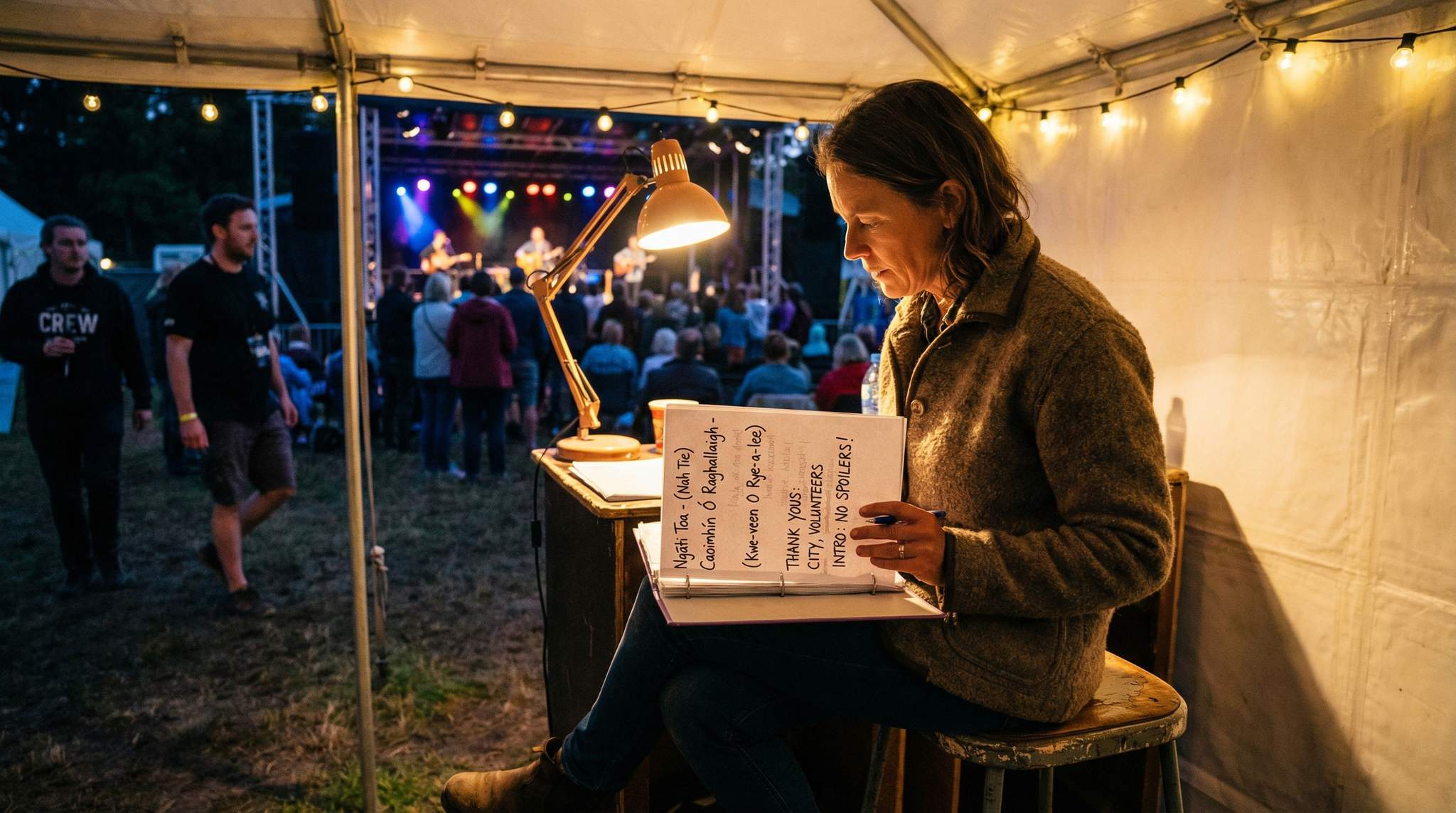
Nothing can deflate a performance’s momentum faster than the MC botching an artist’s name. Folk festivals often feature artists from diverse cultures, each with unique names and band monikers. Festival organisers should ensure every name in the script is written phonetically – a simple but effective step to avoid embarrassment. Before the show, the MC (or someone on the production team) must speak with each act to confirm how to pronounce all names. For example, if Irish fiddler Siobhán is performing, note it as “Shi-vawn” in the script. Likewise, a band like Genghar might be clarified as “Geng-gar,” and Ng? Tae (a M?ori group) as “Nah Tie.” Writing names out in a familiar phonetic way gives MCs the confidence to say them correctly in front of large crowds.
Beyond names, consider any cultural terms, song titles in foreign languages, or place names that might trip up a tongue. If a Canadian folk band sings in French, the MC should practice those song titles. If an Appalachian group uses regional terms, know them. Doing homework on pronunciations is a mark of respect – it shows artists and audiences that the festival cares about their heritage and identity. A great case study is the Alaska Folk Festival, where volunteer MCs are given an emcee manual emphasising the importance of getting names right. Many international festivals, like WOMAD (World of Music, Arts and Dance) founded by Peter Gabriel, brief their MCs on artists from Tuva to Tanzania, often with phonetic guides. This preparation prevents on-stage stumbles and sets a professional tone.
Free Tool: Size Your Festival Site
Zoned capacity planning for arena, campsite, parking and entry lanes — against UK Purple Guide and NFPA density standards. Finds your bottleneck zone.
Catching errors in advance is also crucial. Seasoned festival producers recall cautionary tales of when things went wrong – such as an MC at a world music stage who introduced Malian legend Salif Keita with a mispronunciation. The artist graciously corrected it on mic, but the moment could have been avoided with better prep. The lesson is clear: double-check every pronunciation. Don’t assume; ask the artists or someone from their crew. It can even help to write a cue like “(rhymes with ___)” if that aids memory. Your MC will walk on stage relaxed, knowing they’ll say Tlahuitoltepec or Caoimhín Ó Raghallaigh correctly, and the audience (and artist) will appreciate the professionalism.
Provide Context with Key Stories – But Keep Intros Tight and Spoiler-Free
Audiences love a bit of background that enriches the performance they’re about to experience. A skilled MC offers context or a key story about the artist or the piece – just enough to spark interest. For instance, mentioning that The Chieftains are celebrating 60 years as Ireland’s folk ambassadors, or that a young bluegrass duo learned their skills at a local jam session, can forge a connection between the act and the crowd. These tidbits give the audience a richer appreciation: “Here’s why this next act is special.” At the Cambridge Folk Festival in the UK, MCs often share a quick anecdote like how an upcoming singer was busking at the festival five years ago and now returns as a headliner, illustrating the festival’s nurturing community. Such context turns a simple introduction into a memorable story.
Planning a Festival?
Ticket Fairy's festival ticketing platform handles multi-day passes, RFID wristbands, and complex festival operations.
However, intros must remain tight and spoiler-free. The crowd came to hear music, not long speeches. A common rookie mistake is an MC rattling off a detailed biography or the entire story behind a song – effectively stealing the artist’s thunder. Keep it concise: a sentence or two of context, then the name of the act. If an artist loves to tell the story behind their songs on stage, the MC should avoid preempting those stories. For example, if a band has prepared a surprise guest or a new twist in their set, the introduction shouldn’t give it away. Spoilers can diminish the impact of the performance. A good rule of thumb: tease, don’t tell. Say just enough to build anticipation (“they have a special treat in store for us tonight”) without revealing the surprise.
To strike this balance, coordinate with the artists beforehand. Ask if there’s a particular anecdote they’re comfortable with you sharing, or if there’s anything they’d prefer you not mention. Many performers will gladly offer a favorite fun fact for you to use. Perhaps the singer wrote a song after meeting a fan at this very festival, or the fiddle player dedicates a tune to her grandfather who taught her music. These are heartwarming and relevant pieces to share – as long as they don’t give away what the artist will say or do on stage. Keep introductions under a minute (often 20–30 seconds is ideal for small acts). In fast-paced festivals where stages flip quickly, intros might be literally one line. In a more intimate folk club setting, you might stretch slightly longer to set a scene. Read the crowd’s energy: if they’re restless for the headliner at a large festival, brevity is golden; if they’re seated and attentive in a listening tent, a touch more context is fine. Always end an intro clearly by naming the artist(s) and inviting them on: e.g., “Please welcome the wonderful, the one-and-only… [Artist Name]!”
Thank Sponsors, Funders, and Communities – Respectfully and Often
Behind every great festival are those who make it possible – sponsors, grant funders, local community organisations, and of course the host community itself. The MC’s script should weave in gracious thank-yous to all these stakeholders. Importantly, these should never feel like dry obligations or advertisements, but genuine acknowledgments. A tip is to spread out the thank-yous rather than rattling them all off in one go. For example, mention a major sponsor once early on (“We’d like to thank TradBank for helping make this stage possible”) and again later in the day, instead of listing all sponsors back-to-back which can lose the audience’s attention. Find a natural moment, perhaps right after a rousing set when the crowd’s energy is high, to slide in a quick thanks – it will be better received.
Community appreciation is especially vital at folk festivals, many of which are deeply rooted in local culture. Always acknowledge the people of the town or region hosting the event, and any community groups involved. For instance, at the Winnipeg Folk Festival in Canada, MCs traditionally thank the city and local volunteers for their hospitality, making attendees (many from out of town) applaud the local community. In Australia and New Zealand, it’s now common (and respectful) for the MC to include an Acknowledgment of Country – recognising the Indigenous people of the land where the festival takes place – at least during opening ceremonies or each day’s start. If your festival is on M?ori land in New Zealand or First Nations territory in Canada, consult with community leaders and include a sincere acknowledgment in the script. Deliver it with respect: pronounce group names correctly (again, phonetics are your friend here) and avoid rushing through it. Such acknowledgments, when done genuinely, earn trust and goodwill.
Free Tool: Project Your Bar Revenue
Per-head spend benchmarks by event type turned into projected bar and food revenue, with a stock-mix estimate and gross-margin line. Free calculator.
Don’t forget the funders and partners who may not be as visible as commercial sponsors. Arts councils, tourism boards, cultural institutes – these often underwrite a festival, especially folk and cultural events. A quick thanks to “our friends at the Ministry of Culture for their support” or “the XYZ Arts Council grant that made the workshop series possible” gives credit where it’s due. It also signals to artists and attendees alike that the festival has community and institutional backing. Be sure to get the official names right (no one wants to mis-thank an organisation with the wrong title).
Lastly, volunteers and staff deserve hearty thanks. Folk festivals rely on armies of volunteers – from the stage crew to the folks at the membership table. Encourage the MC to collect volunteer team names and even personal names if appropriate. Shouting out “Let’s hear it for our wonderful stage crew: Jane, Hiroshi, Carlos and the team!” humanises the event and usually draws big cheers. Volunteers feel recognised (boosting their morale for the work yet to do), and the audience sees that there’s an entire community behind the scenes. At some festivals – Burning Man’s smaller regional offshoots or Montana Folk Festival – organisers bring key volunteers or community figures on stage for a quick bow during closing announcements. All these gestures build a spirit of gratitude and inclusivity. As a seasoned festival producer will tell you: you can never thank people enough, as long as you do it sincerely.
Need Festival Funding?
Get the capital you need to book headliners, secure venues, and scale your festival production.
Safety and Access: Announcements that Protect and Include Everyone
While not the most glamorous part of an MC’s duty, safety and accessibility announcements are non-negotiable. A festival audience spans all ages and abilities, and it’s the organisers’ responsibility (through the MC’s voice) to keep them informed for their well-being. Key safety messages should be scripted and delivered clearly at intervals – without inciting alarm, but with confidence and care. Typical safety reminders include pointing out emergency exits, first aid and medical tent locations, lost-and-found information, and requests to keep pathways clear and not overcrowd certain areas. For example, at a large festival like Woodford Folk Festival in Queensland, MCs at each stage routinely remind people to stay hydrated (the Aussie summer heat is fierce) and to “look after one another.” These little prompts can prevent medical issues by encouraging personal responsibility. At urban festivals with noise restrictions, an MC might warn about volume or provide earplug info (“Free earplugs are available at the info desk for those who need them”).
Access reminders are equally important. Today’s festival culture strives to be inclusive, so use the MC’s platform to note facilities for those with disabilities or special needs. A quick announcement about wheelchair viewing areas (“Folks who need accessible viewing, there’s a reserved area to the right of the stage – please see our staff for assistance”) or the availability of sign language interpretation for certain performances goes a long way. Some folk festivals now employ ASL (American Sign Language) or ISL (International Sign) interpreters on main stages. If so, give them a nod of appreciation in the script, and perhaps introduce them at the start of a set: e.g., “Joining us to interpret the music in sign language is [Name] – let’s give them a hand!” This not only informs those who need the service, but also highlights the festival’s commitment to accessibility.
Crucially, safety messages should be regular but rotated – don’t dump a long list all at once (people tune out). Instead, sprinkle them across the day or evening. Before a high-energy headliner might be a smart time to calmly remind everyone where exits are and to be mindful of those around them. If there are weather-related concerns (say, heat, or a coming storm), the MC can relay official advice like where to seek shelter or to use sunscreen. Always keep the tone helpful and positive, not scolding. For instance, rather than “Don’t push or you’ll be ejected,” say “Let’s all take a step back and give each other some room – we want everyone to be safe and comfortable.” Audiences respond better to a caring tone.
And yes, sometimes the MC might have to be the bearer of tough messages – like instructing an evacuation due to severe weather or pausing the show for a medical emergency. This is where preparation truly shows: a festival organiser should pre-brief MCs on emergency protocols so they know exactly what to say in those critical moments. Having a printed card with emergency scripts (and even key local emergency numbers or instructions) at the MC’s podium is wise. It’s like a fire drill: you hope never to need it, but it must be there. One shining example occurred at Roskilde Festival in Denmark after a tragic incident years ago – since then, MCs and stage hosts there make routine safety announcements and are trained to address the crowd calmly if anything goes wrong. Thankfully, serious incidents are rare, but proactive communication keeps everyone safer and shows the festival’s professionalism in risk management.
Free Tool: When Should You Announce?
Pick your event date and genre — the free planner outputs a recommended announce, presale, on-sale and reminder schedule anchored to how your audience actually buys.
Staying on Schedule: Debriefing MCs Nightly on Timing
In the whirlwind of a festival, timing is everything. Stages often have dozens of acts lined up, with set lengths and changeovers precisely planned. The MC acts as the informal timekeeper on stage – bridging gaps, but also wrapping up when needed to keep things on track. Festival organisers should brief their MCs about the day’s schedule strictness, including any hard curfews or potential bottlenecks. For example, if the city noise curfew is 11:00 PM sharp or if there’s a live broadcast scheduled at a certain time, the MC needs to know that there is zero wiggle room for overruns. This awareness will shape how they handle their script: they might shorten an intro if a previous act ran long, or conversely, be prepared to stretch (tell an extra story or make additional announcements) if there’s an unexpected delay setting up the next band.
A great practice is to debrief MCs at the end of each festival day. Gather your MCs (some festivals have one per stage, others one main MC and assistants) for a quick chat every night. Review what went well with timing and what didn’t. Did the afternoon stage run 15 minutes late because the MC’s welcome speech dragged on? Was the open-mic workshop unexpectedly quick, leaving a gap that the MC adeptly filled with a joke and sponsor thank-yous? Sharing these observations helps adjust for the next day. It’s also an opportunity to update the MCs on any schedule changes or artist drop-outs for tomorrow, so they can tweak their scripts accordingly. Many experienced festival producers treat MCs almost like airline pilots – there’s a “pre-flight” briefing each morning and a “post-flight” debrief each night to review timing, weather (really – weather might change how you do things), and any messages to emphasise.
By debriefing regularly, you also keep MCs feeling like part of the production team loop. They’ll appreciate being updated (“Tomorrow the Mayor is coming on stage at 6pm for a quick speech – let’s be ready to introduce her”). It’s far better to inform them the night before than to spring surprises in the moment. If an MC did run overtime themselves, use the debrief as a supportive coaching moment: gently reiterate the importance of tight intros or sticking to the schedule. On the flip side, celebrate their successes – if they brilliantly handled a schedule hiccup or got the crowd energy up after a rain delay, acknowledge it. MCs who feel valued and guided will perform even better.
Also consider having a visible clock or timer facing the stage that the MC can see (many festivals do this). Some festivals go high-tech with a countdown timer for each act’s set and changeover. The MC should be aware of these cues – e.g., a flashing light at 2 minutes to go – and wrap up announcements accordingly. In the earlier mentioned Alaska Folk Festival, for instance, MCs work with the monitor crew who have a timer and they know to help an act finish if needed by leading applause. Smooth time management is a team effort between stage managers, sound techs, and the MC. With nightly check-ins, the whole team stays aligned and the show runs on schedule (audiences and artists both appreciate a well-run show!).
Adapting to Festival Size and Audience
Every festival has its own character. A cosy folk weekend in a small village will have a different vibe and MC approach than a sprawling international festival like Festival Interceltique de Lorient in France, which draws nearly a million attendees. It’s important to tailor the MC script and style to the festival’s scale and audience. For a smaller boutique folk festival, the tone can be very informal and familial – the MC might personally know many performers and even audience members. In such cases, a touch of friendly charm and local humour works well (inside jokes about the town, or acknowledging “Auntie Marge’s famous meat pies at the bake sale tent”). Just ensure any humour is good-natured and inclusive; even in-jokes should be explained so newcomers don’t feel alienated.
In contrast, on a big festival main stage, the MC might be a professional radio presenter or a notable figure brought in to host. The style there could be more polished and universally appealing. Jokes or references should cater to an international crowd. For example, at WOMADelaide in Australia, MCs often speak in both English and occasionally a few words of the artist’s language to make overseas guests feel welcome (e.g., greeting a Spanish band with “¡buenos días!” to cheers). A large crowd also means the MC must exert more vocal energy and clear diction – almost like an arena sports announcer at times – whereas in a small folk club, a gentle conversational tone suffices.
Turn Fans Into Your Marketing Team
Ticket Fairy's built-in referral rewards system incentivizes attendees to share your event, delivering 15-25% sales boosts and 30x ROI vs paid ads.
Consider audience demographics too. A daytime folk festival show with families and elders in attendance might warrant a slightly slower, clearer delivery and absolutely clean language (no swearing or crude jokes). Folk festivals, in particular, tend to be family-friendly. The MC should be prepared to adapt their content: for instance, emphasising children’s activities or thanking the “parents and grandparents for bringing the next generation to experience the music.” On the other hand, an late-night folk fusion act might attract a younger, more boisterous crowd – here the MC can ramp up the excitement and use more informal banter. It’s all about reading the room (or field!) and adjusting within the bounds of the prepared script.
Another aspect of adaptation is the cultural context. In some countries, formal titles and honorifics are important. If you’re producing a festival in, say, India or Malaysia, and one of your funders is a government official or a royal patron, the MC script must include their proper titles and a respectful greeting when they’re acknowledged. This could mean saying “The organisers wish to thank Datuk so-and-so” or “Her Excellency ____” as appropriate. Research the protocol – it’s a small but significant detail. In contrast, a laid-back festival in California might thank the mayor just by name without formalities. Knowing what’s expected in the local culture prevents awkward faux pas on stage.
Finally, be mindful of language. In many non-English-speaking regions, festivals will do introductions in the local language and then English (or vice versa) to cater to all attendees. This may mean double the script content, so plan timing accordingly. If your festival has a multilingual audience (like Europe’s cultural festivals or events in bilingual countries like Canada), decide if the MC will repeat key points in a second language. If the MC isn’t bilingual, perhaps a co-MC or interpreter can assist. At Montreal’s folk festival, for instance, one might hear an introduction in French, then an English translation to follow. The goal is to make everyone feel included and informed.
Conclusion
Crafting MC scripts for folk festivals is an art and a science. It requires attention to detail (like phonetic spellings and correct titles), a sense of storytelling, and a big dose of empathy and respect. A festival’s MC is more than just a host – on stage, they become the voice of the festival’s brand and values. By properly equipping them with a great script and guidance, festival organisers ensure that voice rings out clearly and positively.
From intimate gatherings in local halls to global extravaganzas in vast parks, the fundamentals remain consistent. Pronounce every name with care, give context that enhances the music, express gratitude often, uphold safety and inclusivity, and keep the show running on time. These practices create a welcoming atmosphere and smooth experience for everyone involved – artists, audience, crew, and sponsors alike. In turn, a well-hosted festival builds a strong reputation, as people remember not just the performances, but how the event felt. And when an event feels both professional and heartfelt, attendees will come back year after year.
As one final piece of wisdom from festival veterans: prepare diligently, then be ready to improvise. Live events always hold surprises – a rain delay, a power outage, a last-minute schedule swap – and often the MC is the one holding it together in front of the crowd when things shift. With a solid script in hand and the principles above in mind, an MC (and the producing team supporting them) can handle any curveball with grace. That’s the mark of an outstanding festival experience.
Accept Payments Across 13 Countries
Local currency processing via Stripe, Razorpay, Xendit, Paystack, and OXXO across 13 countries with region-specific payment methods.
Frequently Asked Questions
How should an MC prepare for difficult artist name pronunciations?
Festival organizers must ensure every name in the script is written phonetically to guarantee accuracy. The most effective method is for the MC or production team to speak directly with each act before the show to confirm pronunciations. Writing cues like “rhymes with” or “Shi-vawn” prevents on-stage errors and shows respect for cultural heritage.
What key elements should be included in a festival MC script?
A comprehensive festival MC script includes phonetic artist introductions, context-setting stories, and essential safety announcements. It must also incorporate gracious thank-yous for sponsors, funders, and volunteers, distributed naturally throughout the event. Additionally, the script should contain specific timing cues and emergency protocols to ensure the event runs smoothly and safely.
How long should a band introduction be at a music festival?
Band introductions should remain tight and concise, ideally lasting between 20 to 30 seconds for smaller acts or up to one minute for headliners. In fast-paced festival environments where stages flip quickly, introductions may be reduced to a single line. The goal is to build anticipation without delaying the performance or stealing the artist’s thunder.
What safety announcements are essential for festival MCs to make?
Essential safety announcements include the locations of emergency exits, first aid tents, and lost-and-found stations. MCs should also provide reminders about hydration, sun protection, and keeping pathways clear. These messages should be delivered calmly and rotated throughout the day to keep the audience informed without causing alarm or fatigue.
How should MCs thank sponsors during a festival performance?
MCs should spread thank-yous out across the event rather than listing all sponsors in a single block. Acknowledging specific sponsors or funders naturally after a high-energy set ensures the message is well-received. Genuine gratitude toward local community groups, volunteers, and grant providers builds goodwill and avoids the feel of a dry commercial obligation.
Should an MC reveal song stories or set surprises in their introduction?
MCs must avoid revealing detailed backstories or specific surprises that the artist intends to share on stage. The introduction should tease the performance to build anticipation without acting as a spoiler. A good rule is to provide just enough context to spark interest while leaving the storytelling and special moments to the performers themselves.
How can festival organizers ensure MCs stay on schedule?
Organizers should brief MCs on schedule strictness and utilize visible stage clocks or countdown timers to manage set lengths. Conducting nightly debriefs allows the production team to review timing issues and adjust scripts for the following day. This coordination between stage managers and MCs ensures seamless changeovers and adherence to curfews.
Why is it important to include an Acknowledgment of Country at festivals?
Including an Acknowledgment of Country or recognizing Indigenous territories demonstrates deep respect for the land and local history. This practice, common in Australia, New Zealand, and Canada, fosters inclusivity and earns trust with the community. Organizers should consult local leaders to ensure the acknowledgment is worded correctly and delivered with genuine sincerity.