Ensuring family-friendly festivals accommodate breastfeeding parents is both a legal necessity and a chance to win attendee loyalty. Festival production teams around the world are learning that supporting nursing mothers isn’t just about avoiding lawsuits – it’s about creating an inclusive, welcoming environment for all. A well-known example involved Australia’s Laneway Festival: a mother was initially told she couldn’t leave and re-enter to breastfeed her baby due to a strict no pass-out policy, but after she reminded organisers of the law protecting breastfeeding, management quickly arranged special escorted re-entry for her as often as needed, a struggle detailed by Kidspot regarding how management rectified the situation. This incident highlights why proactive planning for nursing rights is vital. By publishing a supportive nursing policy consistent with local laws, training staff to protect rather than police, and providing comfortable options for breastfeeding, festival producers can ensure compliance without friction – and earn immense goodwill from families.
Understand Local Nursing Rights and Laws
Before drafting any policy, festival organisers must educate themselves on local breastfeeding laws. In most locales, nursing mothers have the legal right to breastfeed in public. For instance:
- United States: As of 2018, all 50 U.S. states and Washington D.C. legally protect nursing in public. No attendee can be prohibited or punished for breastfeeding openly at a festival.
- United Kingdom: Under the Equality Act 2010, it is considered discrimination to treat a breastfeeding mother unfavourably or ask her to stop. Businesses (including event venues) cannot ask a nursing mum to cover up or leave – doing so could lead to legal action.
- Australia & beyond: Similar protections exist. Australian anti-discrimination laws consider breastfeeding a protected attribute – it’s illegal to treat someone badly for nursing. Canada, New Zealand, the EU and many other regions likewise uphold a mother’s right to feed her child wherever she is authorised to be.
Actionable advice: Research the specific statutes or human rights codes in your festival’s region. Consult local authorities or legal advisors if needed to ensure your event’s policies align with current laws. This knowledge isn’t just for fine print – it will inform staff training and how you handle situations on the ground. Knowing the law gives you confidence to enforce a pro-nursing stance and immediately correct any staff or security missteps. It also means you can educate attendees (gently) if someone objects to a mother breastfeeding, by pointing out that she is exercising a protected right.
Publish a Supportive Nursing Policy
Once you understand the legal landscape, craft a clear, supportive nursing policy and make it public. This policy should be prominently featured in your festival guidelines, website FAQs, and on-site signage or programs for family areas. The tone should be welcoming and unequivocal: nursing parents are welcome to feed their children anywhere on the festival grounds.
Turn Fans Into Your Marketing Team
Ticket Fairy's built-in referral rewards system incentivizes attendees to share your event, delivering 15-25% sales boosts and 30x ROI vs paid ads.
Consider wording such as: “[Festival Name] is a family-friendly event. Breastfeeding and bottle-feeding are permitted anywhere on site. We support parents’ rights to care for and feed their infants, in accordance with [Local Law X].” This sets expectations for all attendees and staff from the outset.
Case in point: Some festivals explicitly advertise themselves as breastfeeding-friendly. In Northern Ireland, an entire event called Breastival is dedicated to normalising and celebrating breastfeeding – a sign of how far public attitude has come. While your festival might not be themed around infant feeding, you can still take inspiration from Breastival’s approach: be proud to support nursing mothers openly. By publishing a policy, you also feed the ego of parent attendees; they’ll appreciate seeing a festival acknowledge their needs. It signals that your event has thought about families in its planning.
Planning a Festival?
Ticket Fairy's festival ticketing platform handles multi-day passes, RFID wristbands, and complex festival operations.
Moreover, having a written policy can serve as a protective measure. If a staff member or attendee challenges a nursing mother, the policy backs your team up. It also provides a reference if any complaint arises – showing that your festival is proactively compliant with the law and committed to inclusivity. Make sure to update the policy if laws change, and try not to bury it in fine print. A visible show of support (even a line in the festival program or a social media post about “nursing moms welcome here”) can go a long way in winning hearts and minds among your community.
Train Staff to Support, Not Police
Even the best policy means little if ground-level staff don’t uphold it. Every festival staff member, volunteer, and security officer should be trained that their role is to protect nursing mothers, rather than police them. Sadly, there have been incidents at events and public venues where untrained staff asked mothers to “cover up” or move, causing distress and public backlash. Prevent this with thorough training and clear protocols. Here’s how:
- Include nursing support in staff orientation: When briefing staff (especially those in customer-facing roles like security, ushers, or information desk personnel), explicitly cover your breastfeeding policy. Explain that mothers have a right to nurse and that festival staff must facilitate that right. Emphasise that under no circumstances should a nursing parent be asked to stop, move, or cover up because of breastfeeding.
- Empower staff to be allies: Frame your team’s duty as one of support. For example, if staff see a mother nursing, their default approach should be respectful and non-intrusive. They might offer help only if the parent looks like they need something (e.g. water, or directions to the family lounge), but otherwise give the parent privacy and a sense of normalcy. Staff should also be ready to shield nursing mothers from any harassment – meaning if another attendee makes a fuss, it’s the staff’s job to politely intervene on the mother’s behalf (more on handling complaints below).
- Address practical considerations: Security personnel should be trained to recognise breastfeeding equipment and supplies. A pumping mother might carry a breast pump kit or cooler bag with ice packs for milk. These items should be allowed through bag checks (and exempt from any “no outside liquids” rules when it’s breast milk or formula). Inform your security team in advance so they don’t accidentally confiscate or question these essential supplies. Many festivals treat such items akin to medical necessities – which, effectively, they are.
- Learn from mistakes: Use real stories as teaching tools. The Laneway Festival example above is a perfect case – the staff enforcing a no re-entry rule weren’t trying to be difficult; they were following general policy, but without flexibility for a breastfeeding need. By sharing this story in training, you illustrate why a one-size-fits-all approach can fail, and how important it is for staff to escalate or seek exceptions when family needs are at stake. The positive resolution (management stepping in to grant re-entry) also shows staff that the festival wants to accommodate, and that they have backup from higher-ups when doing so.
- Cultural sensitivity: If your crew is international or your festival tours different countries, ensure everyone is aware of local norms too. In some cultures, public breastfeeding may draw more attention or discomfort from bystanders. Staff should be prepared to calmly reinforce the mother’s right regardless of any cultural bias, but also know how to do so sensitively. For example, providing a shawl or cover is appropriate only if the mother herself requests it – never impose one. “Protect, not police” means staff stand on the nursing mother’s side every time.
When your team is properly trained, they become guardians of a family-friendly atmosphere. They’ll handle situations confidently and compassionately, reducing the chance of any friction or negative scene. Seasoned festival producers know that every front-line interaction matters – a single misguided comment from security can tarnish your reputation. Conversely, a helpful, trained staffer who stands up for a breastfeeding mum will likely earn you a glowing social media mention from that grateful parent later on.
Provide Nursing Lounges and Embrace Open Nursing
A key strategy for making nursing parents comfortable is to offer options. Some mothers prefer a quiet, private spot to feed or pump; others are fine breastfeeding in the middle of the crowd. The best family-friendly festivals cater to both. Here’s how to strike that balance:
Free Tool: Size Your Festival Site
Zoned capacity planning for arena, campsite, parking and entry lanes — against UK Purple Guide and NFPA density standards. Finds your bottleneck zone.
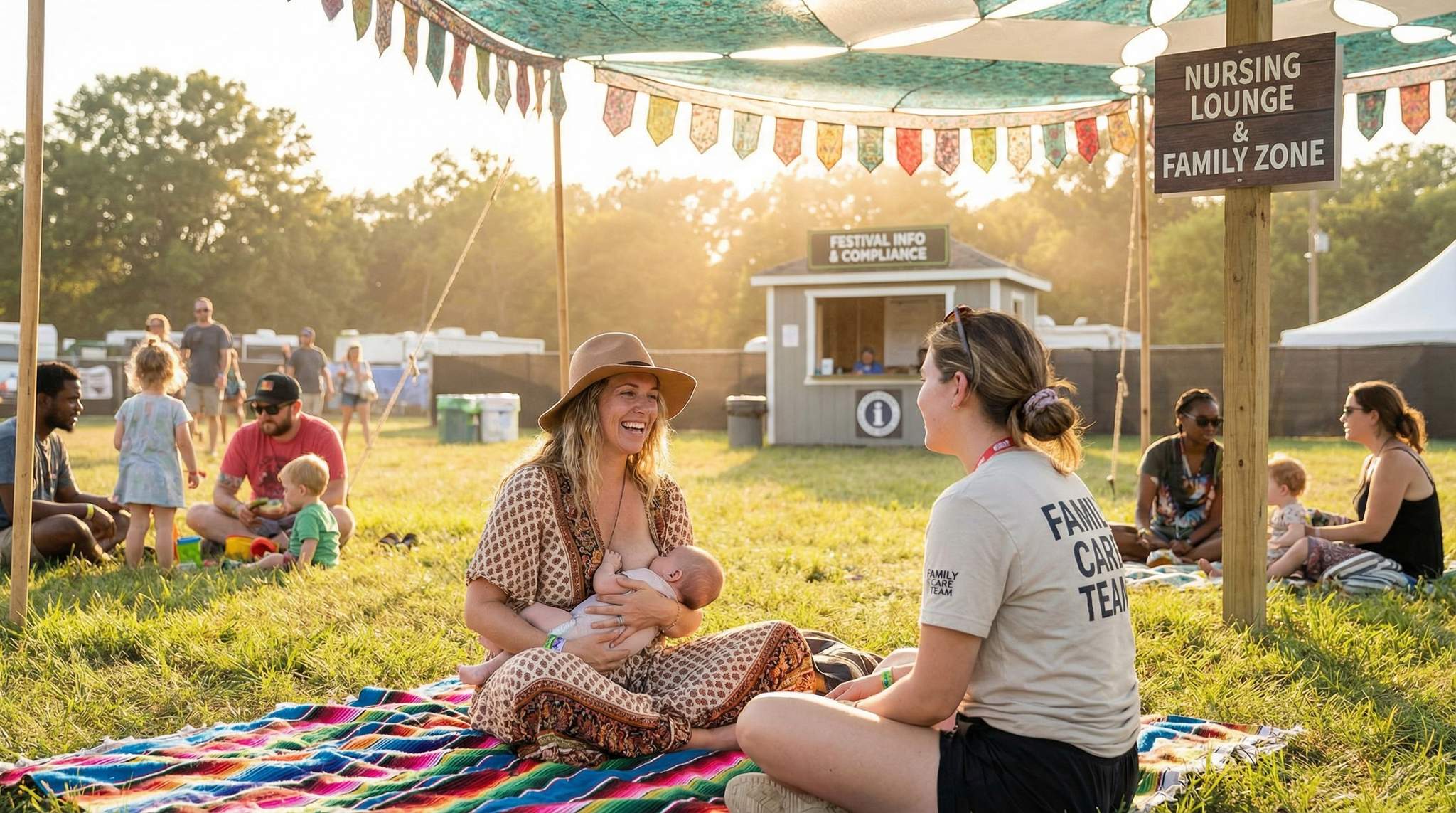
1. Designated Nursing & Baby Care Areas: Setting up a private or semi-private nursing lounge can be a game-changer for parents with infants. This could be a dedicated tent, yurt, or room on the festival grounds where mothers (and any parent) can nurse, pump, or simply take a break with their baby. Equip this space thoughtfully: comfortable seating (rocking chairs or cushions), shade and ventilation (fans if it’s hot), and access to water and hand-washing facilities. A few useful additions include a changing table, wet wipes, and perhaps some toys or mats for toddlers. Case study: Glastonbury Festival in the UK, known for its massive scale and diverse crowd, still takes care of its youngest attendees. In the Kidzfield area, Glastonbury provides an NCT (National Childbirth Trust) Baby Tent – described as a calm haven for babies and parents. This kind of partnership with a parenting organization not only gives professional support (NCT volunteers on hand to advise or help) but strongly signals that breastfeeding families are welcome.
Other festivals have introduced similar spaces. Stendhal Festival in Northern Ireland brought in a special “breastfeeding wagon” – a dedicated caravan for nursing mums to relax, which even had breastfeeding support workers available for chat and advice. These examples show that whether it’s a large tent or a cozy wagon, parents deeply appreciate having a safe space. If your festival is small or on a tight budget, you can still create a simple nursing corner: for instance, a roped-off area with a shade umbrella and a couple of comfortable chairs can do wonders. Some events partner with sponsors (like baby product companies or family services) to provide a fully kitted “family rest area” at no extra cost to the festival.
Need Festival Funding?
Get the capital you need to book headliners, secure venues, and scale your festival production.
2. Open-Nursing Acceptance Everywhere: Equally important is reinforcing that beyond those lounges, nursing is acceptable anywhere on festival grounds. A mother shouldn’t feel confined to a special tent every time the baby is hungry – especially if it means missing a favourite band’s performance. Your policy and on-site messaging should make it clear that using the nursing lounge is entirely optional. Many parents will use both approaches: sometimes finding a quiet spot, other times feeding right in the middle of the fun.
Make sure festival staff and signage send the message that “Breastfeed anywhere you like!”. This could be as simple as including a line in the festival map brochure: “Parents are welcome to nurse or bottle-feed infants freely throughout the venue. We’ve also provided a Family Lounge at Location X if you prefer some privacy.” By normalising open nursing, you also help chip away at any stigma among other attendees. Seeing babies with headphones on, nursing while mom or dad enjoys a concert, might become a regular sight. In fact, many modern festivals celebrate this: at Download Festival (a major rock/metal festival in England), one breastfeeding mother reported she was able to watch almost all the bands she loved with her baby in tow, and not a single person batted an eye. Encouraging that vibe of acceptance makes your event feel truly family-friendly rather than just tolerating kids.
3. Facilities for Pumping and Milk Storage: Don’t forget that some nursing attendees might be pumping milk (especially if they’ve come without the baby, or need to express milk during a long festival day). If feasible, provide a power outlet in the nursing area for electric pumps. A small refrigerator (or at least a cooler with ice) in the staff first-aid tent could be offered for safely storing expressed milk – mothers will be grateful not to worry about milk spoiling in the summer heat. At conferences and large expos, lactation rooms often include such amenities by default, but at an open-air festival you may need to improvise (a generator-powered mini-fridge or asking medical staff to tag and store milk). Ensure any such service is communicated to attendees, perhaps in the policy or at the info booth.
By providing both practical facilities and a permissive culture, you cover all bases. Parents can choose what makes them most comfortable. This dual approach – private lounges plus open nursing anywhere – directly reflects the mantra “Rights + comfort = wins hearts.” You’re not only doing the bare minimum of upholding rights; you’re actively making the experience nicer for families. In return, you’ll likely see greater loyalty and positive word-of-mouth from parents who attend.
Free Tool: Project Your Bar Revenue
Per-head spend benchmarks by event type turned into projected bar and food revenue, with a stock-mix estimate and gross-margin line. Free calculator.
Handle Complaints with Firm, Friendly Scripts
Even with clear policies and training, you may occasionally encounter complaints or discomfort from other attendees when they see a mother breastfeeding. It could be a misinformed staffer or a patron who “thinks it’s inappropriate” in public. How your team handles these moments is crucial. The goal is to defuse any tension while standing resolutely by the nursing parent’s rights and comfort. Having some prepared “friendly but firm” scripts can help staff respond consistently and confidently. Here are strategies and sample language:
- Stay calm and informative: If someone complains (for instance, saying “I don’t want to see that” or “she should do that in private”), the staff member should maintain a polite, matter-of-fact tone. A good response might be: “I understand it may be unexpected for you, but we allow breastfeeding here and it’s quite normal. She’s just feeding her baby. We have a festival policy – and in fact, the law – that permits it anywhere on site.” This type of script reassures the complainer that their concern was heard (“I understand”) but immediately clarifies the festival’s stance and the mother’s right.
- Reference the policy/law, then offer alternatives: Sometimes people just need to know that this is officially sanctioned. A staffer can say, for example: “Our festival is family-friendly and supports nursing moms. It’s actually protected by law, and we want all our guests, including parents, to be comfortable. If it bothers you, you’re welcome to move to another area – but we cannot ask her to stop.” This script is friendly (in tone) but unequivocal. It subtly puts the onus on the person complaining to remove themselves if they’re truly uncomfortable, rather than on the mother who is doing nothing wrong.
- Never suggest the mother relocate: Be sure your team never responds to a complaint by asking the nursing mother to move, cover up, or go to the nursing tent. Doing so legitimises the complaint and effectively polices the mother – exactly what we want to avoid. Instead, staff should be her advocate. Often, just explaining the policy as above will end the discussion. In many cases, the complaining person will back down once they realise the festival explicitly supports breastfeeding and that they are in the minority view.
- Use security or supervisors if needed: On the rare occasion someone continues to harass a nursing parent, treat it as you would any other form of harassment. Your team can involve security to firmly tell the offender that their behaviour is unwelcome. This is where having the law on your side is useful – staff can mention that asking a woman to stop breastfeeding could be considered discrimination and is not allowed at the event. Preserve that friendly tone as long as possible, but don’t hesitate to be firm. For example: “I’m sorry, but we cannot interfere with a mother feeding her child. If you continue to disturb other patrons, we’ll have to ask you to leave instead.” It rarely comes to that, but having a scripted escalation prepared helps staff feel prepared.
- Educate and normalize: In some cases, a person’s complaint may come more from ignorance than malice. Festivals can turn these moments into teachable opportunities. Some events even put up small signs or include program notes like “Breastfeeding is welcome here – if you have any concerns, please approach our staff who will be happy to talk.” This pre-empts complaints by setting a norm. If someone still comments, staff can kindly say: “Our festival celebrates families. We’ve got lots of parents with little ones this year – it’s great to see! We make sure they’re comfortable, just like we want everyone to be.” This reframes the situation positively, and often that positive framing can disarm a would-be critic.
By handling any complaints or awkward interactions with a firm yet friendly script, you prevent conflict while clearly asserting the rights of nursing guests. Train your team with role-play scenarios: What if a teenage attendee makes a rude joke when he sees a mom breastfeeding? What if a older attendee complains loudly? Give them the words and authority to respond. When staff consistently respond in a supportive manner, word will spread that your festival truly has parents’ backs. It only takes one viral social media post of “I was nursing at X Festival and a staff member came over – I thought I was in trouble – but they actually offered me water and told the guy who was bothering me to kindly move along. So impressed!” to elevate your event’s reputation.
Rights + Comfort Wins Hearts (and Loyalty)
Ultimately, creating a breastfeeding-friendly festival environment is about respect and comfort. When you honour mothers’ rights and go the extra mile to ensure their comfort, you foster an atmosphere where families feel truly welcome. This has tangible benefits for your festival’s success:
- Wider Audience Appeal: Making accommodations for nursing parents means young families can attend events they might otherwise skip. This can expand your ticket sales and attendee demographics. A mum or dad who might have stayed home with the baby will consider coming if they know the festival is equipped for infants. (Be sure to advertise these family-friendly features in your marketing!)
- Positive Word-of-Mouth: Parents are a tight-knit community. When they have a great experience – like finding a clean, welcoming nursing tent or encountering super supportive staff – they talk about it. You can expect appreciative posts in parenting forums, social media groups, and reviews. This kind of praise is gold for your festival’s image. It paints your team as caring and progressive, which can draw even more attendees who value that ethos.
- Legal Peace of Mind: By complying with local laws proactively, you avoid nasty surprises like complaints filed with human rights commissions or negative press coverage about a breastfeeding mum being mistreated. Instead, you might end up in the news for positive reasons – like being the festival that “got it right” for families. It’s far better to be celebrated for inclusion than to go viral for the wrong reasons.
- Community Goodwill: Festivals often rely on community support and a positive relationship with local authorities. Being known as a family-friendly, inclusive event helps build goodwill with city councils, sponsors, and venues. For example, a city might be more inclined to grant permits to an event that has a track record of community-minded policies (and fewer complaints from the public).
- It’s the Right Thing to Do: Beyond business metrics, organisers who champion nursing rights contribute to normalising something that benefits society. You’re sending a message that your festival culture values caregiving and equality. Seasoned festival producers often mention that some of their most rewarding moments were seeing all ages enjoying the event – from babies in earmuffs to grandparents dancing. Embracing breastfeeding is part of that full circle of life at festivals.
In the end, compliance without friction comes down to planning and empathy. By anticipating the needs of nursing mothers and baking solutions into your festival operations, you remove potential friction points before they happen. Publishing a supportive policy means everyone knows the rules; training staff ensures those rules are upheld kindly; providing lounges and acceptance covers both privacy and inclusivity; and prepared scripts help handle the occasional challenge with grace. These efforts don’t go unnoticed – they win hearts. A mother who feels genuinely welcome will remember it for years (and likely become a loyal fan of your festival). Fellow attendees, even those without kids, will notice the positive family atmosphere. It’s hard not to smile seeing a content baby nursing while music plays in the background – it adds a human touch to the festival experience.
As you implement these practices, remember that continuous improvement is key. Solicit feedback from parents at your events. If something isn’t working (maybe the lounge needs to be closer to the main stage, or more signage is needed), adapt and refine. The next wave of festival producers can build on the hard-won lessons of seasoned organisers – and the collective wisdom says that championing nursing rights and comfort is a win-win for everyone.