The High Cost of Overstock and Stockouts
Why Merch Inventory Planning Matters
Festival merchandise isn’t just a few t-shirts on a table – it’s a major revenue stream and a core part of the fan experience. Getting the stock levels wrong can be costly. If a festival orders far too much merch, money gets tied up in unsold goods and precious budget is wasted. If they order too little of popular items, they miss out on revenue and leave fans disappointed. Merch inventory planning sits at the intersection of finance and fan satisfaction, making it one of the most critical tasks for any festival producer.
Lost Sales from Understocking
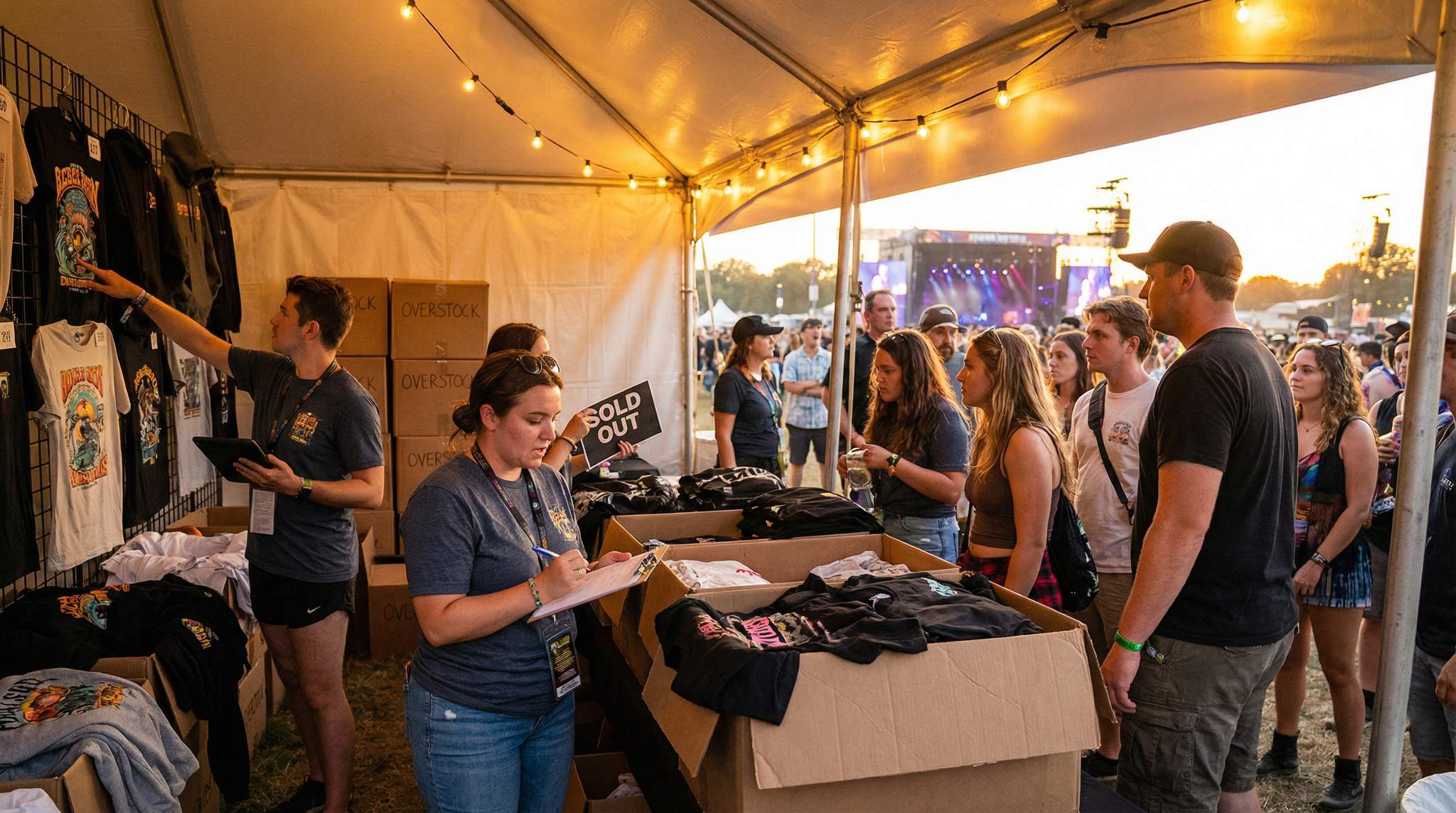
Running out of hot-selling items mid-festival is every festival producer’s nightmare. When a fan finally gets to the merch booth only to find their size sold out or their favorite design gone, that’s a lost sale and an unhappy attendee. The revenue from that potential purchase is lost forever – and worse, the fan leaves with a poor impression. In an age where fans eagerly share their festival haul on social media, having empty shelves means missed marketing opportunities too. Festivals like Rock en Seine in France noticed that understocking popular shirt sizes led to dozens of frustrated fans, prompting them to improve forecasting for the next year. Ensuring ample stock of anticipated bestsellers (especially in common sizes) prevents these situations and captures every possible sale.
Leftover Stock Drains the Budget
On the flip side, overstocking merchandise can bleed a festival’s finances dry. Every unsold hoodie or poster represents money spent that didn’t come back. Leftover merch often ends up heavily discounted at the end of the festival or stored (incurring storage costs) – either way, it erodes profit margins. For example, a food festival in Singapore once printed thousands of extra branded tote bags that attendees never picked up; boxes of leftovers sat in storage for years, a constant reminder of overestimation. Excess inventory can also become obsolete if it’s event-specific (like shirts with the year or lineup). Those items lose relevance quickly and might never sell unless repurposed. Beyond the immediate financial hit, there’s an environmental cost – producing goods that go unused contributes to waste. Unsold merchandise also undermines sustainability efforts – in fact, many events are now adopting sustainable merch practices to minimize waste and reduce environmental impact. In short, ordering too much not only locks up cash in unsold goods but can also tarnish a festival’s sustainability goals.
Striking the Right Balance
The goal of merch inventory optimization is to thread the needle between too little and too much. That “just right” zone means most attendees can buy what they want (maximizing revenue and fan happiness) while the festival isn’t stuck with piles of unsold stock. Achieving this balance requires a blend of art and science: art in understanding your audience’s desires, and science in using data and forecasting methods. Successful festival organizers treat merch planning as a dynamic process – one that starts months before the event and continues through to post-festival sales. In the sections that follow, we’ll dive into proven strategies for forecasting demand, adjusting orders, and creative tactics to avoid both stockouts and leftovers. By learning from both successes and failures in festival merchandising, any event can get closer to that optimal balance.
Boost Revenue With Smart Upsells
Sell merchandise, VIP upgrades, parking passes, and add-ons during checkout and via post-purchase emails. Increase average order value by up to 220%.
Analyzing Past Data for Accurate Forecasts
Reviewing Sales from Past Festivals
Historical data is a festival producer’s best friend when forecasting merchandise needs. Start by digging into last year’s sales figures and inventory records. What were the top-selling items? Which designs or products sold out, and how quickly? Conversely, which items barely moved? By identifying patterns in past sales, organizers can make informed predictions for the upcoming festival. For instance, if records show that 80% of all T-shirt stock sold out by day two last year, it’s a clear sign to increase T-shirt quantities this time around. Many large festivals keep multi-year logs of merch performance – a practice that helps in spotting growth trends (e.g., merchandise revenue rising in proportion to attendance) or shifts in preferences (maybe hats started outselling posters over the years). If your festival is new and lacks its own history, look for data from similar events or reach out to industry colleagues for benchmarks. The key is to base decisions on evidence rather than gut feeling.
Bestsellers vs. Slow Movers
Not all merch is created equal – some items fly off the shelves, others collect dust. Break down your historical sales by product type to pinpoint bestsellers and slow movers. Perhaps T-shirts and hoodies consistently account for 70% of merch revenue, while keychains or fridge magnets barely sell. With this insight, you can prioritize budget and inventory space for the money-makers. It’s also wise to analyze design-specific performance: maybe the shirt with the festival’s bold artwork sold out, but the one with just the lineup text didn’t. For example, at Australia’s Splendour in the Grass, a tie-dye festival tee vastly outsold a plain logo tee – a lesson that unique, eye-catching designs can trump generic ones in popularity. Identifying slow movers (like that leftover stack of last year’s posters) teaches you what to cut or produce in smaller quantities. Sometimes, a product is a slow mover not because fans don’t want it, but perhaps because of pricing or placement issues – however, often it’s simply not what the audience values as a keepsake. Focus on what sells, and don’t be afraid to trim the rest.
Planning a Festival?
Ticket Fairy's festival ticketing platform handles multi-day passes, RFID wristbands, and complex festival operations.
Learning from Size Distribution
One often-overlooked data point is the size distribution of apparel sold. Ordering the right number of each size is crucial to avoid leftovers. Analyze last year’s apparel sales by size: did you run out of mediums by the second day? Were there piles of 3XL shirts left unsold? Many festivals have discovered that medium and large are typically the fastest-moving sizes for unisex T-shirts, an insight crucial when implementing sustainable strategies that sell, whereas very small or very large sizes tend to remain unsold in higher proportions. For example, Electric Daisy Carnival (EDC) noted that sizes in the middle range sold 2–3 times more than XS or XXL. Using such insights, you might order a higher percentage of M and L, and fewer of the extremes. A common approach is to follow a ratio like 5:7:7:5:3 (S:M:L:XL:XXL) for unisex tees as a starting point – then adjust based on your event’s specific audience (a yoga festival might skew towards smaller sizes, a heavy-metal festival might skew larger, for instance). By tailoring the size mix to real demand, you reduce the chance of ending the event with a box of nothing but XS and XXL left over.
External Benchmarks for New Festivals
If you’re launching a new festival or adding merch for the first time, you won’t have past event data – but you can still make educated forecasts. Look at festivals similar in genre, size, or audience demographic and see if any case studies or reports are available. Industry research can offer ballpark figures for merch sales per attendee. For instance, major music festivals often expect anywhere from 10–20% of attendees to buy a T-shirt or hoodie. If a comparable festival of 10,000 attendees sold 3,000 clothing items, that suggests a 30% attach rate (though factors like weather or lineup popularity can sway this). You can also glean insights by surveying other event organizers (many are surprisingly open to sharing broad stats if you’re not a direct competitor in their region). Use these external benchmarks to set initial estimates, then refine them with any unique context of your festival (e.g., if you have a cult-following headliner, expect higher merch uptake). It’s not an exact science, but grounding your forecast in real-world numbers will get you in the right ballpark.
Leveraging Attendee Insights Pre-Festival
Pre-Event Surveys and Polls
Why guess what attendees want when you can ask them directly? Pre-event surveys and polls are powerful tools for gauging merch demand before you place orders. Many festival producers send a short survey to ticket holders or newsletter subscribers a few months before the event, with questions like: “Which type of merch are you most likely to purchase? (T-shirt, hoodie, cap, etc.)”, “What price range are you comfortable with for a hoodie?”, or even images of two T-shirt designs asking, “Which do you prefer?”. The feedback can be invaluable. For example, Byron Bay Bluesfest in Australia polled its community on whether they’d be interested in eco-friendly merch like reusable water bottles; the strong positive response justified adding a high-quality branded bottle to the merch lineup (which then sold out on Day 1). Tools like Google Forms or social media polls make this easy to implement. Just be sure to incentivize responses (entry into a raffle for free merch, for instance) to get a good sample size. The goal is to reduce uncertainty – if 70% of respondents say they want a festival hoodie, you know to stock up accordingly.
Early Bird Merchandise Pre-Orders
Another clever forecasting tactic is to offer merch pre-orders to fans, either as an add-on during ticket purchase or via an online store before the festival. This not only generates early cash flow but also acts as a crystal ball for demand. When fans vote with their wallets in advance, you get hard data on which designs and sizes are popular. Some festivals even offer limited-edition items exclusively for pre-order to encourage uptake (for example, a special color T-shirt that won’t be sold on site). Shambala Festival in the UK famously opens their comprehensive online merch emporium months before the gates open, offering a curated selection of sustainably made items. By the cut-off date, the Shambala team knows exactly which items are hits and in what sizes, allowing them to adjust final production numbers. Fans benefit by securing their favorite designs (often picking them up at the festival without fear of a sell-out), and the organizers benefit by virtually eliminating guesswork. If pre-orders for that new tie-dye hoodie explode, you can confidently produce more; if hardly anyone pre-buys the poster, you print a smaller batch.
Smart Promo Codes & Presale Access
Create percentage or flat-rate discount codes with usage limits, date ranges, and ticket type restrictions. Plus unlock codes for private presales.
Social Media and Design Feedback
Social media communities around your festival can provide a treasure trove of insight for merch planning. Engage your followers with sneak peeks of potential merch designs or new product ideas, and listen to their reactions. A simple Instagram post showing two hat designs and asking “Which one do you love more?” can yield hundreds of comments – essentially a free focus group. Pay attention to like counts, shares, and comments for clues on what will resonate. Some festivals take it a step further by running a fan-sourced design contest, where attendees submit T-shirt art and the winning design (voted on by the community) gets produced. This not only guarantees a design the fans adore, but also creates built-in demand – the community feels ownership of the merch. When Big Day Out (a former touring festival in Australia/New Zealand) let fans vote on a throwback shirt design, the chosen design’s print run sold out in record time because fans were waiting for “their” shirt to drop. Beyond design, you can monitor general chatter: Are people asking if you’ll have tote bags this year? Is there buzz about the lineup that suggests certain artist merch might be in demand? Tapping into these organic signals online helps fine-tune your inventory decisions.
Aligning with Ticket Sales and Demographics
One more pre-festival insight comes from your ticket sales data. The number of tickets sold (and the rate of sales) obviously influences how much merch to stock – a festival trending toward a sell-out crowd might justify ordering that extra box of shirts. But beyond volume, look at the demographics and locations of ticket buyers. Are a large portion traveling from abroad? Those attendees might be more inclined to buy commemorative merch since it’s a big trip. Is your audience skewing younger this year (perhaps due to a youth-oriented headliner)? Younger fans might drive trends in what styles will sell (maybe more interest in trendy streetwear-style merch). Conversely, an older crowd might favor practical items like high-quality jackets or even collectible posters over cheap trinkets. If you see a VIP package is popular, remember those high spenders may also be big merch buyers, so cater to them with premium items. By correlating ticket data with likely buying behavior – for instance, noting that 60% of your attendees are 18–25-year-olds – you can adjust merch types and quantities to match. Pre-event information isn’t just about asking people what they want; it’s also interpreting who your attendees are and predicting what they as a group will value most at the merch stand.
Need Festival Funding?
Get the capital you need to book headliners, secure venues, and scale your festival production.
Crafting the Right Merch Lineup
Choosing Merchandise Types Wisely
Selecting the assortment of products is a foundational step in inventory optimization. A diverse merch lineup is great, but it should be driven by what fans actually want to buy. Core apparel pieces like T-shirts, hoodies, and caps are almost always safe bets, as they tend to be the most popular sellers at music and cultural festivals. A survey of festival merchandise trends shows T-shirts often make up about half of all merch sales on average, with hoodies or sweatshirts contributing another significant chunk. Beyond apparel, consider items that match your festival’s theme and audience. At an EDM festival, LED bracelets or festival flags might be hot items, while a folk music festival could successfully sell picnic blankets or enamel pins. The key is to brainstorm a list, then check it against both past data and fan input. It’s usually better to have a focused range of items that you can stock adequately, rather than spreading thin over too many product types. Quality also matters: fans will shy away from cheaply made merch. A well-made item might cost a bit more to produce, but it enhances the festival’s brand and is more likely to sell out (attendees can tell the difference). One memorable example is Fuji Rock Festival in Japan, which opts for high-quality rain ponchos and hand-held fans with festival artwork – they sell out every year because they’re useful, durable souvenirs that attendees cherish.
Identifying What Custom Merchandise Sells Best at Music Festivals
When curating your product mix, organizers frequently ask what custom merchandise sells best at music festivals to maximize revenue per head. While standard logo tees are reliable, bespoke items tailored to the specific event culture often drive the highest margins. Custom-dyed hoodies, premium heavyweight garments with unique cuts, and artist-collaborative capsule collections consistently outperform generic blanks. For electronic and dance events, custom pashminas, high-quality hand fans, and bespoke hydration packs are massive revenue drivers. For indie and folk gatherings, custom enamel pins, embroidered patches, and screen-printed tote bags offer accessible price points with excellent sell-through rates. The secret to moving custom gear is ensuring the item feels like an exclusive piece of streetwear or a highly functional festival accessory, rather than just a cheap promotional product.
Timeless vs. Event-Specific Designs
Design choices can influence whether leftover merch becomes a problem or an opportunity. Event-specific designs (like a T-shirt listing the festival year or full lineup) are tempting as they mark a moment in time. However, they essentially expire once the festival is over – it’s hard to sell a 2023 tour tee when 2024’s event is already being planned. On the other hand, timeless designs centered on the festival’s logo, iconic art, or slogans can remain relevant year after year, a key tactic for greening your festival merch sustainably. Many veteran festivals strike a balance by producing a mix of both. For example, Coachella and Lollapalooza often create limited-edition dated merch for collectors (which usually sells out to the on-site crowd), while also offering evergreen items like logo hoodies or classic hats that they can re-introduce annually. The evergreen items serve two purposes: they tend to keep selling well each year, and if any stock remains, it’s not a loss – those items can be sold at future events or online as official festival gear without looking outdated. When deciding your design mix, consider limiting the quantity of heavily dated pieces (making them special and exclusive) and investing more in timeless designs that won’t lose value if you have leftovers. That way, leftover inventory isn’t really “leftover” at all – it’s just stock for the next cycle.
Limited Editions and Collectibles
Nothing motivates fans to buy quite like the words “limited edition”. Introducing some limited-run merchandise not only adds hype but also helps ensure you’re not stuck with extras – by definition, you’re producing a limited amount. This strategy works particularly well for items like posters, pins, or variant-color shirts. For instance, you might announce that only 200 silk-screened festival art posters are available, or you create a special T-shirt design exclusive to VIP ticket holders. The perceived rarity drives up demand, often allowing you to charge a premium and still sell out the batch. Tomorrowland in Belgium is known for highly coveted collectible merchandise, such as deluxe yearbooks, specially designed flags, and even custom beer steins that are only sold in limited quantities on-site. These items tend to become instant keepsakes and rarely leave any leftovers – if anything, people wish there were more to go around. When planning limited editions, be transparent in marketing (“only 100 available!”) to create urgency. Just be careful to deliver on exclusivity: if word gets out that “limited” merch was available in unlimited quantities later, trust erodes. Another twist on limited edition is daily drops at multi-day festivals – e.g. offering a unique shirt design each day of the event. This staggers inventory and creates a reason for enthusiastic fans to visit the merch booth daily (and buy more). Limited items can be a double win: controlled supply for the organizer, and a special experience for the fan.
Automated Waiting Lists for Sold-Out Events
Capture demand when tickets sell out and automatically notify waitlisted buyers when tickets become available through cancellations or resale.
Price Points and Upsells
Pricing plays a pivotal role in merchandise sell-through. Set prices too high, and even great merch might not move; set them too low, and you could sell out but leave money on the table (or signal low quality). Research your audience’s price sensitivity – festivals catering to college students might need more budget-friendly items, whereas a high-end event like Tomorrowland or Electric Picnic (Ireland) can succeed with premium-priced gear. It’s wise to have a range of price points: some lower-priced souvenirs (stickers, patches, lanyards under $10) for casual buyers, mid-range staples (tees, hats in the $25–$40 range), and a couple of high-end items (quality hoodies or jackets, $60+). This tiered approach ensures everyone can participate and you maximize revenue across demographics. Additionally, think about upselling and bundles as part of your lineup strategy. Offer a slight discount if someone buys a cap with a T-shirt, for example, or create a bundle of a poster + tee for a special price. Bundles help move less popular items by pairing them with hot sellers. One festival in New Zealand found success offering a “festival fan pack” (T-shirt, programme, and water bottle) at a 15% discount versus buying each separately – it encouraged more multi-item purchases and cleared out stock evenly. Smart pricing and bundling can thus influence inventory outcomes by boosting the sale of items that might otherwise linger.
Precision in Order Quantities and Sizes
Calculating Order Quantities
Armed with data and insight, the next step is determining how many of each item to produce or order. One practical method is to first estimate the total merch sales volume you expect. For example, if your festival has 5,000 attendees and you predict 25% will buy merch (based on similar events or past data), that’s about 1,250 buyers. If each buyer on average purchases 1.2 items, you’re looking at around 1,500 total merch items to be sold. Now, allocate that across product types according to popularity – say 50% T-shirts (750 shirts), 20% hoodies (300 hoodies), 15% caps (225 caps), and 15% split among posters and other items (225 pieces). This kind of top-down calculation gives a starting blueprint. Cross-check it with your budget and intuition: does it seem reasonable, too high, or too low? Always consider a safety margin, but decide whether you want to lean towards a slight overstock or understock. Some festivals intentionally slightly under-order expensive items to ensure a sell-out (creating exclusivity and avoiding inventory risk), whereas others would rather have a handful leftover than miss a sale. It often comes down to your tolerance for risk and financial flexibility. A useful tip is to keep about 5–10% of your merch budget in reserve initially – you can use this to place a last-minute top-up order on a couple of items if early sales are stronger than expected, rather than committing all funds up front.
Getting the Size Ratios Right
We touched on analyzing size data earlier; now it’s about applying those insights to your order. Using a size ratio is a common practice. For a unisex T-shirt, a festival might use a ratio like S: 15%, M: 30%, L: 30%, XL: 15%, XXL+: 10% when placing the bulk order. This means, for instance, out of 1,000 shirts you’d order 150 Small, 300 Medium, 300 Large, 150 XL, 100 XXL/3XL. The exact percentages should be tailored to your audience – maybe your past data shows Medium is in especially high demand (so bump it up) or that you have relatively few attendees requesting XS (so you could even skip XS entirely to save costs). Be cautious of personal bias – it’s easy to project one’s own size distribution onto an order (“I think plenty of people wear XL”), but the numbers don’t lie. Also account for style differences: if you offer a fitted women’s tank top as well as unisex tees, the demand for sizes will distribute differently than for a unisex cut. A helpful approach is to create a table of your planned size breakdown for each apparel item, like so:
| Item & Size | Percentage of Order | Quantity (if total 500) |
|---|---|---|
| T-Shirt – Small | 15% | 75 |
| T-Shirt – Medium | 30% | 150 |
| T-Shirt – Large | 30% | 150 |
| T-Shirt – XL | 15% | 75 |
| T-Shirt – XXL | 10% | 50 |
Such a matrix ensures you’ve done the math and can easily communicate it to your supplier. Once the event is over, remember to compare what sold versus these initial ratios – it will make next year’s ordering even sharper.
Considering Vendor Lead Times and Minimums
Your merch order is not just dictated by demand, but by the practicalities of production. Vendors often have lead times (time to produce and deliver merchandise) and minimum order quantities (MOQs) that you must factor in. If your shirt printer requires a minimum of 100 pieces per design and you only have evidence to confidently sell 80, you face a decision: either adjust the design strategy or be prepared for some excess. Long lead times also mean you have to lock in your quantities well in advance – sometimes before late ticket sales surges or final weather forecasts (rain can spike poncho or hoodie sales; heat might boost tank tops and caps). One strategy is to negotiate smaller initial runs with the option to reorder quickly if needed. Some agile suppliers can do a second batch on short notice if you suddenly sell out of something early on – but only if you’ve planned for that possibility. For example, a Canadian folk festival coordinated with a local print shop on standby to produce an extra 200 shirts overnight after Day 1 sales shattered expectations. This arrangement prevented lost sales without the festival over-committing upfront. When planning inventory, talk with your merch vendors about turnaround times, and consider splitting orders (like an initial order and a potential second order) if it makes sense. It may cost slightly more per unit in some cases, but it’s a form of insurance against both oversupply and undersupply.
Budgeting for Merch Inventory
Every extra piece of merch you order is an investment of festival funds, so it’s vital to align your inventory plans with the budget. Work out a merchandise budget early, which includes not just production costs but also shipping, import duties (if any), storage, and even booth setup expenses. A helpful practice is calculating a breakeven point for each item: if a hoodie costs $20 to produce and you sell it for $60, you break even after selling one-third of that batch. Ideally, you want to project selling through a high percentage of each item to maximize profit. Some festivals set a target like “sell 85% of merch by event end” to drive their ordering strategy. It’s also wise to allocate some budget to contingency plans – for instance, funds for an emergency reprint or for post-festival marketing of leftover stock. Below is an example breakdown of a merch production budget for a hypothetical festival:
Free Tool: Project Your Bar Revenue
Per-head spend benchmarks by event type turned into projected bar and food revenue, with a stock-mix estimate and gross-margin line. Free calculator.
| Budget Item | Allocated Amount | % of Merch Budget |
|---|---|---|
| T-shirt printing (1000 tees) | $8,000 | 40% |
| Hoodie production (300 units) | $6,000 | 30% |
| Caps and accessories | $3,000 | 15% |
| Shipping and import fees | $1,000 | 5% |
| On-site merch booth setup | $1,500 | 7.5% |
| Contingency reserve | $500 | 2.5% |
| Total | $20,000 | 100% |
This table is just an illustration, but it demonstrates how costs can add up. By planning financially, you ensure that inventory decisions (how much to produce) make sense in the context of expected revenue. If the budget shows you’re spending $20,000 on merch, but realistically you can only sell $15,000 worth given your crowd size, that’s a red flag to scale back orders. The ultimate aim is to invest wisely so that merch sales significantly exceed costs – optimizing inventory levels is key to hitting that goal.
Real-Time Inventory Management During the Festival
Live Sales Tracking and Replenishment
Once the festival is underway and merchandise is selling, the work isn’t over – in fact, real-time inventory tracking becomes crucial. Make sure your merch team has a system (even if it’s a simple tally sheet or a spreadsheet on a tablet) to monitor sales of each item and size throughout each day. By midday of Day 1, you should have a sense of what’s hot and what’s not. If you notice only 5 posters sold but hundreds of shirts flew off the racks, you can adjust your tactics – maybe promote the posters more visibly or accept that they might be overstocked and focus on pushing the popular shirts. Real-time tracking also helps in replenishment: if you have multiple merch booths or a storage area, you’ll know when to rush more size L shirts to the front, or when one booth needs restocking on a certain item. Large festivals often have a “merch command center” with staff radioing updates (“We’re down to 10 black hoodies at the East Booth, bring more from storage”). Technology can help here – point-of-sale (POS) systems that deduct from inventory as sales happen, or even inventory management apps, can provide live updates. The investment in a good tracking process pays off by preventing situations where something sits unsold in a storage truck while customers at a booth are asking for it.
Utilizing Smart POS Systems for On-the-Spot Substitutions
Even with meticulous planning, certain sizes or popular designs will inevitably run dry. To prevent these stockouts from becoming lost revenue, forward-thinking organizers are upgrading their point-of-sale technology. Implementing a smart POS tool that recommends substitutes on the spot when items are sold out at shows can salvage countless transactions. If a fan requests a sold-out medium black pullover, the system instantly prompts the merch staff to offer a medium black zip-up or a long-sleeve tee featuring similar artwork. This automated cross-selling empowers temporary event staff—who may not have the entire inventory memorized—to confidently pivot the customer to an available alternative, preserving the sale and keeping the line moving efficiently.
On-Demand Printing and Agile Production
In recent years, some innovative festivals have embraced on-demand printing to align supply directly with demand. This means rather than pre-printing all merchandise, certain items (like T-shirts or posters) are printed on-site or in local print shops as orders come in. This method supports festival merch that moves quickly and helps in avoiding clogged inventory arteries. For example, a live screen-printing booth can let fans choose a design and have it printed on a shirt in their size right there. The upside? Virtually zero excess inventory – you’re only producing what has actually sold. On-demand production also covers you if you severely under-forecast a design’s popularity: instead of lamenting a sell-out, you can simply print more in real time. It’s not feasible for every festival or every item (it requires the right equipment and coordination), but it’s a fantastic solution for reducing inventory risk. Some smaller festivals in New Zealand and Indonesia have even taken pre-orders online and then printed shirts during the event for pickup, a strategy for creating festival merch that moves, ensuring they didn’t print a single extra piece beyond what people wanted. Even if on-demand printing isn’t an option, being agile is still possible. Keep some blank apparel on hand and a relationship with a local printer who might turn around a quick batch if needed. Or allocate a portion of your inventory for a second wave: for instance, hold back 20% of stock in reserve and only bring it out if you see something is selling fast (if it’s not needed, those items stay pristine for online post-sales). The more flexibly you can respond to what’s selling in the moment, the closer you get to the optimal inventory outcome.
Adjusting for Multi-Day Festivals
If your festival runs multiple days, you have a golden opportunity to refine inventory usage each day. The first day’s sales data can guide Day 2 and Day 3 adjustments. For example, if Day 1 shoppers bought far more baseball caps than anticipated, you could rearrange your display to feature caps more prominently on Day 2, or bring additional stock of caps out of storage. Some festivals even introduce new designs or color variants on different days (so-called “daily drops”) to keep the momentum and manage inventory. You can ensure festival merch moves without clogging arteries by using strategies like daily drops, which allow you to release limited items strategically. This strategy not only excites fans (“I need to check the merch tent today to see the new limited shirt!”) but also allows you to spread out inventory so you’re not putting all stock on sale at once. Instead, you test the waters day by day. If a particular item sells out early, you might release a comparable item the next day to capture that unmet demand. Conversely, if something flops on Day 1, you might discount it on Day 3 to make it move. Communication is vital: your merch team should debrief after each day to decide if any shifts in strategy or stock distribution are needed for the next round. Multi-day events essentially let you “course-correct” as you go – a luxury single-day festivals don’t have, so take advantage of it.
Communication and Crowd Feedback
Don’t underestimate the value of on-the-ground feedback during the event. Train your merch booth staff to listen and report back on what they hear from customers. Are people asking for an item you didn’t stock this year (“Do you have any kids’ shirts?” or “No festival socks this time?”)? That’s intel for next year’s planning. Are multiple attendees coming up and leaving without buying because you ran out of mediums in a certain design? That real-time complaint can justify a quick fix like printing more (if possible) or even enabling an online order kiosk at the festival for later delivery. Keep communication channels open between front-line sellers and the managers who can make decisions. Some festivals set up a group chat for merch staff to update when something is running low or when a customer makes a noteworthy comment. Also, consider the crowd flow and adjust: if lines are too long (a different kind of inventory issue – an inventory of staff or checkout points), deploy more staff or even mobile sellers walking through the crowd with popular items. Remember, every frustrated customer who walks away due to inconvenience is effectively a “lost inventory” problem – you had the item, but the customer gave up. By staying flexible and responsive to feedback during the event, you maximize conversions of interest into sales, and ensure your carefully planned inventory actually ends up in fans’ hands.
Recover Lost Ticket Sales
Automated abandoned cart emails re-engage potential buyers at the optimal time, recovering lost sales and boosting your conversion rate.
Strategies for Unsold Merchandise
Post-Festival Online Sales
Even with great forecasting, you’ll occasionally end up with unsold merchandise – but that doesn’t mean the sales opportunity is over. Setting up an online merch store to continue selling after the festival is a must in the digital age. In the days immediately following the event, there’s often a surge of interest: attendees who hesitated on-site or couldn’t bear the long lines might head to your website to purchase items they regretted not buying. Fans who couldn’t attend the festival at all are often excited to grab official merchandise as a way of feeling connected. Capitalize on this post-event enthusiasm by promptly updating your online store with any leftover stock and even a limited post-event exclusive.
Beyond immediate post-event sales, leading festivals have even turned merch into a continuous revenue stream. Tomorrowland’s official online store strategy includes seasonal collections and a physical flagship store – illustrating the demand for festival brands year-round.
Clearance Sales and Mystery Boxes
As time passes, it’s wise to clear out lingering inventory to free up cash and storage for next year’s merch. One popular method is running clearance discounts on the online store or at end-of-year pop-up sales. Dropping the price can entice fans who were on the fence at full price. However, to avoid devaluing your brand, frame it as a special event – for instance, a “holiday merch sale” or “summer warehouse clearance” – rather than just a bargain bin. Another creative approach is the mystery box or merch bundle. This is where fans pay a set price (say $50) for a grab-bag of assorted festival merchandise. You, as the organizer, get to include a mix of overstock items (perhaps that pile of extra sunglasses, some leftover medium tees, and a few stickers from past years). Fans love the surprise element and perceive they’re getting a deal, while you discreetly move unsold stock. EDC Las Vegas one year offered a “Merch Mystery Pack” online that included random items from previous years – they sold out of boxes and turned what would have been dead inventory into revenue. This highlights the potential of launching an online festival merch store to drive year-round revenue. If doing bundles, ensure the perceived value is higher than what they pay (throw in a premium item or two). Also, always double-check the contents to avoid, say, sending only size XL shirts to someone who might not appreciate it. These clearance strategies not only recover money but also extend the merch’s life with fans.
Donations and Recycling for Goodwill
When merchandise truly cannot be sold – maybe those event logo visors just didn’t catch on – consider donation or recycling options. Donating unused shirts or caps to local charities or community organizations can generate goodwill and positive PR. There are charities that welcome clothing donations, and a stack of festival shirts could be given to homeless shelters, youth clubs, or disaster relief efforts (a lot better than sitting in storage). Some festivals partner with organizations to ensure even branded merch gets used to help others, often publicizing the donation which reflects positively on the festival’s image. If the items aren’t suitable for donation (maybe an excess of dated wristbands or other niche items), look into recycling programs. Textile recycling companies can often take cotton or fabric products to repurpose them, and some manufacturers will accept unsold merchandise back for recycling if arranged beforehand. The sustainability angle here is important – modern audiences appreciate festivals that handle waste responsibly. Highlighting that “zero merch went to landfill” (because you sold, reused, or donated all leftover items) can even be a point of pride in your marketing. It shows that you planned well and also cared enough to not toss out the excess.
Learning and Adapting for Next Year
Every piece of unsold inventory tells a story and provides a lesson for future planning. Post-festival, do a thorough inventory audit: list out what remained (by item and size), calculate the total leftover value, and compare it to your initial orders. Perhaps you’ll discover that tank tops barely sold, or that you consistently overestimate how many posters to print. This data is gold for adjusting next year’s strategy. Maybe the solution is to cut that item from the lineup, or reduce its quantity by 50%. On the flip side, if something sold out too quickly (especially if people asked for it after it was gone), mark that as an opportunity to expand that offering next time around. Some festivals keep a spreadsheet year-over-year noting these adjustments – over time, their ordering becomes incredibly fine-tuned. Another smart move is to solicit feedback from attendees in the post-event survey specifically about merch: “Did you find the merchandise you wanted in stock?” or “What merch item do you wish we had that we didn’t offer?”. These insights can reveal whether your stock levels truly met demand. The best festivals treat merch planning as a cycle of continuous improvement – forecasting, measuring outcomes, learning, and tweaking for next year to steadily reduce both leftovers and missed sales.
Merchandise Planning Timeline
From Design to Post-Festival Sales
Effective merch inventory management happens in phases. Here is an example timeline outlining key milestones in the merch planning process for a festival:
Data-Driven Event Marketing
Track ticket sales, demographics, marketing ROI, and social reach in real time. Exportable reports give you the insights to make smarter decisions.
| Timeline Milestone | Key Merch Planning Actions |
|---|---|
| 6–8 Months Before | Research & Design: Analyze past merch sales data, survey fans for preferences, and set a preliminary budget. Begin designing new merchandise (artwork and item selection) based on insights. |
| 4–5 Months Before | Forecast & Pre-Order: Finalize the merchandise lineup and designs. Open pre-orders or early-bird merch sales to gauge interest. Order samples if needed for quality checks. Confirm quantities with suppliers (consider lead times and MOQs) but remain ready to adjust if new info arises. |
| 2–3 Months Before | Production & Logistics: Place full production orders for all items. Coordinate with vendors on delivery timelines. Plan on-site logistics: merch booth layout, staffing, payment systems, and inventory tracking tools. If using local printers for backup or on-demand printing, secure those arrangements. |
| 1–2 Weeks Before | Delivery & Prep: Receive merchandise shipments and perform quality/quantity checks. Organize inventory by item and size. Train merch staff on sales systems, stock management, and customer service. Set up the festival merch areas (booths, signage, displays) in advance if possible. |
| During Festival | Sales & Monitoring: Launch on-site sales. Continuously monitor inventory levels and sales trends each day. Replenish stock at booths as needed. Implement on-demand printing or daily limited releases if planned. Communicate among team about fast-sellers and low-stock warnings. Adjust tactics in real-time (e.g. end-of-day specials) if necessary to move stock. |
| Immediately After | Post-Event Sales: In the days right after the event, update the online store with leftover stock. Announce to attendees and followers that merch is available online for those who missed out. Consider a special post-event item release (e.g. a “Thank You Edition” shirt listing all performers) to capitalize on post-festival excitement. |
| Off-Season | Evaluation & Clearance: Analyze final sales data and leftover inventory. Gather attendee feedback on merchandise. Run any clearance sales or bundle offers to clear remaining stock. Document lessons learned about forecasting, design popularity, and sizing. Begin planning for next year’s merch, incorporating these insights and starting the cycle anew. |