Effective communication is the backbone of any successful festival. Whether coordinating a small boutique food fair or a massive music festival with hundreds of staff members, two-way radios (walkie-talkies) and other communication devices serve as the lifeline that keeps everyone connected. Clear, disciplined radio communication ensures that security, operations, medical teams, and all other departments work in sync. In critical moments – like a medical emergency or a sudden weather event – quick and clear radio communication can literally save lives by enabling fast response and coordinated action.

Image source: Pexels
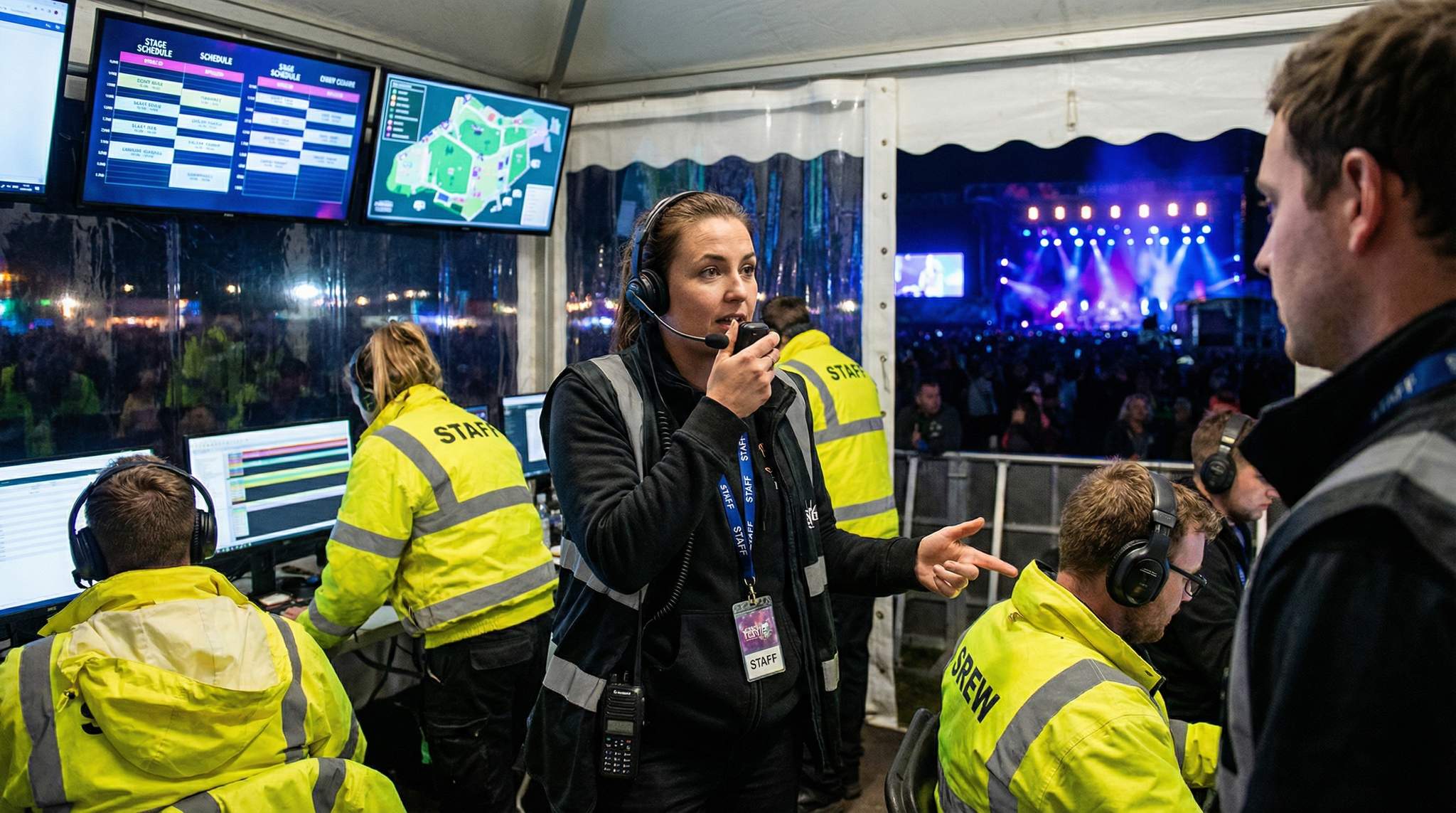
Radios are typically lightweight and easy to carry, allowing staff to remain mobile while staying in touch. For instance, a security coordinator with an earpiece and radio can discreetly manage crowd issues even amid the noise of a live concert. This ability to communicate in real time across the venue is what keeps operations running smoothly.
Radio Etiquette Best Practices for Staff
At its core, radio etiquette refers to the established set of rules and professional standards that govern how team members communicate over two-way radios. In a high-stakes festival workplace, correct radio communication etiquette ensures that critical information flows without ambiguity, preventing operational bottlenecks. Mastering walkie talkie radio etiquette transforms a chaotic network of voices into a streamlined, efficient dispatch system.
Free Tool: Size Your Festival Site
Zoned capacity planning for arena, campsite, parking and entry lanes — against UK Purple Guide and NFPA density standards. Finds your bottleneck zone.
A universally recognized framework for effective festival communication is the 5 C’s of radio communication: Clear, Concise, Correct, Complete, and Courteous. Training your event management team to filter every transmission through these five principles drastically reduces on-air confusion and ensures that critical operational updates are understood the first time.
Failing to enforce strict radio etiquette can quickly derail event logistics. When temporary hires or volunteers ignore basic walkie-talkie protocols—such as talking over one another or using the network for casual chatter—it creates dangerous blind spots for the command center. Establishing clear rules from day one ensures that your radio communications for festivals remain a reliable tool rather than a source of operational noise.
Planning a Festival?
Ticket Fairy's festival ticketing platform handles multi-day passes, RFID wristbands, and complex festival operations.
When developing your site-wide communication plan, establishing strict walkie talkie etiquette is just as important as the hardware you deploy. For many temporary hires, understanding how to properly operate these devices requires a mental shift from casual conversation to precise, tactical updates. Proper walkie-talkie protocols dictate that every transmission must have a clear operational purpose, minimizing channel congestion so that critical event management radios remain open for priority dispatch.
-
Use Clear and Concise Language: Festival staff should always speak clearly and use plain language or standard codes. Avoid slang, jargon, or long-winded explanations. Think about what you need to say before pressing the talk button. For example, instead of saying, “Hey, I was wondering if maybe someone could bring some extra water to the stage because we might run low,” say, “Requesting water restock at Stage A.” Be direct and to the point.
-
Identify Yourself and Who You’re Calling: A fundamental radio etiquette rule is to start every transmission by identifying who you are and who your message is for. This is often done in the format “[Your Name] for [Recipient’s Name].” For instance, a stage manager named Alice calling the site office might say, “Alice for Site Operations.” This method immediately tells everyone on the channel who should pay attention. It’s far more effective than simply saying “Site Operations?” or shouting a name into the radio. By clearly stating your name and the intended recipient, you avoid confusion and ensure the right person responds.
-
Wait for Acknowledgement: After calling someone (“Alice for Site Operations”), wait for their reply before continuing with your message. Radio systems are typically half-duplex, meaning only one person can speak at a time. Give a few seconds for the person to respond. If there’s no answer after, say, 10 seconds, you can try again once: “Alice for Site Operations, do you copy?” If there’s still no response, they might be occupied or out of range – consider contacting an alternate person or using another method if urgent. Never rattle off a long request without confirming the right person is listening.
Free Tool: Project Your Bar Revenue
Per-head spend benchmarks by event type turned into projected bar and food revenue, with a stock-mix estimate and gross-margin line. Free calculator.
-
Keep Chatter Minimal: Radio channels can become cluttered if people use them for non-essential chatter. All staff should practice radio discipline – speak only when necessary and keep communications brief. During a festival, dozens of urgent tasks compete for airtime on the radio. Unnecessary updates or side conversations can block someone else’s critical message. As a rule of thumb, if it’s not important for the wider team to hear, save it for an in-person chat or use a phone/text if appropriate. This doesn’t mean going radio-silent – it means every transmission should have purpose. Use the radio for operational needs, safety issues, or coordination, not for gossip or non-urgent commentary.
-
One Speaker at a Time: If two people transmit at the same time, the messages can overlap and become garbled. Always listen for a break in radio traffic before you press the push-to-talk button. If you start to speak but hear someone else, release immediately and wait. In urgent situations where you must interrupt (for example, you see an immediate danger), you can break in by saying “Break, break” to indicate an emergency or priority transmission. Otherwise, patience ensures that messages come through clearly without stepping on each other.
Need Festival Funding?
Get the capital you need to book headliners, secure venues, and scale your festival production.
-
Standard Codes and Acknowledgments: Festival teams often adopt simple radio codes to streamline communication:
- “Go for [Name]” – The person you called is now on the air and ready to receive your message. For example, if you call “Alice for Site Operations,” the Site Operations manager might reply, “Go for Site Operations” or simply “Go ahead, Alice.”
- “Stand by” – If the person is busy and cannot talk immediately, they might respond, “Stand by for Site Operations.” (Using “stand by” is preferred over saying “hold on,” which can be misheard.)
- “Copy” or “10-4” – Acknowledges that the message was heard and understood. For instance, if someone says “We need two more volunteers at the front gate,” you might respond with “Copy that” or “10-4” to confirm you got the message.
- “Repeat” – Asks the speaker to repeat their last message if it wasn’t clear or was cut off.
- “Over” – Indicates you’ve finished speaking and are waiting for a reply. (In many festival settings, people omit saying “Over” every time, but it can be useful during long or critical exchanges to avoid confusion.)
- “Out” – Indicates the conversation is complete and you are signing off (no reply expected). Typically used by a control center or when closing an exchange.
- Numeric codes like “10-20” (meaning “Location”) or “10-9” (“Say again”) can be used if your team is familiar with them, but don’t overcomplicate things. It’s better to use plain language than confuse staff with a long list of codes they might forget.
-
Use Code Words for Sensitive Situations: For certain situations, especially ones that could cause panic if overheard, establish code words or phrases. Many events use code names to report sensitive incidents discreetly. For example:
- A lost child might be referred to as “Code Adam” or “lost patron,” rather than announcing a missing child over the radio, to avoid alarming nearby guests.
- A serious medical emergency could be signaled with a code like “Code Blue at Stage B” instead of saying “person having a heart attack,” which might spread fear if overheard.
- Fire or fire risk is often “Code Red.”
- An aggressive guest or security threat might have a code name as well (some festivals create unique color codes or nicknames for this). Make sure all staff are briefed on any codes before the event. Use them consistently and only for real emergencies – never as a joke. The goal is to convey the urgency to staff without causing undue alarm to attendees who might overhear radio chatter.
-
Standardize Role-Based Call Signs: Beyond emergency scenarios, standardizing walkie talkie code names for key personnel and locations helps streamline daily operations. Instead of using personal names, which change between shifts or get lost in translation, assign role-based call signs (e.g., “Stage Alpha Manager” or “Medical Team One”). This ensures that anyone using the radio communications for festivals can instantly reach the correct department without needing a staff roster.
-
Dedicated Emergency Channel: Many large festivals set aside a specific radio channel for emergencies and urgent incidents. If your event uses multiple channels (for example, one channel for security, one for operations, one for concessions, etc.), designate one as the Emergency Channel that stays clear unless a crisis occurs. Train your team that whenever a serious incident happens – like a severe injury, weather evacuation, or security threat – that emergency channel is where key personnel should switch to or where they’ll hear critical instructions. Do not use the emergency channel for any routine talk. Keeping it free of everyday chatter means that in a true emergency, communication can happen immediately without folks scrambling to find a free channel. For smaller events with only one channel, you can achieve a similar protocol by having a special emergency call signal (like saying “Emergency, emergency, emergency” to clear the channel). In any case, emphasize to staff that during an emergency, non-essential radio traffic must cease on all channels so responders can work.
-
Maintain Professionalism and Calm: Emotions can run high during festival operations, but the radio is not the place to vent frustration or panic. Staff should remain calm and use a neutral, professional tone even under stress. In a crisis, voice clarity and composure will help everyone listening stay focused. Avoid yelling into the radio – it often makes your voice less intelligible and can spread panic. If you’re reporting an emergency, speak clearly, slowly, and provide succinct details (who, what, where). Other team members should stay off the air unless they have information that will help the situation. By modeling calm over the airwaves, leaders help the entire crew respond more effectively.
Communication Devices and Equipment Management
Beyond knowing what to say and how to say it, festival producers must also handle the logistics of communication devices. Proper equipment and management ensure that technology won’t fail you when it’s needed most.
-
Two-Way Radios (Walkie-Talkies): High-quality two-way radios are the workhorses of festival communication. For a small festival, a set of a dozen walkie-talkies might suffice, whereas a huge multi-stage festival may deploy hundreds of radios across various teams. Decide early whether to rent or purchase radios based on your event’s scale and budget. Renting can be practical for large events needing advanced radio networks (vendors can provide programmed channels, repeaters for extended range, and on-site support). Owning a set of basic radios might make sense for smaller recurring events. Ensure the radios have enough range to cover your entire venue – sometimes large fairgrounds or remote farm locations require signal repeaters or a base station so that radios on far ends can reach each other.
-
Why Walkie Talkies for Festivals Outperform Cell Phones: Promoters often wonder if standard mobile devices can replace dedicated hardware. The reality is that walkie talkies for festivals are indispensable because they do not rely on local cellular towers, which frequently become overloaded when thousands of attendees flood the venue. Dedicated event management radios provide instant, push-to-talk reliability that cuts through network congestion.
-
Choosing the Right Event Radio Systems: Not all two-way radios for festivals are created equal. When evaluating event management radios, organizers must choose between UHF (Ultra High Frequency) and VHF (Very High Frequency) models. UHF radios are generally better for navigating physical obstacles like stages, tents, and indoor venue walls, making them the industry standard for most festival sites. Additionally, upgrading to digital radio communications for festivals offers clearer audio quality, better background noise cancellation, and enhanced security compared to older analog systems.
-
Key Features in Event Radio Systems: When sourcing hardware, prioritize durability and battery life. The best radios for events feature rugged, weather-resistant casings (IP54 rating or higher) to withstand rain, dust, and drops. Additionally, look for multi-channel capacity and noise-canceling microphones, which are essential when coordinating logistics near booming main stages or crowded vendor areas.
-
Scaling Two-Way Radios for Festivals: When expanding from a single-stage setup to a sprawling multi-day event, your communication infrastructure must scale accordingly. The most reliable two-way radios for festivals offer multi-site trunking capabilities, allowing staff to roam seamlessly across massive fairgrounds without dropping the signal. Promoters should work with specialized vendors to map out potential dead zones and deploy repeaters strategically, ensuring that every walkie-talkie remains connected from the main stage to the furthest parking lot.
-
Distribution and Channel Assignments: Plan out which staff members and departments get radios, and assign channels if you have multiple. Typically, security, operations/production, stage management, medical, and logistics teams will each need their own radio units. Create a channel list or cheat-sheet: for instance, Channel 1 = Operations (All-team), Channel 2 = Security, Channel 3 = Medical, Channel 4 = Production/Stage Crew, etc., with one channel reserved for Emergency. Distribute this channel plan to everyone so they know where to tune in. It’s wise to have key supervisors monitor the main operations channel in addition to their team channel, so information flows between groups. In pre-event meetings, clarify radio call signs or titles if used (e.g., the main control center might go by “Control” or “Base”).
-
Spare Batteries and Charging Stations: Few things are worse for staff communication than radios dying mid-event. Always have plenty of spare batteries and a plan for charging. Start each day with fully charged radio batteries, and if the event runs multiple hours (or multiple days), schedule a mid-shift battery swap for devices that drain quickly. Provide a charging station at the staff HQ or production office where depleted batteries can be replenished. In the field, some crew carry a spare battery on them as well. Making battery management someone’s responsibility (for example, assigning a team member to round up and recharge units overnight) prevents the scenario where on Day 2 of the festival you find that many radios have already died by midday. Modern digital radios often have battery life indicators – remind staff to notify their manager if their battery is low, so it can be replaced before it dies at a critical moment.
-
Using Headsets and Earpieces: In a loud festival environment – near stages or large crowds – earpieces or headsets are invaluable. They let staff hear communications clearly without trying to shout over music or noise. Security teams, in particular, often use transparent acoustic tube earpieces (the kind that loop over the ear) so they can quietly receive instructions. Headset mics also keep conversations discreet; guests won’t overhear potentially sensitive information or directions. Another benefit is that with a push-to-talk button on a headset, staff can use the radio hands-free, continuing their task while speaking. Make sure to test earpieces with the radios ahead of time for compatibility and volume levels. If your radios support it, wireless Bluetooth earpieces can reduce cable snags. The bottom line is that providing even simple earpieces to your crew can greatly improve communication effectiveness in noisy conditions.
-
Alternate and Backup Communication Tools: While radios are the primary tool, smart festival organizers also prepare backups and alternate methods of communication:
- Push-to-Talk Apps: Smartphone apps (like Zello or specialized event communication apps) emulate walkie-talkies over cellular or Wi-Fi networks. These can be a useful supplement, especially if some staff are off-site or if you need to include remote team members in communications. However, be cautious – during big events, cellular networks can become overwhelmed or crash, rendering phone-based apps unreliable. If your festival venue has a strong private Wi-Fi network for staff, a push-to-talk app could work as a secondary channel.
- Group Texts/Messaging: For non-urgent coordination or sharing detailed info (like sending a photo of a lost item or a detailed address), messaging apps or SMS in a staff group can help. Encourage text for longer, non-time-sensitive communications to keep radio channels free for immediate needs. For example, the vendor manager might text the team a schedule change for food truck deliveries rather than broadcasting it on radio.
- Public Address (PA) Systems: In extreme situations (such as an evacuation due to weather), having a way to directly address attendees is key – this might be through stage microphones or dedicated PA systems. While not a radio device, it’s part of the comms toolkit for emergencies. Ensure your radio procedure includes how to trigger public announcements (e.g., radio the control center to initiate an emergency message).
- Hand Signals/Visual Cues: Don’t underestimate simple on-site hand signals or flags for certain teams (like parking or stage crew) as a backup when radio noise is too high or technology fails. These are last-resort methods but can complement your communication plan.
-
Device Security and Accountability: Having dozens or hundreds of radio units in the field means you need a system to avoid loss and misplacement. Implement a check-out/check-in procedure for radios at your staff HQ or production office. Log which person takes which numbered radio, and ensure they return it at shift end or festival close. Not only does this help retrieve all devices, but it also assigns responsibility – someone is less likely to misplace a radio if it’s tracked to their name. Remind staff to keep radios on them at all times during their shift (clipped securely to a belt or harness) and to report immediately if one is lost or if they experience technical issues. Also, caution team members not to take radios home or off-site by accident. If a radio must go off-site (say a staff shuttle driver needs one), make sure everyone knows the coverage range – once outside the festival grounds, they may go out of range and be unreachable by radio. Plan for such cases by having a phone contact list as backup, but ideally keep critical staff within the communications zone.
Integrating Radios with Event Control Centers
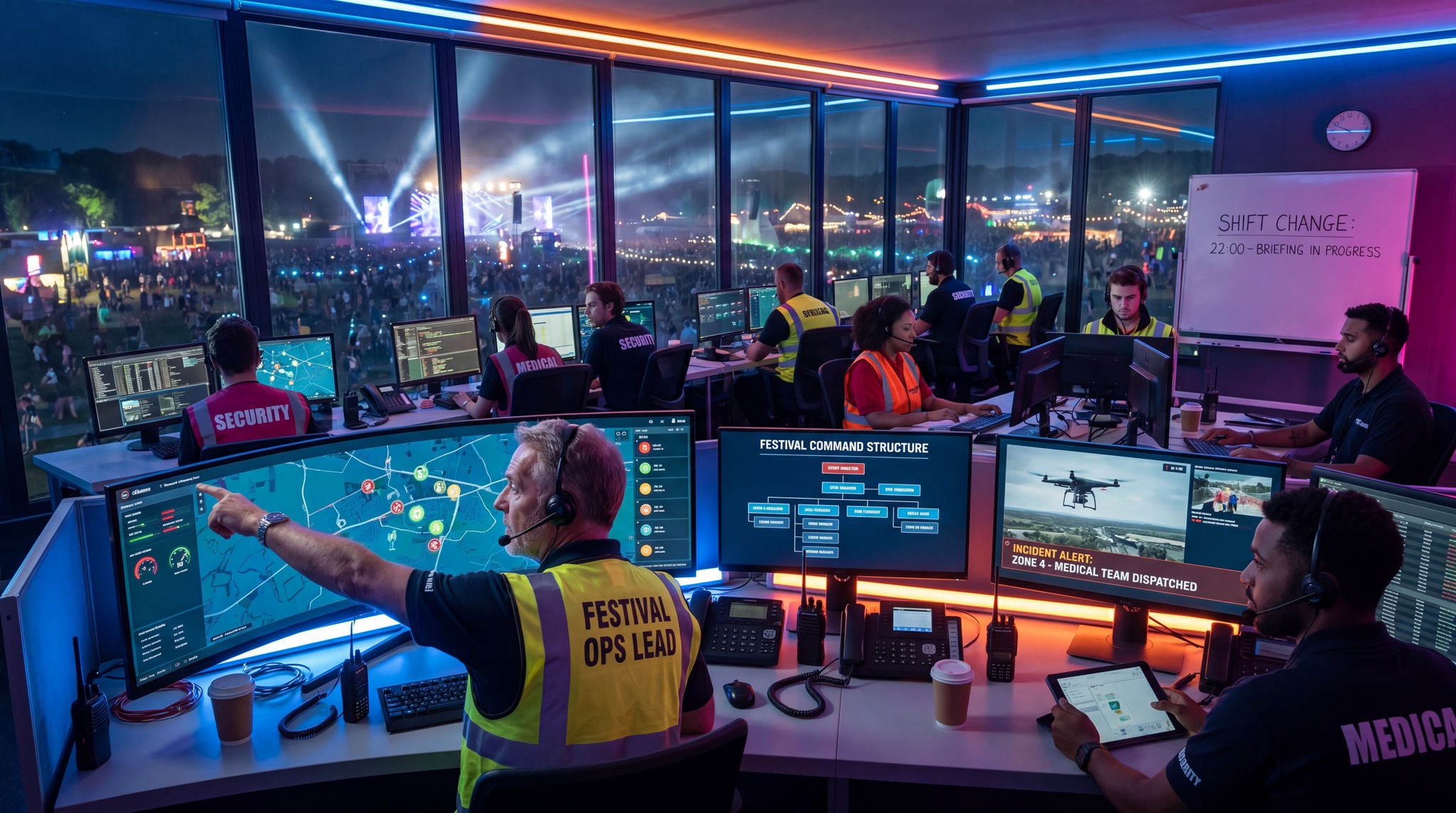
For large-scale productions, standalone walkie-talkies are just one piece of the puzzle. Modern event radio systems are often integrated directly into a centralized Joint Operations Center (JOC) or Event Control room. Dispatchers use specialized software to monitor multiple channels simultaneously, track the GPS locations of staff carrying advanced event management radios, and log all radio communications for festivals in real-time. This bird’s-eye view allows the command center to instantly route the closest medical or security personnel to an incident, drastically reducing response times. When designing your communication infrastructure, consider whether your two-way radios for festivals need to interface with dispatch consoles or digital logging recorders to maintain a comprehensive audit trail of operational decisions.
Building out a resilient event radio system requires careful infrastructure planning before the first stage is even built. Producers must map the venue’s topography to identify potential signal obstructions, such as dense tree lines, concrete stadium walls, or massive steel stage structures. By deploying a network of linked repeaters and utilizing dedicated frequency allocations, organizers ensure their communication grid remains impenetrable to outside interference, even when tens of thousands of attendees are using cellular devices nearby.
Training Your Team in Communication Protocols
Even the best equipment and written protocols won’t help unless your staff are properly trained to use them. Many festival producers have learned through hard experience that assumptions like “radios are intuitive” can lead to chaos. Instead, take time to train and practice:
-
Pre-Event Orientation: Include a radio communications briefing in your staff training or orientation sessions. Walk everyone through the basic etiquette rules and codes your festival uses. Demonstrate how to operate the radios: how to turn the volume up/down, switch channels, and properly use the push-to-talk button (for example, hold the button for a half-second before speaking so the beginning of your message isn’t cut off, and speak across the microphone, not directly into it, to reduce wind noise). If you have many first-time volunteers or staff, consider doing a quick role-play: e.g., have one person call another over the radio in front of the group to model the correct procedure (“Charlie for Tina… Go for Tina … Send the message… Copy”). People learn faster by seeing and hearing it in action.
-
Dedicated Radio Etiquette Training: Don’t assume new hires or volunteers understand the nuances of professional radio use. Implement a specific radio etiquette training module that covers the meaning of standard phrases, demonstrates correct radio etiquette examples (like how to properly request a medical dispatch versus a routine restock), and explains the consequences of poor channel discipline. Providing clear examples of what to say—and what not to say—builds confidence and ensures everyone adheres to the same communication standards.
-
Emergency Drills: For larger events or those with high-risk scenarios, run short drills for critical communications. For example, practice a simulated lost child report or a severe weather alert. Use the designated code words and channels as if it were real. This not only reinforces the protocol for staff but can also reveal any glitches (like someone not knowing how to change to the emergency channel, or confusion over a code word) before those skills are needed in a life-or-death situation.
-
Cheat Sheets and Reference: Provide a quick-reference guide in print or digital form to all team members. This could be a small card attached to their credential or a page in the staff handbook that lists radio channel assignments, key code words, and basic etiquette reminders (“identify yourself, say ‘copy’ to acknowledge, keep it short,” etc.). When things get hectic, even seasoned staff can forget less-common codes, so having something to refer to helps.
-
Learning from Experience: Encourage a culture where after each day of the festival (or after the event), the team reviews what went well and what didn’t with communications. Maybe during the debrief you discover that security and medical teams were talking over each other on a shared channel, or that some volunteers never turned their radios on (yes, it happens!). Use those lessons to improve training or adjust your channel assignments on the fly. Veteran festival producers often have a trove of “war stories” about radio miscommunication – from the trivial (like a stagehand accidentally broadcasting static by sitting on the push-to-talk) to the serious. Sharing these anecdotes with your team can underline the importance of good radio habits. For instance, one festival’s staff might recall how failing to use code words caused public alarm during a minor fire, whereas at another event, strict radio discipline helped quickly mobilize safety teams when a severe storm hit, resulting in a safe evacuation. These real examples stick in people’s minds far more than abstract rules.
Conclusion: Communicate for Success and Safety
Every festival – no matter the size or type – runs on communication. By establishing clear radio etiquette, using the right equipment properly, and training your staff, you create a communication network that keeps the event safe, efficient, and enjoyable for everyone. The seasoned festival producer knows that when the music is loud, the crowds are thick, and the pressure is on, a calm voice on the radio saying “10-4” or “Copy that, on our way” can make all the difference.
Invest time in your communication plans just as you would in stage setups, vendor coordination, or event ticketing advances. Equip your team with knowledge and tools: give them the radios, teach them the language, and set the expectations. With disciplined radio etiquette and reliable devices in hand, your staff will be ready to respond to anything – from routine operations to critical emergencies – like true festival professionals. Communication is key, and with the right approach, it will be one of your festival’s greatest strengths.
Frequently Asked Questions
How should festival staff start a radio transmission?
Festival staff should begin every radio transmission by identifying themselves and the intended recipient using the format “[Your Name] for [Recipient’s Name].” After stating this, the speaker must wait for an acknowledgement before delivering the message. This protocol prevents confusion and ensures the correct person is listening before critical information is shared.
What are common radio codes used at festivals?
Common festival radio codes include “10-4” or “Copy” to acknowledge a message, “Stand by” when busy, and “10-20” to ask for a location. Staff also use “Go for [Name]” to signal readiness to listen and “Break, break” to interrupt for emergencies. Using these standard codes streamlines communication and keeps channels clear.
Why do festivals use code words for emergencies?
Festivals use code words to communicate sensitive incidents like medical emergencies or lost children without causing panic among attendees who might overhear radio chatter. For example, staff might use “Code Adam” for a lost child or “Code Blue” for a medical issue, allowing the team to respond urgently while maintaining a calm atmosphere.
Why should security staff use earpieces with two-way radios?
Earpieces allow security staff to hear communications clearly despite loud music and crowd noise, ensuring they receive instructions without shouting. They also maintain discretion, preventing guests from overhearing sensitive information. Acoustic tube earpieces are particularly useful for keeping conversations private while allowing staff to remain hands-free and mobile during operations.
What is the purpose of a dedicated emergency radio channel?
A dedicated emergency channel ensures a clear line of communication is always available for crises like severe injuries or weather evacuations. This channel remains free of routine chatter so key personnel can switch over and coordinate immediately without waiting for airtime. Strict discipline is required to keep this channel open for critical safety incidents.
How can festival organizers prevent radio batteries from dying?
Organizers can prevent power failures by establishing a charging station at staff headquarters and scheduling mid-shift battery swaps for long events. Assigning a specific team member to manage charging ensures all units are replenished overnight. Staff should also carry spare batteries and monitor indicators to replace low batteries before they die during critical tasks.
Do walkie talkies work at festivals?
Yes, professional two-way radios are the most reliable communication method at festivals. Unlike cellular networks, which frequently crash or become overloaded by thousands of attendees, dedicated event radio systems operate on independent frequencies. To ensure they work across large or complex sites, organizers often deploy signal repeaters to boost the range and eliminate dead zones.
What are the 5 C’s of radio communication?
The 5 C’s of radio communication stand for Clear, Concise, Correct, Complete, and Courteous. This framework trains event staff to speak intelligibly, keep messages brief, provide accurate information, include all necessary details, and maintain a professional tone during high-pressure festival operations.
What are standard walkie talkie code names for event management?
Event management teams use walkie talkie code names to discreetly handle sensitive situations. Common examples include “Code Red” for fire, “Code Adam” for a missing child, and “Code Blue” for a medical emergency. Using these standardized code names prevents panic among attendees while instantly alerting the appropriate response teams.
What are the most important features in event management radios?
When selecting radios for events, organizers should prioritize rugged durability, long battery life (12+ hours), and noise-canceling capabilities. Multi-channel functionality is also critical so different departments—like security, medical, and site operations—can communicate simultaneously without talking over one another.
What is the typical range of two-way radios for festivals?
The effective range of two-way radios for festivals depends heavily on the terrain, infrastructure, and whether you are using UHF or VHF frequencies. While a standard walkie-talkie might reach one to two miles in an open field, large stages, metal structures, and dense crowds can significantly reduce that distance. To ensure reliable radio communications for festivals across expansive sites, organizers typically install signal repeaters to boost coverage and eliminate dead zones.
Should festival organizers rent or buy event radio systems?
For most large-scale or annual events, renting event radio systems from a specialized communications vendor is the most cost-effective and reliable choice. Rental providers supply fully programmed, commercial-grade hardware, handle FCC licensing requirements, and often provide on-site technicians to manage repeaters and troubleshoot issues. Purchasing a fleet of two-way radios for festivals only makes financial sense for venues that operate year-round or production companies managing multiple events per month, as the maintenance, battery replacement, and storage costs can quickly add up.
What are some clear radio etiquette examples for event staff?
Good radio etiquette examples include stating your name and the recipient before delivering a message (e.g., “Site Ops, this is Main Gate”), pausing for a half-second after pressing the push-to-talk button to avoid cutting off the first word, and using “Stand by” instead of “Hold on.” Another prime example of correct radio communication etiquette is keeping transmissions under ten seconds to ensure the channel remains open for emergency traffic.
How do organizers enforce proper radio etiquette among temporary festival staff?
Organizers enforce communication protocols by incorporating mandatory walkie-talkie training during pre-event orientations. Providing printed cheat sheets with channel assignments, standard codes, and basic etiquette rules helps temporary staff remember the guidelines. Additionally, having supervisors actively monitor channels to correct improper usage in real-time ensures the network remains clear for critical operations.
How should organizers teach volunteers how to use walkie talkies?
Organizers should teach volunteers how to operate two-way radios by conducting hands-on demonstrations during pre-event orientation. Training must cover basic walkie talkie etiquette, such as holding the push-to-talk button for a half-second before speaking, using role-based call signs, and keeping the channel clear of non-essential chatter. Providing printed reference cards with channel assignments further reinforces these protocols.
What components make up a professional event radio system?
A complete event radio system consists of handheld two-way transceivers for mobile staff, a central base station for the command center, signal repeaters to extend coverage across large venues, and multi-bay charging stations. Advanced setups may also incorporate digital dispatch software, GPS tracking, and specialized headsets tailored for high-noise environments.
How can organizers standardize walkie talkie talk lingo across different vendor teams?
To ensure seamless communication, producers should distribute a unified communication sheet to all external vendors, security contractors, and medical teams before load-in. This guide should outline the specific walkie talkie talk lingo, emergency code words, and channel assignments the festival uses, ensuring everyone speaks the same operational language regardless of their parent company.