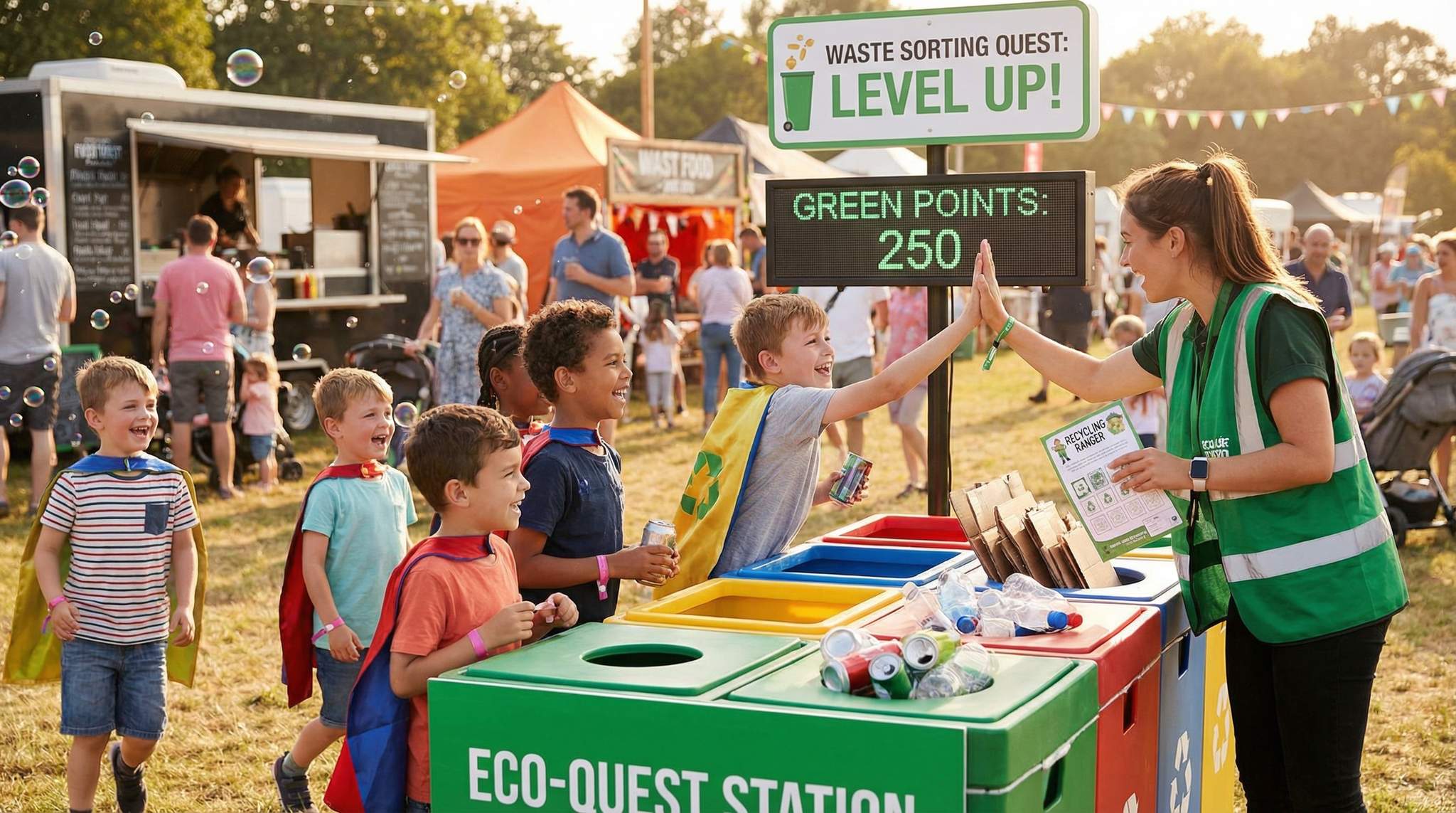
Imagine a group of children at a bustling family-friendly festival, excitedly racing each other to a colorful Eco-Quest Station. Instead of simply tossing trash, they’re sorting waste into the correct bins, earning points and cheers from a friendly guide. This isn’t a chore – it’s a game, and the kids are thrilled to play. Making recycling fun at festivals can transform young attendees from passive observers into enthusiastic “eco-heroes,” all while effectively managing event waste.
Turning Recycling into a Game: Waste-Sorting Quests
Transforming waste sorting into a point-earning quest is a powerful way to engage kids (and their parents) in sustainability. Festivals can create a scavenger hunt or Eco Challenge where children earn points for eco-actions like correctly sorting recyclables, picking up litter, or answering green trivia. For example, a festival might hand out “Recycling Ranger” quest cards that list tasks such as finding the right bin for a plastic bottle or discovering a fun fact at the eco-education booth. Each completed task gives kids a stamp, sticker, or points toward a reward.
Real-world events have seen success with similar gamification. At major festivals in the UK, programs like Every Can Counts deployed recycling games and quizzes that drew thousands of participants, encouraging positive behavior change through play. In the US, some music festivals introduced deposit-refund games where attendees (often families with kids) could exchange bags of collected cans or cups for prizes like T-shirts or merchandise, as seen in successful recycling initiatives. Children at these events turned cleanup into a friendly competition – who can collect the most recyclables? – making waste reduction feel like an adventure rather than a duty.
To implement a recycling quest at your festival, design it to be age-appropriate and inclusive:
Turn Fans Into Your Marketing Team
Ticket Fairy's built-in referral rewards system incentivizes attendees to share your event, delivering 15-25% sales boosts and 30x ROI vs paid ads.
- Simple Rules: Keep instructions easy to understand. Young kids might have a pictorial “treasure map” of eco-tasks, while older kids could use a mobile app or booklet to track points.
- Physical Activity: Include active elements like a recycling relay race or a “toss the trash in the right bin” carnival game. Physical games burn energy and draw kids in, especially in an outdoor festival setting.
- Creative Challenges: Not all tasks need to be about picking up trash. You can ask kids to spot and report something (e.g., “find the compost bin near the food court”) or to create a piece of trash art. Live trash art sessions – as seen at eco-conscious festivals – invite kids to turn discarded materials into artwork, proving that recycling can be creative.
- Collaborative Quests: Encourage teamwork by allowing siblings or friends to form “eco teams.” They can tackle a task together, which is great for family bonding at the event.
By turning recycling into a playful quest, festivals tap into children’s love of games and competition. The result is not only a cleaner venue but also kids who internalize recycling habits while having a blast.
Eco-Educators at Every Bin: Staffing Stations with Guides
Many festivals simply place recycling and trash bins around the site and hope for the best. But a family-focused festival can do more by staffing eco-stations with educators rather than leaving bins unattended. Imagine “Green Guides” or costumed “Eco Heroes” at each recycling point – friendly staff or volunteers who interact with attendees (especially kids), teach them how to sort waste properly, and make them feel part of a story.
Planning a Festival?
Ticket Fairy's festival ticketing platform handles multi-day passes, RFID wristbands, and complex festival operations.
Having knowledgeable staff at waste stations turns a mundane action into a learning moment. For example, the Rainforest World Music Festival in Malaysia deployed Green Warriors at eco-stations throughout the grounds to personally guide festivalgoers on sustainable practices. These volunteers didn’t just monitor bins; they actively educated the crowd on what goes where, and why it matters. At a children’s festival in Romania, a recycling advocate group set up interactive booths with games and quizzes, immersing kids in eco-learning in an engaging way. The presence of enthusiastic educators made the experience memorable and effective.
Key considerations for staffing your festival’s recycling stations:
- Train Your Team: Ensure volunteers or staff know their recycling facts and have a kid-friendly approach. They should be able to explain, “Why does this go in compost, and how will it help the planet?” in simple, inspiring terms.
- Make it Theatrical: Kids love characters and stories. Consider having staff dress up as recycling superheroes, friendly animals (like a “Recycling Raccoon” or “Green Dragon”), or even goofy “trash monsters” who love sorting waste. A little theatrical flair can turn an ordinary bin into an attraction.
- Interactive Demos: Equip stations with more than just bins. Maybe a quick demo – like showing how a banana peel becomes soil or displaying items made from recycled materials – can captivate curious young minds. Hands-on mini-workshops (e.g., “touch and feel” different materials and guess which bin they belong in) work well in keeping children engaged.
- Language and Culture: If your festival draws an international crowd (or is in a multicultural community), brief your educators to handle language barriers – perhaps with visual aids or multilingual signs. This ensures no child or parent is left out of the fun due to language.
Remember, an educator at a bin can do more than any signage can. They can praise a child for recycling correctly, gently correct mistakes, and even engage parents in conversation about the festival’s green initiatives. This human touch at sustainability stations fosters a community atmosphere. Attendees feel the festival genuinely cares (because it invested in people, not just posters), and kids get real-time feedback that reinforces their learning. As one organizer put it, people support what they help create – if kids help keep the grounds clean, they take pride in that environment, enhancing the festival experience for everyone.
Badges and Story Cards: Rewarding Green Heroes
No game is complete without rewards! For kids, tangible rewards can be incredibly motivating and make the experience unforgettable. Rather than giving generic prizes, festivals are now using badges, stickers, and story cards tied to eco-education. These rewards serve dual purposes: they reward the child’s effort and carry a learning message.
Free Tool: Size Your Festival Site
Zoned capacity planning for arena, campsite, parking and entry lanes — against UK Purple Guide and NFPA density standards. Finds your bottleneck zone.
Collectible Badges
Think of badges as modern-day merit stickers or the festival equivalent of scout badges. When a child completes a recycling quest or participates in a green activity, reward them with a badge or button they can pin to a lanyard or shirt. For instance, a child might earn the title of “Plastic Patrol Hero” with a colourful badge after collecting a certain number of plastic bottles for recycling. Another badge might be “Compost Champion” for those who correctly sort their food waste at meal time. These little tokens of achievement can feature fun icons (like a smiling earth, a cartoon recycling bin, or a friendly animal mascot) to make them visually appealing. Kids love to show off their badge collections to friends around the festival, which can spark interest from other families (“Where did you get that badge? We want to play too!”).
Some festivals take this further by creating a badge series or hierarchy – think bronze, silver, gold levels or different characters to collect. For example, at a multi-day festival, kids could aim to collect all five badges available (one for each day or each eco-task). This encourages repeat participation: a child who picked up recycling on Friday might come back to the eco-station on Saturday eager to earn the next badge in the series.
Need Festival Funding?
Get the capital you need to book headliners, secure venues, and scale your festival production.
Educational Story Cards
Story cards are another creative reward that doubles as an educational souvenir. Imagine a set of illustrated cards, each telling a short story or cool fact about recycling and the environment. Every time a child completes an eco-challenge, they receive one card. One card might have a comic about a plastic bottle’s journey from a recycling bin to becoming a new toy, while another card could feature a superhero character who fights pollution, sharing tips about reducing waste. By the end of the festival, kids can compile the cards into a little storybook or a collectible series.
A real-life example of this concept in action: at a children’s festival in Sarajevo, young participants who engaged in recycling activities were rewarded with a picture book titled “Everything You Didn’t Know About Recycling,” along with a cute mini recycling-bin toy. The kids not only had fun making crafts from waste, but they also took home a story-driven memento to reinforce the lessons. Similarly, some environmentally themed events hand out trading cards of endangered animals or environmental heroes when children complete tasks, effectively turning education into a collectible game.
When designing rewards, make them age-appropriate and culturally relevant. Cartoony stickers might delight a five-year-old, whereas a ten-year-old might prefer a slick badge or a more challenging trivia card they can quiz parents with. Also, consider sustainable materials for the rewards themselves – recycled-content paper for cards, or wooden pins instead of plastic badges – to keep the messaging consistent.
Lastly, don’t underestimate the power of recognition and narrative. A festival might publically announce, “Today we recognize our Junior Green Heroes!” and have kids who earned all their badges come up on stage or be mentioned on social media. This kind of positive reinforcement and a little moment in the spotlight can be life-long memorable for children. It not only motivates the kids who participated, but also shows everyone at the festival that sustainability and community involvement are core values of the event.
Free Tool: Project Your Bar Revenue
Per-head spend benchmarks by event type turned into projected bar and food revenue, with a stock-mix estimate and gross-margin line. Free calculator.
Share the Success: Daily Diversion Scores and Feedback
One of the most engaging ways to keep momentum and encourage learning is to show the impact of everyone’s efforts. Kids (and adults) love to know that their actions contributed to something big. Festivals can capitalize on this by publishing daily diversion scores and other fun metrics, essentially turning sustainability into a collective achievement game.
Imagine a big, colourful scoreboard near the main stage or entry that’s updated each day: “Yesterday, 500 kg of waste was diverted from landfill!” or “Day 1: We composted 300 kg of food scraps – let’s beat that on Day 2!” By making waste reduction a visible part of the festival’s narrative, you instill pride and a bit of friendly competition among attendees to do even better. Parents can point out the numbers to their kids: “Look, because everyone recycled, we saved so much trash from the dump. Let’s help make tomorrow’s number even higher!”
Many eco-forward festivals already track their waste management performance. For instance, large events often report the percentages and amounts they recycle or compost. Rainforest World Music Festival, as part of its sustainability initiative, announced that over 1.5 tonnes of waste were recycled or composted during its three-day 2025 event, including specific metrics for food waste diversion. While those figures impress stakeholders, simplifying and sharing such stats in a kid-friendly way on-site can make attendees feel directly involved in that success. It’s like giving the whole festival a “grade” each day – and everyone wants to get an A+ by the end!
How to implement daily eco-scoreboards:
- Use Visuals: A number on its own is abstract, especially for kids. Make it visual – e.g., a big thermometer graphic filling up to represent progress to a goal (like 1000 kg recycled), or icons (? trees saved, ? oceans protected) to symbolize the impact. If 500 kg recycled doesn’t mean much to a child, equate it to something tangible: “500 kg is like 50 kid-sized elephants in weight saved from landfill!” – fun comparisons can spark awe.
- Announcements and Celebrations: Take a minute during daily stage announcements or in the festival newsletter to celebrate the green achievements. “Give yourselves a hand, festival family – we hit a new recycling record today!” It makes everyone, especially kids who contributed, feel like superstars in the story of the festival’s sustainability journey.
- Feedback Loop: Encourage festivalgoers to provide input or share their experiences. Maybe have a “Green Suggestions” board where kids can pin ideas or draw their favorite eco-activity they did. Showing a few appreciative notes (“I loved the recycling game – Maya, age 8”) or drawings at the info booth or on social media can validate the efforts of your eco-education program and provide heartwarming content to share.
- Friendly Competition Between Festivals or Areas: If the event is multi-venue or multi-day, compare results: “Camping area recycled more than the day-trippers” or “This year’s festival beat last year’s diversion rate.” Some festival organizers even engage in light competition with other festivals, which can be all in good fun – e.g., touting, “We diverted 5% more waste than Festival X!” (though always keep the focus positive rather than shaming).
Crucially, by broadcasting the outcomes, you close the loop in the learning process. Kids see that their personal actions (putting a bottle in the right bin, playing the recycling game) added up to something impressive. This reinforces the lesson that collective small actions make a big difference – a takeaway that aligns perfectly with the environmental education message.
Adapting to Different Festivals and Audiences
Every festival is unique – from a small-town family fair to a sprawling international music festival. The principles of recycling games and eco-education can be adapted to fit different scales, budgets, and cultural contexts:
Boost Revenue With Smart Upsells
Sell merchandise, VIP upgrades, parking passes, and add-ons during checkout and via post-purchase emails. Increase average order value by up to 220%.
-
Small-Scale Local Festivals: At a one-day community festival or a local fair, resources might be limited, but the close-knit vibe can be an advantage. You might set up one central Eco Education Tent where families can come for scheduled “green game” sessions. A local school teacher or community environmentalist could volunteer as the educator. Because the crowd is smaller, you can give more personal attention – perhaps even remember kids by name when they return with their completed quest cards to claim a prize, which absolutely delights them. Budget-friendly rewards like handmade badges (think painted bottle caps on safety pins) or donated mini-books from the local recycling authority can work well. Even on a shoestring budget, creativity and community partnerships (e.g., a local recycling company sponsoring the game prizes) can make it a hit.
-
Large Festivals and Multi-Day Events: Bigger festivals with thousands of attendees and multi-day schedules provide an opportunity to scale up the gamification. Here, technology can help – consider a simple festival app feature where attendees scan QR codes at eco-stations to log their points, or an SMS system for families without smartphones (“Text FESTIVALGREEN to report how many items you recycled today”). However, technology should complement, not replace, the human element. You’d still want those Green Guide volunteers spread across the grounds; in fact, you may need a whole Green Team crew. Large events can also afford to have more elaborate setups – multiple themed stations (a “Compost Castle” play zone in the kids’ area, or a “Recycle Rangers HQ” near the food court) to prevent crowding. With more attendees, you can even consider tiered challenges (easy, medium, hard quests) to keep older kids and teens engaged. And don’t forget accessibility – for a huge diverse crowd, ensure materials are in multiple languages if needed, and that activities are inclusive for children with disabilities (e.g. a child in a wheelchair can still easily participate in a sorting game). Planning and coordination are key, but the payoff of seeing thousands of festival-goers, young and old, rally around your sustainability mission is immense.
-
Different Types of Festivals: Tailor the content to match the festival’s theme. At a food festival, the game can focus on composting and avoiding food waste, with chefs or food vendors involved in teaching kids about compost ingredients (maybe a “build a compost” relay race with pretend food scraps). At a music or pop culture festival, incorporate music into the eco-activities – perhaps a “trash percussion” workshop where kids make instruments from recyclables and perform, highlighting reuse. Cultural festivals can integrate traditional stories or art – for example, an Indian cultural festival might use a puppet show (a popular art form) featuring characters that reinforce recycling messages, making the lesson culturally resonant. By aligning with the festival’s core, the eco-education feels like a natural part of the festivities rather than an add-on.
-
Audience Demographics: Know your audience. Families with very young children (toddlers) will need simpler, shorter activities – maybe just a sensory bin of clean recyclable objects for them to play and sort with parent’s help, or a mascot character to take a photo with (kids remember the fun of the mascot, and the recycling message that character carries). School-age kids (6-12) are the sweet spot for quests and competitive games – they can read, follow a story, and relish the challenge and recognition. Teenagers might act cool, but many still enjoy gamification if it’s tech-based or tied to social media. Perhaps let teens earn points for their festival wristband to unlock small perks (like discounts on merch or a shout-out from the stage). Also consider incentives that appeal to parents: a certificate emailed post-event saying “Your family was a recycling rockstar!” which they might proudly share – this encourages the whole family unit to join the effort.
-
Safety and Hygiene: Regardless of scale, ensure that any activity involving waste is safe. Provide kids with gloves if they’re picking up litter, have hand-sanitizing stations, and supervise closely especially with younger children. Emphasize safe items to collect (e.g., only paper, plastic, or aluminum cans – no sharp objects or glass for kids). If you incorporate creative reuse (making crafts from trash), pre-clean the materials. A well-thought-out plan addresses these concerns so that parents feel comfortable and confident in letting their kids engage fully.
Learning Through Play: Why It Works
Underlying all these initiatives is a simple truth: learning sticks when it’s playful. Educational psychologists and veteran teachers alike will attest that children (and adults!) retain knowledge better when they experience it rather than just hear it. By gamifying recycling and embedding eco-education in fun activities, festivals create experiential learning opportunities. A child might forget a lecture about recycling, but they’ll remember the time they became a recycling hero in a game, or the moment an educator praised them for sorting correctly in front of their parents and peers. Those positive emotions attach to the lessons learned, making it far more likely the behavior will continue beyond the festival.
Free Tool: When Should You Announce?
Pick your event date and genre — the free planner outputs a recommended announce, presale, on-sale and reminder schedule anchored to how your audience actually buys.
Furthermore, these playful eco-activities contribute to the festival’s atmosphere. They signal that the event is family-friendly, community-minded, and forward-thinking. Festivals have a unique power to influence culture – thousands of people gathered in one place, sharing experiences. By making sustainability a core, visible part of that experience (and doing so in a joyous way), you’re effectively planting seeds in all those minds. The kids carry those seeds back home to their schools and communities, often educating friends (or even adults) with the excitement of “I learned this cool thing at the festival!”. This ripple effect is how a single festival’s initiative can spark wider change.
Finally, these efforts can boost the festival’s reputation and relationships. Attendees appreciate when organizers take extra steps to educate and entertain, rather than just focusing on profit or logistics. Community leaders and sponsors love to see successful engagement programs – it’s great press and aligns with corporate social responsibility goals. For instance, a waste management sponsor will be thrilled to see families cheering about recycling and might support the festival in bigger ways in the future. And if something doesn’t work perfectly the first time (maybe the quest was too easy, or the badges ran out), that’s okay – learn from the hiccups and adapt. Many leading festivals known for sustainability, like Shambala in the UK or Australia’s Splendour in the Grass, built their green reputations through years of trial, feedback, and improvement, always with attendee engagement at heart.
By infusing recycling and eco-education with play, everyone wins: the festival site stays cleaner, children gain knowledge and confidence, parents get meaningful family activities, and the festival brand shines as an innovator in family-friendly sustainability.