Scenario: Imagine a massive festival with tens of thousands of attendees posting live updates, complaints, and questions on social media. If a minor issue arises – say, long water lines or a sudden stage delay – it can explode online within minutes. This is where a Social Media War Room becomes invaluable. For large-scale festivals, having a dedicated team monitoring and managing social channels in real time can mean the difference between a quickly-resolved hiccup and a full-blown PR crisis.
A well-run social media war room acts as the festival’s digital command centre. It listens to attendee chatter, swiftly addresses concerns with empathy and facts, quells rumours before they spread, and relays critical information to on-site leadership. This article dives into how festival organisers can set up and operate an effective social media war room, with practical advice, real examples, and lessons learned from festivals around the world.
Building the War Room Team
Successfully managing social media during a festival requires the right people in the right roles. In a busy war room, every team member has a specific focus:
- Listeners: These team members continuously monitor social platforms – Twitter (X), Instagram, Facebook, TikTok, Reddit, you name it – for mentions of the festival, trending hashtags, and keywords. They use social listening tools and good old-fashioned observation to catch potential issues before they escalate, focusing on facts rather than personal feelings or defensiveness. Listeners are the early warning system, spotting spikes in complaints or dangerous rumours in real time. For example, if multiple attendees tweet about a particular food stall causing illness or a gate getting overcrowded, the listeners flag it immediately.
- Responders: Responders are the festival’s voice online. They craft replies to attendees’ posts and comments, providing help, information, and reassurance. Crucially, responders must communicate with empathy and specifics – not generic boilerplate. A compassionate, tailored response (“We’re sorry you had to wait 30 minutes at Gate 4 – extra staff are on the way to speed this up, thank you for your patience!”) shows attendees they’re heard and that the organisers are taking action. In contrast, a canned reply (“We’re sorry for any inconvenience”) can feel dismissive. Quick, human responses can turn a complaining attendee into a relieved one. Two things will kill your chances of managing a crisis: an insincere response and no response at all, as Hootsuite’s guide to social media crisis management notes. Thus, responders focus on being prompt, genuine, and helpful in every interaction.
- Fact-Checkers & Liaisons: These team members verify information and connect the war room to the on-site command. When a concerning post pops up – e.g. a rumour of a safety issue or an image of a flooded walkway – the fact-checker’s job is to find the truth fast. They might call the stage manager to confirm if a set is really running late, or ask the site operations team whether water stations ran out. Fact-checkers ensure that the information the war room puts out is accurate. They also serve as liaisons to the festival’s Emergency Operations Center (EOC) or event control room, escalating anything that needs urgent on-ground attention.
Real-World Example: At a major festival in Germany, the organisers faced a sudden security threat and had to evacuate the site. The social media war room sprang into action: listeners picked up attendee confusion online, and responders immediately posted clear instructions and updates. Fact-checkers coordinated with police and confirmed it was a precautionary evacuation. The organisers announced the situation and kept everyone informed via all channels, including social media, radio, and loudspeakers, as reported in coverage of the Rock am Ring terror threat. As a result, tens of thousands of fans exited calmly, singing on their way out, and the festival resumed once authorities gave the all-clear. This example shows how each war room role – listening, responding, verifying – works together to manage a potentially chaotic situation.
Grow Your Social Following With Every Sale
Require social media follows, shares, or playlist adds to unlock presale access or special pricing. Turn every ticket purchase into audience growth.
Real-Time Monitoring: Tracking Sentiment, Rumours & Emerging Issues
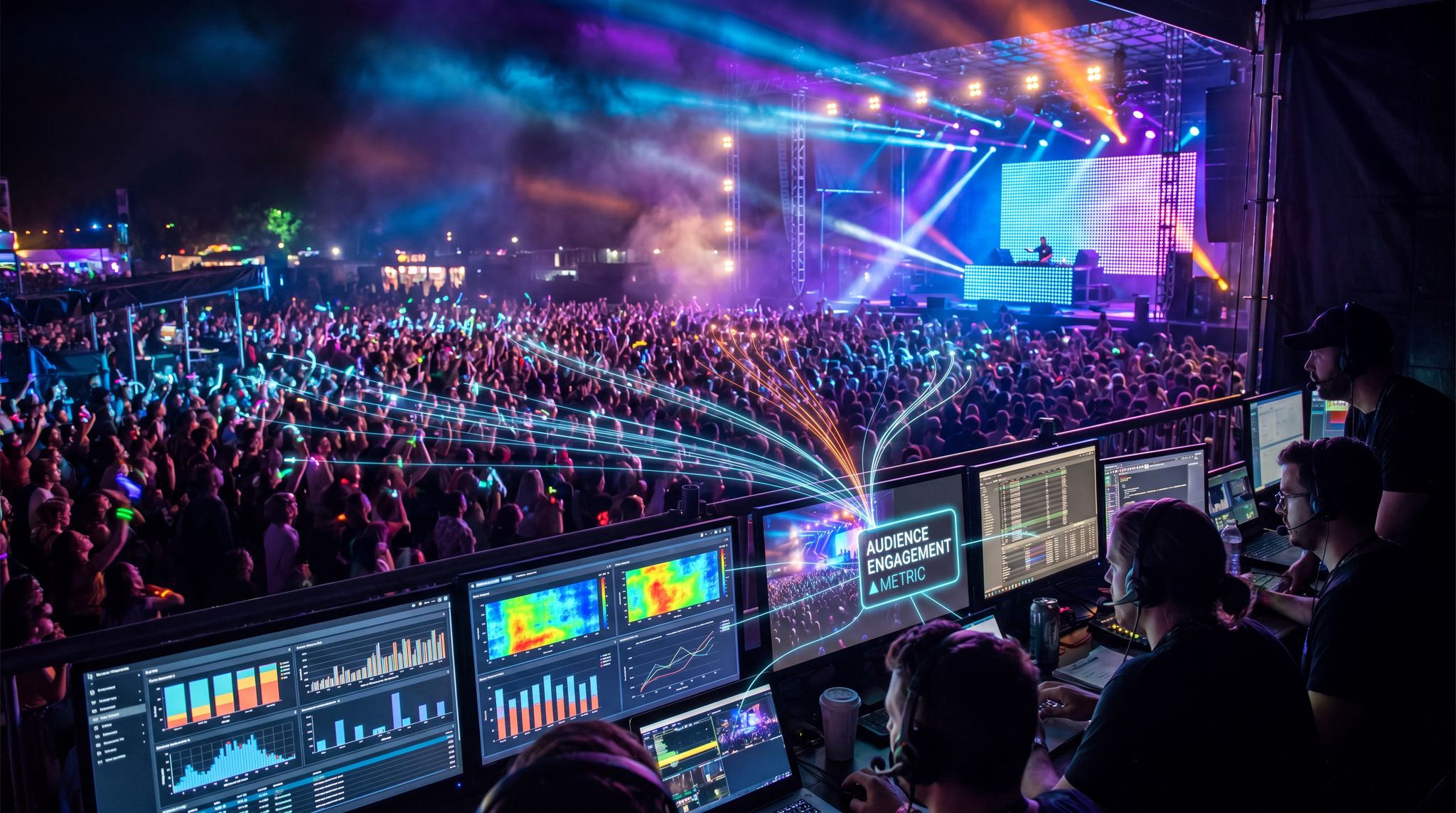
A festival’s social media war room should operate like a radar system, constantly scanning for any sign of trouble or trending topics among the fan base. Real-time monitoring is critical – you can’t respond to what you don’t see. Modern sentiment analysis tools allow festival teams to gauge the mood of the crowd online. By watching mentions and keywords in real time, you can spot if negative feedback is suddenly spiking and identify hot issues that might spark a crisis using sentiment analysis for reputation management. For instance, if posts complaining about parking problems or water shortages start to surge, that’s a clear signal to investigate and address those issues promptly.
Beyond general sentiment, the team should watch for rumours and misinformation. In the social media age, an unfounded rumour can go viral rapidly and create panic. We’ve seen this happen in real events – during the Burning Man 2023 event in Nevada, heavy rains left attendees stuck on site, and wild rumours spread online about an Ebola outbreak in the festival camp (which was completely false), a situation detailed in reports on the Burning Man misinformation spread. Festival organisers must be prepared to squash such rumours with verified facts. That means posting proactively as soon as you’ve checked the facts: “We’ve seen some rumours about XYZ – these are NOT true. Here’s what’s really happening…”. By openly correcting misinformation, you stop the rumour mill and reassure your community.
Planning a Festival?
Ticket Fairy's festival ticketing platform handles multi-day passes, RFID wristbands, and complex festival operations.
To efficiently track what’s being said, war rooms for large festivals often use dashboards aggregating feeds from multiple platforms. Hashtags, geotagged posts from the festival location, and even local news or community forums should be on the watchlist. For example, Tomorrowland (Belgium) and Coachella (USA) each draw hundreds of thousands of fans worldwide – their digital teams monitor not just English-language posts but also chatter in other languages, since attendees come from dozens of countries. If a wave of Spanish-language tweets complains about toilet cleanliness in one campsite, the monitoring team should catch it and translate the issue for responders to handle. The key is to meet your attendees where they are online. Younger crowds might vent on Twitter/X or TikTok, while an older audience might post in a Facebook group – know your demographic and keep eyes on the relevant platforms.
Tools & Techniques: Embrace technology to help with the deluge of social media data. There are social listening tools (like Hootsuite, Brandwatch, or Talkwalker) that can alert you to certain keywords (“fire”, “cancelled”, “danger”, etc.) and spikes in negative sentiment. Set up internal protocols for common issues – e.g., if you see more than 10 posts in 5 minutes about water being out at a certain area, that triggers an immediate alert to operations. Train your listener staff to differentiate noise from real signals, and to always err on the side of caution by flagging unusual activity or mentions. It’s better to double-check a false alarm than to miss a real problem brewing.
Integrating Niche Platforms: When building your tech stack, consider how enterprise listening platforms can connect with specialized community apps. For example, organizers of craft beverage events often look for ways to monitor check-ins and reviews on niche platforms, sometimes exploring custom API connections or Hootsuite integrations to track activity on apps like Untappd. By bridging your primary social media management software with specialized event networks, your digital command center can capture hyper-specific audience sentiment that might not surface on mainstream channels.
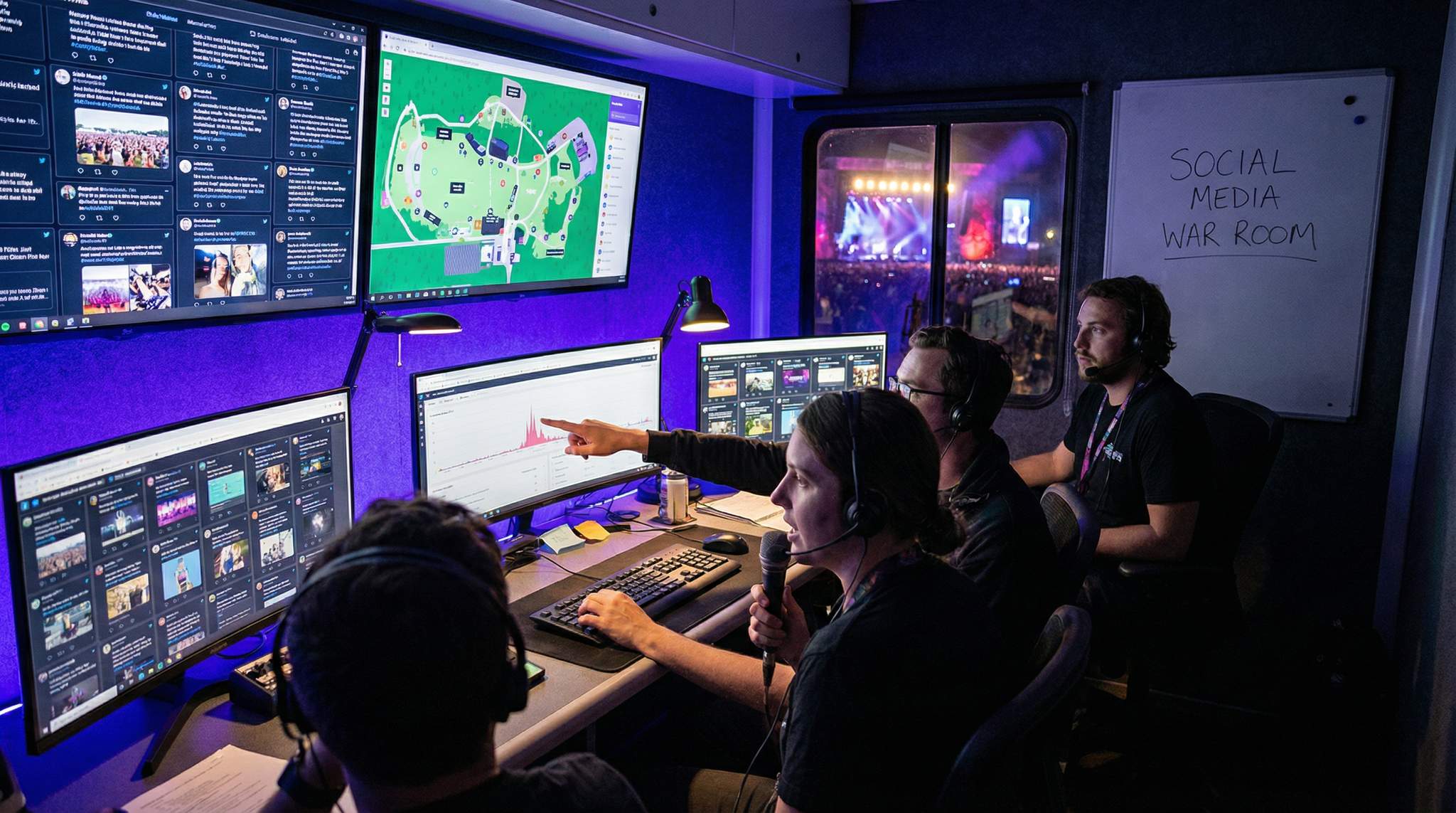
Structuring Your War Room Monitoring Displays: Effective war room monitoring relies on visual organization. In a high-stakes festival environment, your digital command center should feature dedicated screens for different data streams. Organizers typically set up one display for overarching brand mentions, another for geolocation-based tracking around the venue, and a third specifically for operational keywords (like “security,” “water,” or “medical”). This segmented approach to social media war room oversight ensures that listeners aren’t overwhelmed by a single chaotic feed and can quickly route critical alerts to the appropriate on-site teams.
Free Tool: Size Your Festival Site
Zoned capacity planning for arena, campsite, parking and entry lanes — against UK Purple Guide and NFPA density standards. Finds your bottleneck zone.
Empathetic, Specific Responses (No Boilerplate Replies)
When attendees reach out on social media – whether they’re asking a question, voicing a complaint, or panicking about an issue – how you respond is just as important as responding quickly. The tone and content of your replies can either calm an upset attendee or pour fuel on the fire. The golden rule for festival social responses is to be empathetic, human, and specific.
Avoid Copy-Paste Corporate Speak: Nothing frustrates an angry festival-goer more than receiving a generic “Thank you for your feedback, we’re looking into it” reply that feels automated. It comes across as cold and insincere. Instead, tailor each response to show you truly understand the concern. Use the person’s name if you have it (or their handle), acknowledge their specific situation, and echo their emotion. For example:
Need Festival Funding?
Get the capital you need to book headliners, secure venues, and scale your festival production.
- Attendee: “I’ve been standing in line for security for 2 hours. This is ridiculous! #FestivalFail”
- Bad reply: “We apologise for any inconvenience. Your feedback is noted.” (? Sounds like a brush-off.)
- Good reply: “Hi Alex – we’re so sorry about the long wait at the West Gate. A huge crowd arrived all at once. We’ve just added more staff to get everyone in faster. Thank you for hanging in there – we’ll make this right.” (? Personalised, apologises sincerely, and details the action being taken.)
Notice how the good reply addressed the attendee’s pain point specifically (the West Gate delay) and showed empathy (“so sorry”, “thank you for hanging in”). It also provided a concrete solution (adding more staff). This kind of response not only appeases the person who complained; it also shows anyone else reading the exchange that the festival is proactively fixing the issue.
Stay Positive and Professional: Keeping an empathetic tone is key, even if some posts are angry or rude. Remember that during a festival, attendees might be tired, intoxicated, or stressed – a bit of understanding goes a long way. Responders should never get defensive or snap back, even if provoked. Instead, validate how your audience feels and focus on solutions. Phrases like “I understand why you’re upset, and I’m sorry this happened” can diffuse tension. The goal is to make each individual feel heard and valued.
Be Ready with Factual Info: Often, people turn to social media for quick answers. “What time does parking open?” “Is Stage 2 running late?” “Where can I find first aid?” – these are chances to shine by replying instantly with helpful info. Prepare a fact-sheet for your responders: key festival info, emergency procedures, and approved messaging for likely questions. That way, responses are both fast and accurate. Just be careful to avoid sounding like a scripted bot; even when using prepared info, phrase it in a friendly, human way. For instance, instead of pasting a dry policy blurb about re-entry, a responder might write, “Hey, just to help out – re-entry is allowed until 8 PM as long as you get your wristband scanned out when you leave. Hope that helps!”
Finally, don’t be afraid to take certain conversations to private messages if needed. If someone has a detailed complaint or sensitive issue, a public Twitter back-and-forth might not resolve it. Acknowledge them publicly (“So sorry to hear this, let’s DM and sort it out”) then move to direct message where you can gather details and make it right. This shows others that you’re handling it, while giving the attendee personal attention. Public or private, the guiding principle remains: genuine empathy, clarity, and a personal touch are your best tools for online festival communications.
Free Tool: Project Your Bar Revenue
Per-head spend benchmarks by event type turned into projected bar and food revenue, with a stock-mix estimate and gross-margin line. Free calculator.
Rapid Escalation to On-Site Command (EOC)
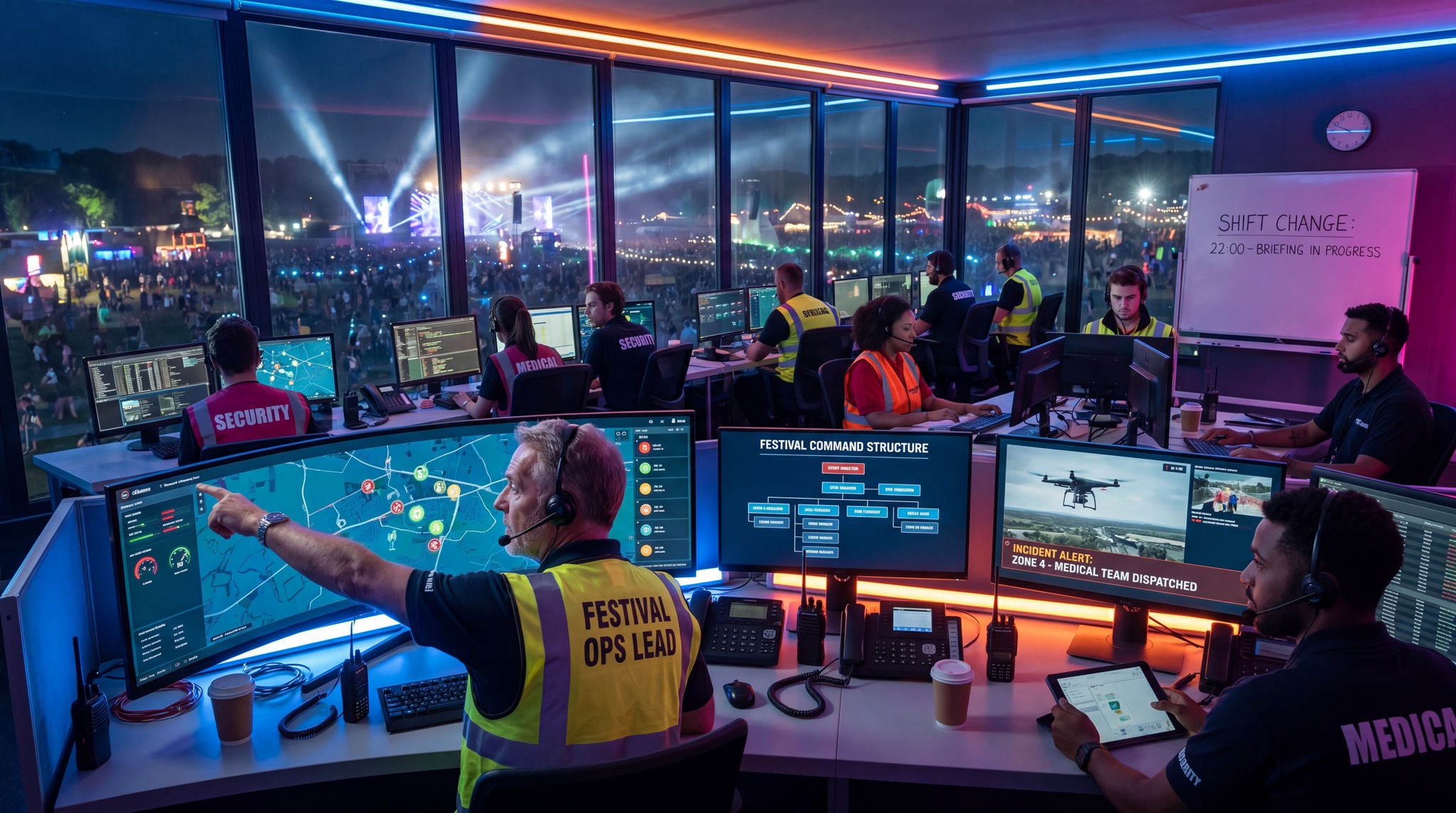
A social media war room is not an island – it must be tightly integrated with the festival’s on-site leadership and emergency operations. EOC stands for Emergency Operations Center (sometimes called the Event Operations Center) – essentially the control room where festival directors, security, medical, and other key teams coordinate. When the war room spots a critical issue online, speed is everything in getting that information to the EOC and relevant departments.
Establish Clear Protocols: Before the festival begins, set up escalation guidelines. For example, if any social media post suggests an immediate safety threat (like a fire, violence, a dangerous overcrowding situation, etc.), the war room should have a direct line (phone or radio) to the EOC to report it within minutes. Less urgent but still important issues (say, multiple complaints about overflowing toilets in one area) might be escalated via a ticket system or regular check-in call. Define what types of issues merit a “drop everything and call it in” versus those that can be relayed in scheduled updates. It’s better to err on the side of caution – if the listeners and fact-checkers are seeing something concerning, push it up the chain quickly.
Example – Stopping a Rumour from Becoming a Crisis: Let’s say at a large outdoor festival in Australia, several attendees start tweeting about a stage structure that looks unstable. One tweet goes viral with people claiming a collapse is imminent. The war room should immediately 1) check with the stage managers (via the fact-checker liaison) if there’s any real structural issue, and 2) alert the EOC about the viral rumour. If the stage crew reports “everything is safe and sound,” the social team can promptly post reassurance (“We’re hearing concerns about Stage X – our safety team has double-checked and all is well. There is no danger to the public.”). On the other hand, if there is an issue (say a support beam is bent), the EOC can decide to pause the show and fix it, while the social team informs attendees of a temporary delay for safety checks. In either scenario, the key is the war room acting as an early warning system and immediately looping in the on-ground decision-makers.
Rapid escalation isn’t only for safety threats. It could be used for medical situations (someone posts that a friend collapsed at a campsite – the war room should call medical dispatch and reply to get the location), or for any operational breakdown that could seriously impact the festival (like a parking lot closure or a major traffic jam on the way out). By funnelling real-time intel from social media to the EOC, the organisers can often mobilise a response before official reports come through traditional channels. In essence, social media becomes another set of “eyes and ears” on the ground, often crowdsourcing the first signs of a developing problem.
Integration with the Team: Consider stationing someone from the social media team inside the EOC, or at least in direct communication via headset or chat, during the festival. This ensures seamless information flow. At some large festivals in the UK and Europe, the person monitoring social media will literally sit with the police and emergency services in a joint control room. This way, if they see a tweet about an incident, they can turn to the relevant officer and say “Can we confirm this?” in seconds. The closer your war room ties into the physical event control, the faster you can react collaboratively to any situation – which ultimately keeps attendees safer and happier.
Transparency and Trust: How Openness Defuses Crises
In the midst of festival crises or controversies, transparency is truly the best policy. Seasoned festival producers have learned that being honest and forthcoming with information will calm stakeholders far more effectively than silence or spin. When things go wrong, your attendees want to know what’s happening and what you’re doing about it. Being transparent doesn’t mean you have to expose every internal detail, but it does mean communicating openly about the situation at hand.
Data-Driven Event Marketing
Track ticket sales, demographics, marketing ROI, and social reach in real time. Exportable reports give you the insights to make smarter decisions.
Admit Mistakes and Explain Solutions: If the festival organisation dropped the ball in some way, it pays to own up and say so. Attendees are remarkably forgiving when you treat them with respect and tell the truth. A great example comes from the inaugural Untappd Beer Festival in the USA, which ran into multiple operational problems – long entry lines, beer shortages, even a weather evacuation where people were left confused due to scant communication. The backlash on social media was swift and loud, as detailed in local news coverage of the event issues. Instead of getting defensive, Untappd’s leadership came out and openly acknowledged their mistakes, extending the festival by an hour that day to make up for lost time and promising improvements for the future, admitting they made operational mistakes. The company’s president even talked about compensating affected attendees. This level of transparency and accountability helped regain some goodwill with attendees, even though the festival’s first impression was rocky.
Similarly, when a festival listens to attendee concerns (as voiced on social media) and responds with visible changes, it should communicate that. For instance, at a recent music festival in Charlotte, USA, fans spoke out online about the lack of free water in hot weather. The organisers responded by quickly adding water stations and then publicly announced this update, noting that they “heard the feedback” and acted on it, confirming organizers addressed health and safety concerns. By closing the feedback loop – “You raised an issue, and here’s what we’re doing to fix it” – festivals show the community that attendee safety and satisfaction come first. This proactive transparency not only resolves the immediate problem but also builds long-term trust.
Debunk False Information with Facts: We touched on rumours earlier – transparency is your weapon against them. Rather than hiding issues or staying quiet while misinformation spreads, get out there and correct the record with authority. During the Burning Man 2023 incident, crazy rumours (like a supposed disease outbreak) flew around online. Official channels quickly debunked the false claim about an Ebola outbreak, with health officials confirming no such problem existed, effectively debunking false social media rumors. By promptly addressing the rumour head-on, they prevented panic from spreading among participants’ families and the public. The lesson for festival organisers is clear: when faced with unfounded claims, respond quickly with the facts and the source of those facts (e.g. cite the health department, police, or other credible authority). Even for less extreme misinformation – say, a tweet wrongly claiming a certain stage is closed – a fast, factual correction from the official account will usually stop the confusion in its tracks.
Ongoing Communication: Transparency during a crisis also means giving updates frequently, even if the update is “we are still working on it.” When a festival has to delay gates, postpone a performance, or handle an emergency, silence is the worst option. People will fill in the void with speculation. Instead, post regular updates: “We’re aware of the issue with [X] and our team is addressing it. Next update in 30 minutes.” And then make sure you follow up with that update. Being transparent in this way shows responsibility and keeps attendees from feeling abandoned. As one famous case in public relations put it, trying to shove a crisis under the rug usually makes everything worse, whereas addressing issues openly and head-on is far more effective. In the festival context, that openness can mean the difference between a hiccup that attendees accept versus a fiasco that they rant about for years.
Finally, transparency helps defuse anger. Even if people are upset about something, seeing a sincere apology or explanation from the festival can take the sting out. It humanises the organisers. Many veteran festival producers will recall times when a heartfelt public apology and a clear plan of action turned an angry crowd into a supportive one. Transparency, coupled with empathy, turns down the heat of an issue – it’s hard to stay mad when you know the organisers are listening and earnestly trying to make things right.
Adapting to Festival Size and Type
Every festival is unique – a boutique 5,000-person indie folk festival won’t need as large a war room operation as a 100,000-strong EDM extravaganza, but the principles remain the same. Scale your social media team to the event’s needs. For a smaller festival, you might have one or two people wearing multiple hats (one person monitoring and responding on all platforms, another coordinating with operations). For a mega-festival, you may have a fully staffed war room with 10+ people on shifts covering 24/7 during the event. The larger the event, the more important it is to have specialization and clear division of roles – but even a small event benefits from having someone assigned to watch and manage social media feedback in real time.
Smooth Entry With Mobile Check-In
Scan tickets and manage entry with our mobile check-in app. Supports photo ID verification, real-time capacity tracking, and multi-gate coordination.
Also consider the type of festival and audience demographics when planning your social strategy. A food and wine festival might see most attendee interaction on Facebook or Instagram, perhaps with longer posts or comments requiring thoughtful replies. A gaming or pop-culture convention could have vibrant Discord channels or subreddit threads that need monitoring. A music festival targeting Gen Z will see rapid-fire TikTok and Twitter activity. Tailor your war room focus to where your attendees are most active. It can be useful to hire or assign team members who are already familiar with those platforms and the communication style that works there.
Cultural and Regional Sensitivity: Festivals around the world have different community norms on social media. In some countries, attendees may be more formal in their complaints; in others, sarcasm and memes might be the preferred way to air gripes. Your responders should understand the cultural tone of your audience’s posts and adapt accordingly. If you’re running a global event like Tomorrowland or Ultra Music Festival which draws people internationally, it’s wise to have multilingual support in your war room. Responding to a French tweet in French, or an Indonesian Facebook comment in Bahasa Indonesia, can wow your attendees and show that the festival truly values everyone. Even if you can’t cover every language, acknowledging someone’s post and offering to find a translator or help in another language demonstrates effort and inclusivity.
Preparing for the War Room: Rehearse and Educate
Lastly, a note on preparation: don’t wait until show day to figure out your social media crisis plan. In the weeks leading up to the festival, train your war room team and run drills. Simulate some scenarios (like “a rumour is trending that we ran out of food” or “a minor fraud on tickets is spreading on Facebook”) and have the team practice their response workflow – from spotting the issue to escalating and crafting a public reply. Share past case studies among the team: what went well at other festivals, what went wrong and why. The more familiar your staff are with the playbook, the more confidently they’ll react under real pressure.
Also, coordinate with all departments on what information can be shared publicly and who the point contacts are. If the social team knows exactly whom to call for a given issue (the safety chief, the logistics manager, the artist liaison, etc.), they’ll get verified info faster. Create a contact list or a communications tree for the event. Everyone should know how to reach the war room too – sometimes on-site staff might see something and alert the social team (“People are starting to complain about X over here”). It’s a two-way street of information.
By investing this effort in preparation, your festival’s social media war room will be ready to tackle anything – ensuring that when the festival gates open, the online experience of your attendees is as smooth and well-managed as the on-ground experience.
Frequently Asked Questions
What equipment is needed for a festival social media war room?
A fully equipped digital command center requires high-speed, redundant internet access, multiple large monitors for dashboard aggregation, and dedicated workstations for your listeners and responders. Organizers should also ensure direct communication lines (such as two-way radios or dedicated phone lines) to the on-site Emergency Operations Center (EOC) and access to enterprise-level social listening software.
How many staff members are required to run a social media war room?
Staffing depends entirely on the scale of your event. A boutique gathering might operate effectively with two dedicated digital managers handling both monitoring and response. In contrast, a mega-festival hosting 100,000+ attendees typically requires a rotating team of 10 to 15 specialists, divided into distinct roles like listeners, responders, and fact-checkers, operating in shifts to provide 24/7 coverage.
What are the best practices for war room monitoring during a live event?
Successful war room monitoring requires segmenting your data streams. Instead of watching one massive feed, organizers should use dedicated dashboard columns for specific operational keywords, geolocation tags, and VIP or influencer mentions. This structured oversight allows the digital team to filter out general noise and immediately spot actionable logistical issues or emerging safety concerns.