Introduction
Festival stages and art installations are the heart and soul of an event’s atmosphere. Yet all too often, these impressive scenic elements end up as waste once the music stops. In an era where sustainability is paramount, forward-thinking festival producers are reimagining how they design and use scenic materials. The goal is simple: create stunning environments without leaving a mountain of discarded wood, plastic, and metal after the show. This article explores how festivals worldwide can embrace sustainable scenic design – from choosing lightweight, flat-pack structures to reusing decor year after year – and how these choices can become a powerful part of a festival’s brand story.
Lightweight, Modular Scenic that Ships Flat
One of the most effective strategies for sustainable scenic design is to favor lightweight, modular pieces that ship flat and assemble quickly on site. This approach offers multiple benefits:
- Reduced Transportation Footprint: Flat-pack and modular scenic elements take up less space in trucks or shipping containers. A stage backdrop made of interlocking lightweight panels can often fit into a fraction of the volume required by a traditional one-piece set. Fewer and lighter truckloads mean lower fuel consumption and carbon emissions, which is good for the planet and the budget.
- Cost Savings on Logistics: When a scenic design can be broken down into flat components, it’s not just the environment that benefits. Festival organizers save on freight costs and storage. For instance, a touring electronic music festival in Australia once redesigned its stage decor into collapsible sections, reducing the number of shipping containers needed from four to two – cutting transport costs nearly in half while also shrinking its carbon footprint.
- Faster Setup and Takedown: Modular scenic systems are often designed for quick assembly. Think of them like life-sized LEGO blocks or IKEA-style kits for festivals. Crews can put together pre-fabricated pieces with minimal tools and labor. The quicker a stage or installation goes up, the more time saved (and usually, less labor expense). Quick takedowns also mean less overnight or overtime work, improving safety and reducing fatigue for production teams.
- Adaptability to Different Venues: Festivals often take place in unique locations – from city parks to remote fields or even cruise ships. Having a modular scenic kit means you can adapt to various stage sizes and site layouts. Need a wider stage facade for one venue? Simply add more panels. Low ceiling in an indoor venue? Use fewer stackable pieces. This flexibility ensures materials get reused in different contexts, rather than building completely new sets for each venue.
Case in Point: The team behind a major European EDM festival developed a modular stage backdrop system consisting of lightweight aluminum frames and tension-fabric graphics. These frames packed flat, so an entire stage design fit into a single trailer. The system could be configured into various shapes – a tall narrow setup for a warehouse venue in Germany, or a wide setup for an outdoor stage in Spain – using the same components. Not only did this innovation save tens of thousands of euros in shipping and fabrication costs over multiple events, it also dramatically reduced waste. Each time, the only new element was a fabric cover with event-specific art, and those fabric pieces were later recycled. The heavy aluminum frame structure itself was reused for years across festivals in the UK, France, and even shipped to events in Asia.
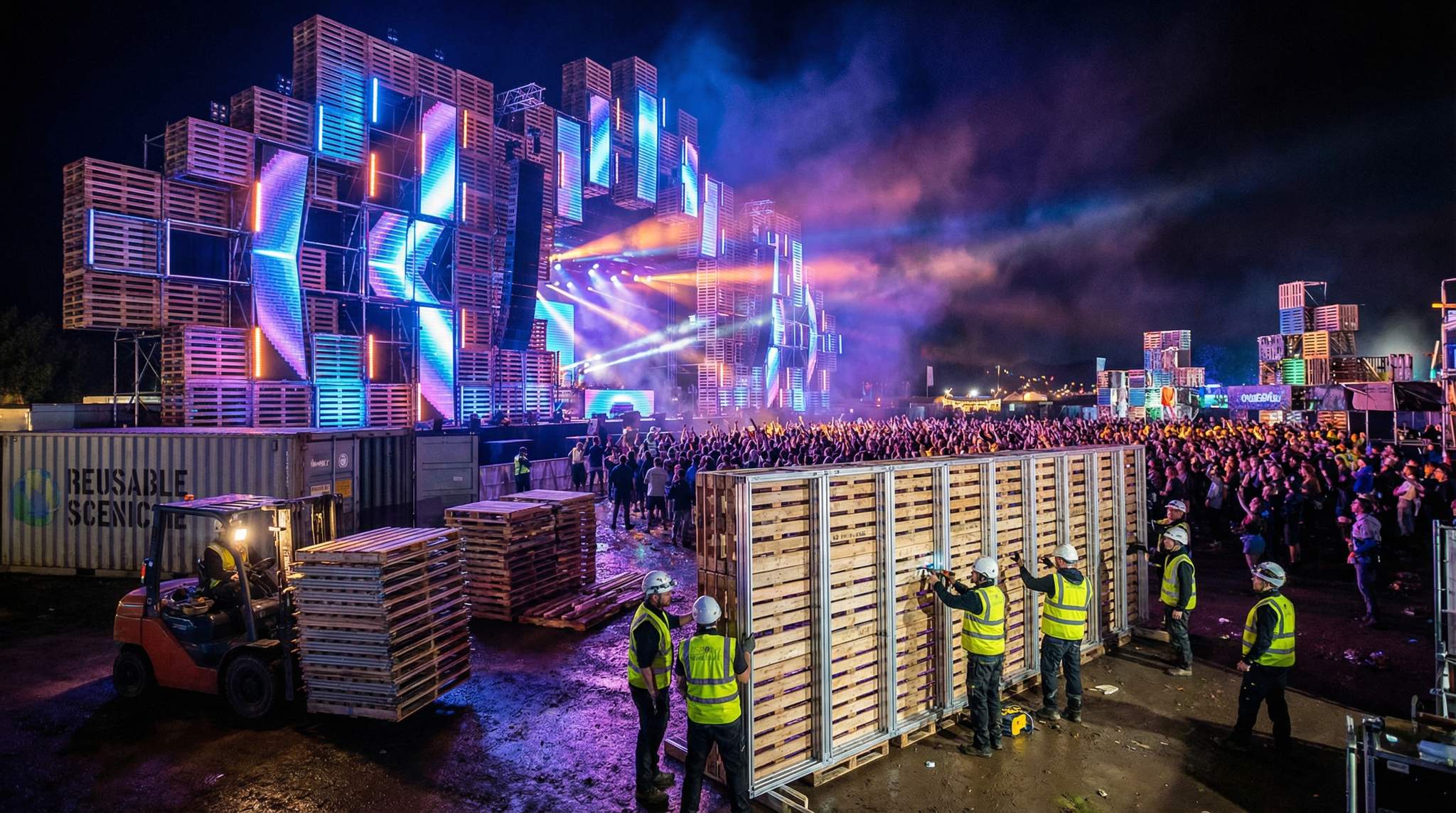
Another example comes from the world of art and architecture at festivals: Hungary’s Sziget Festival features the iconic Colosseum stage, a circular open-air venue built entirely out of standard wooden pallets. The structure, designed by the Hello Wood collective, uses 4,400 pallets stacked and secured to form an arena-like wall. Here’s the sustainable twist – the festival doesn’t own thousands of pallets permanently, nor do they dispose of them. Instead, they rent these pallets for the event and return them after the festival. The pallets go back into circulation (for shipping goods as they were originally meant), meaning the materials live on instead of heading to a landfill or requiring long-term storage. This creative modular design (essentially “LEGO blocks” of pallets) not only looks stunning and industrial-chic, it epitomizes the idea of a structure that ships flat and assembles quickly. In just a few weeks, local crews transform a blank space into a massive clubbing arena, and in days it’s dismantled with virtually zero waste.
Free Tool: Size Your Festival Site
Zoned capacity planning for arena, campsite, parking and entry lanes — against UK Purple Guide and NFPA density standards. Finds your bottleneck zone.
Choosing the Right Materials
Selecting materials is key when aiming for lightweight and flat-packable scenic elements:
– Aluminum and Composites: Aluminum truss and frame systems are a festival mainstay because they are both lightweight and strong. They can be used as the skeleton for stages, signage towers, and lighting rigs. Aluminum can be reused indefinitely and is fully recyclable if it ever gets damaged. Some festivals in the United States and Canada invest in modular truss archways for their entrances – these structures are assembled on-site and disassembled into compact segments that are easy to ship.
– Fabrics and Inflatable Elements: Instead of heavy wooden or steel set pieces, many event production teams use tension-fabric panels, inflatable art, or projection screens to achieve large visual impacts. For example, an electronic music festival in Singapore deployed a series of inflatable sculptures as stage decor. These towering shapes looked like giant art installations when inflated, but afterwards they packed down into a couple of duffel bags. The festival was able to reuse these inflatables at multiple editions (and even loan them to a partner event in Indonesia), simply rebranding them with different colored LED lighting each time. This not only saved on construction materials but also made international shipping much easier.
– Sustainable Woods and Cardboards: If you do use wood, opt for sustainably sourced plywood or even innovative materials like recycled cardboard panels that are designed for events. There are modular cardboard set systems that ship flat, are very lightweight, and can be assembled like building blocks on site. They’re surprisingly sturdy when designed well. Some eco-conscious festivals in New Zealand have experimented with honeycomb cardboard backdrops for stages – these structures hold up through the weekend and then are recycled after use if they can’t be stored for another event. The key is they replaced what would have been plywood walls (heavy and harder to recycle) with a lighter material that served the purpose and left a smaller environmental trace.
When evaluating festival materials for your next build, consider the entire lifecycle of the products you purchase. Sourcing eco-friendly construction elements means looking beyond the initial aesthetic to ask how the items were manufactured and where they will end up. Organizers are increasingly turning to biodegradable plastics, mycelium-based foams, and recycled textiles to replace traditional, single-use synthetics. By prioritizing renewable resources, production teams can drastically cut down on the environmental footprint of their site infrastructure.
Planning a Festival?
Ticket Fairy's festival ticketing platform handles multi-day passes, RFID wristbands, and complex festival operations.
Beyond the decorative facade, the core stage materials used for structural support and decking must also align with your sustainability goals. When sourcing heavy-duty staging components, festival producers should prioritize suppliers who offer modular scaffolding and staging decks made from high-grade, recyclable alloys and sustainably harvested timber. Utilizing standardized construction elements not only ensures compliance with rigorous safety and load-bearing regulations but also guarantees that the underlying infrastructure can be rented, reused, and seamlessly integrated into future event layouts without generating construction waste.
Sustainable Scenic Fabrication Techniques
Beyond just selecting the right materials, the actual process of sustainable scenic fabrication plays a critical role in reducing an event’s environmental impact. When festival producers ask, “what are stages made of?”, the answer increasingly involves a mix of extruded aluminum truss systems, composite decking, and CNC-routed sustainable plywood cladding. By utilizing precision manufacturing techniques like CNC milling and 3D printing with recycled filaments, fabrication shops can minimize off-cut waste during the build phase. Furthermore, integrating eco-conscious event decoration ideas—such as using zero-VOC (volatile organic compound) paints, water-based sealants, and biodegradable structural adhesives—ensures that the stage designs remain environmentally safe from the workshop to the festival grounds. Partnering with scenic shops that prioritize green manufacturing processes allows organizers to build massive, awe-inspiring environments while maintaining strict sustainability standards.
Core Principles of Sustainable Stage Design
For festival producers, executing a successful sustainable stage design requires balancing aesthetic impact with environmental responsibility. The most effective stage designs integrate structural safety with eco-friendly sourcing from day one. This means collaborating closely with structural engineers and scenic carpenters to ensure that the primary load-bearing elements—such as the main stage roof and PA wings—utilize rented, reusable trussing rather than custom-welded, single-use steel. By standardizing the underlying architecture, organizers can focus their custom fabrication budget on the lightweight, modular cladding discussed earlier, ensuring the overall production remains both visually striking and environmentally sound.
Tracking Reuse Cycles and Designing for Refinish
Sustainability in scenic design isn’t just about the cool new modular structure you debut this year – it’s about how many times you can use it over many years. Tracking reuse cycles means keeping tabs on how often each piece of scenic element is used and planning for how it can be refreshed or refurbished for future shows. Designing for refinish means creating pieces that can get a “makeover” for a new theme or look, instead of tossing them out. Here’s how festival teams can make that happen:
Free Tool: Project Your Bar Revenue
Per-head spend benchmarks by event type turned into projected bar and food revenue, with a stock-mix estimate and gross-margin line. Free calculator.
- Inventory Your Scenic Assets: It may sound obvious, but you can’t reuse what you don’t remember you have. Successful festival producers maintain a catalog or database of all their major scenic pieces, props, and set elements. This can be as simple as a spreadsheet with descriptions, dimensions, photos, and notes on condition. A music festival in California that runs events three times a year found value in this approach – the production crew photographs and labels each set piece when it’s put into storage. Before designing a new stage setup, they review this inventory to see what can be repurposed. It’s amazing how often a panel from last season’s EDM stage can reappear as part of a decorative wall for this season’s indie folk stage, with a new coat of paint and some creative tweaks.
- Plan a Reuse Cycle at the Design Stage: When commissioning designers or building decor in-house, set the expectation that scenic elements should ideally have a life beyond one festival. This might mean using neutral base colors and sturdy materials that can be re-skinned or repainted. For example, if you’re creating a large sign with your festival’s name, consider building it as individual letters or modular sections. That way, if the logo or branding changes in the future, you don’t have to trash the whole sign – you could replace just one section or update the face of the letters. One European festival brand that expanded from the UK to multiple countries did this cleverly: their logo sign for the main stage was built with removable front panels. When they went from “Festival X” to “Festival Y” in a new country, they kept the same sign structure and swapped out the front to display the new event name. The audience never knew, and the organizers saved thousands by not rebuilding signs from scratch.
- Design for Disassembly and Modularity: Avoid permanent glue and irreversible joins when building scenic pieces. Use bolts, screws, clamps, and other fasteners that allow parts to separate. If you’re building a decorative wall, think in terms of uniform panels (say, 4×8 foot sections) that can be taken apart. Not only does this help in flat shipping as mentioned, but it also means if one panel is damaged you can replace or repair just that section without throwing the entire wall away. A festival in Mexico learned this the hard way: they built a beautiful mosaic-style stage façade for a day-long event, but it was constructed as one giant piece. When part of it was damaged in transit and later by rain, it became nearly impossible to fix on site or reuse later. Had it been modular sections, the intact portions could have lived on at future events. The lesson: design with future you in mind, the one who might need to fix or update this thing a year from now.
- Refinish, Repurpose, Donate: Even the sturdiest scenic elements will eventually show wear and tear after being hauled around to festivals or exposed to the elements. Instead of disposing of them, plan for a refinish. Wooden structures can be sanded and repainted. Metal can be refinished or powder-coated anew. Fabrics can be re-dyed or used as backing material for new prints. Think of it like repainting a house – a fresh finish can make an old set piece look brand new. Some festivals also get creative in repurposing items: the decor from a cancelled event might be turned into art installations at the next one, or stage pieces can be transformed into site art around the festival grounds (saving them from the dumpster and adding value for attendees). If you truly can’t reuse something, consider donation or resale rather than landfill. In the UK and Canada, there are event industry networks for trading and giving away scenic materials – one festival’s trash can literally become another theater troupe’s treasure. For example, a community theater in Toronto might gladly take those old stage flats off your hands to use in their productions.
Case Study – Reuse in Action: Look at Pickathon, a boutique music festival in Oregon, USA, known for its groundbreaking sustainable practices. Pickathon doesn’t just ask “Can we reuse this decor?” – they design entire stages with the next life in mind. In one edition, architects and students built a gorgeous performance venue out of 160 giant wooden cable spools (the kind industrial companies use for heavy cable). After the festival, instead of throwing away materials or storing an awkward spool-made structure, they dismantled it and returned all the spools, which went back to work in their original industrial roles. In another year, Pickathon’s team constructed a pavilion from hundreds of recycled wooden panels, which were later repurposed to build community housing. By tracking each component’s journey (often literally numbering pieces and noting their usage history), the festival ensures that very little ends up as waste. The production crew can tell you exactly how many times those modular panels have been re-painted and reused over the past seasons. They joke that some pieces have more festival experience than the newer crew members!
This commitment to reuse requires planning and coordination – it doesn’t happen by accident. Pickathon’s approach demonstrates that with creativity and partnerships (like working with architecture schools or sustainability nonprofits), even small festivals can achieve big impacts. The key takeaway for any festival producer is to think past the event: envision where each piece of your scenic might go next, even as you’re developing it for the current edition.
Need Festival Funding?
Get the capital you need to book headliners, secure venues, and scale your festival production.
Weaving Sustainability into Your Brand Story
Making sustainable choices in scenic design isn’t just an operational decision – it’s a storytelling opportunity for your festival’s brand. Modern audiences, especially in the electronic music scene and younger demographics globally, are increasingly eco-conscious. They appreciate and support events that take environmental responsibility seriously. By communicating your sustainability choices effectively, you can strengthen your festival’s brand, win loyal fans, and even attract sponsors. Here’s how to make sustainability a visible part of your story:
- Be Transparent and Proud: Let attendees know what you’re doing. Signage at the event or posts on social media can highlight interesting facts: “This stage design is constructed with 100% reclaimed materials” or “These 50 art lanterns around the venue are made of biodegradable fibers that will be composted after the festival.” When Glastonbury Festival in the UK rolled out new stages built from salvaged wood and even parts of a decommissioned helicopter, it wasn’t kept a secret – it became part of the media buzz around the event. People love to hear that the spectacular set pieces they’re looking at have an inspiring backstory. It adds depth to their experience, knowing that the festival values creativity and responsibility.
- Engage the Community: Some festivals turn sustainable practices into interactive experiences. For example, a festival in Bali might invite local artists to create decor from natural materials like bamboo, which festivalgoers can watch being woven live on-site. This not only gives locals a platform but also educates the audience on traditional, sustainable craftsmanship. In another instance, a community arts festival in Canada held workshops for volunteers to help repaint and refurbish old set decorations before the event – giving superfans a hands-on role in the festival’s sustainability mission. By involving your audience and community in these efforts, sustainability becomes a shared value rather than just a behind-the-scenes policy.
- Highlight the Benefits, Not Just the Effort: When communicating, tie your sustainable scenic approach back to things your audience cares about. Yes, it’s about saving the planet, but festival-goers will also be excited to hear how it makes their experience better. Did your modular design save costs that allowed you to invest in a better lineup or improved amenities? Tell them! Perhaps your lighter, flat-pack stage means fewer diesel generators or trucks on site, resulting in cleaner air and a more comfortable environment at the festival – that’s worth bragging about. If you achieved a big reduction in waste, share the stats: “By reusing scenic elements, we reduced landfill waste by 80% compared to last year,” or “Our main stage saved 10 tons of materials from going to waste through clever reuse.” Concrete numbers and outcomes give weight to your story and show that it’s not just greenwashing.
- Involve Sponsors and Partners: Sustainable scenic design can open doors to partnerships. Many brands – from beverage companies to tech firms – want to associate with eco-friendly initiatives. If your festival has a strong sustainability angle, you might attract sponsors who have corporate social responsibility goals. Perhaps an environmentally friendly paint company would sponsor the repainting of your reusable stages each year, in exchange for subtle branding rights. Or a shipping company proud of its carbon-neutral program might offer discounted transport for your flat-packed scenic gear, if they can be featured as a green logistics partner. This can offset costs while amplifying your message.
- Be Consistent and Authentic: One thing to avoid is trumpeting sustainability while doing the opposite in practice. Festival audiences are savvy; if you claim to be eco-friendly but they see heaps of trashed materials after the event, the reputation damage can outweigh any goodwill. So integrate sustainability holistically – if you’re focused on reusable scenic, also pay attention to other eco-areas like recycling bins, reducing single-use plastics, etc. Over time, build a track record. A festival in India, for instance, started with reusing stage structures and then gradually expanded its green initiatives each year (introducing solar lighting, rainwater harvesting on festival grounds, etc.). They shared each milestone in their marketing. Now, that festival is known across India as a pioneer in green event production, which draws attendees and media interest beyond just the music lineup.
- Facilitate Sustainable Fan Projects: Often, passionate attendees want to contribute to the atmosphere through fan projects for concerts and festivals, such as coordinated light shows, massive banners, or interactive art gifts. As an organizer, you can guide these grassroots initiatives toward sustainability. Provide guidelines that encourage fans to use recyclable paper, biodegradable glitters, and reusable LED wearables rather than single-use plastics or toxic glow sticks. By officially supporting eco-friendly fan projects, you empower your community to co-create the event’s magic without generating excess waste.
Ultimately, communicating your sustainable scenic and production choices is about sharing your values. It sets your festival apart in a crowded market. Whether your event is a 50,000-strong mega-festival in Germany or a 500-person boutique gathering in New Zealand, a genuine commitment to sustainability can be a defining part of your identity. And when you tell that story well, you inspire others – vendors, artists, attendees, and even other event organizers – to follow your lead, creating a ripple effect of positive change throughout the industry.
Scaling Sustainability: From Niche to Norm
It’s worth noting that sustainable scenic practices apply to all scales and types of festivals:
– Small Local Festivals: If you’re running a community or niche festival (say a regional food and music fair), you might not have massive stage sets at all – and that’s okay. You can still apply these principles by reusing whatever decor you do have (banners, booths, signs) and opting for simple modular rentals. Small events often benefit from renting staging and scenic elements from suppliers, which is inherently a reuse model (the rental company uses the same items for many clients). You can also collaborate with local theatres or schools to borrow props and set pieces, giving them new life at your event. Emphasize local and handmade elements – for instance, a folk festival in Mexico might use hand-painted tapestries each year as stage backdrops, a tradition that is both sustainable and culturally meaningful, since the fabric can be used year after year.
– Large Festivals and Tours: Big international festivals or touring festival brands can invest in higher-end sustainable solutions. This might include custom-designed modular stages that travel the world, or durable scenic elements that are used across multiple years. Some large electronic music festivals have signature stage designs or iconic art installations that reappear in evolved forms each edition – by planning this intentionally, they create a sense of continuity for fans and get maximum mileage out of their investments. For example, an annual festival in Spain re-purposed the massive LED-wall structures from last year’s stage into this year’s arena entrance tunnel, showcasing innovation and thrift. Large events often have the advantage of storage facilities; using that wisely means staging from one year can be refurbished in the off-season and come out looking new for the next.
– Cultural and Themed Events: Not all festivals are music-centric; think of film festivals, cultural celebrations, or conventions. These events also use scenic elements (step-and-repeat backdrops, themed decorations, exhibition booths). The same rules apply – use modular exhibition systems, choose reusable pieces, and avoid one-off prints with dates that force you to throw things away annually. A film festival in France stopped printing the year on their branded signage; instead, they invested in high-quality, timeless banners and digital screens that can be updated with new information each year. This reduced waste significantly and cut costs on printing annually. It’s a reminder that sometimes sustainable choices are as simple as changing what information you put on your decor (do you really need the year or sponsor logos permanently affixed, or can those be applied in a temporary way?).
Sustainable Event Decorations and Thematic Ideas
Whether you are producing a massive multi-day outdoor gathering or curating corporate festival theme party ideas, the approach to decor should remain rooted in reusability. Planners looking for fresh event decorations ideas can utilize upcycled vintage furniture, living plant walls that are replanted post-event, and dynamic projection mapping instead of physical props. Projection mapping, in particular, allows you to completely transform a blank modular facade into a lush jungle, a futuristic cityscape, or a psychedelic dreamscape at the push of a button. This digital approach to thematic styling provides endless creative flexibility while requiring zero physical storage space and generating absolutely no landfill waste.
Across countries and cultures – from the desert festivals in Nevada, USA to beach festivals in Goa, India – the push for greener events is universal. Many governments and cities are also encouraging sustainable event practices. Festival producers should anticipate that sustainability standards will only get stricter in the future. By embracing reusables and sustainable scenic now, you’re future-proofing your event and staying ahead of regulations, and earning the respect of audiences who care about the planet.
Frequently Asked Questions
Why should festivals use lightweight modular scenic designs?
Lightweight, modular scenic designs significantly reduce transportation footprints and freight costs by allowing elements to ship flat in fewer containers. These systems enable faster onsite assembly and takedown, saving labor costs. Additionally, modular components adapt easily to different venues, allowing materials to be reused across various stage sizes and locations.
What are the best materials for sustainable festival stage design?
The most effective materials for sustainable scenic elements include lightweight aluminum truss systems, tension-fabric panels, and inflatable art that packs down into duffel bags. Eco-conscious festivals also utilize sustainably sourced plywood or innovative honeycomb cardboard backdrops, which offer sturdy, recyclable alternatives to heavy, non-recyclable construction materials.
How can festivals use wooden pallets for sustainable stage construction?
Festivals can rent standard wooden pallets to build massive, modular structures like Sziget Festival’s Colosseum stage, which used 4,400 stacked pallets. By renting rather than buying, organizers return the pallets to circulation for shipping goods after the event, ensuring the materials live on instead of becoming landfill waste.
How do festivals track and reuse scenic assets effectively?
Successful production teams maintain a detailed inventory database of all scenic pieces to identify items for repurposing. They design elements for disassembly using reversible fasteners like bolts instead of glue, allowing specific sections to be repaired or replaced. Crews also plan for refinishing, such as repainting wood or re-skinning frames.
Does flat-pack scenic design save money for music festivals?
Flat-pack scenic designs generate substantial cost savings by reducing the volume of shipping containers needed, which lowers freight and fuel expenses. For example, one Australian festival cut transport costs nearly in half by redesigning decor into collapsible sections. Modular kits also reduce labor costs through faster assembly and takedown times.
Why is sustainable scenic design important for a festival’s brand?
Sustainable scenic design strengthens a festival’s brand by appealing to eco-conscious audiences who value environmental responsibility. Transparently sharing stories about reused materials or waste reduction builds fan loyalty and attracts sponsors looking for corporate social responsibility partnerships. It transforms operational choices into a compelling narrative about creativity and care for the planet.
What is sustainable scenic fabrication?
Sustainable scenic fabrication refers to the environmentally conscious manufacturing and construction of stage designs and event decor. This process prioritizes zero-waste building techniques, the use of renewable or recycled materials, non-toxic finishes, and modular engineering that ensures the final structures can be easily dismantled, transported, and reused across multiple events.
What are modern festival stages made of?
Modern festival stages are typically constructed from a combination of heavy-duty aluminum truss systems for the load-bearing skeleton, composite or sustainably harvested wood decking for the performance floor, and lightweight, flat-packable cladding such as tension fabrics, honeycomb cardboard, or recycled plastics for the visual facades.
How can organizers make fan projects for concerts more sustainable?
Promoters can guide fan-led initiatives by issuing sustainability guidelines that encourage the use of biodegradable materials, recyclable paper, and reusable LED items, ensuring that crowd-sourced creativity doesn’t result in single-use plastic waste.
What are some eco-friendly event decorations ideas for festival-themed parties?
Sustainable decor concepts include using upcycled vintage furniture, living plant installations that can be replanted, and digital projection mapping, which allows organizers to instantly change themes without manufacturing physical props.
How does sustainable stage design impact overall event production costs?
While the initial investment in eco-friendly materials or modular systems might be slightly higher, sustainable stage design ultimately reduces overall event production costs. Organizers save significantly on freight, heavy machinery rentals, and waste disposal fees. Over multiple festival editions, the ability to reuse and re-skin existing stage architecture drastically lowers year-over-year fabrication expenses.
How do you select the best stage materials for outdoor festivals?
Selecting the best stage materials for outdoor events requires balancing weather resistance, structural integrity, and environmental impact. Producers should opt for modular aluminum scaffolding, composite decking, and wind-permeable acoustic scrims that can withstand harsh conditions while remaining fully reusable and recyclable across multiple festival seasons.