Warehouses and other industrial spaces are popular venues for electronic music festivals, but their hard surfaces and cavernous interiors can turn great music into a muddy echo. Taming a “hard room” requires careful planning and some acoustic wizardry. Experienced festival organizers know that achieving clear sound in a warehouse isn’t just about bringing big speakers – it’s about treating the space itself. This guide breaks down practical steps to transform an acoustically challenging warehouse into a festival venue with punchy, clear sound.
The Challenge of Hard Warehouse Spaces
Warehouse venues often come with high ceilings, concrete floors, metal walls, and other flat, reflective surfaces. These hard surfaces create long reverberation times (imagine clapping and hearing the sound linger for seconds). In a festival setting, uncontrolled reverb can blur the music’s details and cause that unpleasant “boomy” or “slap-back” echo. Parallel walls in a warehouse can generate flutter echoes – a rapid ping-pong of sound – especially noticeable on sharp sounds like snare hits or hand claps.
For example, festival producers in Berlin repurposing an old factory noted that a single shout could bounce around the room multiple times. In Mexico City, a techno event in a concrete warehouse initially suffered from a 4-second RT60 (reverberation time) that made the kick drums sound like distant thunder. These real-world scenarios illustrate how hard rooms can impair the audience experience. The goal is to minimize those reflections and echoes without killing the energy of the space.
Acoustic Treatment vs. Soundproofing a Warehouse
When organizers ask how to soundproof a warehouse, they are often confusing two different acoustic concepts: internal treatment and external isolation. The drapes and panels discussed throughout this guide are acoustic treatments designed to improve sound quality inside the room. Soundproofing a warehouse, on the other hand, is about preventing noise from escaping the building and triggering neighbor complaints or permit violations. Because low-frequency bass waves easily pass through thin metal or single-brick walls, making an industrial room completely soundproof for a temporary festival is notoriously difficult. However, you can mitigate noise leakage by sealing all air gaps (sound travels wherever air can), covering windows or loading bay doors with mass-loaded vinyl (MLV), and utilizing the cardioid subwoofer setups mentioned later in this guide to steer bass energy away from sensitive exterior walls.
Free Tool: Size Your Festival Site
Zoned capacity planning for arena, campsite, parking and entry lanes — against UK Purple Guide and NFPA density standards. Finds your bottleneck zone.
If you are exploring how to make a room soundproof for a longer-term lease or a semi-permanent venue, you must focus on decoupling and adding mass. Stopping noises through the wall—especially the relentless thud of subwoofers—requires structural interventions like building a “room within a room,” installing resilient channels, or adding multiple layers of acoustic drywall. For temporary warehouse festivals, true isolation is rarely feasible, so operators must rely on strategic site layout, pointing sound systems away from residential boundaries, and strictly enforcing decibel limits at the property line.
When evaluating a new industrial space, promoters should conduct a baseline noise bleed test during the site visit. Firing up a test PA system and walking the exterior perimeter with an SPL meter will quickly reveal the building’s weak points, such as unsealed ventilation shafts or thin corrugated roofing. Identifying these acoustic leaks early allows production teams to implement targeted mitigation strategies—like erecting temporary mass-loaded barriers or adjusting the stage orientation—before local authorities or neighbors raise noise complaints.
Planning a Festival?
Ticket Fairy's festival ticketing platform handles multi-day passes, RFID wristbands, and complex festival operations.
For promoters transitioning from one-off events to permanent installations, the conversation shifts from temporary mitigation to structural isolation. Upgrading a raw industrial shell to match the acoustic isolation of a purpose-built nightclub requires significant capital. Venue operators must evaluate whether the investment in heavy-duty soundproofing materials—such as floating floors, acoustic hangers, and multi-layered gypsum board—aligns with their long-term lease agreements and business models.
Deploying Drapes and Soft Goods (With Safety in Mind)
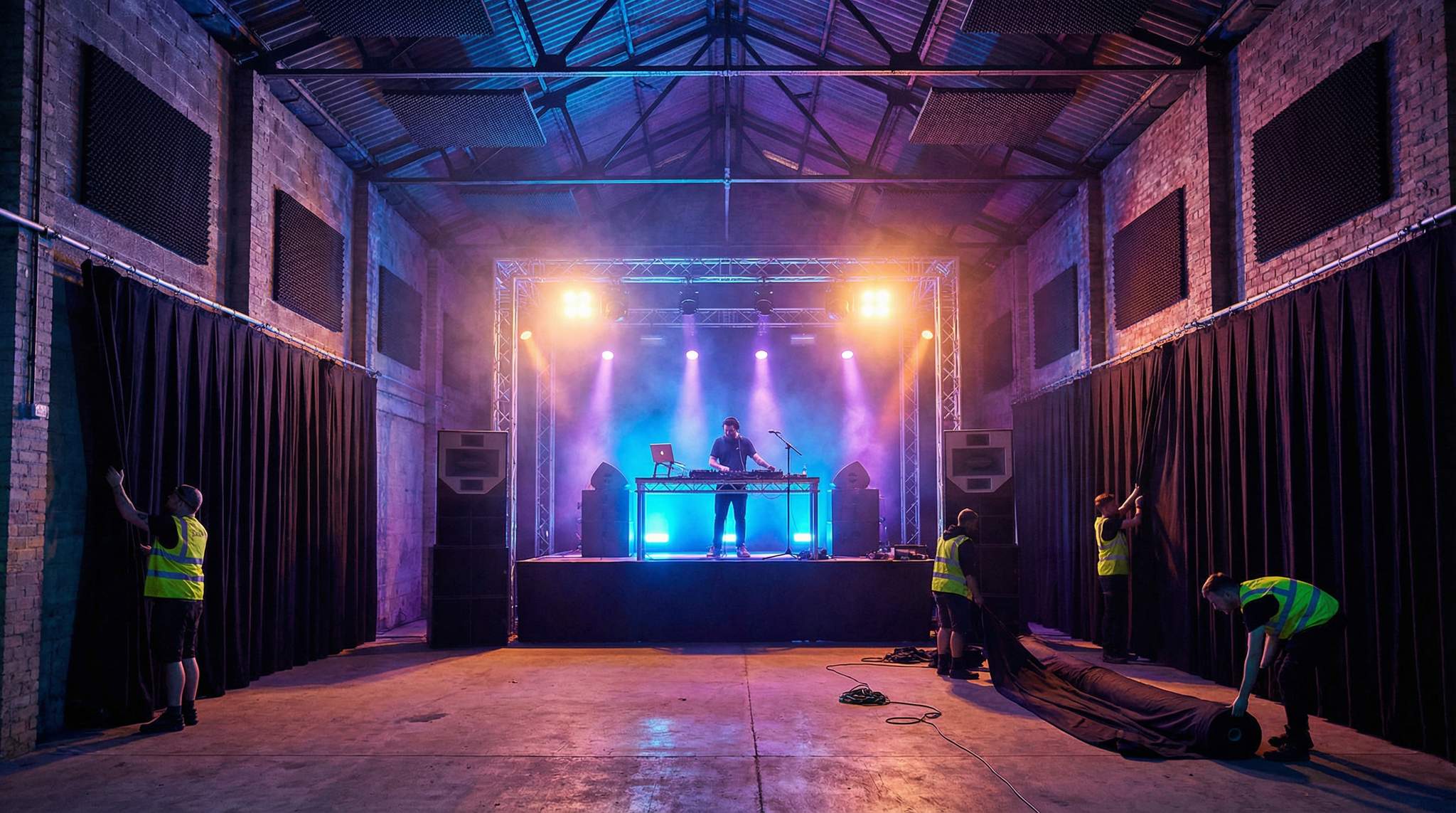
One of the most effective solutions to tame a hard room is adding absorption in the form of heavy drapes, curtains, and other soft goods. Hanging thick fire-rated curtains along walls or over large flat surfaces will absorb a lot of the mid and high-frequency sound that would otherwise bounce back. Festival organizers from Sydney to Mumbai have found that encircling a warehouse dance floor with velour theater curtains or acoustic drapes can significantly cut down on harsh reflections. These materials act like giant sponges for sound, soaking up energy and reducing the overall reverb.
Fire Codes and Safety: It’s critical to ensure any drapery or material used meets local fire safety codes. Using non-certified fabrics is not only illegal in many countries but extremely dangerous. (Remember the cautionary tales of nightclub fires – many started when flammable soundproofing or decor caught fire.) Always source flame-retardant (FR) or inherently flame-resistant (IFR) curtains and padding. In the US and Canada, look for NFPA 701 certification on fabrics; in the UK, BS5867 or equivalent standards apply. Many professional event drapes are tagged and come with certificates to satisfy fire marshals. Safety aside, meeting fire codes is often required to get permits or insurance for your festival. So, while a cheap carpet hung on the wall might dampen sound, if it isn’t fire-treated it’s not worth the risk.
The Industry Standard: There is a reason you frequently see heavy IFR velour in AV production spaces and high-end festival environments. Inherently Flame-Resistant (IFR) velour is woven from synthetic fibers that will not catch fire, meaning its safety rating won’t wash out or degrade in humid warehouse conditions—unlike chemically treated FR fabrics. Beyond safety, its dense, plush surface area makes it exceptionally effective at absorbing high and mid-tier frequencies, while its opacity perfectly blocks out unwanted ambient light from warehouse skylights.
Free Tool: Project Your Bar Revenue
Per-head spend benchmarks by event type turned into projected bar and food revenue, with a stock-mix estimate and gross-margin line. Free calculator.
For technical directors and venue operators, standardizing on these inherently flame-resistant textiles also simplifies cross-rental and inventory management. Because the fire-retardant properties are woven directly into the fabric, production companies don’t have to worry about re-treating their drape inventory after a damp outdoor festival or a dusty warehouse deployment. This durability makes high-weight synthetic velour a highly cost-effective, long-term investment for AV vendors and recurring event producers who need reliable acoustic dampening and light-blocking capabilities across diverse industrial venues.
Not Just for Looks: Sometimes organizers hang banners or decor on warehouse walls for ambiance – but thin fabrics or purely aesthetic hangings won’t help acoustics much. Prioritize function: heavy velour, wool serge drapes, or quilted moving blankets are better than lightweight vinyl backdrops when it comes to absorption. That said, you can be creative and blend acoustic treatment with decor. For instance, one festival in Paris printed art and logos on thick sound-absorbing panels to serve as both branding and acoustic treatment. Another in Singapore hung colorful fabric installations that were secretly backed with mineral wool. The key is to cover large surface areas with something that has soft, porous qualities (think fabric, fiberglass panels, foam) so that sound doesn’t keep ricocheting off hard metal or concrete.
Need Festival Funding?
Get the capital you need to book headliners, secure venues, and scale your festival production.
Angles and Placement of Treatment: If possible, hang drapes with some space behind them or at a slight angle to the wall. An air gap behind a curtain (even just 6–12 inches/15–30 cm) increases its sound absorption effectiveness, especially at lower frequencies. Angling paneling or soft flats (instead of mounting them perfectly flush) can also help break up reflections – any slight tilt means sound waves reflect off in a different direction rather than straight back as an echo. In one large Canadian warehouse venue, the production team strung acoustic panels in a zig-zag pattern from the ceiling trusses, both absorbing sound and scattering what wasn’t absorbed.
Strategic Speaker Placement in Hard Rooms
Beyond treating the room itself, speaker placement and system design are crucial in a warehouse. A common mistake is putting speaker stacks right up against walls or, worse, tucked into corners without a plan. In a hard, reflective room, the old sound engineer adage holds true: “Put sound where the people are, and avoid putting sound where the people aren’t.” In practical terms, that means aim your speakers toward the audience and away from large bare surfaces as much as possible.
Avoid Parallel Wall Proximity: Position your main speaker stacks a few feet (a meter or two) away from side walls if you can. If the stacks are too close to a parallel wall, the sound from the sides of the speakers will smash into that wall and reflect right back into the audience, causing immediate comb-filtering (frequency cancellation) and a sense of “harshness.” By giving some gap or angling the speakers inward slightly, you reduce how much direct energy hits the walls. During a London warehouse party, the audio crew discovered that moving their left and right PA stacks just 3 feet away from the side walls cleared up a nasty high-frequency slap echo that was audible on the dance floor.
Don’t Blast Straight Down a Long Axis: In a rectangular warehouse, try to avoid firing the main speakers straight down the longest dimension of the room (unless you have ample treatment or delays). A long, unchecked throw invites more reverb build-up as sound travels and ricochets. Some veteran producers even set up the stage on a diagonal inside rectangular halls. Angling the entire sound system to face a corner (so it’s not parallel to any wall) can reduce flutter echoes between opposite walls. At a Melbourne techno festival in a shipping depot, the organizers rotated the stage 45 degrees to the room’s grid; this unconventional layout helped scatter the reflections and earned praise for surprisingly clear audio in an otherwise unforgiving space.
Free Tool: Model Promoter Payouts
Flat-percentage, flat-per-ticket, or tiered-bonus commission structures — get per-promoter payouts and total commission as % of gross. Free calculator.
Beware of Corner Loading (Unless Intentional): Corners act like megaphones for bass frequencies – a phenomenon known as corner loading. Placing subwoofers in a corner will indeed make them sound louder by reinforcing low frequencies, but it can also create overwhelming boomy spots and uneven bass across the venue. Unless a corner placement is part of a deliberate acoustic design (for example, a carefully modeled bass array), it’s safer to keep subs and main stacks out of the extreme corners. Use spacing and aim to achieve a smoother bass response. A drum and bass event in Auckland learned this the hard way: they had stacked subs in a corner to save space, only to find the bass was insanely loud near the back wall but oddly weak on the dance floor. The fix was to bring the subwoofers out of the corner and deploy them across the front of the stage in a distributed array, instantly improving bass consistency.
Use Cardioid Sub Arrays: One modern technique to control bass in warehouses is using cardioid subwoofer arrays or arrangements that direct bass energy toward the crowd and cancel it going toward the walls or backstage. Cardioid (and end-fire) sub arrays can significantly reduce low-frequency spill to the rear and sides – meaning less bass exciting the warehouse’s structure (and less noise leaking outside as a bonus). Many large festival sound companies in the US, UK, and India have adopted cardioid subwoofer setups especially in reverberant or urban venues. This technology can require extra subs and careful calibration, but it’s worth it when you hear tight, punchy bass on the dance floor without a ten-second bass rumble after each beat.
Distributed Speakers for Large Spaces: If the warehouse is very large or long (say an aircraft hangar or massive factory floor), consider a distributed sound system rather than trying to have a single pair of speakers cover it all. By adding delay stacks or extra speakers further back in the room, you can keep the sound level more consistent and avoid overdriving the front speakers to reach the distant corners. A secondary benefit is that more of the audience will be closer to a speaker, increasing the ratio of direct sound to reverberant sound. In a cavernous venue in Germany, a festival organizer set up four smaller satellite PA towers around the dance floor in addition to the main stage speakers. This way, people in the middle of the crowd were never more than 10–15 meters from a speaker, and the music remained clear even though the natural reverb of the hall was high. When using multiple sources like this, you’ll need a skilled audio engineer to time-align delays and manage the system tuning, but it can transform an echoey barn into a more intimate-feeling space. Keep in mind that you still want to avoid aiming any of these speakers at bare walls or ceilings – focus them on audience areas only.
Measuring and Tuning Before Doors Open
Every warehouse is different, so analyzing the venue’s acoustics in advance is essential. Long before the doors open (ideally in a site visit weeks prior, or at least during load-in), take the time to measure and listen for problematic reflections.
Measure Decay Times: Using tools like an SPL meter, a test signal and microphone with software (such as SMAART, REW, or mobile apps), measure the reverberation time (RT60) of the empty venue. This is the time it takes sound to decay by 60 dB in the space. If you find extremely long decay times – for instance, anything above 3 or 4 seconds in mid frequencies – plan to add absorption until you bring that down to a more manageable length. In practice, a warehouse full of people will have shorter decay at high frequencies (bodies and clothing absorb some sound), but low frequencies could still ring out. Pay attention to low-frequency decay in your measurements; a common issue in concrete or metal halls is a bass “ring” that can last several seconds at, say, 50 Hz or 100 Hz. If you detect that, you might combat it with additional bass trapping (e.g., stacks of fiberglass in corners hidden behind covers) or by adjusting your subwoofer tuning (like using that cardioid technique or EQing out a resonant frequency).
When evaluating these measurements, audio engineers often ask about the ideal RT60 for an EDM venue. While classical music halls thrive on long, lush reverberation (often 2.0 seconds or more), electronic dance music requires tight, punchy transients to keep fast basslines and synthesized percussion clear. For a warehouse hosting techno, house, or bass music, the target reverberation time should generally fall between 1.0 and 1.5 seconds across the mid-band frequencies. Achieving this shorter decay time ensures that rapid kick drum hits don’t bleed into one another, preserving the rhythmic energy and clarity that dance music fans expect.
When targeting a specific reverberation time (RT60), an EDM club venue typically features custom bass traps and decoupled floors to achieve that pristine 1.0-second decay. Warehouse producers must emulate this environment using temporary baffles and strategic speaker deployment to keep the low-end tight.
Bridging the gap between a highly reflective industrial shell and the controlled acoustic environment of a premium nightclub requires continuous monitoring. Advanced production teams often deploy real-time acoustic analysis software during the event itself. As the room fills with attendees, the ambient temperature, humidity, and physical bodies will naturally alter the decay characteristics. By tracking these shifts, system engineers can make live EQ adjustments to maintain that ideal club-like sonic clarity, ensuring the bass remains impactful without overwhelming the mid-range frequencies.
Identify Early Reflections: Walk the space clapping or using a handheld speaker to create short bursts of sound. Listen and identify where you hear quick echoes coming from – those are early reflections off surfaces like a side wall, a metal door, or a glass window. Once you pinpoint a reflective culprit, you can address it. For example, if you hear a distinct slap-back echo when standing on the dance floor facing the stage, it might be the sound bouncing off the back wall. Solution: hang a curtain or place panels on that back wall, or angle your speakers downwards more so they don’t fire directly at it. If there’s a balcony face or ceiling beam causing a weird bounce, try to cover it with a banner or tilt a panel there. It’s far better to solve these issues now than have the audience hear them. Savvy festival crews often arrive with a bag of tricks – spare stage drapes, movable baffles, even stacks of shipping blankets – specifically to fix nagging reflections during soundcheck.
System Tuning: Use your measurement tools with the sound system on. Play reference music or pink noise and walk around measuring the frequency response. Warehouses can create nasty peaks or nulls at certain frequencies due to room modes. A parametric EQ on the system can notch down a ringing frequency (for instance, a painful 500 Hz honk or a 60 Hz boom). Be careful: equalization can’t remove reverb, but it can reduce the prominence of a resonance. Combine EQ with physical treatment for best results. By the time doors open, you want to have a good handle on the room’s behavior so the first beat sounds solid.
Don’t Forget Monitor World: If you have live performers or DJs on stage, remember that they too can suffer from bad acoustics. A DJ hearing a half-second slapback of their last track can get thrown off. Position stage monitors and speakers for artists in a way that minimizes their exposure to reflected sound. Often, angling monitor speakers up toward the performer’s ears (and away from hard rear walls) and even placing a small carpet onstage can help tighten what they hear.
Scale and Budget Considerations
Taming a warehouse’s acoustics can range from relatively simple to very involved, depending on the scale of your event and budget. A small-scale underground rave in an abandoned warehouse might have a shoestring budget and very limited setup time. In these cases, focus on the highest-impact, lowest-cost steps: speaker positioning and volume management. Simply reducing overall SPL (sound level) a bit and turning up the direct-to-reverb ratio (for instance, using more speakers at lower volume each) can make the difference between a wash of noise and a decent mix. Filling the room with people will naturally absorb some sound – as one UK organizer wryly noted, “the cheapest acoustic treatment is a sold-out crowd.” So for a one-night DIY event, you might not be able to hang tons of drape, but you can still arrange your setup to avoid glaring issues (like not pointing the DJ booth straight at a brick wall 30m away).
For large festivals or high-profile events where audio quality is paramount, it’s worth allocating a healthy budget to acoustics. This might include renting pipe-and-drape systems with certified wool serge drapes that can encircle the venue, hiring an acoustician or sound consultant to model the venue in advance, or bringing in specialized gear (like those extra delay towers or bass arrays). While these measures can be expensive, consider the payoff: better sound means happier attendees, which leads to positive reviews and return customers. Poor sound, on the other hand, can tarnish an otherwise great festival. Attendees in countries known for massive warehouse parties – from Germany’s techno halls to warehouse EDM raves in the United States – have become quite vocal about sound quality. Investing in acoustics is investing in your festival’s reputation.
Budget Tips: Look for creative solutions if funds are tight. Sometimes you can borrow or rent theatrical curtains from a local theater company or film studio when they’re dark. Some festivals partner with staging companies that also stock acoustic treatment panels. If your event tours internationally, consider building or buying a set of portable acoustic baffles that can travel with you (modular panels that can be quickly erected inside various venues). Also, factor in labor and time – hanging 500 feet of drape from roof beams isn’t trivial; you might need boom lifts and skilled riggers. Plan load-in schedules accordingly.
Balancing Acoustics with Aesthetics and Vibe
A warehouse festival often has a certain gritty charm, and organizers sometimes worry that too much acoustic treatment will “dampen the vibe” or ruin the industrial look. In reality, it’s about balance. You don’t need to wrap every inch of a warehouse in foam to get a good result. Strategically placed treatments can be enough, and they can often be done in a visually pleasing way. Use lighting to your advantage: back-light those wall drapes with colored LEDs to turn them into decor elements, or print graphics on acoustic fabric as mentioned earlier. Attendees will be focusing on the music and lighting, and they’ll feel the better sound even if they don’t explicitly notice the black curtains hung high on the walls.
Keep some reflective surfaces intentionally if you want a bit of liveliness – after all, a completely dead room can feel uncanny for dance music. The aim is controlled live-ness. You might leave some concrete exposed but cover the majority of problem areas. Many successful warehouse venues (from London to Los Angeles) maintain their edgy look while hiding acoustic treatment in plain sight (painted panels matching the walls, mesh banners that double as absorbers, etc.). Remember that good acoustics ultimately enhance the vibe because the crowd can hear the music’s details and feel the bass correctly, making the experience immersive rather than frustrating.
Learning from Successes – and Mistakes
The best teachers are real events. Consider the following lessons gleaned from festivals around the world:
-
Success Story – Barcelona EDM Festival: Faced with a highly reverberant old freight warehouse, the festival’s production team hung massive flame-retardant drapes along 70% of the wall surface and suspended acoustic “cloud” panels above the crowd. The result was a reduction in reverb by roughly half, turning a once cavernous echo chamber into a tight-sounding club environment. Attendees praised the sound clarity, many surprised that a warehouse could sound that good.
-
Success Story – New York Warehouse Party: Organizers used a combination of speaker tricks – including a cardioid subwoofer setup and pointing the main speakers slightly inward – to avoid exciting the walls. They also rented portable acoustic panels which they placed at each side of the stage and along the back wall. During the soundcheck, engineers measured an even frequency response across the dance floor. On show night, the normally problematic space delivered crisp highs and solid, controlled bass, impressing even the touring DJs.
-
Lesson Learned – Unprepared in Tokyo: A promoter in Tokyo tried an industrial space for a multi-genre festival without budgeting or planning for acoustics. They brought a top-notch sound system, but in the untreated hall the music was drowned in echo. The parallel concrete walls created a flutter echo that listeners described as “machine-gun reverb” on every snare hit. Halfway through the first day, the team scrambled to improvise; they ended up hanging some stage backdrops and relocating speaker stacks. It provided some relief, but the damage was done – reviews criticized the sound. The takeaway: never underestimate a hard room, and always do a site acoustics assessment and prep before the event.
-
Lesson Learned – Overdoing It: On the flip side, a festival in Amsterdam invested in extensive treatment for a warehouse stage, including floor-to-ceiling drapes everywhere. The reverb was controlled, but the room became so dry that DJs felt the atmosphere lost a bit of natural gel. The organizers later adjusted by removing some drapes higher up to let a little reflection mingle with the music, restoring a sense of space. This shows that more treatment isn’t always better than smart treatment – you want balanced acoustics, not a recording studio deadness for a live show.
Each case reinforces the importance of tailored acoustic strategy. No two venues are exactly alike, and you often have to experiment to find the right approach.
Frequently Asked Questions
How do hard surfaces in warehouses affect festival sound quality?
Hard surfaces like concrete floors and metal walls create long reverberation times and flutter echoes, blurring musical details. These reflections cause unpleasant boomy or slap-back echoes that ruin the audience experience. To fix this, organizers must minimize reflections without killing the space’s energy using absorption techniques.
How can festival organizers reduce echo in warehouse venues?
Hanging heavy, fire-rated drapes along walls and over large flat surfaces effectively absorbs mid and high-frequency sound. Materials like velour, wool serge, or quilted moving blankets act as sponges to soak up acoustic energy. For maximum effectiveness, drapes should be hung with an air gap or at a slight angle to the wall.
What is the best speaker placement strategy for warehouse festivals?
Speakers should be positioned away from parallel walls and corners to prevent harsh reflections and comb-filtering. Angling stacks inward or rotating the stage diagonally helps scatter sound rather than firing it straight down a long room. This placement ensures direct energy hits the audience instead of bouncing off bare surfaces.
Why is placing subwoofers in corners problematic for warehouse acoustics?
Corner placement creates corner loading, which artificially amplifies bass frequencies and causes uneven, boomy spots across the venue. While it makes subs louder, it often results in overwhelming low-end noise near walls and weak bass on the dance floor. Distributed arrays or cardioid setups provide much smoother, tighter bass response.
What safety standards must acoustic drapes meet for festival use?
Acoustic drapes must be flame-retardant (FR) or inherently flame-resistant (IFR) to meet local fire codes. In the US and Canada, fabrics should carry NFPA 701 certification, while UK venues require BS5867 standards. Using non-certified materials is dangerous and often illegal, potentially preventing organizers from obtaining necessary permits or insurance.
How do cardioid subwoofer arrays improve sound in industrial spaces?
Cardioid subwoofer arrays direct bass energy toward the crowd while canceling sound traveling toward walls or backstage areas. This technique significantly reduces low-frequency spill and structural vibration, resulting in tight, punchy bass. It is particularly effective in reverberant warehouses where standard setups might cause a muddy, lingering bass rumble.
What is the ideal RT60 for an EDM venue?
For electronic dance music, the ideal RT60 (reverberation time) typically falls between 1.0 and 1.5 seconds in the mid-frequencies. Unlike acoustic or classical music venues that benefit from longer reverb, EDM requires a shorter decay time to ensure fast transients, heavy basslines, and rapid kick drums remain tight and punchy without muddying the mix.
What is the difference between acoustic treatment and soundproofing a warehouse?
Acoustic treatment involves using absorptive materials to improve sound quality inside the venue by reducing echo and reverb. Soundproofing a warehouse focuses on isolation—stopping noise from escaping the building to prevent neighbor complaints. While true soundproofing requires structural changes like adding mass or decoupled walls, temporary events can reduce noise leakage by sealing air gaps, covering loading doors with heavy materials, and using directional speaker arrays.
Why is IFR velour commonly used in AV production spaces?
IFR (Inherently Flame-Resistant) velour is the industry standard in AV production spaces because its fire-retardant properties are built into the synthetic fibers, meaning they won’t degrade in humid conditions. Additionally, its dense, plush texture provides excellent acoustic absorption for mid and high frequencies, while its opacity effectively blocks out unwanted ambient light.
How can promoters test a warehouse for noise leakage before an event?
Conducting a baseline noise bleed test during a site visit is crucial. Promoters should set up a test PA system and walk the exterior perimeter with an SPL meter to identify acoustic weak points like unsealed vents or thin roofing. This allows the production team to implement targeted mitigation strategies, such as adjusting stage orientation or adding mass-loaded barriers, before noise complaints occur.
How does the RT60 of a warehouse compare to a purpose-built EDM club venue?
A raw warehouse typically has a much longer RT60 (often 3 to 5 seconds) due to its hard, reflective surfaces, which causes muddy sound. In contrast, a purpose-built EDM club venue is acoustically treated to achieve a tight RT60 of 1.0 to 1.5 seconds. Festival organizers must use temporary acoustic treatments, like heavy drapes and strategic speaker placement, to lower the warehouse’s reverberation time and emulate that pristine club sound.