Facing the future of event technology through immersive experiences is taking on the event industry by storm. As event organizers, you know your audiences are seeking more immersive, personalized experiences – and these technologies are not a fleeting fad. They’re here to stay for good.
With the global spread of advanced interactive tech, attendees now expect you to deliver wow moments that make your events stand out. Research bears this out: as of 2024, around 90% of people in the US and UK are aware of VR technology according to Leftronic’s virtual reality statistics, and a majority of those who’ve tried it want even more interactive content from their experiences. The good news is that many event organizers have already started embracing AR and VR as staple event tools, moving beyond one-off gimmicks to integrated parts of their event strategy.
Now more than ever, technology is transforming the attendee journey and the way events are designed. Forward-thinking planners ask themselves at every turn how innovations like AR or VR could elevate their event and create a better experience. It’s becoming standard to brainstorm immersive elements during planning – which tech can wow our audience and set us apart? By leveraging AR and VR, you can fulfill your audience’s high expectations with user-driven experiences that truly impress. Attendees choose to come to events hoping for something remarkable that they can rave about (and inevitably post on social media). AR and VR empower you to deliver exactly that kind of interactive, envy-inducing adventure.
What’s Ahead: In this guide, we’ll cover three critical aspects of using AR and VR for unforgettable events:
– The key differences between AR and VR technology, and when to use each one.
– What you need (in terms of planning, partners, and equipment) to implement AR/VR at your event.
– Real-world examples of how AR and VR have been used to promote events and enhance live experiences.
Turn Fans Into Your Marketing Team
Ticket Fairy's built-in referral rewards system incentivizes attendees to share your event, delivering 15-25% sales boosts and 30x ROI vs paid ads.
Understanding Augmented Reality (AR) vs. Virtual Reality (VR)
You’ve heard the buzz and you’re eager to maximize event experiences with AR and VR – but first, it’s crucial to grasp what makes these two technologies distinct. The terms are often confused, yet the differences are key to successfully implementing them. In short, augmented reality and virtual reality both create immersive experiences, but they do so in very different ways.
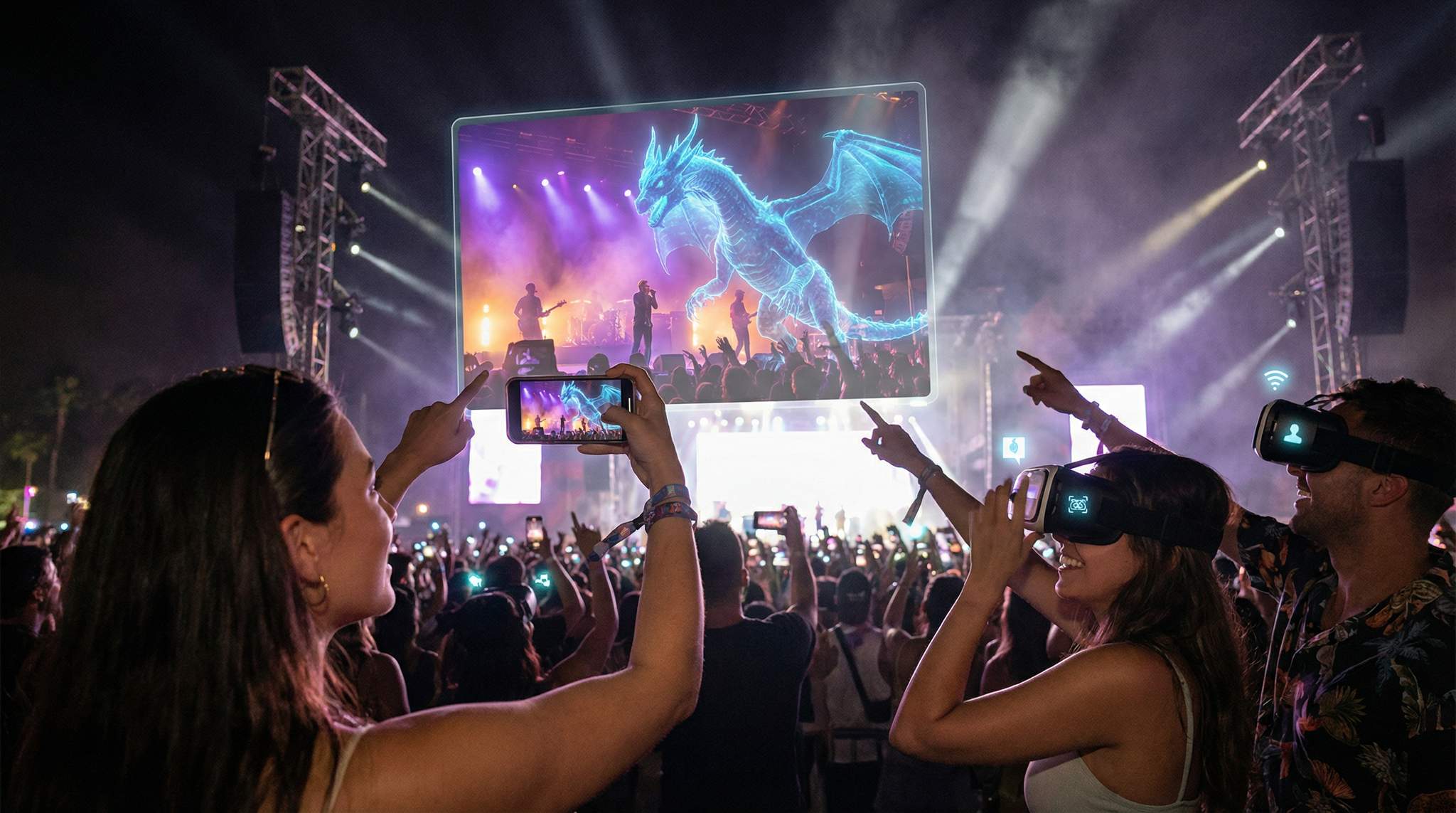
Augmented Reality (AR) overlays digital content onto the physical world. Using a smartphone, tablet, or AR glasses, AR adds visual, auditory, or other sensory layers to the environment around you. The key point: AR does not transport users to an entirely new place – instead, it enhances the real world they’re in. Done right, AR can make your surroundings feel like an interactive story. Imagine holding up your phone at a festival and seeing virtual fireworks, stage information, or whimsical characters floating above the crowd. The physical venue remains the stage, but AR adds a unique digital adventure on top of reality.
Ready to Sell Tickets?
Create professional event pages with built-in payment processing, marketing tools, and real-time analytics.
Virtual Reality (VR), by contrast, creates an entirely new environment from scratch. Think of VR as a portal to a different world: when someone puts on a VR headset, they’re fully immersed in a digital space and the real world is left behind. In VR, attendees can look around 360° and interact with a simulated environment – whether it’s a fantasy game realm, a virtual concert venue, or a 3D model of an expo hall. VR typically requires a headset (like an Oculus/Meta Quest, HTC Vive, or similar device) and sometimes hand controllers to navigate the experience. The result is total immersion: users might “travel” to a virtual festival stage or networking lounge without ever leaving their home or the event’s media room. It’s like a parallel version of your event that exists purely in software.
For event organizers, understanding this difference helps you decide when to use each technology. A simple rule of thumb is: use AR to enhance on-site experiences without pulling people away from the physical event, and use VR when you want to transport people somewhere else or include remote attendees in an immersive way. AR is great for adding a layer of engagement at your venue (because attendees remain present in the real-world event while using it), whereas VR shines for delivering experiences that go beyond your venue’s limits or for creating standalone virtual events.
Defining AR and VR in Live Events
When producers ask exactly what is AR for live events, the answer lies in spatial computing that complements the physical build. Augmented reality in live events functions as a digital utility layer—allowing organizers to deploy interactive sponsor activations, dynamic wayfinding, and 3D art installations without increasing their physical footprint or fabrication costs. Conversely, if you are wondering what is VR for live events, it represents a complete digital venue replacement. Virtual reality in events enables promoters to construct fully immersive, standalone digital environments where remote attendees can gather, interact, and consume content as if they were physically present.
| Aspect | Augmented Reality (AR) | Virtual Reality (VR) |
|---|---|---|
| Environment | Enhances the real world with digital overlays (users see the live venue plus added graphics/info). | Replaces the real world with a fully virtual environment (users see a computer-generated world). |
| Hardware Needed | Smartphone or tablet (most common), or AR smart glasses. Utilizes devices attendees often already have. | VR headset and controllers (e.g. Meta Quest, HTC Vive). Requires dedicated equipment for each user. |
| User’s Presence | User stays in the physical event space and can interact with real people and objects while using AR. | User is separated from the physical surroundings; they are engrossed in the virtual world and usually stationary or in a designated VR area. |
| Ideal Use Cases | On-site engagement: interactive venue maps, AR scavenger hunts, virtual photo ops, product demos overlaying real products. | Remote participation or fantasy experiences: virtual attendance for distant fans, VR livestreams of concerts, fully virtual conferences or training simulations. |
| Social Interaction | Shared in-person experience – multiple attendees can use AR together and still see each other (e.g. everyone pointing phones at an AR-enhanced stage). | Shared virtual experience – users may interact as avatars in VR, but they can’t see the real people around them. Great for online socializing, but isolates from the on-site crowd. |
| A Real Example | AR wayfinding at a festival: attendees point their phone camera to see arrows guiding them to stages or AR creatures to collect around the venue. This technology is rapidly enhancing the on-site festival experience by ensuring fans no longer need physical maps. | VR concert livestream: fans at home wear headsets to feel like they’re standing front-row at a live show, experiencing a 360° view of the stage and crowd. |
What You Need to Get Started with AR/VR at Events
Once you’ve decided to incorporate AR or VR into your event, the next step is planning how it will work. Success starts with a clear vision. Outline the experience you want to create and why it will enhance your event. Ask yourself: Will AR or VR be a fun add-on (like a game or photo op), or a core part of the event (like a virtual attendance option)? Is it for practical use (say, an AR navigation app to help people find sessions) or purely interactive entertainment? Defining the role of AR/VR early will guide your budget and technical requirements. For example, adding a simple AR scavenger hunt might just require a mobile app and creative content design, while offering a full VR experience area could mean procuring multiple VR headsets, computers, and a specialized team to run it.
Next, identify the right technology partner or vendor to help execute your vision. Unless you have an in-house development team, you’ll likely collaborate with an experienced AR/VR provider. Look for partners with a proven track record in live events – they should be able to consult on both the software (the AR/VR app or platform) and the hardware (like headsets, projectors, servers) needed for your venue. A good partner will guide you through setup and even on-site operation. They’ll let you know, for instance, if attendees need to download an app in advance, or if you’ll need to beef up the venue’s Wi-Fi/5G coverage to support hundreds of people using an AR feature simultaneously. Essentially, your AR/VR vendor should act like part of your production team, ensuring the tech runs smoothly and safely.
Don’t forget the logistics and staff training. Plan how you’ll integrate the technology into the physical event space. Will there be a dedicated “VR zone” with staff helping attendees put on headsets and navigate the virtual world? Will you need charging stations for smartphones because an AR app might drain batteries? These are the nitty-gritty details to nail down well in advance. It’s wise to do a test run or two – perhaps at a smaller event or a private demo – to iron out any technical kinks. Train your event staff (or hire specialists) to assist attendees with the AR/VR experience. A little guidance goes a long way for guests who might be unfamiliar with the tech. You want their first AR/VR try to be seamless and awe-inspiring, not confusing.
Grow Your Events
Leverage referral marketing, social sharing incentives, and audience insights to sell more tickets.
When scheduling an augmented reality demonstration for venues, what to expect involves a comprehensive site audit rather than just a simple software pitch. A reputable tech partner will typically map your physical space using spatial computing tools to identify optimal anchor points for digital overlays. They will test lighting conditions, assess potential interference from stage rigging, and verify that your venue’s network infrastructure can handle the bandwidth required for seamless AR and VR events. This hands-on demo is critical for venue operators to understand how digital elements will interact with crowd flow and physical architecture before committing to a full-scale deployment.
During this evaluation phase, you might wonder exactly what features should I look for in an AR demo for venues? A high-quality demonstration should showcase robust spatial mapping capabilities, ensuring digital assets remain firmly anchored even in dynamic, high-traffic environments. You should also look for cross-platform compatibility (working seamlessly across both iOS and Android devices without requiring heavy app downloads), real-time content management systems that allow your team to update digital signage on the fly, and built-in analytics dashboards to track attendee engagement and dwell times. These core functionalities separate a novelty AR gimmick from a scalable, enterprise-grade event technology solution.
If your event takes place in a municipal space, city park, or civic center, you might specifically ask what should I expect in an augmented reality demonstration for public venues? Unlike private facilities, public spaces introduce unique variables such as unpredictable cellular coverage, strict permitting rules for physical markers, and open-access crowd dynamics. A thorough tech walkthrough in these environments will focus heavily on markerless tracking—ensuring digital assets anchor correctly without requiring physical QR codes or signage that might violate city ordinances. Your vendor should also simulate high-traffic stress tests on local public Wi-Fi networks and demonstrate accessibility features that ensure compliance with public accommodation standards.
When operators ask how does augmented reality work in public venues, the answer lies in the shift from traditional marker-based systems to geospatial and visual positioning systems (VPS). In a city park or downtown plaza, you cannot always install physical QR codes or tracking targets. Instead, modern AR relies on a user’s smartphone GPS combined with computer vision to recognize the surrounding architecture. The software cross-references the live camera feed against a pre-scanned 3D map of the civic space, allowing digital assets—like a towering virtual art installation or floating directional signs—to remain perfectly anchored in the real world. This markerless approach ensures that thousands of attendees can simultaneously view and interact with the same digital overlays from different angles, all without altering the physical public property.
If you are taking the planning process a step further and wondering what you should expect from an augmented reality workshop for venue design, the focus shifts from a basic technical audit to collaborative spatial planning. For venue owners and festival producers, these interactive sessions typically involve 3D modeling of your physical space to test crowd flow, stage placements, and digital overlay integration before any physical build begins. You will likely review simulated sightlines, experiment with virtual sponsor placements, and identify structural bottlenecks. Ultimately, an AR design workshop equips your operations team with a precise, interactive blueprint that merges your physical architecture with planned digital enhancements.
For property stakeholders specifically, asking what should I expect from an augmented reality workshop for venue owners? shifts the conversation toward long-term ROI and infrastructure. While festival producers focus on temporary event design, an owner-centric session evaluates the capital expenditures required for permanent high-density networking or 5G installations. You will explore how to create persistent digital sponsorship inventory that can be monetized year-round, and learn how outfitting your property with turnkey AR capabilities can significantly increase its booking appeal to tech-forward promoters.
Pro Tip: Involve your AR/VR tech partner early during venue planning. Have them assess the site map and infrastructure before the event. They might catch critical details – like poor internet coverage in an area, or lighting conditions that could interfere with AR cameras – and help you address them ahead of time. Early technical walkthroughs can save you from nasty surprises on event day.
Virtual Reality Event Planning and Management
Integrating virtual reality in event management requires a shift from traditional logistics to digital-first operational thinking. When executing virtual reality event planning, producers must account for specialized content creation timelines, which often require months of 3D modeling and environment testing. Sourcing high-quality virtual reality content for live events—whether that means custom-built metaverse stages, interactive sponsor booths, or 360-degree video feeds—demands close collaboration with specialized digital studios. Furthermore, managing AR and VR events on-site means allocating dedicated floor space for headset users, ensuring physical safety boundaries, and training staff to troubleshoot hardware issues on the fly.
How AR and VR Elevate Event Marketing and On-Site Experiences
AR and VR aren’t just transforming the during of your event – they can supercharge your event promotion and overall attendee engagement from start to finish. These tools bring a level of fascination and personalization that gets audiences more deeply involved. Used wisely, immersive tech can captivate people at every stage: sparking interest during your marketing campaign, delighting attendees on-site, and even extending the buzz after the event. Let’s explore some of the top ways AR and VR are already being used by event organizers to level up their marketing, engagement, and attendee experience.
Creating Interactive Marketing Campaigns
In event marketing, nothing beats engagement – you want your promotions to not just inform but actively involve your target audience. AR and VR provide innovative ways to achieve this. Forward-thinking promoters have started using these technologies to give potential attendees a taste of the event experience before it happens. For example, instead of a static poster or Facebook ad, imagine an augmented reality flyer that, when scanned with a phone, shows a 3D preview of the stage design or a message from the headlining artist. Some festivals have even built 360° VR teaser videos or virtual venue tours that let fans “step inside” the event from home. It’s one thing to read about a great DJ lineup; it’s another to virtually stand in a crowd with the music thumping around you.
Smooth Entry With Mobile Check-In
Scan tickets and manage entry with our mobile check-in app. Supports photo ID verification, real-time capacity tracking, and multi-gate coordination.
These immersive marketing tactics work. Interactive content tends to be far more memorable than a flat email or banner ad. In fact, about 80% of businesses that implemented AR filters and lenses have reported a boost in brand awareness as a result, according to augmented reality marketing statistics. The same principle applies to events: when your audience can actively experience a preview of your event, they’re more likely to get excited and share it with friends. An AR promo or VR snippet basically turns into a storytelling tool – people who try it can’t help but talk about “this cool thing” they saw. That buzz translates into higher intent to attend. (And by the way, that shareability is free marketing for you.) Many artists and organizers are jumping on this trend; even leveraging Twitch live streams to promote DJ careers to build an online audience has become common practice in the lead-up to live shows. The bottom line: AR and VR can make your marketing campaigns more experiential, which is exactly what today’s event-goers crave.
Gamifying Event Experiences
Once people are at your event, AR can turn the entire venue into a playground. We’re seeing concerts, festivals, and even trade shows use augmented reality to create fun challenges and games that get attendees actively involved. You might set up dedicated AR game zones, but often the best approach is to make the whole event space interactive. For instance, you could design a scavenger hunt in an event app: attendees use their phone cameras to find and collect virtual objects hidden around the venue. (Think Pokémon Go, but customized for your event’s theme.) We’ve seen a pop-culture convention do exactly this – deploying an AR character hunt where fans chased virtual monsters and collectibles on the expo floor, a prime example of augmented reality experiences at festivals. The result? Attendees were thrilled to explore every corner of the venue, and it sparked plenty of friendly competition and conversation along the way.
Gamification through AR/VR not only entertains your crowd, it also encourages them to engage more deeply with the event and with each other. Instead of passively watching a show, attendees become active participants. A conference might use AR trivia games during session breaks, or a music festival might have an AR “easter egg” challenge that rewards the first fans who find a secret virtual item. These activities naturally lead to higher dwell times (people stick around longer because they’re having fun) and more social interaction. Attendees might team up with new friends to solve a puzzle or excitedly share their AR selfies with each other. Ultimately, adding game elements adds to the positive memories people take away. They’ll remember not just the main attraction (like the band or keynote speaker) but also the unique fun they had throughout the event.
Pro Tip: If you introduce an AR game or challenge, give participants a little reward. It could be something simple like a digital badge or a discount code, or something tangible like event merch or an upgraded experience for the winners. Incentives boost participation by giving attendees an extra reason to play along. Plus, a sponsored prize can be a great way to involve your event partners – sponsors love being part of these high-engagement activations, and they might even cover some costs in exchange for branding the AR experience.
Smoother Navigation with AR Guides
Large venues and crowded events can be disorienting, but AR technology offers a cutting-edge solution: augmented navigation. Instead of referring to a paper map or a generic phone map, attendees can use their smartphone camera as a live guide. Imagine holding up your phone and seeing arrows on the screen pointing toward “Stage A” or labels hovering over the image of the actual buildings telling you what’s inside. This is now possible with AR wayfinding apps. In fact, major festival organizers have begun deploying exactly this kind of AR navigation to improve the guest experience. In one recent example, a partnership between a social app and a global event promoter introduced an AR “Compass” feature at several big music festivals, giving attendees a 3D map of the grounds through their phone camera and guiding them to stages in real time, effectively enhancing the on-site experience. With floating stage markers and virtual arrows overlaid on the festival landscape, fans no longer needed to flip through pamphlets or ask staff for directions – they could simply follow the glowing path on their screen.
The benefits of AR navigation are twofold. First, attendees feel more in control and less anxious about finding things, which contributes to a relaxed, enjoyable atmosphere. Second, it eases the burden on your event staff. Fewer people get lost or confused, and that means fewer overwhelmed info booths. AR wayfinding can be as simple as a feature added to your event’s mobile app. Attendees just open the map, lift up their phone, and arrows or icons pop up on the live camera view to show them where to go. It’s like having a personal guide for each guest. And because it’s fun and futuristic, people tend to appreciate the convenience – it’s one more memorable touch. Augmented reality experiences at festivals are becoming increasingly common in this way, blending utility and excitement. If your event venue is complex, this is one tech upgrade that attendees will thank you for.
Data-Driven Event Marketing
Track ticket sales, demographics, marketing ROI, and social reach in real time. Exportable reports give you the insights to make smarter decisions.
Interactions with the Event Space
Another powerful application of AR and VR is turning every corner of your event into an interactive story or spectacle. In the past, if there was downtime between performances or if someone was waiting for a friend, those minutes might be boring. Now, with cleverly placed AR content or VR stations, there’s always something to do or explore. One popular idea is the AR photo booth: rather than a traditional photo backdrop, you set up an AR experience where attendees point their phones at a spot and fantastical things appear for the camera. At a recent Electric Daisy Carnival (EDC), for example, attendees using a special Snapchat AR lens could see iconic festival imagery – like EDC’s signature neon owl mascot – springing to life through their phone screens, with colorful virtual creatures dancing around the real festival grounds, creating magical photos and videos. Naturally, people were recording these AR moments and sharing them widely, effectively turning attendees into event ambassadors on social media.
Event producers are also using AR to create immersive storytelling. You might hide AR “portals” around a venue; when scanned, each portal could show a piece of a narrative or a clue that unfolds throughout the event. This keeps curious attendees engaged at all times, eagerly looking for the next installment. On the artistic side, augmented reality can elevate performances themselves. A landmark example was at a major California music festival, where one stage in 2019 had an AR overlay for those with the festival app: through their screens, fans saw astronauts and planets floating above the stage in sync with the music, showing how organizers can elevate the spectacle. It turned an already thrilling live show into a multi-sensory cosmic experience. And remember, virtual reality can play a role on-site too; some events set up VR booths as attractions, where attendees can try a short VR experience (say, a 5-minute VR music video or a sponsored VR game) as part of the overall entertainment.
The goal of all these AR/VR additions is to ensure there’s never a dull moment and to let attendees actively interact with your event environment. When people have agency – choosing where to explore next, creating their own AR-enhanced photos, or diving into a VR demo – they feel more connected to the event. It’s the difference between just attending and truly participating. And as a bonus, these interactive elements tend to generate tons of shareable content. Every AR photo or interesting VR clip might end up online, spreading the word about your event far beyond the attendees on site.
Curating Augmented Reality Content at Events
When developing augmented reality for events, the most successful organizers focus on utility and sponsor integration rather than mere novelty. Curating high-quality augmented reality content at events requires a strategic approach to digital asset creation. For instance, in the broader events industry, we are seeing a shift toward functional AR—such as interactive 3D product models at trade shows or dynamic digital menus at food and beverage stations. When looking at augmented reality event examples, some of the highest ROI comes from special events that monetize these digital layers. A corporate gala or VIP activation might feature floating digital sponsor logos or interactive centerpieces that attendees can scan, creating new premium inventory for brand partners without cluttering the physical venue.
Scaling Augmented Reality for Festivals
Deploying augmented reality for festivals presents unique logistical challenges compared to indoor corporate functions. When you are dealing with a massive outdoor footprint and tens of thousands of attendees, festival organizers must prioritize infrastructure. To successfully integrate AR in festivals, producers need to ensure robust connectivity—often deploying temporary 5G cell on wheels (COWs) or high-density mesh Wi-Fi networks to handle the simultaneous data load of thousands of fans accessing digital overlays. Furthermore, because AR features can drain smartphone batteries quickly, experienced operators know to strategically place branded charging stations near high-traffic AR activation zones.
From a software perspective, the most effective approach to AR for festivals is embedding the technology directly into the official event app. Forcing attendees to download a secondary, standalone application on-site is a guaranteed conversion killer. By baking spatial computing features, interactive stage schedules, and digital art installations into the primary festival application, promoters can drive higher app adoption rates while delivering seamless, sponsor-monetized digital experiences.
Boost Revenue With Smart Upsells
Sell merchandise, VIP upgrades, parking passes, and add-ons during checkout and via post-purchase emails. Increase average order value by up to 220%.
Virtual Attendance from Anywhere
One of the most revolutionary impacts of AR/VR tech is the ability to include people who aren’t physically at your event. Virtual attendance became a household concept during the pandemic, but it’s here to stay as an option to broaden your reach. By offering a VR or online immersive experience, you can invite unlimited guests from around the world to join in – without worrying about venue capacity. And far from cannibalizing your in-person ticket sales, a well-crafted virtual offering can actually boost your event’s profile. (For example, Coachella streams its performances worldwide to millions of viewers each year, yet still sells out the live festival immediately, proving that integrating festivals with virtual worlds does not decrease demand, as streaming often inspires remote fans to attend in person next time.)
For promoters focused on community building, hosting live VR fan events has emerged as a highly lucrative strategy. Instead of merely broadcasting a passive video feed, organizers can curate exclusive virtual reality content in live events, such as digital meet-and-greets, backstage VR tours, or interactive Q&A sessions where fans’ avatars interact directly with artists. This approach to virtual reality for events not only monetizes a global audience but also creates premium, VIP-tier digital ticket packages that drive significant incremental revenue without adding physical venue overhead.
Successfully executing these digital extensions requires a strategic approach to ticketing and platform integration. When hosting live VR fan events, promoters must select metaverse platforms that support high-concurrency user loads and offer seamless e-commerce capabilities for digital merchandise. By treating these virtual reality environments as distinct, monetizable venues, organizers can sell tiered access passes—ranging from general admission viewing to exclusive backstage avatar interactions—thereby maximizing the ROI of their digital event strategy.
Audiences have shown significant interest in these virtual event experiences. Surveys in recent years found that around 45% of adults would be interested in attending a music event in the metaverse or VR, highlighting how metaverse events bring mesmerizing experiences to audiences – basically, a sign that nearly half your potential audience is open to a virtual concert or festival. To tap into this, some festivals and conferences now run hybrid events: a live in-person event complemented by a parallel virtual experience. For the virtual component, you might create a 3D version of your venue or a “metaverse” space where remote attendees can navigate with avatars. They can watch a live stream of the main stage, visit virtual sponsor booths, and even network with each other in virtual lounges. As an organizer, you’re not limited by geography or venue walls. A fan in Japan or Brazil could attend your London event through VR and feel almost as if they’re there.
From a planning perspective, integrating VR attendees does require effort – camera setups for 360° video, a platform to host the virtual world, and moderators to manage the online crowd – but it can pay off by expanding your community. Importantly, the industry has embraced hybrid models: by 2025, an overwhelming 92% of event marketers said they plan to include virtual elements in their events, according to virtual events statistics. The key is to ensure your virtual experience is high-quality and engaging, not an afterthought. You might schedule exclusive online-only sets, or offer VR angles and backstage streams that on-site attendees don’t get, so the remote fans feel they have a special window into the event.
Warning: Not everyone can handle a VR headset for long periods. Over half of users have experienced some degree of motion sickness when using VR, as noted in virtual reality usage data. If you’re providing a VR option, make it comfortable – recommend that users take breaks (you can program reminders), and ensure there’s a simpler live-stream alternative available for those who can’t use VR. Also, test your VR experience thoroughly; technical hiccups or a confusing interface will frustrate remote attendees who don’t have staff on hand to help. Maintain a support channel for virtual guests so they feel taken care of, just like your in-person audience.
Bringing Events into the Future
The live events space is entering an exciting new era of innovation. AR and VR are just the beginning – the “tip of the iceberg” – of how technology can create richer, more immersive experiences. As an event organizer, staying ahead means continually exploring these advancements and thoughtfully integrating them into your events. Embracing AR/VR now is a strong signal to your audience (and sponsors) that your event brand is forward-thinking and dynamic.
That said, it’s important to implement new tech with purpose and care. Successful events in the 2020s blend cutting-edge innovation with the timeless elements of a great event (music, art, community, hospitality). Use AR and VR where they add real value for attendees, not just for show. For example, an AR game that entertains festival-goers or provides useful info enhances the fan experience, whereas a high-tech feature that’s confusing or buggy can detract from it. Many veteran producers stress this balance: focus on tech that truly improves the event rather than gimmicks, looking toward festival tech trends that actually deliver value. By doing so, you build trust with your audience – they know that when you introduce a new feature, it’s going to be worth their while.
Looking ahead, the line between physical and digital experiences will continue to blur. We’ll see more hybrid events, more use of mixed reality (like the upcoming AR/VR wearable devices from major tech giants), and higher audience expectations for interactivity. By gaining experience with AR and VR now, you’re not only creating unforgettable moments today but also future-proofing your events for the next wave of innovation. Attendees will remember that your event amazed them and made them feel like a part of the story – and that feeling is what drives loyalty and word-of-mouth.
When evaluating the broader commercial impact, the strategic deployment of AR/VR in events is increasingly viewed as a primary driver for sponsorship revenue rather than just an attendee novelty. By creating exclusive digital real estate—such as branded virtual lounges or sponsored 3D overlays—that can be sold to corporate partners, integrating AR/VR in events transforms a traditional technology expense into a measurable, high-margin profit engine.
Ultimately, the transition toward AR and VR events requires a shift in how we measure return on investment. When evaluating virtual reality in events, organizers should look beyond initial hardware costs and focus on long-term digital asset monetization, extended audience reach, and the rich behavioral data these platforms generate. The producers who thrive will be those who treat immersive tech not as a novelty, but as a core pillar of their operational and commercial strategy.
Ticket Fairy is a ticketing platform built to support these kinds of cutting-edge events, including those using AR and VR. We handle everything from seamless online ticketing to on-site technology integrations that can complement your immersive experiences. If you’re planning to take your event to the next level with AR/VR, feel free to book a demo call with us to discuss how we can help make it a reality.
Go Cashless With RFID Technology
Enable contactless payments, faster entry, and real-time spending analytics with RFID wristbands and NFC-enabled ticketing for your events.
You May Also Like:
– How Metaverse Events Bring Mesmerizing Experiences To Your Audience
– Boost Your DJ Career: Twitch Streaming Guide for Music Pros
– 2024 Music Festival Trends: Shifting Attendance Patterns Revealed
Frequently Asked Questions
What is the difference between augmented reality and virtual reality in events?
Augmented Reality (AR) overlays digital content onto the physical world using smartphones or glasses, enhancing the on-site environment without removing the user from it. Virtual Reality (VR) creates a completely immersive, computer-generated environment that replaces the real world, typically requiring a headset to transport users to a separate virtual space.
What hardware is required to set up AR and VR experiences at events?
Implementing AR usually utilizes attendees’ own smartphones or tablets to view digital overlays via an app. Conversely, VR experiences require dedicated hardware like headsets (e.g., Meta Quest or HTC Vive) and controllers. Organizers must also ensure robust Wi-Fi or 5G infrastructure is in place to support these data-heavy technologies effectively.
How do AR and VR technologies enhance event marketing campaigns?
AR and VR transform marketing by offering immersive previews, such as 3D stage designs or virtual venue tours, before the event occurs. These interactive experiences are highly memorable, with 80% of businesses using AR filters reporting increased brand awareness. This experiential approach drives excitement and encourages potential attendees to share content.
How does augmented reality gamification improve attendee engagement?
AR gamification turns venues into interactive playgrounds through activities like digital scavenger hunts where attendees collect virtual objects using phone cameras. This active participation increases dwell times and fosters social interaction as guests collaborate to solve puzzles. Offering rewards like digital badges or merchandise for completing challenges further boosts participation.
How does AR wayfinding technology assist with event navigation?
Augmented reality navigation uses smartphone cameras to overlay digital arrows and labels onto the real-world view of a venue. This technology guides attendees to specific stages or amenities in real time, significantly reducing confusion compared to paper maps. It streamlines the guest experience while relieving pressure on event information staff.
How does virtual reality enable remote event attendance?
VR technology facilitates virtual attendance by creating 3D environments or metaverse spaces where remote guests can explore venues and watch live streams via avatars. This hybrid model expands audience reach beyond physical capacity limits, catering to the 45% of adults who express interest in attending music events through virtual platforms.
What does V/R mean in the context of live event production?
V/R stands for Virtual Reality. In live event production, it refers to the use of computer-generated, fully immersive digital environments that replace the physical world. For organizers, deploying virtual reality in events means creating standalone digital venues or hybrid experiences where remote attendees can interact, explore, and consume content using specialized headsets, regardless of their physical location.
What are the primary benefits of hosting AR and VR events?
Hosting AR and VR events allows promoters to transcend physical venue limitations, unlock new digital sponsorship inventory, and dramatically increase global audience reach. By integrating AR/VR in events, organizers can offer gamified on-site activations, immersive remote attendance options, and rich data analytics on attendee engagement that traditional formats cannot provide.
What should I expect from an augmented reality workshop for venue design?
Venue owners and event organizers should expect a collaborative session focused on spatial planning and digital integration. These workshops typically involve creating 3D models of your physical space to simulate crowd flow, test stage and structural placements, and map out where digital overlays will appear. The goal is to identify logistical bottlenecks and optimize the attendee experience before any physical construction or final technical deployment begins.
What should I expect from an augmented reality workshop for venue owners?
Property stakeholders can expect these sessions to focus heavily on infrastructure ROI and long-term monetization. An owner-centric workshop evaluates the capital expenditures needed for permanent high-density networking, explores new digital sponsorship inventory that can be sold across multiple events, and demonstrates how built-in spatial computing capabilities can make the facility more attractive to prospective promoters.
What features should I look for in an AR demo for venues?
When evaluating an augmented reality demonstration for your venue, prioritize robust spatial mapping for stable digital anchoring, cross-platform compatibility for attendees’ smartphones, and a real-time content management system. Additionally, look for built-in analytics to measure user engagement and ensure the vendor’s platform can handle high-density crowd environments without significant latency.
What are the key infrastructure requirements for augmented reality at festivals?
Implementing augmented reality for festivals requires high-density network infrastructure, such as temporary 5G towers or mesh Wi-Fi, to support thousands of simultaneous users. Additionally, organizers should integrate AR features directly into the main event app to reduce download friction and provide ample mobile charging stations to combat battery drain caused by spatial computing applications.
What are the key considerations for virtual reality event planning?
Successful virtual reality event planning requires organizers to prioritize digital infrastructure, secure specialized hardware, and allocate sufficient lead time for 3D environment design. When managing AR/VR in events, producers must also source engaging virtual reality content, establish safe physical boundaries for on-site headset users, and train staff to provide technical support.
What is AR for live events?
For event organizers, AR (Augmented Reality) for live events is a technology that overlays digital elements—such as interactive sponsor graphics, 3D art, or real-time wayfinding—onto the physical venue. It enhances the on-site attendee experience and provides new digital inventory for monetization without requiring additional physical construction.
How do organizers manage AR content at live events?
Managing AR content at live events involves using spatial computing platforms and real-time content management systems (CMS). Producers typically integrate these features directly into the official event app, allowing their operations team to update digital signage, trigger sponsor overlays, and monitor attendee engagement metrics dynamically throughout the show.
What is VR for live events?
VR (Virtual Reality) for live events involves creating a fully immersive, computer-generated digital venue. It allows promoters to host remote attendees in a 3D environment where they can watch performances, interact with other fans via avatars, and participate in exclusive digital activations, effectively expanding the event’s capacity infinitely.
What should I expect in an augmented reality demonstration for public venues?
When evaluating AR technology for municipal spaces, civic centers, or public parks, expect the demonstration to address unique civic constraints. The tech partner should showcase markerless tracking to avoid violating city signage ordinances, test the resilience of digital anchors against unpredictable public crowd flow, and assess the capacity of local public Wi-Fi or cellular networks to handle sudden spikes in data usage.
How is augmented reality used in special events?
In special events like VIP galas, award ceremonies, or exclusive brand activations, augmented reality is used to add premium, personalized digital layers without disrupting the physical decor. Organizers deploy AR to showcase interactive 3D centerpieces, exclusive sponsor messages, or dynamic digital menus, elevating the guest experience while offering unique monetization opportunities.
How does augmented reality work in public venues?
In public venues like city parks or civic centers, augmented reality typically utilizes markerless tracking, GPS, and Visual Positioning Systems (VPS) rather than physical QR codes. The technology uses a smartphone’s camera and location data to recognize physical architecture and anchor digital assets—such as virtual wayfinding or sponsor activations—directly to the environment. This allows organizers to deploy immersive experiences without installing physical infrastructure or violating municipal signage ordinances.