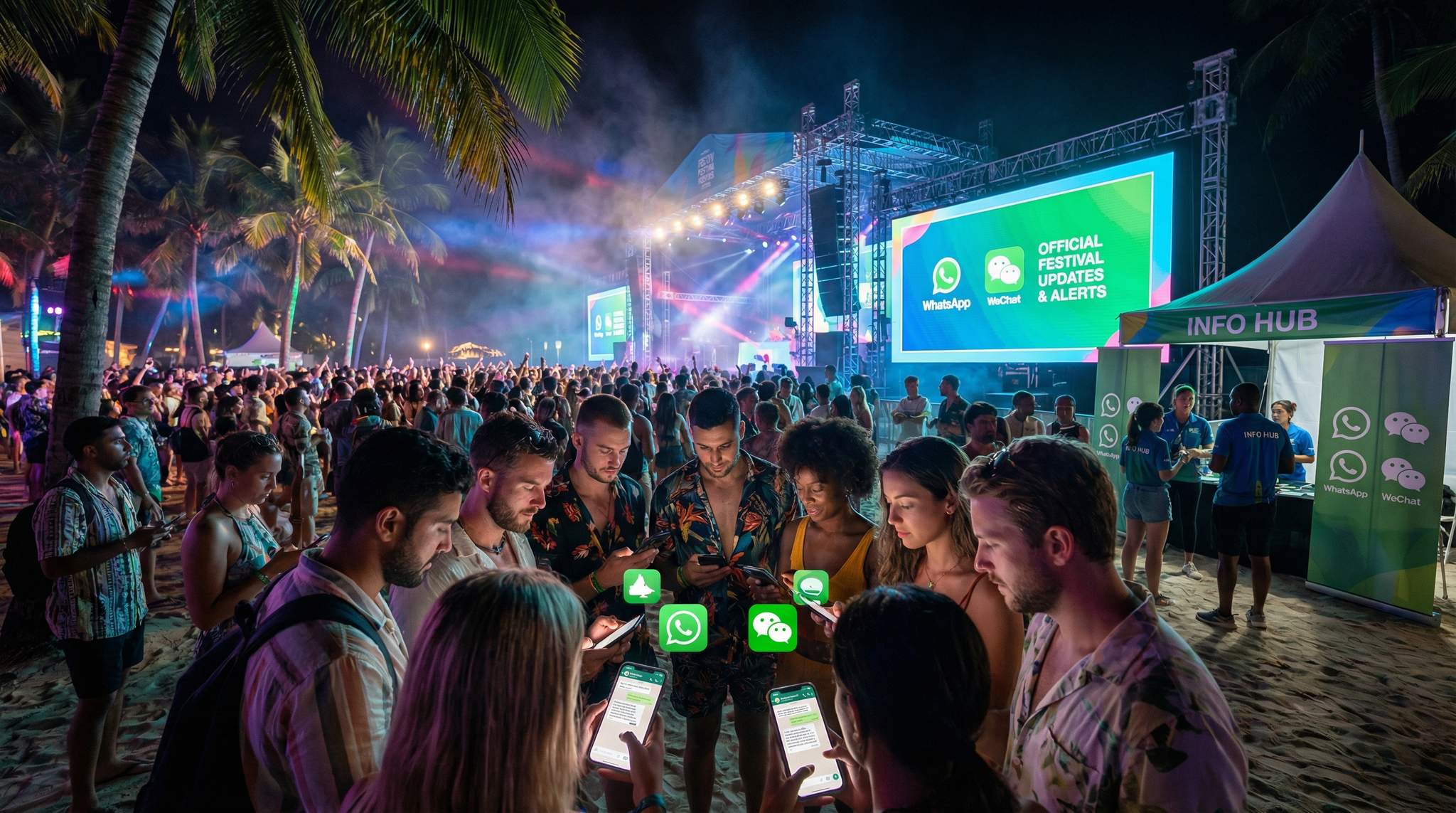
Connecting with Global Audiences at Destination Festivals
Imagine a tropical destination festival where attendees from five continents converge on a remote beach. Suddenly, a tropical storm is inbound and shuttle schedules are disrupted. How do you instantly notify thousands of international guests, all on different mobile plans and social platforms? The solution for modern festival organizers is to meet travelers on the communication channels they already use – apps like WhatsApp, WeChat, and similar international messaging hubs. These platforms centralize guest communications on familiar channels, ensuring critical updates reach everyone in real time.
In the past, festivals might rely on emails, website notices, or local SMS for updates – methods that often fall short for a global audience. Today’s travelers live on messaging apps: WhatsApp alone has billions of users worldwide, and WeChat is ubiquitous among Chinese travelers (with over 1.3 billion active users). By leveraging these platforms, festival producers can broadcast weather alerts, shuttle changes, late-breaking set news, and more – directly to attendees’ smartphones – no matter where they’re from or what SIM card they have in their phone. This article explores how to effectively use WhatsApp, WeChat, and other messaging apps as centralized communication hubs at destination events, with practical tips and real-world examples.
Why Use WhatsApp and WeChat as Messaging Hubs?
Global Reach and Familiarity: WhatsApp and WeChat are two of the most widely used messaging apps globally, making them ideal for international festival communications. WhatsApp is popular across Europe, Latin America, India, parts of the Middle East, and beyond. WeChat is the default communication platform for travelers from China and also widely used in East Asia. By using these apps, festival organizers ensure they’re communicating on channels global travelers already have installed and check regularly. Attendees won’t need to download a new app or worry about missing an email – your updates pop up in the same chat list as messages from their friends and family.
High Engagement and Open Rates: Messages sent via international messaging apps enjoy far higher engagement than traditional channels. For instance, WhatsApp messages have an open rate approaching 98%, meaning nearly every message gets read – a stark contrast to mass emails that might go unopened. Travelers are accustomed to instant messaging for urgent info; by pushing festival updates through WhatsApp/WeChat, you tap into that expectation of immediacy. Whether it’s a schedule update or emergency alert, you can be confident most attendees will see it and see it quickly. This real-time communication loop is crucial at fast-paced events where situations change by the minute.
Accept Payments Across 13 Countries
Local currency processing via Stripe, Razorpay, Xendit, Paystack, and OXXO across 13 countries with region-specific payment methods.
Real-Time Updates, Anytime & Anywhere: At destination festivals, plans can change rapidly – sudden weather shifts, performance delays, or venue adjustments. Messaging apps deliver information instantly to attendees. The moment you hit “send” on a WhatsApp broadcast, phones ping worldwide with the update. Unlike social media or email, which people might check too late, a WhatsApp or WeChat notification grabs attention in real time. Plus, these apps work on any internet connection. Many travelers rely on hotel Wi-Fi or local SIM data; with messaging apps, as long as attendees find a Wi-Fi spot or have roaming data, they’ll get your alerts. This is especially helpful in foreign countries where SMS text might not be reliable or affordable – an internet-based message ensures everyone stays informed without extra cost to them.
No Need for New Apps: Convincing attendees to download a proprietary festival app can be a hurdle, especially for one-time destination events. Many people avoid installing yet another app that they’ll use for only a few days. By using WhatsApp or WeChat (or even alternatives like Telegram or LINE in some regions) you eliminate that barrier. Your audience already knows how to use these apps – there’s no learning curve. This lowers friction and increases the likelihood that attendees actually see your communications. It’s a budget-friendly approach too: instead of developing and maintaining a custom app or SMS system, you can leverage free or low-cost messaging services that scale to your needs.
Planning a Festival?
Ticket Fairy's festival ticketing platform handles multi-day passes, RFID wristbands, and complex festival operations.
Built-In Language Support: Destination festivals often draw multilingual crowds. Coordinating across different languages is a major challenge if you stick to one communication channel. Here, messaging apps offer a hidden gem: tools like WeChat have integrated translation features in chats, and WhatsApp allows quick copy-translate workflows. This means if you broadcast a message in English, a non-English speaker can easily translate it on their phone. Conversely, you might choose to send important alerts in multiple languages (e.g., English and Spanish, or English and Chinese) within the same chat to ensure comprehension. Using internationally friendly platforms shows respect for your diverse audience and helps break language barriers – all within the apps they’re comfortable with. In fact, event teams have found that Chinese attendees deeply appreciate communication via WeChat, their preferred app, rather than being forced to rely on email or Facebook groups which they may not use. The same goes for Latin American or European guests who favor WhatsApp – reaching out in their domain builds good will and clearer understanding.
Setting Up an International Messaging Hub for Your Festival
Creating a centralized messaging hub requires forethought and a bit of setup, but it pays dividends in smoother communication. Here’s how a festival organizer can establish an effective WhatsApp/WeChat communication channel for attendees:
-
Choose Your Platform(s) Wisely: Start by identifying which messaging apps best cover your attendee demographics. If your festival in Bali expects a large European, North American, and Indian turnout, WhatsApp is a safe bet (since it’s widely used across those regions). If you also anticipate many Chinese travelers, set up a WeChat presence as well, because most Chinese visitors won’t be on WhatsApp (and services like WhatsApp may even be blocked for them without VPN). In some cases, you might run two or three parallel channels – for example, a WhatsApp broadcast list and a WeChat official group – to ensure you reach all nationalities. Tip: You can poll ticket buyers beforehand about their preferred communication app, or check regional ticket sales data, to guide which platform to use.
-
Selecting the Right Messenger for Festival Operations: When evaluating a messenger for festival use, consider the specific features each app offers for business accounts. A dedicated festival messenger setup should allow for automated replies, bulk messaging, and clear analytics. For European and Latin American events, WhatsApp Business is often the default, while WeChat dominates the Asian market.
Free Tool: Size Your Festival Site
Zoned capacity planning for arena, campsite, parking and entry lanes — against UK Purple Guide and NFPA density standards. Finds your bottleneck zone.
In European markets, particularly DACH regions where promoters frequently evaluate the best “messenger für festival” (messenger for festivals), data privacy is a top concern. Platforms like WhatsApp and Telegram are favored because they offer end-to-end encryption alongside robust broadcast capabilities, satisfying both attendee privacy expectations and operational needs.
-
Official Festival Groups or Broadcast Lists: There are two main ways to communicate via these apps – group chats or broadcast (one-way) messaging. WhatsApp Groups can include up to 1024 people now (with recent updates), and allow everyone to see messages and even respond (though you might restrict posting permissions to admins for clarity). Groups are great for smaller-scale festivals or if you want some community interaction (attendees can ask questions or share tips, moderated by the event team). On the other hand, a WhatsApp Broadcast List or Channel allows one-to-many messaging where attendees receive your updates privately, like a BCC email – they won’t see each others’ numbers or messages. Broadcasts are excellent for pushing urgent alerts without chatter. The catch is that recipients must have the sender’s number saved as a contact to get broadcast messages, so you’ll need to instruct attendees clearly during signup (or use WhatsApp Business API which can bypass that requirement).
Need Festival Funding?
Get the capital you need to book headliners, secure venues, and scale your festival production.
-
Utilizing a WhatsApp Business Announcement Group: For mid-to-large scale events, transitioning from a standard chat to a dedicated WhatsApp Business announcement group is highly recommended. This setup restricts posting privileges to admins, preventing the channel from becoming cluttered with attendee chatter. When drafting your first WhatsApp group announcement message, keep it concise and action-oriented. A strong initial announcement message sets the tone, letting subscribers know exactly what type of alerts they will receive and how frequently you will post.
-
Setting Up on WeChat: For WeChat, the common approach is to create an Official Account for your festival or a WeChat group chat for attendees. An Official Account (either a service account or subscription account) is useful if you have a significant Chinese audience – users can follow it and receive your messages as formal updates (service accounts allow up to 4 broadcast messages per month that appear in their chat list with a notification). If time is short or the event is a one-off, a simpler WeChat Group might do – although WeChat groups are typically limited (generally up to 500 members, and some features require a Chinese ID-verified account to exceed 100 members). Many large events partner with Chinese promoters or travel agencies to manage their WeChat communications. If your festival has a known presence in China (for example, some major festivals have verified WeChat accounts), make sure to advertise that to Chinese ticket-buyers so they can get info in their language.
When evaluating the landscape of chatting apps in China, event producers quickly realize that standard Western platforms are typically blocked or unused. Because WeChat dominates the market of apps used in China for chatting, integrating it into your communication strategy is non-negotiable if you want to effectively reach and support Chinese ticket buyers.
-
Leveraging the WeChat Scheduled Message Sending Feature: Managing communications across multiple time zones can be taxing for your digital team. To streamline operations, organizers can utilize the WeChat scheduled message sending feature available through official accounts or third-party management tools. This allows your team to draft daily lineup reminders, weather updates, or sponsor messages in advance and schedule them to deploy at peak engagement times, ensuring your international audience receives updates exactly when they wake up or arrive at the venue.
Free Tool: Project Your Bar Revenue
Per-head spend benchmarks by event type turned into projected bar and food revenue, with a stock-mix estimate and gross-margin line. Free calculator.
-
Promote Your Channels Early: Building adoption of your messaging hub is critical – it only works if attendees join or subscribe before or as the event begins. Use all your pre-event touchpoints to invite people in: mention it during ticket purchase confirmation, send an email blast with a WhatsApp group invite link or QR code, and post on your official social media that “Our event has an official WhatsApp/WeChat channel for live updates – join here!” For WeChat, a QR code is the easiest way (Chinese users will scan a QR to join a group or follow an account in seconds). For WhatsApp, you can generate an invite link for group or provide a number to add for broadcast. Also, consider signage at the event check-in and around the venue: a poster that says “Join our WhatsApp group for real-time festival updates” with a QR code can catch those who missed the memo. The goal is to centralize as many guests as possible onto these channels before critical information needs to be sent.
Remember that solo travelers and international attendees are often actively searching for official WhatsApp groups to join prior to departure. By prominently linking your official community or announcement group on your website and ticketing page, you capture this search intent and bring them into your secure, moderated communication ecosystem rather than losing them to unofficial, fan-run chats.
-
Moderation and Management: If you use an interactive group chat, assign team members (or trusted volunteers) as moderators. They can welcome new joiners, answer frequently asked questions, and gently keep conversations on-topic so important announcements don’t get drowned out. It’s wise to set clear guidelines: for example, ask that only organizers post important updates, while attendees can use the group to ask urgent questions or seek help, not for off-topic chat. If the group becomes very large, consider locking it for admin-only posts and create a second “community chat” group for general discussion among attendees. On WeChat, an official account doesn’t have discussions (it’s one-way), which keeps it simple – but you might still run a group chat as a supplement for interactive support. Whatever the setup, ensure someone is tasked with sending timely updates and monitoring these channels throughout the event. It’s as important as having staff on the ground – think of it as having staff in the digital space of attendee phones.
Operating a live, two-way festival chat requires active oversight to prevent misinformation. A well-moderated festival chat not only answers immediate logistical questions but also serves as a real-time feedback loop, allowing organizers to spot and resolve on-site issues—like long bar queues or depleted water stations—before they escalate.
-
Privacy and Consent: Always handle attendee communications with respect to privacy. Encourage sign-ups but do not automatically add people without permission. It’s best practice (and legally required in some jurisdictions) to let guests opt in to messaging. A simple checkbox during ticket checkout like “I want to receive important festival updates via WhatsApp/WeChat” works well. For broadcast lists, remind users they might need to save the festival number as a contact to get messages. Assure attendees that the channel will be used only for pertinent event information (no spam) and that their phone numbers will be protected (especially in a group setting – using broadcast mode or hiding group member list can help maintain privacy).
Use Cases: Crucial Updates to Broadcast on Messaging Apps
Once your WhatsApp/WeChat communication hubs are set up and attendees connected, it’s time to leverage them for maximum impact. Destination festivals come with unpredictable elements – here are the key situations where broadcasting updates on these channels can save the day (or even lives):
Turn Fans Into Your Marketing Team
Ticket Fairy's built-in referral rewards system incentivizes attendees to share your event, delivering 15-25% sales boosts and 30x ROI vs paid ads.
1. Instant Weather Alerts and Safety Warnings
Outdoor festivals in far-flung locations are at the mercy of weather. Tropical storms, sudden rain, extreme heat, or even cold snaps in the desert can all pose safety risks and logistical headaches. Using WhatsApp or WeChat to send instant weather alerts gives your guests precious time to react. For example, when a severe thunderstorm approached a camping festival in Spain in 2022, organizers sent out an urgent mobile alert and evacuated the campsite in minutes – many credit the direct messaging for preventing chaos and keeping everyone safe. If your event faces high winds and you need to delay opening gates, a WhatsApp blast lets attendees know to take shelter or stay at their hotels a bit longer instead of lining up outside. In critical scenarios (lightning, wildfire risk, etc.), you can not only warn people but also share clear instructions: e.g. “Lightning alert – all stages temporarily closed, please go to the nearest sheltered area (marked on the event map) and wait for updates.**” Having this capability means you’re not relying solely on on-site PA announcements (which many may not hear) or social media (which not everyone will see in time). You’re literally putting the warning directly into each attendee’s hand with a notification buzz.
In addition to emergencies, consider using it for less dire but important weather news: send heat advisories (“Stay hydrated, today will reach 35°C / 95°F. Free water stations at points X, Y, Z.”) or cold night tips (“Temperatures will drop tonight, grab a jacket before you head to the after-party outdoors.”). Travelers might not be familiar with the local climate – your heads-up helps them prepare and shows that the festival cares about their well-being.
2. Shuttle, Transport, and Logistics Updates
Destination festivals often involve complex logistics: airport shuttles, charter buses, ferry schedules, rideshare pickup zones, and more. Attendees might be unfamiliar with the area and heavily rely on the transportation arranged by the event. Messaging apps are a perfect way to keep everyone synchronized on these moving parts. If a shuttle bus is running late due to traffic, a quick WhatsApp message like “Shuttle Update: The 10:00 AM hotel shuttle will be 20 minutes late – please remain at the pickup point, it’s on the way” prevents frustration and uncertainty. Similarly, if you have multiple shuttle routes, you can broadcast reminders (“Blue Route buses stop running at midnight; last return to downtown is 11:45 PM, don’t miss it!”).
For example, consider a large festival in Mexico where attendees fly in from abroad: organizers created a WhatsApp broadcast list for all ticket holders who booked the official airport transfer. When some inbound flights were delayed, the festival team used WhatsApp to coordinate with those travelers in real time, holding shuttles for a few extra minutes so nobody was stranded. Attendees were impressed that the festival was aware of their situation and kept them in the loop. Even within the event grounds, transport updates matter – perhaps the tractor shuttles between camping and stages change routes, or there’s a temporary road closure. A message out to all guests ensures they know how to get around without confusion.
Logistical broadcasts can cover entry and exit info too: if there’s a long queue at the main gate, you might notify everyone of an alternative entrance that’s quicker. Or after the festival ends, use WeChat or WhatsApp to inform attendees about return transportation options (“Trains back to the city will have extra service at 1 AM from Festival Station”). These real-time transit communications reduce anxiety for travelers and help your event run on schedule despite inevitable hiccups.
3. Late-Breaking Set Changes and Announcements
Live events are dynamic – artists miss flights, surprise guests appear, and schedules shift on the fly. For attendees, missing a favorite act or a special moment because of outdated information can be a huge disappointment. International messaging hubs allow you to blast out schedule changes or special announcements so every fan has the latest info. For instance, if a headline DJ’s set is pushed back an hour due to technical delays, a WhatsApp message like “Schedule Change: DJ Thundercat now starts at 9:30 PM (instead of 8:30) on the Main Stage. All later sets will shift accordingly. Enjoy the extended break and stay tuned!” will ensure people don’t show up early and wait unnecessarily – or worse, walk away thinking it was canceled. Likewise, if you have to swap two stage times or an act cancels last-minute, an immediate broadcast prevents confusion and rumors.
Free Tool: When Should You Announce?
Pick your event date and genre — the free planner outputs a recommended announce, presale, on-sale and reminder schedule anchored to how your audience actually buys.
On the flip side, messaging apps are fantastic for sharing good surprises: imagine you’ve arranged a secret sunrise set on the beach or a pop-up guest performance. By sending a WeChat or WhatsApp note to all attendees (“Head to the Oasis Stage at 2 AM for an unannounced special guest – trust us, you don’t want to miss this!”), you create excitement and ensure the opportunity reaches everyone, not just those who happen to be in the right place by luck. This can greatly enhance the attendee experience, making them feel like insiders who get exclusive info.
Other announcements that fit well in this channel include: changes in venue areas (“The Silent Disco has moved to the indoor pavilion due to wind”), lost & found notices (“A passport belonging to John Doe was found – collect at Info Desk”), or community announcements (“Tonight’s fireworks show will begin in 5 minutes at the lakeside – look up!”). Essentially, any information that would improve a guest’s experience or prevent a problem is worth pushing through your messaging hub. Since destination festival-goers might not have access to local news or might not be refreshing the festival website constantly, proactive messaging keeps them empowered and reduces the load on your info booths and customer service.
Tailoring Your Approach for Scale and Audience
Every festival is different, and communication strategies aren’t one-size-fits-all. Here are some additional considerations to fine-tune your WhatsApp/WeChat communications plan based on your event’s size and audience demographics:
-
Small vs. Large Events: If you’re running a boutique retreat or a festival with just a few hundred to a couple thousand attendees, you can afford a more personal touch. A single WhatsApp group (or a couple of groups divided by attendee interest or package type) might be sufficient. In a smaller group, two-way interaction is manageable – participants can ask the organizers questions in the chat, and you can address issues individually, almost like a concierge service. This personalized approach is often critical for events with specific regional event ticketing needs, where community building starts long before the gates open. In contrast, a massive festival of 50,000 people can’t have one giant group chat – that would be chaos. For large-scale events, lean on one-to-many broadcast tools: consider setting up a WhatsApp Business API account or the new WhatsApp Channels feature to send out one-way updates to unlimited subscribers. You might also split communications by category: e.g., a dedicated “Emergency Alerts” channel for critical safety info, and a separate “Daily Highlights” channel for non-urgent updates, so people can subscribe to what they care about. Make sure to clearly communicate to attendees how each channel or list is used.
-
Audience Demographics: Know the preferences of your crowd. A tech-savvy younger audience (say a global EDM festival in Bali) will hop onto a messaging app quickly and expect instant service. They might also be active on Telegram or Discord – if analysis shows a significant segment uses those, you could mirror your updates there too. An older crowd, perhaps for a destination food & wine festival, may be less familiar with chat groups – in that case you might keep the messaging stream purely one-way to avoid confusion, and provide a quick “how to guide” in your pre-event communications (“This is how our WhatsApp updates work…”). Also consider language needs: if a good chunk of your attendees speak Spanish, French, or Japanese, you might send out bilingual messages or have separate groups per language that are managed by multilingual staff. The extra effort here prevents anyone from feeling left out of the loop due to language barriers.
-
Timing and Frequency: Be mindful of time zones and schedules when broadcasting messages, especially pre-event. Your attendees might still be traveling from abroad. If you have information for them before they arrive (like a last-minute COVID test requirement or a change in check-in procedure at the hotel), send it at a reasonable hour considering where they might be coming from. During the festival, stick to local time of the event, but avoid blasting non-urgent messages at 3 AM when people might be sleeping (unless it truly is urgent). Additionally, don’t over-message. Curate the updates so that each one provides value. If guests feel spammed by trivial notifications, they may mute the channel – and then miss the important one later. A good rule of thumb: for multi-day festivals, perhaps send a concise morning update (weather, schedule highlights, any changes) and an evening update (reminders for the next day or late-night special info), plus immediate safety alerts as needed. This establishes a reliable rhythm without overwhelming people.
Data-Driven Event Marketing
Track ticket sales, demographics, marketing ROI, and social reach in real time. Exportable reports give you the insights to make smarter decisions.
-
Integration with Ticketing & Apps: If you’re using an advanced event platform (like Ticket Fairy for ticketing and attendee management), see if it can assist your communications. For example, your ticketing system likely has a database of attendee contact info. You could send an email or SMS prompt encouraging WhatsApp opt-in, or even automate WhatsApp messages through integration if available. Some platforms might allow you to segment attendees (VIPs, those who bought add-ons like shuttle passes, etc.) so you can target messages to relevant groups – very useful if, say, only your VIP ticket holders have access to a certain lounge and you want to message those folks about a location change. Always ensure any integration follows privacy guidelines. This level of detail is especially important when managing complex systems like burn regional event ticketing, where community and access are tightly controlled. While WhatsApp and WeChat are external apps, your use of them can be planned alongside your other communication channels for consistency. Consider mirroring critical announcements on multiple channels (e.g., send a push notification in your event app or an email and a WhatsApp message for an emergency) – redundancy can be life-saving in emergencies, as there’s no such thing as reaching people too often when safety is involved.
-
Testing and Backup Plans: Before the festival, do a dry run of your messaging hub. Add your team and maybe some beta testers to the group or broadcast list and simulate sending an alert. This helps verify that messages send properly, links unfurl correctly (if you’re sharing URLs or maps), and that everyone receives them in a timely manner. It’s better to catch a glitch (like an invite link not working on iPhones, or a time zone stamp issue) before you’re in the thick of the event. Also, acknowledge that not every attendee will join the WhatsApp/WeChat channel, and technology can fail. Have backup communication methods: on-site loudspeaker announcements, info screens, text messages for those who opt for SMS, and staff who can spread information word-of-mouth if needed. The messaging hub is a powerful tool, but it shouldn’t be a single point of failure for critical communications. Use it as the primary channel and support it with backups.
Success Stories and Lessons Learned
To illustrate the impact of these international messaging hubs, let’s look at a couple of real-world scenarios where festival communications made all the difference:
-
Case Study – Evacuating Ahead of the Storm: At a Southeast Asian island festival in 2019, weather forecasts suddenly predicted a monsoon downpour on Day 2 of the event. Organizers had provided a WhatsApp number during ticketing for attendees to subscribe to emergency texts. When the storm warnings intensified, the team sent out a WhatsApp alert to all 3,000 attendees urging them to secure their tents and gather at solid structures. They also pinged a secondary message in multiple languages (English, Thai, and Mandarin) given the diverse crowd. The result? Attendees received the warning well in advance – dozens later reported that they saw the notification and headed to safety before the official stage announcements were even heard. The festival experienced zero injuries from the storm, and guests praised the organizers for the prompt, direct communication. The key lesson was that speed and multilingual messaging through a widely-used app prevented confusion and kept everyone safe.
-
Case Study – Managing a Last-Minute Venue Change: A destination music festival in Australia once faced an unexpected challenge when one of its stages lost power due to a generator failure. The acts on that stage had to be moved to other stages later in the day, shuffling the schedule. In the pre-smartphone era, this kind of change would have caused mayhem and missed performances. However, this festival had an official WhatsApp announcements group which about 70% of attendees had joined. As soon as the issue was confirmed, the organizers shot out a message: “Announcement: The Volcano Stage is temporarily closed due to technical issues. Artists X and Y will now perform at the Jungle Stage at 7 PM and 8 PM respectively. Updated schedules will be posted around the venue.” Because most guests received this on their phones instantly, they adjusted their plans calmly – many headed to grab food or visit another attraction until the new times, instead of crowding around a silent stage wondering what happened. Those who didn’t have WhatsApp still eventually heard via digital signage and word-of-mouth from others. The seamless handling turned a potential disaster into a minor hiccup. Organizers learned that encouraging as many people as possible onto the messaging hub beforehand was crucial – the 30% who hadn’t joined were the only ones initially in the dark. After this, the festival made it standard in future editions to get 90%+ of attendees onto its comms channel through aggressive promotion (including QR codes on tickets and incentive giveaways for those who signed up early).
-
Lesson – Beware of Information Overload: Not every story is a success; there have been festivals that overdid their messaging and faced a backlash. One cultural festival in Europe set up a well-intentioned WhatsApp group for attendees but did not moderate it properly. Organizers were posting every minor update (dozens of messages a day), and attendees also chatted off-topic, resulting in hundreds of notifications. Many users muted or left the group out of annoyance – unfortunately right before a crucial update needed to be sent about a change in entry requirements. The takeaway here is that quality over quantity matters. Use your messaging hub for value-added communications, not spam. Set expectations with participants on what will be communicated and how often. It’s wise to keep the channel focused on important announcements and maybe a fun update or two – but it’s not the place for marketing blasts or trivial content during the event. Retain trust by making every message count.
Conclusion
In an age where attendees cross oceans to experience unforgettable festivals, speaking their language (literally and figuratively) is an essential part of event management. WhatsApp, WeChat, and similar international messaging platforms have emerged as invaluable tools for centralizing guest communications in real time. They empower festival organizers to deliver timely, targeted information directly into the hands of every guest, whether it’s guiding them through an emergency or enhancing their enjoyment with insider tips. By leveraging channels global travelers already use daily, organizers can overcome the barriers of distance, language, and infrastructure that often come with destination events.
The practical wisdom is clear: meet your audience where they are. A decade ago, that might have meant emails and printed flyers at the info desk. Today, it means a vibrant WhatsApp community or an official WeChat alert that makes your guests feel informed, cared for, and connected throughout their journey. The next generation of festival producers can learn from the successes and stumbles of those before them – invest time in a robust messaging communication strategy. Plan it as seriously as you plan your line-up or site map, because it can dramatically influence the attendee experience and safety. When done right, international messaging hubs become the digital heartbeat of your destination festival, pulsing out information and warmth in equal measure.
By embracing these channels, you not only solve logistical problems – you build a rapport with your audience. Guests who feel “in the know” are happier and more relaxed, which leads to better vibes all around the festival. In the end, whether your festival is on a remote island, a cruise ship, or a foreign city, effective communication is the key that turns a potentially chaotic adventure into a smoothly orchestrated, magical experience for everyone.
Frequently Asked Questions
Why use WhatsApp and WeChat for destination festival communications?
Festival organizers use WhatsApp and WeChat because they offer global reach and familiarity to international attendees without requiring new app downloads. These platforms ensure high engagement, with WhatsApp open rates approaching 98%, and allow for instant, real-time updates regarding weather, safety, and schedule changes regardless of the user’s SIM card.
How can festivals set up a centralized messaging hub for attendees?
Organizers can establish a messaging hub by creating WhatsApp Broadcast Lists or Groups and WeChat Official Accounts tailored to attendee demographics. Promotion is critical, so teams should share invite links or QR codes via email, social media, and on-site signage to ensure guests subscribe before critical updates are needed.
What is the benefit of using WeChat for Chinese festival attendees?
WeChat is the default communication platform for over 1.3 billion users, making it essential for reaching Chinese travelers who may not use WhatsApp. Setting up an Official Account or group allows organizers to bypass potential VPN blocks and deliver translated updates directly to the chat lists these attendees check regularly.
What critical updates should festivals broadcast on messaging apps?
Messaging hubs are best used for time-sensitive information such as instant weather alerts, shuttle schedule disruptions, and late-breaking set changes. Broadcasting these updates ensures attendees receive critical logistics and safety details immediately, preventing confusion and allowing guests to adjust plans in real time without relying on unreliable SMS or email.
What is the difference between WhatsApp Groups and Broadcast Lists for events?
WhatsApp Groups allow community interaction among up to 1,024 members, though admins can restrict posting permissions. In contrast, Broadcast Lists enable one-to-many messaging where updates appear privately to recipients like a BCC email. Broadcasts are ideal for pushing urgent alerts without generating noise or revealing attendee phone numbers to others.
How do messaging apps improve safety at outdoor festivals?
Messaging apps improve safety by delivering instant emergency alerts, such as lightning warnings or evacuation orders, directly to attendee smartphones. This real-time communication capability allows organizers to share clear instructions and maps immediately, ensuring guests can seek shelter or exit dangerous areas faster than they would via on-site PA announcements.
How do you write an effective WhatsApp group announcement message for a festival?
An effective WhatsApp group announcement message should be concise, clear, and action-oriented. Festival organizers should use a WhatsApp Business announcement group to restrict replies, ensuring the message stands out. Start with a clear header (e.g., “? SCHEDULE UPDATE”), provide the essential details immediately, and include a link to the festival map or website if further context is needed.
Can festival organizers automate updates using a WeChat scheduled message sending feature?
Yes, festival organizers managing Official Accounts can utilize the WeChat scheduled message sending feature to queue up broadcasts in advance. This is particularly useful for destination events, allowing production teams to draft daily reminders, transport schedules, and welcome messages ahead of time and schedule them to send at optimal hours for attendees in various time zones.
What are the primary chatting apps in China used for event communications?
When looking at apps used in China for chatting, WeChat is the undisputed leader. Because many Western messaging services are restricted, festival producers must utilize WeChat Official Accounts or groups to reliably reach and support Chinese attendees.
How should organizers moderate a community festival chat?
A community festival chat should be moderated by dedicated digital staff or trusted volunteers. Organizers must establish clear guidelines, ensuring the channel remains focused on event logistics, peer-to-peer assistance, and positive engagement rather than off-topic spam.